Reviews of trade paperbacks of comic books (mostly Marvel), along with a few other semi-relevant comments / reviews.

30 March 2012

Avengers Academy, v. 2: Will We Use This in the Real World?

Collects: Avengers Academy #7-13 (2011)

Released: January 2012 (Marvel)

Format: 168 pages / color / $19.99 / ISBN: 9780785144977

What is this?: The students being trained by the Avengers not to be supervillains start getting some field work.

The culprits: Writer Cristos Gage and artists Mike McKone, Sean Chen, and Tom Raney


As I mentioned in my review of Avengers Academy, v. 1: Permanent Record, Avengers Academy is a series with potential. The problem with potential, of course, is that you have eventually start delivering on it.

Writer Cristos Gage had the luxury of devoting an issue on each of the Academy’s six morally ambiguous and powerful students in v. 1, showing readers each character’s set up and establishing his or her personality. In Avengers Academy, v. 2: Will We Use This in the Real World?, he has to start developing these characters. Which way will they go — toward heroism or toward the dark side? Of course, advancing the characters doesn’t mean showing their final choices immediately; it just means they have to become something more or different than they were.

Avengers Academy, v. 2: Will We Use This in the Real World? coverWell, not really. For characters that are already interesting, such as the amoral and emotionally disconnected Finesse, the only thing Gage needs to do is keep the character interesting; unfortunately, Finesse gets only two character moments in this book, and one of them is fighting Taskmaster. Taskmaster may be Finesse’s father, but their skirmish reveals more about Taskmaster than Finesse.

Other characters don’t get much to do either. Mettle is still a good-natured lug, trapped in an unsightly form, although he’s reaching out more toward Hazmat. Striker is still a self-centered jerk, and one incident shakes his confidence in the value of fame compared the risk involved in heroism. Reptil, the ostensible leader of the group, barely shows up until the end of the volume, when he confronts Finesse and has to decide how much his maturity is worth.

The students who get the most development are Hazmat and Veil. They (and Striker) are partners in crime in avenging the Hood’s attack on Tigra, and they share the blame. They both learn that in the future, they will not be cured (or more accurately, in a possible future, they will not be cured). Credit goes to Gage for addressing the possibility of using nullifier technology to help Hazmat, who gets a day with power-stealing mutant Leech to enjoy the world without her killing powers. She rejects Leech as a long-term therapy, seeing that she would only be using him as a crutch. Veil makes the worst decisions possible, and somehow, she comes out smelling like a rose at the end of it all. Infuriatingly, her teachers smile indulgently rather than punishing her. At least she learns some self-reliance.

The teachers get some screen time as well. Quicksilver is still his acerbic self, and he steals any scene he’s in. Justice exists, and his only real importance comes at the party in #13. Speedball is still the New Warriors martyr, and his cutting in Permanent Record is revealed to be his way of powering up for fights (yeah, right). Hank Pym becomes Giant Man again; it’s never a great sign for Pym’s mental health when he changes names, and it doesn’t help that he highlights his many names and bouts of mental instability in issue #7. On the other hand, Pym and Gage get points for mentioning the Sentry was the least mentally stable Avenger, and Pym’s moment of compassion for Absorbing Man is a nice moment for Pym.

Tigra gets a good deal of attention, although most of it revolves around her dealing with the Hood attacking her in New Avengers #35 (not footnoted), but there’s also a bit of her relationship with Hank Pym and the baby she had with Skrull Hank Pym. (Did you know she had a child? Neither did I, but it was born in Avengers: The Initiative #35. It was never mentioned in Permanent Record, though. You’d think that would be important, even if Tigra is a secondary character in this title.) She seems to be making another attempt at a relationship with Pym, which makes even less sense that it did the first two times. But what is Avengers Academy if not the refuge of heroes who make horrible, horrible choices?

I really didn’t appreciate the use of Korvac as a villain in #11 and 12. He was the antagonist for one of the most lauded Avengers stories of all time (The Korvac Saga), in which he beat a powerhouse lineup of Avengers and was defeated only because he gave up. Using him to give the Avengers Academy students a push doesn’t make the Avengers Academy kids (or their future versions) look tough; it just makes them look as if they found a loophole the defeated Avengers did not. Although in theory defeating Korvac should make the team look impressive, Korvac will return, and if we’re lucky, this story will be referenced. Honestly, I get the feeling this battle will disappear, never to be referenced outside this title again — and that’s not something that should happen with a conflicted, powerful character like Korvac.

The final issue in Real World features a party that includes the Young Allies and some members of The Initiative as guests. In theory, this is an outstanding idea; it increases the dating pool, and gives the characters non-psychopathic colleagues and peers to interact with. On a practical level … I’m not so sure. It does give readers some closure on the Firestar / Justice romance that we’ve needed for a long time, and it allows some romantic subplots to move forward. However, having the students attend the dance in their costumes is an awful choice, emphasizing the artificiality of the setup. What kid would want to go to a dance in their work clothes or form-fitting spandex? If they wanted to conceal their identity, they should have gone with domino masks or some other contrivance.

More importantly, some of the interactions in #13 are predicated upon knowing what happened in the Young Allies / Avengers Academy crossover, Avengers Academy: Arcade: Death Game (also not footnoted). With a name like that, you would think it would have been included in the numbering of Avengers Academy volumes. Unfortunately, it wasn’t, and it doesn’t include any issues of the regular Avengers Academy or Young Allies series; instead, the book has the double-sized Avengers Academy Giant-Size and two reprint issues featuring the villain Arcade. I am not paying $15 to buy that (or even $3 to interlibrary loan it). That’s not Gage’s fault, I suppose, but it does put a slight crimp in my enjoyment.

As for the art in Real World… Oh, Mike McKone. I didn’t care for his work in Permanent Record, and I liked it less in Real World. McKone pencils #8 and 9, and he has the same odd spacing of characters in close ups that make them look as if they are about to kiss, regardless of the emotions between the characters. He has Tigra wearing more to bed (a t-shirt) than she wears in public. The cover for issue #8 (featured on the back cover) features Finesse seemingly leaning backwards to display her breasts; unfortunately, to get that angle, her neck is doing impossible things to put her head forward.

How did Finesse get Taskmaster’s sword? I don’t know.More importantly, his art for the battle between Finesse and Taskmaster is lacking. With two characters who can mimic the fighting style of anyone they see, McKone can do anything, show all sorts of crazy attacks. But what McKone actually shows are the moments between the attacks. Finesse disarms Taskmaster of his sword; how? I don’t know. A panel shows her kicking it, but it’s already out of Taskmaster’s hand by the time that happens. Taskmaster disarms Finesse right back, probably with a shield bash, but it’s hard to reconcile with the panel before it. Taskmaster chokes Finesse with a lariat; how did he get it around her neck? At one point, Taskmaster throws his shield at Finesse … and misses. A man who has copied Captain America, fighting an inexperienced opponent, just misses. That’s a horribly missed opportunity.

On the other hand, I was able to identify minor crimelord the Slug just from McKone’s art. So there is that.

I enjoyed the other artists much more, and I would very much like to see more of them (and less of McKone). Tom Raney penciled #7 and 11-12; he’s been a good artist for quite a while. I liked his work with the size-changing Pym, but his adult Reptil didn’t look old enough — more like a college student with a goatee than a 30-year-old. He really needed to put more work in on the redesigns of the students’ future versions; evidently, all that will change is that the males who can will grow goatees and Hazmat and Finesse will get slight changes to their costumes. Sean Chen was my favorite, as I enjoyed the tight, controlled line of his artwork, and he was able to handle the quiet conversations and crowded party scenes in #13 equally well. I can’t decide whether Hazmat and Leech’s mysteriously unexplained transportation from New York to San Francisco and back in an afternoon is his fault or Gage’s (teleportation? Infinite mansion? Quinjet?).

Gage continues to develop some of the new characters, even if in Real World it’s only Hazmat and Veil. Unfortunately, between Korvac and Finesse’s pointless fight and Tigra’s less than satisfactory moments, there are some questionable plot choices. There is still hope for the future, though.

Rating: Avengers symbol Avengers symbol (2 of 5)

Labels: , , , , , , , , , , , , , , , , ,

11 March 2011

Incredible Hercules, v. 2: Secret Invasion

Collects: Incredible Hercules #116-20 (2008)

Released: February 2009 (Marvel)

Format: 128 pages / color / $14.99 / ISBN: 9780785128298

What is this?: The gods of the Hu-mans take on the gods of the Skrulls when the Skrulls invade Earth.

The culprits: Writers Greg Pak and Fred van Lente and penciler Rafa Sandoval

I’m not sure why I feel as I do about Incredible Hercules: Secret Invasion: I’m JUST not convinced that it’s a good book.

Like with the previous volume of Incredible Hercules, I want to like Secret Invasion. Writers Greg Pak and Fred van Lente have their protagonists down by now. Boy genius Amadeus Cho and god idiot Hercules make an amusing team, with Hercules getting the best lines this time. Hercules comes into his own this issue, boiling situations down to their simplest form and coming up with pithy analysis: “I punch stuff, and it falls down!” he says at one point. “That’s the only ‘strategy’ I’ve ever needed!”

Incredible Hercules: Secret Invasion coverOf course, that strategy raises an interesting point: Hercules is put in charge of the band of gods that assault the Skrull gods, just as the Skrull invasion begins in earnest on Earth. Why does Athena choose Hercules to lead the rather paltry expedition? It’s never made clear. Perhaps it’s to teach Hercules a lesson, which could be made clear in later volumes of the Incredible Hercules series. But it feels like Herc got the job because he’s the title character. Ajak, an Eternal, points out Hercules’s many flaws as the final battle begins, and he would have made a much better choice. Two other members of the “God Squad” might have been better leaders, but neither the evil Mikaboshi nor the God-Eater could be trusted.

I was happy to see the other member of the team, Snowbird. A longtime member of Alpha Flight, Snowbird doesn’t get many guest appearances these days. But fans of Alpha Flight will be happy to see how she deals the murderer of Alpha Flight, and she does come across as the only member of the God Squad other than Mikaboshi who has a plan other than punching. (Ajak complains about Hercules, but his plan boils down to “use energy beams until it falls down”). The relationship between Snowbird and Hercules takes a surprising and not welcome turn, but the reactions of both heroes is satisfying enough for me to grant them some leeway. Although I must ask: can any female resist Hercules’s masculine wiles? I’m going out on a limb and saying only Athena. And Hera.

I don’t feel like giving any leeway to the phrase “God Squad,” though. It feels too knowing. I’m glad Hercules stopped Cho from using “Godmobile” more than once, though. On the other hand, Cho names his pup “Kirby,” ostensibly a shortening of “Kerberos,” the name of the three-headed dog of Hades. The name makes sense, but does the Marvel Universe need yet another tribute to Jack Kirby? (I know some — many? — readers will say “yes,” which should teach me to ask rhetorical questions.)

For some reason, Cho got on my nerves in Secret Invasion. The cutesy names are just part of it; Cho is completely out of his depth in a world of gods and is often wrong, but he rarely admits it. He never loses his attitude, which is fine — even endearing — when he’s right, but when he’s doing nothing, it’s unlikeable. His most valuable contribution to the expedition, to use his words, is to “do nothing,” which is bizarre; Hercules is a bad leader, so why can’t Cho help him with that?

Perhaps part of the problem is that this is part of the Secret Invasion crossover. There’s nothing Cho can do to sniff out Skrulls, after all. But in a larger sense, the crossover seems to highjack Cho and Hercules’s plotline. It seems random that the Skrull gods would need to be fought — we’ve never seen Earth’s deities battle alien pantheons in other large crossover events, have we? — and stranger that Cho would need to be along. But that does seem to be the best way to tie Hercules and his cast into the crossover, so away they go! Evidently, attendance in this crossover was mandatory. Oh, how I wish Hercules could have gotten out of it with a letter from Asclepius.

The only saving grace I saw in the Secret Invasion crossover is that it allowed the writers to show why Hercules might be reluctant to have a young sidekick. While Hercules was part of the Argo’s journey for the Golden Fleece, his young friend Hylas was kidnapped by a nymph, which caused Hercules to go on a rampage and forget about the quest he was on. Van Lente and Pak keep the mythological references that I enjoyed in Against the World, although they are not integrated into the structure of Secret Invasion as they were previously.

The art by Rafa Sandoval gives me a headache. Not so much for Sandoval’s contributions, really, but because colorist Martegod Gracia gives the book a green-gray tint — Skrull tone, I suppose. It murks up Sandoval’s work, which is unhelpful, and it’s an unpleasant tint to begin with. I like Sandoval’s work during the first three issues, which are mainly talking heads and a few small-scale fights. Unfortunately, the large fights, with the five gods battling against the gods enslaved by the Skrull pantheon, are hard to parse. The coloring really did not help here, as it frequently made it difficult to decipher the details necessary to make out what was going on.

I feel my rating is a little harsh. There really isn’t that much to dislike about this book, but I feel it’s a step back from Against the World. The psychological darkness is dialed back, the fluidity of the plot is sacrificed for a crossover, and the characters include two evil gods and a snarky child. The colors are unattractive, the logic is odd, and I’m sick of Skrulls, who do little in the entire crossover and nothing here.

Rating: Marvel symbol Marvel symbol Half Marvel symbol (2.5 of 5)

Labels: , , , , , , , , , , , ,

02 July 2010

Essential Daredevil, v. 5

Collects: Daredevil #102-25, Marvel Two-in-One #3 (1973-5)

Released: February 2010 (Marvel)

Format: 496 pages / black and white / $19.99 / ISBN: 9780785144540

What is this?: Daredevil loves and loses the Black Widow and battles Hydra, Thanos’s goons, Mandrill, and a few others

The culprits: Writers Steve Gerber, Chris Claremont, Tony Isabella, and Marv Wolfman; pencilers Don Heck, Bob Brown, and Gene Colan, with some others

Essential Daredevil, v. 5, comes from a sort of forgotten era in Daredevil’s career. Daredevil has a lot of forgotten eras; everything between Stan Lee’s last Silver Age issue of Daredevil and Frank Miller’s first issue is generally unremembered, as is most of what falls between Ann Nocenti’s “Typhoid Mary” storyline and the Kevin Smith late ‘90s reboot. For the most part, forgetting is the best course of action for those issues.

However, that’s not true of v. 5 — this stuff deserves to be remembered. That may, in part, be because there’s more continuity of creators than usual for an early Bronze Age Essential. The book has a long run from writer Steve Gerber and penciler Bob Brown, and writer Tony Isabella and penciler / inker Don Heck have shorter runs.

Essential Daredevil 5 coverAs you might expect from Gerber’s involvement, this isn’t Daredevil’s usual kind of stories, resembling neither what came before or after. He’s in San Francisco, playing Marvel Team-Up with the Black Widow; both changes were set up by Gerry Conway in the previous Essential Daredevil. But Gerber takes that and runs with it, having Daredevil battle large crises by himself. Daredevil fights the minions of Thanos, and Gerber puts Moondragon (who introduces herself as “Madame MacEvil”) and Angar the Screamer to good use. He uses two of my favorite characters, Mandrill and Nekra — they’re both goofy and menacing, especially Mandrill’s telepathic control of women. Gerber’s not afraid to have Daredevil lose fights, as the Beetle beats him and Kraven the Hunter defeats both him and the Black Widow. He shows an occasional flair for the Black Widow’s dialogue, especially when she snarks with society ladies in #104. And there’s something charming about having the Owl try to steal Daredevil’s brain.
Although some of the pieces of Gerber’s run are fascinating, the overall picture feels warped. There’s no denying that Thanos, Captain Marvel, and Moondragon are poor fits for Daredevil, and Mandrill’s nationwide revolution doesn’t quite work as a Daredevil story. Shanna the She-Devil and her story don’t exactly feel at home either, and meeting Man-Thing in his swamp really feels like something Spider-Man or the Thing would do rather than Daredevil. Perhaps most damningly, Gerber draws a hamfisted line under Black Widow and Daredevil’s relationship — Moondragon as a romantic foil for the Black Widow? Really? — as well as the entire San Francisco experiment.

Isabella’s five-issue run is more tightly focused, and it holds together much better. It involves Daredevil, the Black Widow, and SHIELD vs. Hydra, with the life of Foggy Nelson at stake. I’m a sucker for a good Hydra story, and this one is just that — a good Hydra story, rather than a great one. It has Silvermane and his son trying to guide the Hydra to a new resurgence, backed by several second-string villains — El Jaguar, Man-Killer, Mentallo, Blackwing. It’s a good idea, with the ousted Maggia leader presumably having the organizational capability to mold a splinter of Hydra into something more, and I wouldn’t mind seeing that sort of plot again.45

The art is especially solid for the Bronze Age but not spectacular, except for isolated issues. Heck doesn’t get as much respect as some of his Silver Age contemporaries at Marvel. But he does an excellent job here in his five issues as penciler (he also inked some issues); he’s outstanding in the non-action scenes, with extremely expressive faces. His action scenes can be a little stiff, however. Brown is the real surprise. I’d never heard of him before — or maybe I didn’t remember him. His action scenes are a real step up from Heck, and even if he isn’t quite the equal of Sal Buscema (who drew the Marvel Two-in-One issue included) or Gene Colan (who did a couple of Daredevil issues), he’s still pretty impressive. He can get across emotion through the faces and bodies of the characters as well as Heck, although sometimes his conceptions of the characters — especially Black Widow — seem a little off compared to Heck. Then again, Heck did co-create the Black Widow, so he’s got a slight advantage here.

There are more than a few things that aren’t quite right about Essential Daredevil, v. 5. But that’s what happens when a writer tries hard to do different things with a title — big things, in the case of Gerber. Sometimes it doesn’t quite work, but that doesn’t mean it’s not worth reading. It’s different from just about everything else with Daredevil in it, which isn’t nothing.

Rating: Marvel symbol Marvel symbol Marvel symbol Half Marvel symbol

Labels: , , , , , , , , , , ,

25 June 2010

Gigantic

Collects: Gigantic #1-5 (2008-10)

Released: April 2010 (Dark Horse)

Format: 128 pages / color / $17.99 / ISBN: 9781595823267

What is this?: A giant, exploding robot appears in San Francisco and, well, explodes, part of an alien reality show.

The culprits: Writer Rick Remender and penciler Eric Nguyen

I’m not sure what got me excited about Gigantic, but I wrote myself a note before the first issue came out in November 2008 to pick it up when it came out in trade paperback. Remarkably, I remembered to do so when the trade came out a year and a half later.

Gigantic — which seems to be designed to appeal to fans of kaiju (those giant monsters who often fight in Japanese movies) — features a giant robot that appears in San Francisco, crushing innocent passerby. Then, in the resulting fight, the eponymous robot seems to explode, killing more people. It turns out that the person in the robot suit is actually an Earthman, and Earth is just a giant reality show for some feckless aliens. … Kane Blake, the man inside Gigantic, was kidnapped by the aliens as a child; his family was the focus of one of the reality programs, and in space, he entered gladiatorial combats and became more famous. Now he’s escaped and come back home.

Gigantic coverI think the log line I read for Gigantic was more brief. I certainly can’t remember what it was that interested me.

The rest of the plot is hitting spliced with less interesting developments. The villains of the piece are stereotypical television corporations; the aliens behind these corporations are more telegenic than Mojo from the original Longshot miniseries, but they aren’t anywhere near as interesting. The aliens curse, of course, and not very well — “farge” for the other f-word (probably), “glorking,” etc. Although sometimes they curse in good English as well. For some reason, alien weaponry has no visible effect on Gigantic’s armor, but a chainsaw — which I’ve seen defeated by wires inside trees — rips right through it. Kane’s brother, Scott, should take medication to control his emotions, which swing wildly with every shocking revelation and tend to drive most of the plot the aliens don’t. About two-thirds of the way through the book, writer Rick Remender uses the plot twist from Total Recall, and somehow Kane isn’t quite as convincing as a heel as Arnold Schwarzenegger. And for some reason, the evil mastermind thinks making an Earthling into the Leader is a good idea.

I know I nitpick about plot; it’s a flaw hardwired into my body. I can’t help it. The little things I pick out about the plot, while annoying, aren’t the book’s major flaw (well, the Total Recall and stereotypical evil television execs might be).

The problem is Kane — Gigantic — isn’t a very good hero. His presence kills dozens if not hundreds, making him a mass murderer. He cries about it. When Earth needs saving from its own self-destruct sequence, he can’t save it, and he doesn’t seem to care about preserving the life of the person who does stop the countdown. He’s manipulated by his employers at every turn; his true self is supposed to be as big a villain as his employers. His final victory comes when he explodes once again, with the actual heroism being done by his brother and the kid with the big green head.

Gigantic does punch things, and he does provoke a panic by revealing the presence of the aliens. But that’s not enough to make a good hero.

There are some good things. I liked the Iconoclast, another fighter who claims to be highbrow in his style when actually he is only a bombastic gladiator whose popularity is fading. The scene in which the flying saucers around Earth were revealed was a nice one. But those nice moments were few and far between.

The art from penciler Eric Nguyen occasionally had me scratching my head during the fight scenes. There was a problem of distance as well. For instance, when Gigantic’s brother bursts through a barn … door, I think (I hope to hell it’s not a wall), Nguyen has the tractor covering too much ground and running over an attacker; if the attacker wasn’t paralyzed, it should have been able to sidestep the tractor easily. Also, sometimes the brother’s farm seems near the San Francisco Bay and occasionally seemed far away from the city. Ironically, Nguyen’s art does have a sense of scale when it comes to the size of the robots and monsters scrapping with each other; the destruction is appropriately large, and the punches look large and powerful.

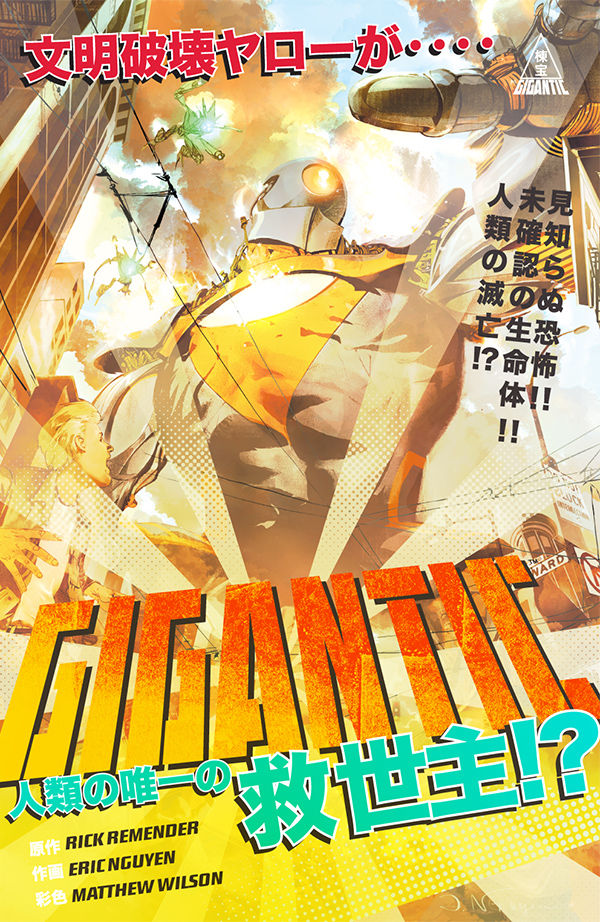
I don’t know whether to blame Nguyen for the Japanese writing on the covers or not; given that very little of the book takes place in Japan, it seems misleading and an attempt to make readers believe Gigantic is more kaiju than it is.

Gigantic begins with a senseless slaughter and ends with a sappy ending we’re supposed to feel good about. But both feel arbitrary, and I never really felt engaged with the book, its plot, or its hero.

Rating: Dark Horse symbol

Labels: , , , , , , ,

10 July 2009

Hulk, v. 1: Red Hulk

Collects: Hulk (v. 2) #1-6, stories from Wolverine #50 and Mini Marvels (2007-8)

Released: February 2009 (Marvel)

Format: 176 pages / color / $19.99 / ISBN: 9780785128823

What is this?: Who is the Red Hulk? And who will he beat up / shoot next?

The culprits: Writer Jeph Loeb and penciler Ed McGuinness

We finish our fortnight of Hulk reviews with Hulk, v. 1: Red Hulk. If you have any hopes of this troika of reviews ending on a high note, please wad those hopes up and drop them in the nearest recycling bins now. 36

After World War Hulk, Bruce Banner is imprisoned, but a new Red Hulk stalks the land, pummeling and shooting the Hulk’s enemies … or anyone else who gets in his way, or meets, for that matter. Writer Jeph Loeb asks the question, “Who is the Red Hulk?” The follow-up question is, “Who the hell cares?” The Red Hulk is a snarling force of nature that only destroys and doesn’t have the magnetism or even simple charm of the “Hulk-Smash!” Hulk. An earthquake would have been more efficient and has more character. He uses guns, for heaven’s sake; Hulk punches harder than guns! Even the best SHIELD tech can’t compete with the Hulk’s punches.

Hulk: Red Hulk coverThe trouble is, I am curious who the Red Hulk is. God help me, I want to know. Loeb is blatant about not revealing who the Hulk is, having people knocked over the head or whisked off stage just as the Red Hulk’s identity is revealed. The Red Hulk’s identity can’t be withheld forever; it isn’t revealed here and hasn’t been revealed yet, and there’s only so long a writer can keep the mystery alive without alienating the audience. This sort of obvious dangler (Who is Stryfe?) is simultaneously what kept the X-Men at the top of the comics heap for so long and caused its popularity to dip in the new millennium.

When it comes down to it, the Red Hulk is stupid. He punches (and shoots) everybody: Iron Man, She-Hulk, Thor, even Uatu the Watcher. (Why? Since when has punching the Watcher been a mark of might?) He rages throughout the story without betraying any emotion other than smug vindictiveness. That’s not a character: that’s a character note, something the writer reminds himself to work in or refer back to while doing more worthwhile things with the character. I’m not about to get into “A-Bomb,” the new gamma-spawned halfwit monster who’s really Rick Jones, but rest assured the idea is even less rewarding than you’re thinking. And who thought, “The madder Red Hulk gets, the hotter he gets” was a bright idea? And why would overheating be a problem for the Red Hulk?

I don’t know. But plotting isn’t an important consideration for Loeb. He wastes most of the first issue with a pointless “investigation” into the Abomination’s death and a fight with the Winter Guard, Russia’s superheroes. Space is wasted on heroes trying to shore up San Francisco and save its residents while the Hulks fight; I can do without that. Loeb could have used that space for … something interesting, if he could find it. Uatu shows up out of nowhere just to get punched. So does Thor, for that matter. And I don’t believe for a second that Red Hulk can pick up Thor’s hammer.

There are a few bits of dialogue that are amusing, and the extra touches on the Gamma Base are interesting — robot guards and robot harpies that look like Betty Banner as the Harpy — but mostly it’s smashing and dumb Hulk (and dumb A-Bomb) talking in broken sentences while the Red Hulk is insufferable. It gets irritating quickly.

Penciler Ed McGuinness is better than the material he’s given. His work is larger than life, gleefully dynamic, and fun to look at. Really, he’s almost the perfect fit for this storyline, and there’s not much negative to say about his pencils. However, I will anyway: either he has a dental fetish or he really enjoys drawing teeth; the Hulks look like supersized PSAs for dental care. I’m not sure what emotion the final panel is supposed to inspire: the incapacitated Red Hulk grits his teeth and glares at the reader in front of a featureless background after he’s been berated by puny humans. Fear? Amusement? It actually managed to confuse me, so that’s an emotion right there. There’s also a small error in that he draws the Red Hulk’s gun in two different ways: humongous revolver and ginormous automatic. Well, I say it’s an error; it could be Loeb doubling his idiotic idea by having the Red Hulk steal two Hulk-sized guns. (Why would SHIELD even make one? What possible advantage could that give them?)

There are also some interesting extras at the end of the book. The three Red / Green / Blue Hulk Mini Marvels strips, by Audrey Loeb and Chris Giarrusso, are reprinted from the second Mini Marvels collection. They’re fun, as is anything Mini Marvel related. Loeb and McGuinness’s backup from Wolverine (v. 3) #50, “Puny Little Man,” is also included; it retells the story of Wolverine’s first confrontation with the Hulk, although Wolverine admits he doesn’t quite know what’s true and what’s story (and for good measure, the Hulk tearing Wolverine in half from Ultimate Hulk vs. Wolverine is included to muddy the waters). Decent backup, although it’s more Wolverine related than Hulk.

Still, neither McGuinness nor the extra features should be enough to induce buyers to pick this up. Stay away, save your money, and keep watching comic-book news sites and Wikipedia for the revelation of who the Red Hulk is.

Rating: Hulk head (1 of 5)

Labels: , , , , , , ,

02 June 2009

Uncanny X-Men: Divided We Stand

Collects: Uncanny X-Men #495-9 (2008)

Released: September 2008 (Marvel)

Format: 120 pages / color / $12.99 / ISBN: 9780785119838

What is this?: The X-Men find their new home city of San Francisco is a bit trippier than they expected.

The culprits: Writer Ed Brubaker and penciler Michael Choi

You might expect the first X-Men volume after Messiah CompleX, which essentially stated things would be different for the X-Men, would seize the new direction and run with it. You would be wrong.

So instead, we get a five-issue stall in Uncanny X-Men: Divided We Stand, in which the X-Men wait for issue #500 in Germany, Russia, San Francisco, and the Savage Land. Oh, Scott Summers tells us things are different, but the San Francisco storyline flashes back to the psychedelic ‘60s and the X-Men fight old villains throughout. And you don’t get much more classic X-Men than the Savage Land, although I’ve never understood the link between mutants, Tarzan knockoffs, and Lost Worlds.29

X-Men: Divided we Stand coverAfter their vacation in the Savage Land, Scott and Emma head to San Francisco, where they find the city (and many of their teammates) are in the midst of a ‘60s flashback. Wolverine, Nightcrawler, and Colossus head to Nightcrawler’s and Colossus’s old European stomping grounds (technically, I believe Colossus is supposed to be from Siberia — Asian Russia — but I don’t think that’s spelled out). There, they run afoul of the Russian government and Omega Red … who I think is the only evil Russian mutant I can remember. It says something — and it isn’t good — that several years after M-Day, writers can still do stories about the obvious consequences of that story that no one else has done; in this case the Russians rightly wonder why the X-Men were relatively unaffected by M-Day but Mother Russia lost all their operatives.

None of it is terribly high-tension or earth-shattering, but not every storyline has to be about the end of the world. Besides, just because Divided We Stand is marking time doesn’t mean it isn’t entertaining. I’ve never seen what others have seen in writer Ed Brubaker — perhaps because I haven’t read his strongest work — but I get a glimpse here. Emma and Scott’s vacation is entertaining, and we finally get a glimpse of why Emma stays with Scott after she’s already cracked his nut. (Metaphorically.) Brubaker also has a good sense of the humorous interplay between Wolverine, Colossus, and Nightcrawler. The dialogue is in character, and although it’s not quite as sharp as, say, Joss Whedon’s best, it’s still very good.

Penciler Mike Choi gets to have the great fun of putting the X-Men into ‘60s fashions — well, it looks like it’s fun. I’m not sure if I like his work; it’s clear and straightforward but a little soft and unassertive in its line. Choi also makes his males a little less rugged than you would expect from a superhero comic, especially Wolverine. (I’m beginning to think any sort of manga-influenced art is a bad idea for Logan, as it makes him look less animalistic and powerful, two of the keystones of his character, and more like a teenage manga character — the weird hair is mandatory for both, though.) Still, as I said, the ‘60s costumes are fun, and there’s nothing wrong with his work: I just find it a little … off.30

Brubaker, through Cyclops, keeps promising things are going to change. I haven’t seen it yet. After the cause of the ‘60s flashback is revealed to be an amnesiac mutant, he even has Emma give a speech calling the middle-aged hippies “pathetic” for using the mutant to “relive [their] glory days.” I think the implications are clear: not only is Brubaker going to change things, but dwelling on those glory days is pathetic. I don’t disagree. The only way to go is forward. I resent having to wait for the next book, but the change is long overdue.

Rating: X-Men symbol X-Men symbol X-Men symbol Half X-Men symbol (3.5 of 5)

Labels: , , , , , , , ,

16 September 2008

Agents of Atlas

Collects: Agents of Atlas #1-6, Yellow Claw #1, Menace #11, Venus #1, Marvel Mystery Comics #82, Marvel Boy #1, Men’s Adventures #26, What If? (v. 1) #9 (1947, 1948, 1950, 1954, 1956, 1978, 2006)

Released: June 2007 (Marvel)

Format: 256 pages / color / $24.99 / ISBN: 9780785127123

In the previous post, I said some reviews were easy, some were hard. This is one of the hard ones.

I really wanted to like Agents of Atlas. Really, I did. I’d picked up issue #1 from a quarter bin, and I’d enjoyed it. I’d heard good things about writer Jeff Parker, mainly about his all ages work in the Marvel Adventures line and X-Men: First Class, and his Spider-Man / Wolverine story was the best part of a recent What If? TPB. I wasn’t familiar with artist Leonard Kirk, other than a somewhat forgettable Hulk story from that same What If? TPB. But the art looked excellent.

Agents of Atlas coverBut I’m not entirely sold on the actual product. Agents takes six rarely used, pre-Silver Age Marvel heroes (Jimmy Woo, Ken Hale the Gorilla Man, M-11 the Human Robot, Venus, Marvel Boy, and Namora) who were teamed for one issue of What If? and puts them together again. On one hand, it takes a rarely used area of the Marvel Universe — the Golden (ne Yellow) Claw and his Fu Man Chu-lite machinations — and gives them an explanation beyond mere vaulting ambition or power madness. It also takes his original adversary, FBI agent Jimmy Woo, and elevates him the job of stopping the Golden Claw.

There is an interesting and entertaining conspiracy story here, although I’m not sure about the payoff measures up to the mystery’s setup. Parker and Kirk obviously have great fun playing with these vintage, barely used toys. Ken Hale is obviously the most entertaining, getting all the good lines, and Woo, a man out of time after a death and resurrection, is compelling: he’s occasionally baffled by our bright new present, but investigating and stopping the Golden Claw is more important, keeping him from seeming like a baffled newcomer the entire book. Kirk, more than Parker, does an excellent job of making Marvel Boy, who lived for years on Uranus, look and feel alien. Kirk’s Venus is suitably beautiful, and M-11 is appropriately retro — in fact, there’s a retro vibe throughout the entire book, even in Hale’s clothing. In fact, the art is uniformly well done, with excellent storytelling and design.

But the action is sparse and the plot slow. It takes more than four issues simply to gather the team, and they had four of the six together at the beginning. This seems like wasted space, shifting time and attention away from the investigation and action. What should have been big action scenes, where the team rolls up several arms of the evil Atlas Foundation, is a disappointing montage — the most disappointing is a fight against the children from The Village of the Damned, with a page of set-up ending with the kids beating the snot out of the team, but a narration box explains Marvel Boy regained enough telepathic control to defeat them. The limited time really doesn’t allow Parker to develop the characters past their new origins, which is a shame; they’re largely unexplored, and it would be nice to get something of an arc for more than Woo and Venus.

To an extent, Parker’s story is obsessed with the past, which would be fine for an ongoing but merely complicates things in a miniseries. Namora must be resurrected. Marvel Boy’s presence must be explained, given his apparent death in a Fantastic Four #165. The contradictions in Venus’s appearances in the Marvel Universe must be explained by complicating / changing her origin. Even M-11 is altered, with the final pages of the series substantially changing his original origin story, which readers can read for themselves in the volume. The Yellow Claw sheds his horrible, racist name, which is frankly welcome. Still, that much retconning is never a good idea, and only Hale is left uncomplicated — which is perhaps why he’s the most fun part of the book.

Regardless of what Amazon says, this book is available only as one of Marvel’s Premiere hardcovers, so I put off buying it for a year, hoping there will be a paperback. (There won’t be.) There are extras in a hardcover that wouldn’t be in a paperback: reprints of the agents’ first appearances from the ‘40s and ‘50s and the team’s first appearance in What If? #9. The reprints are mainly interesting from a historical standpoint; the reasons superhero comics weren’t popular in the ‘50s go beyond cultural zeitgeist. The non-superhero comics — Menace #11, featuring the creation of the Human Robot, and Men’s Adventures #26, Gorilla Man’s first appearance — are the best, although I’m not sure they are the best of their genres for the decade. The issue of What If? is pretty good, though, with writer Don Glut having fun with a relatively inconsequential idea from Roy Thomas.

Also included in the Premiere version is a lot of promotional interviews and concept sketches detailing the creation of Agents. Sometimes this is interesting; it is always promotional material, though. A condensed version hitting the highlights would have been welcome. I’ve already bought the damn book; you don’t have to sell it to me again.

This book should be fun, given the creators’ enthusiasm and ability, but it isn’t most of the time. It’s tough to recommend this book, then; as a complete story, it falls short. The proposed ongoing series written by Parker might change that: as an opening arc, exploring these characters and moving them beyond their new status quos might be more entertaining and make this more palatable as a setup.

Rating: Marvel symbol Marvel symbol (2 of 5)

Labels: , , , , , , , ,