Reviews of trade paperbacks of comic books (mostly Marvel), along with a few other semi-relevant comments / reviews.

14 August 2015

Captain America: Castaway in Dimension Z, Book 1

Collects: Captain America v. 8 #1-5 (2013)

Released: June 2013 (Marvel)

Format: 136 pages / color / $24.99 (hardcover) / ISBN: 9780785168263

What is this?: In Dimension Z, which is ruled by Arnim Zola, Captain America fights Zola’s mutates and raises Zola’s infant son.

The culprits: Writer Rick Remender and penciler John Romita Jr.


I’ve never read much by writer Rick Remender before. Unfortunately, reading Captain America: Castaway in Dimension Z, Book 1, didn’t encourage me to read anything else by him.

In Castaway, Captain America is snatched away from Earth on a magic subway car and brought to Dimension Z. There, Arnim Zola, a villain who engages in genetic modification of humanoids, implants a television with Zola’s face into Captain America’s chest and steals his blood to give Zola’s kids the Super Soldier serum. Captain America escapes, of course, and as he runs, he kidnaps Zola’s infant son, whom he names Ian after his grandfather.
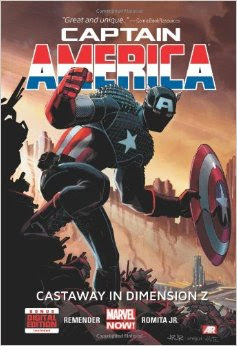
Captain America: Castaway in Dimension Z, Book 1 coverRemender tries to cram too much into this arc. The emotional component of the story is Captain America raising Ian as his son and inculcating him with Captain America’s values while remembering his own difficult youth. Meanwhile, Captain America is dealing with the television infection and effecting regime change among the locals. Remender also tries to sell Zola’s plan, which is raising superchildren of his own while dabbling in horror science, as something we should be concerned about. Remender also has the difficulty of making Dimension Z anything other than a generic otherdimensional world.

Setting the story in Dimension Z is a mistake, I think. Dimension Z is uninteresting, in and of itself, a tortured landscape that doesn’t distinguish itself from other tortured landscapes. (A few indigenous lifeforms liven up events, but they account for only a few pages.) Twelve years pass in Dimension Z, which is a bit of a cheat; it’s easy to say more than a decade passes, but little seems to change. Having Captain America fight for Dimension Z lowers the stakes considerably, since readers don’t care about it or its inhabitants or whether Zola conquers it. What happens in Dimension Z doesn’t matter to Earth, and Zola has conquered almost all of the dimension any way. Captain America isn’t going to stop the conquest or lead a revolution.

I can honestly say the first few throwaway pages, in which Captain America defeats the Green Skull, an ecological terrorist, in San Francisco, interested me far more than anything that followed it.

In an editorial that ran in place of the letter column in #1, reprinted in this volume, Remender traces the origins of his attraction to Zola. It shows; every scene with Zola raised my interest levels to detectable levels. Zola’s villainous patter, whether it’s about the qualities of revenge or his lack of bio-ethics, has a bit more verve than the platitudes about hope mumbled by Captain America amidst the hellscape that is Dimension Z.

Captain America, in an unfamiliar landscape and surrounded by unrecognizable life forms, will of course act like Captain America. He will stand up for the little guy, make the moral choices, and help against dictators. When a race of humanoids called the Phrox take him in, he incites his host into standing up to the tribe’s leader, calling him a tyrant. The tyrant kills Captain America’s host, causing Cap to pummel and exile the tyrant. Thankfully, the next eleven years pass uneventfully, because what possible complications could overthrowing a dictator-for-life cause for a community? None that I could think of.

On the other hand, Captain America lacks intelligence or foresight; he tolerates his Zola infection for more than a decade, but as a dramatic moment at the end of the book, he just cuts it out without little difficulty and no consequences. Why didn’t he do that a few issues before? He claims to Ian that the infection has been trying to take over his consciousness, but we see little evidence of this. Perhaps he just wasn’t annoyed with it enough yet. Eleven years of the thing, sure, but twelve ...? Not a moment more!

Ian fights a Captain of Zolandia.The art is provided by John Romita, Jr.. I am not a fan of Romita; his faces used to have lines in them where few human faces have lines in them. That’s not relevant here, though some of his panels are difficult to parse …

Romita is asked to draw a lot of monsters, which make up Zola’s army and the Phrox. Most of them seem like generic blocky humanoids, unremarkable enough that at times I was unable to tell which were friendly and which weren’t. Only the Captains of Zolandia, monochrome mockeries of Captain America, stand out, and they appear in only a few panels. (They stand out not only visually; the battle cry of three of the Captains is, “War!” “Injustice!” “And slavery for all!”)

The reliance on these monstrous humanoids is a problem, though. The mutates and Captains of Zolandia (modified mutates, probably) serve Zola; presumably they were warped by Zola from the genetic stock of the Phrox or a similar race. Unfortunately, both are so alien it is difficult to be truly horrified at what the mutates have become. The mutates behavior is evil, of course, but that would have happened if Zola had merely stolen Phrox children and raised them as his army. The mutates’ and Captains’ appearance don’t have the visual impact of the flashback panel in which Zola’s servant has been combined with a Doberman; the woman’s humanity gives the reader something to understand, be horrified about and empathize with. The Phrox and mutates … well, they’re both weird. Who’s to say which is weirder?

Jet Zola makes her dramatic entrance.Romita also seems to have trouble drawing children, but he’s a successful artist who has most likely seen a child. I don’t often give artists enough credit for what they are trying to do, so I have to ask myself what Romita is hoping to accomplish. Why does Ian appear to be about 5 or 7 a year after Captain America stole the infant? Probably the wastelands Ian was raised in toughened the child. In that case, though, why does Ian appear to be about 12 or 13 eleven years after that? I’m baffled. When Captain America takes Ian, his sister, Jet, seems to be 5 or fewer years old; twelve years later, she’s given a straps-and-bikini costume … She’s pretty young. Try not to sexualize her, John.

Flashback of young Steve Rogers and a young girl.Ian has a huge noggin, as do all the Depression-era children in Captain America’s flashbacks. Is Romita trying to say that despite their tiny bodies, they have to take on adult responsibilities? Unlikely, given that even the ones without obvious burdens are macrocephalic. Some sort of distorting lens of memory? But there should be more distortions if that were true. Are those giant craniums full of dreams for the future? It’s the Depression, so that’s unlikely. Are there contaminants in New York City, causing massive structural defects in its youth? That’s as likely — more likely — than anything else, but it’s not germane to the story.

The Castaway in Dimension Z storyline doesn’t end here. It’s continued in Book 2, and it’s possible that some of the things I have complained about here pay off in that book. But if Remender hadn’t tried to fit so much into Book 1, we wouldn’t have to wait.

Rating: Avengers symbol  symbol (1.5 of 5)

Labels: , , , , , , ,

08 February 2013

Spider-Man: Spider-Island

Collects: Amazing Spider-Man #666-73 and backups from #659-60 and 662-4, Venom #6-9, and Spider-Island: Deadly Foes #1 (2011-2)

Released: September 2012 (Marvel)

Format: 376 pages / color / $34.99 / ISBN: 9780785151050

What is this?: The Jackal gives spider powers to everyone in New York City.

The culprits: Writers Dan Slott and Rick Remender and artists Humberto Ramos, Stefano Caselli, Tom Fowler, and Giuseppe Camuncoli


Over the summer, I started reading all of the Spider-Man collections after the Brand New Day reboot, using a combination of bargain books and interlibrary loan. Overall, the stories were amusing, but I didn’t think it was worth the huge retcon it took to set it up.72 I finally caught up with the collections by reading Spider-Man: Spider-Island.73

When Spider-Island begins, Spider-Man is on top of the world, being part of two superteams, pursuing his solo career, basking in New York City’s adulation, dating police forensic scientist Carlie Cooper, working a dream job, and finishing his martial arts lessons with Shang Chi, Master of Kung-Fu. Into this set up wanders Miles Warren, also known as the Jackal, and a Spider-clone …

Spider-Man: Spider-Island coverWait! Come back! This is not a saga, and the clone is incidental. The Jackal, however, is important; his plan this time involves giving everyone in New York spider powers that will turn them into monstrous arachnids, then controlling them after their transformation via a mysterious ally. From there, the infection should spread across the country and the world, leaving the Jackal to rule over a world of spider humans and superhumans, who are immune to the infection.

Overwriting DNA is part of the Jackal’s modus operandi — I think; it depends on what Warren’s Carrion Virus does this year and whether the Jackal can really clone people. I’m not fond of the Jackal, since the character’s stench is all over the Clone Saga and some other bad stories. He does have a “zany” sense of humor, though, which enlivens his expository scenes and panels with his mysterious benefactor / co-conspirator, but it makes divining his motivations or taking him seriously difficult.

The Jackal is better than his partner, though. She’s portrayed in shadow for most of the crossover, as if readers would recognize her instantly if she were seen clearly. Instead, she’s the Queen, a continuity implant Spider-Man and Captain America fought in Spectacular Spider-Man #15-20. 74 I’ve read that storyline, and I had completely forgotten her; it was not writer Paul Jenkins’s best Spider-work. I don’t mind writer Dan Slott using her, although she does take away from the central Spider-Man / Jackal rivalry. She latches onto the Jackal’s plans after he’s already set them in motion, showing how extraneous she is to the plot. What bothers me, though, is pretending such a minor character is a big deal; the character had not appeared outside of that storyline, yet Spider-Man and Captain America act as if she had been haunting their dreams. If Slott was going to use an overhyped 21st century Spider-villain, I would have preferred Shathra, really.

I have to congratulate the Spider offices on the mechanics of the crossover. It must be easier to coordinate a crossover when there are only two writers and titles (and a one-shot), but Spider-Island’s stories interlock as smoothly as two overlapping plots can. Slott and Venom writer Rick Remender frequently take a page’s worth of panels from the other’s story and use it to start their part of the story, and they manage to avoid contradicting each other. It may sound like I’m damning with faint praise, but I am impressed. Bravo!

Character and plot development is not curtailed in either book because of the crossover. In Amazing Spider-Man, Slott develops Peter and Carlie’s relationship, moves Aunt May and her new husband, Jay, to Boston, and has someone discover Spider-Man’s secret identity. (Weakening Spider-Man’s magical protection in this regard was long overdue, even if I think the actual mechanism used in Spider-Island was weak.) In Venom, Remender continues strengthening the bond between the Venom symbiote and its current host, Flash Thompson, and wraps up Flash’s tumultuous relationship with his father. Interweaving simmering subplots increases the verisimilitude of the stories; life goes on, even in a crisis, no matter how much you might want things to stand still.

Although the crossover’s villains are a disappointment, the supporting figures are wisely chosen. In a story about everyone in New York getting Spider powers, certain characters have to show up: Venom, Anti-Venom, Kaine (the first Spider clone), Alistair Smythe (the inventor of Spider slayers), the new Madame Web, Mary Jane … about the only relevant missing character is Spider-Girl, who gets only a cameo despite Slott’s fondness for the Young Allies. (I’m not fond of Madame Web and can’t understand why her mystical “Web of Life” powers aren’t as derided as JMS’s mystical turn for Spider-Man, but she needs to be in Spider Island.) Slott wisely spends considerable time with J. Jonah Jameson, who, in a development as entertaining as it sounds, gains spider powers.

In the crossover’s plotting is tightly coordinated, the same can’t be said for the art. Four different artists contribute at least one story to the collection. Humberto Ramos provides most of the Amazing Spider-Man art (#667-72). If you’ve been reading Amazing Spider-Man for a while, you know how you feel about his hyper-exaggerated style. I think it works better for comedy than it does for action and drama, but there’s no denying he’s become one of the go-to Spider-artists over the past decade. His work certainly sticks out among the more realistic styles of Stefano Caselli (#666 and 673 and Venom #9), Giuseppe Camuncoli (the main story from Spider-Island: Deadly Foes), and Tom Fowler (Venom #6-8). Of those, Fowler is my favorite, and I’d like to see his simple, retro-tinged style featured on its own. But the muddy coloring from John Rauch clutters and muddies his work. Caselli is fine, except when he gives Peter an emo / manga look very similar to how he draws Phil Urich. Camuncoli’s work is a bit sketchy and exaggerated for my taste, yet it still manages to look stiff occasionally.

I admire the execution of Spider-Island greatly. Unfortunately, that admiration can’t override a lot of what’s wrong in the crossover: the villains, Madame Web, clones ... It makes for a lot of conflicting feelings. The higher stakes hurt as well; Marvel isn’t going to wipe out the human population of New York, so of course the infection has to be completely eradicated. Perhaps if I connected more with Venom / Flash or with Peter’s new status quo, Spider-Island would have been more successful. Unfortunately, it comes across as a middle-of-the-road story.

Rating: Spider-Man symbol Spider-Man symbol Half Spider-Man symbol

Labels: , , , , , , , , , , , , ,

11 January 2011

2010 in review

I had plans for a 2010 review as big as last year’s, listing my favorites (and least favorites) from among the books I reviewed this year. Unfortunately, the books I reviewed — 37 overall — tended toward the mediocre. (That’s not entirely fair; a rating of 3.5, which several books received, is above mediocre. A book that gets 3.5, in my opinion, is fun to read … but it’s not a book that inspires superlatives or a command to go out and buy the book.) So my list of books this year will be short:

  1. Birds of Prey, v. 5: Perfect Pitch and v. 6: Blood and Circuits: The antepenultimate and penultimate volumes of writer Gail Simone’s Birds of Prey run, these two were the apex of her work on the title. After finally shedding artist Ed Benes, Simone (coincidentally or not) was able to hone her characterization and sharpen her plots while retaining her customary witty dialogue. If forced to choose between the two, I would opt for Blood and Circuits because the developments in that book finally jolted the audience from some of its complacency about the safety of the team.
  2. Usagi Yojimbo, v. 24: Return of the Black Soul: Stan Sakai finally explained the origin of the demon Jei, focusing on the demon’s story for a tale that was not only frightening but surprisingly emotional. After 24 volumes of Usagi in more than 20 years, Sakai is still able to tell stories about the character and his world that are new and powerful.
  3. G-Man, v. 1: Learning to Fly and v. 2: Cape Crisis: I’m a big fan of Chris Giarrusso, so it’s no surprise I loved his two G-Man books. Filled with his distinctive humor — a combination of subtle sight gags, running jokes, and absurdist dialogue — G-Man still manages to have an interesting plot, and Giarrusso seems to never forget how the world seems to children.

I actually did better than I thought with the timeliness of the reviews, although given how badly I thought I did, that’s not saying much; still, nearly half the reviews were of books that came out in 2010. Fortunately, G-Man, v. 2, and Usagi Yojimbo, v. 24, were among those, so they’re my picks of 2010. Honorable mention goes to Batwoman: Elegy, the beautiful but occasionally flawed book by Greg Rucka and J.H. Williams III.

The worst books I read this year were The Pulse, v. 2: Secret War and Gigantic. Writer Brian Michael Bendis, who occasionally puts out some great stuff, also generates some of the worst, and The Pulse was about as low as this blog goes: a frequently incomprehensible decompressed mess with bad characterization, saved from a 0 rating only by art from Michael Lark and Brent Anderson. Gigantic, by writer Rick Remender and artist Dustin Nguyen, was a high-concept piece that unfortunately did not live up to the promise of the concept; the writing veered from weird to surprisingly unsurprising, and Nguyen’s scratchy art didn’t help matters either. Since Gigantic was the one that came out this year, it gets my “Worst of the Year” tag despite being better than The Pulse.

What was the best (or worst) collected edition / graphic novel you read this year?

Previous year-end wrap ups:

Labels: , , , , , , , , , , ,

25 June 2010

Gigantic

Collects: Gigantic #1-5 (2008-10)

Released: April 2010 (Dark Horse)

Format: 128 pages / color / $17.99 / ISBN: 9781595823267

What is this?: A giant, exploding robot appears in San Francisco and, well, explodes, part of an alien reality show.

The culprits: Writer Rick Remender and penciler Eric Nguyen

I’m not sure what got me excited about Gigantic, but I wrote myself a note before the first issue came out in November 2008 to pick it up when it came out in trade paperback. Remarkably, I remembered to do so when the trade came out a year and a half later.

Gigantic — which seems to be designed to appeal to fans of kaiju (those giant monsters who often fight in Japanese movies) — features a giant robot that appears in San Francisco, crushing innocent passerby. Then, in the resulting fight, the eponymous robot seems to explode, killing more people. It turns out that the person in the robot suit is actually an Earthman, and Earth is just a giant reality show for some feckless aliens. … Kane Blake, the man inside Gigantic, was kidnapped by the aliens as a child; his family was the focus of one of the reality programs, and in space, he entered gladiatorial combats and became more famous. Now he’s escaped and come back home.

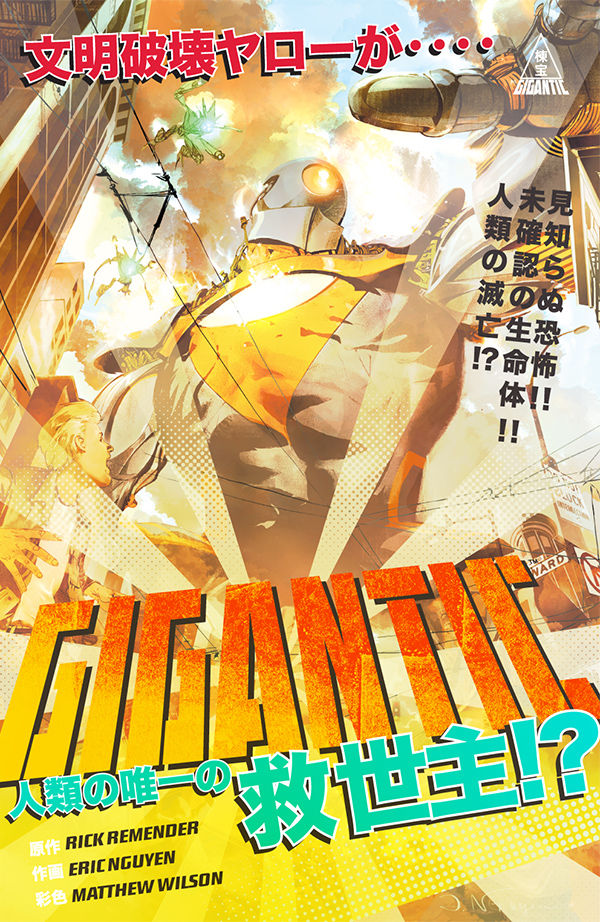
Gigantic coverI think the log line I read for Gigantic was more brief. I certainly can’t remember what it was that interested me.

The rest of the plot is hitting spliced with less interesting developments. The villains of the piece are stereotypical television corporations; the aliens behind these corporations are more telegenic than Mojo from the original Longshot miniseries, but they aren’t anywhere near as interesting. The aliens curse, of course, and not very well — “farge” for the other f-word (probably), “glorking,” etc. Although sometimes they curse in good English as well. For some reason, alien weaponry has no visible effect on Gigantic’s armor, but a chainsaw — which I’ve seen defeated by wires inside trees — rips right through it. Kane’s brother, Scott, should take medication to control his emotions, which swing wildly with every shocking revelation and tend to drive most of the plot the aliens don’t. About two-thirds of the way through the book, writer Rick Remender uses the plot twist from Total Recall, and somehow Kane isn’t quite as convincing as a heel as Arnold Schwarzenegger. And for some reason, the evil mastermind thinks making an Earthling into the Leader is a good idea.

I know I nitpick about plot; it’s a flaw hardwired into my body. I can’t help it. The little things I pick out about the plot, while annoying, aren’t the book’s major flaw (well, the Total Recall and stereotypical evil television execs might be).

The problem is Kane — Gigantic — isn’t a very good hero. His presence kills dozens if not hundreds, making him a mass murderer. He cries about it. When Earth needs saving from its own self-destruct sequence, he can’t save it, and he doesn’t seem to care about preserving the life of the person who does stop the countdown. He’s manipulated by his employers at every turn; his true self is supposed to be as big a villain as his employers. His final victory comes when he explodes once again, with the actual heroism being done by his brother and the kid with the big green head.

Gigantic does punch things, and he does provoke a panic by revealing the presence of the aliens. But that’s not enough to make a good hero.

There are some good things. I liked the Iconoclast, another fighter who claims to be highbrow in his style when actually he is only a bombastic gladiator whose popularity is fading. The scene in which the flying saucers around Earth were revealed was a nice one. But those nice moments were few and far between.

The art from penciler Eric Nguyen occasionally had me scratching my head during the fight scenes. There was a problem of distance as well. For instance, when Gigantic’s brother bursts through a barn … door, I think (I hope to hell it’s not a wall), Nguyen has the tractor covering too much ground and running over an attacker; if the attacker wasn’t paralyzed, it should have been able to sidestep the tractor easily. Also, sometimes the brother’s farm seems near the San Francisco Bay and occasionally seemed far away from the city. Ironically, Nguyen’s art does have a sense of scale when it comes to the size of the robots and monsters scrapping with each other; the destruction is appropriately large, and the punches look large and powerful.

I don’t know whether to blame Nguyen for the Japanese writing on the covers or not; given that very little of the book takes place in Japan, it seems misleading and an attempt to make readers believe Gigantic is more kaiju than it is.

Gigantic begins with a senseless slaughter and ends with a sappy ending we’re supposed to feel good about. But both feel arbitrary, and I never really felt engaged with the book, its plot, or its hero.

Rating: Dark Horse symbol

Labels: , , , , , , ,