Reviews of trade paperbacks of comic books (mostly Marvel), along with a few other semi-relevant comments / reviews.

06 May 2016

Spider-Man: Worldwide, v. 1

Collects: Amazing Spider-Man v. 4 #1-5 (2015-6)

Released: April 2016 (Marvel)

Format: 144 pages / color / $18.99 / ISBN: 9780785199427

What is this?: Parker Industries has offices around the world, and it looks like Peter’s finally a success. However, when PI is targeted by the Zodiac, the criminals seem to be one step ahead of Spider-Man …

The culprits: Writer Dan Slott and artist Giuseppe Camuncoli


I love the idea of Peter Parker finally succeeding. If he’s so smart — and he is, let’s face it: he invented web fluid and web shooters and electronic ankle bracelet monitors — eventually he has to achieve success in some way or die along the way. Unless you contrive an explanation for his lack of success, like a force of the universe being directed against him or him being a jerk, it makes no sense for a smart, moral person like Peter to be continuously a failure. For periods of time, yes, but not forever.

In Amazing Spider-Man: Worldwide, v. 1, Peter is the CEO of Parker Industries, which has become one of the premier technology companies in the world, with offices on three different continents. He’s working with SHIELD to keep the world safe, and he seems to have managed to keep his soul. This should be exactly what I want.

Amazing Spider-Man: Worldwide, v. 1 coverThe problem is that I don’t know that Peter is such a success.

Parker Industries and SHIELD are under assault from Zodiac. Not only is Zodiac physically raiding Parker Industries and SHIELD facilities but they are also involved in a battle of wits with the heroes. Unfortunately, writer Dan Slott doesn’t give Spider-Man very many victories, as it seems the villains win every time. Spider-Man and SHIELD get only minor victories: foiling the robbery that starts the book, defeating an attack by Goblin Nation thugs in Africa, keeping some henchmen from completing employer-insisted suicide. Zodiac defeats Parker and SHIELD almost every time, making the heroes look, well, not very competent. Maybe Peter isn’t such a success after all …

It doesn’t help that Peter built his company during an eight-month gap after the end of the latest Secret Wars series. We don’t know how Peter built his company, what decisions he chose, what compromises he had to make, or why he’s working so closely with SHIELD. His success, then, feels unearned. And that, combined with his lack of success in Worldwide, v. 1, makes me think this version of Peter Parker will be going away sooner rather than later, which is a shame.

I do like some aspects of Worldwide. Bringing back Hobie Brown, the Prowler, to be Parker Industries’ head of security and a backup Spider-Man is a nice choice; Brown was an inventor as well as someone with a costumed identity. I’m not sure Brown is qualified for either job, but I believe it’s totally a choice Peter would make. (I can also see him hiring Rocket Racer as well. Fingers crossed!) Harry Osborn makes his return under an assumed name, but since he hasn’t changed his appearance — not even his hairstyle — I can’t see that working for long. A fellow student from Peter’s college days, Philip Chang, shows up in Parker Industries’ Shanghai office, and Clayton Cole, a low-level thug Spider-Man sent to Parker Industries in the previous volume of Amazing Spider-Man, is working in PI’s New York offices.

The subplots are intriguing as well. How did Dr. Octopus end up inside the Living Brain, and what’s his long-term plan? What will Norman Osborn — or someone posing as him — do after selling weapons in Africa? Who’s wandering around in a red suit, offering to return the loved ones of Spider-Man villains? I’m looking forward to seeing these subplots play out, and I’m betting it’s going to be a combination of Dr. Octopus and Norman who bring down Parker Industries after Zodiac weakens it. (I’d almost bet PI will be Marconi Industries by the end, headed by Doc Ock’s love interest, Anna Maria Marconi.)

I don’t like the introduction of Regent to the main Marvel Universe, though. Regent was the villain in the main Spider-Man mini in Secret Wars. He made an OK villain for a series in a universe that was going to be thrown away once the miniseries was over. In the main Marvel Universe, a villain that exists to drain minor villains and eventually become a powerful threat is a waste; why kill villains to power a supervillain who will be gone once the writers hit his climactic fight, then never return? (Of course, I thought writers would have the sense to never return to Morlun, but boy, was I wrong.)

But the subplots are mostly respites from the main plot. I don’t think Zodiac works well as a Spider-Man villain; the astrology-themed criminal organization generally take on teams, and Spider-Man is a poor team player. This brings up the question of why he’s working with SHIELD — it seems a poor fit, even if he has SHIELD’s worst impulses under control. The new Scorpio’s identity is supposed to be a big deal, but even though Scorpio has an important role outside his supervillain ID in the storyline, the actual reveal falls as flat as the naming of the female villain in Spider-Island. The Human Torch flips out too easily in #3; all it takes is the news that Parker Industries has moved into the Baxter Building to set him on a fiery rampage.

I’m indifferent to Giuseppe Camuncoli’s art. Something seems off about his faces; I think he has trouble with noses, or maybe it’s the space between the eyes. Mockingbird’s mask is awful; the Human Torch’s costume has been given a bustier outline for reasons I can’t possibly imagine. His Melinda May is hardly recognizable as Ming-Na Wen, and I’m only 30 percent sure that the guy I think is Agent Coulson actually is Coulson. Still, his action is fine, and even if his Spider-Man isn’t lithe or a contorted mess — both Hobie and Peter seem stockier than the usual Spidey — he’s still recognizable. (I really enjoy the old, stubby legged spider logo on Spider-Man’s back.)

I should like Worldwide. The premise is something I’ve wanted for years, and the story itself has many trappings I enjoy. But everything about the story seems slightly off. Do I really not want Peter to be a successful CEO? Or is it the execution itself that bothers me? I’ve made it clear I think it’s the execution, but I can’t shake the feeling I might be at fault.

I’m not going to let that doubt inflate the rating, though.

Rating: Spider-Man symbol Half Spider-Man symbol (1.5 of 5)

Labels: , , , , , , , , , , , , ,

23 August 2013

Spider-Man: The Next Chapter, v. 3

Collects: Amazing Spider-Man v. 2 #13-9, Peter Parker: Spider-Man v. 2 #13-9, Spider-Woman v. 3 #9, and Amazing Spider-Man Annual 2000 (2000)

Released: August 2012 (Marvel)

Format: 400 pages / color / $39.99 / ISBN: 9780785159773

What is this?: Spider-Man loses everything — everything — so he can return to the status quo.

The culprits: Writer Howard Mackie, writer / artist John Byrne, and artists John Romita Jr., Graham Nolan, and others


This is how bad the Clone Saga and its aftermath were: about two years after the Clone Saga ended, Marvel decided the solution to the relative disinterest in Spider-Man was to chop the number of Spider-titles in half, relaunch the survivors (Amazing Spider-Man and Peter Parker: Spider-Man, volumes two), and have Howard Mackie write both.

To the modern reader, safely more than a decade away from that decision, having Howard Mackie writing two Spider-Man books seems insane, as incomprehensible as AOL buying Time-Warner or the Internet bubble on Wall Street. Three years after the 1998 relaunch, Mackie was done with his Spider-Man run — and done at Marvel. His alternate-reality X-title, Mutant X, ended in June 2001, a month after Amazing #29, his final Spider-Man issue. (He was replaced on Peter Parker by Paul Jenkins with #20.) After that: nothing, unless you believe he was X, the anonymous writer of The Brotherhood, which ended in March 2002. The only work Mackie has done for Marvel in the last decade is Spider-Man: The Real Clone Saga, which retold the Clone Saga as Mackie and Tom DeFalco intended. Thank God; that was a story that was screaming to be told. Or maybe the screaming was coming from somewhere else. From me, maybe.

Spider-Man: The Next Chapter, v. 3 coverBut evidently we couldn’t see Mackie’s shortcomings back then: his shoddy characterizations, his inability to see a plot or subplot through, his frequently nonsensical plots. Mackie rose to prominence with the 1990s Ghost Rider relaunch, where the fresh take on Ghost Rider, Image-era art, and grim-and-gritty characters overrode those deficiencies. I can’t speak to the exact quality of his previous Spider-Man work, but his X-Factor run (#115-49) charged headlong into incomprehensibility before everyone agreed the best remaining idea for the title was to throw Havok, the X-Factor’s team leader, into an alternate reality and follow the alternate reality Mackie hadn’t yet messed up.

I chose to start with the third volume of The Next Chapter because I already had the single issues that made up v. 1 and 2. But the choice was serendipitous, as v. 3 begins Marvel’s second, slightly more successful attempt to roll back Spider-Man to his early ‘80s settings. The calamitous Clone Saga had taught Marvel, rightly or wrongly, that Peter could not be replaced, so Marvel tried writing Mary Jane out of the comics instead. In Amazing #13, the first issue of The Next Chapter, v. 3, the passenger jet Mary Jane is traveling on explodes in mid-air.

The decision to kill Spider-Man’s wife was both bold and crassly commercial, which is probably why it appealed to those who signed off on it. It is not so appealing in execution. However, Mackie and Amazing plotter / co-writer John Byrne choose to make Peter not believe Mary Jane is dead, and that’s more interesting than weeping and moaning. His friends see it as denial, but in Spider-Man’s world, the choice is backed by some logic. Aunt May returned from the dead, as did Norman Osborn; Gwen Stacy and the Jackal were cloned. Mary Jane’s survival was possible — and in fact, she was alive, reuniting with Peter in Amazing Spider-Man v. 2 #29, a few months after The Next Chapter, v. 3, ends.

The enjoyability of The Next Chapter, v. 3, is elevated above the material itself because it contains the entire storyline, from the violent act to Peter’s eventual acceptance. Rarely do readers get a complete story when Marvel reprints a consecutive, non-storyline based section of continuity. I doubt Marvel planned the reprints that way, but I’m glad it turned out that way — especially since everything else about the story is abysmal.

Peter claims to want Mary Jane back, but he is ineffectual in his attempts to find her. I know Spider-Man isn’t the world’s greatest detective, but he doesn’t investigate Mary Jane’s alleged death or find any clues. He doesn’t try to find any of her previous stalkers, such as Venom, who might have had a grudge. He doesn’t look into the explosion. His only real investigation into her death is following up on an anonymous tip that MJ was being held in Latveria, where her plane was bound. (Why would anyone have a modeling shoot in Latveria, of all places?) He doesn’t try to find who gave him the Latverian tip or MJ’s crooked manager, who embezzled money from his client and disappeared.

It’s almost as if the reader is supposed to think Peter knows how irrational he’s being but doesn’t want any evidence to prove it. Unfortunately, nothing in the text backs up that reading — except that when Spider-Man is haunted by the deceased Harry Osborn in Amazing Spider-Man Annual 2000, he finds Harry’s return patently ridiculous, despite Harry having been dosed with the same Goblin formula that returned Norman Osborn from the dead.

A big part of the storyline’s failure is that the plot requires us to accept whatever Mackie and Byrne dish out to keep things moving or to stop them from moving. Peter’s costume and spider-shooters are stolen after he is kicked out of a flophouse, but why doesn’t Peter take better care of his Spider-equipment? Is he an idiot? (Probably, since he could have stayed with May or one of his friends, and he has no problem accepting money from her or Robbie Robertson.) Why doesn’t he work harder to find the manager who ruined his life? Why did someone want Peter to investigate in Latveria? Why re-introduce the mystery of the fifth Green Goblin, then pointedly not resolve it? In Annual 2000, why do Scrier Jr.’s gauntlets explode when they touch? What is the point of the gratuitous Marvel: The Lost Generation crossover in Amazing #16, other than to boost one of Byrne’s more forgettable ideas? Why does Venom’s bite have such an effect on Sandman, when Sandman loses mass all the time without any consequences and Venom’s bite never was so toxic before? What could possibly be in the box the airline returns to Peter and May, which convinces them of Mary Jane’s death? The answer to all these questions is You shut up.

Even when Mackie and Byrne have good ideas, their inability to commit to the idea undermines their accomplishments. In Peter Parker #16, Spider-Man runs across a half-dozen new, off-brand villains. The interaction between the villains and Spider-Man promises some laughs, with a subplot thrown into the mix; unfortunately, in less than three pages, they are gone, and Spider-Man thinks, “I feel like I’ve stepped into a Reader’s Digest version of a bad day in the life of Spider-Man.” (In contrast, a new Rocket Racer is given a big build-up, making his ignominious and off-hand defeat worth the time spent on him.) Having someone hunt down the Sinister Six, member by member, is an interesting idea, but we never get a good reason why the culprit decides to do so, or why he interrupts his vendetta halfway through to try to court his ex-wife. The ex-wife’s despair is convincing, but not enough time is invested in her thoughts to make her final fate seem believable. Sandman’s disintegration fuels some interesting stories down the line, but Mackie and Byrne are more interested in teasing a Silver-Age villain’s death than in following up on the implications.

Strangely, part of Mackie’s problem is that he can’t let go of the past. Part of the relaunch’s remit was to quietly forget the stories leading up to it. Mackie couldn’t, of course. In v. 3, he’s still dredging up stories from v. 1 of both titles. The awful crossover with Spider-Woman is saturated by references to the Gathering of Five crossover, which immediately preceded the relaunch. (To be fair, the new Spider-Woman was empowered by the crossover, but the stupid solution to defeating the villain revolves around the Gathering of the Five.) More damning, though, is his inclusion of the fifth Green Goblin, who impersonated the villain after the Clone Saga to clear Norman Osborn’s name. That Green Goblin could have been easily forgotten, but Mackie brings him up without resolving his identity, then offs the poor sap. Peter shakes his head and goes on with his life, rather than caring. In the Annual, Mackie brings up Scrier, a Clone Saga hanger-on, and the deceased Harry Osborn.

The reason why these thoughts and stories are half-formed is to give Mackie and Byrne room to tear Peter Parker’s life down. Mary Jane and her earning power are blown up, putting Spider-Man in the poorhouse. He’s single again, earning basically nothing as a dishwasher, and he has to move in with Randy Robertson to make ends meet. Strangely, the writers and Peter refuse to wallow in the protagonist’s misery. Peter is … not cheerful, but he’s not downbeat either. Partially, that is because he refuses to believe in his wife’s death; part of it is because the stories don’t spend much time on the misery of minimum-wage labor and homelessness.

Not everything is bad. Mackie and Byrne use the supporting cast; even when the supporting characters are at their most cardboard, the writers acknowledge the amount of people who care about Peter and May, which is something other writers have trouble with. Cletus Kasady’s escape from the insane asylum without his symbiote underscores that even without Carnage, Kasady is dangerous. J. Jonah Jameson getting his hands on Peter’s Spider-equipment and stopping the Bugle’s Spider-Man vendetta is interesting, although the former isn’t original. Flash’s gloriously self-aggrandizing pep talk to Peter in Peter Parker #18 is wonderful.

Cadaverous Aunt MayMore importantly, the art is very good. John Byrne, who penciled Amazing #13-8, is not at his peak, but he is more than solid throughout. John Romita Jr.’s work on Peter Parker #14-7 and 19 is very good — and considering that I generally don’t like Romita Jr.’s work, that’s saying something. His Hulk in #14 is hulking and brutish without devolving into cartoonishness, which would have been all wrong for a serious issue about Peter dealing with Mary Jane’s absence. Klaus Janson (Annual) and Lee Weeks (PP #13) are excellent on their single issues as well, with Weeks’s realistic style being an excellent choice for an issue focusing on the depowered Carnage and Janson’s slightly dated look complementing a script that concentrates on characters from Spider-Man’s recent past. On the down side, Erik Larsen’s pencils in Amazing #19 look rushed, with May’s face looking less “old” and more “cadaverous.”

This is the end of Mackie’s stranglehold on Spider-Man. Byrne bowed out with Amazing #18, and Mackie was replaced on Peter Parker after these issues. A new era was coming, and few readers looked back on Next Chapter’s false starts with any fondness. To be fair, in v. 3, the stories (and writers) did exactly what Marvel wanted them to: reboot Peter Parker to his good old days. I don’t think anyone wanted to see it done this badly, though.

Rating: Spider-Man symbol Half Spider-Man symbol (1.5 of 5)

Labels: , , , , , , , , , , ,

08 February 2013

Spider-Man: Spider-Island

Collects: Amazing Spider-Man #666-73 and backups from #659-60 and 662-4, Venom #6-9, and Spider-Island: Deadly Foes #1 (2011-2)

Released: September 2012 (Marvel)

Format: 376 pages / color / $34.99 / ISBN: 9780785151050

What is this?: The Jackal gives spider powers to everyone in New York City.

The culprits: Writers Dan Slott and Rick Remender and artists Humberto Ramos, Stefano Caselli, Tom Fowler, and Giuseppe Camuncoli


Over the summer, I started reading all of the Spider-Man collections after the Brand New Day reboot, using a combination of bargain books and interlibrary loan. Overall, the stories were amusing, but I didn’t think it was worth the huge retcon it took to set it up.72 I finally caught up with the collections by reading Spider-Man: Spider-Island.73

When Spider-Island begins, Spider-Man is on top of the world, being part of two superteams, pursuing his solo career, basking in New York City’s adulation, dating police forensic scientist Carlie Cooper, working a dream job, and finishing his martial arts lessons with Shang Chi, Master of Kung-Fu. Into this set up wanders Miles Warren, also known as the Jackal, and a Spider-clone …

Spider-Man: Spider-Island coverWait! Come back! This is not a saga, and the clone is incidental. The Jackal, however, is important; his plan this time involves giving everyone in New York spider powers that will turn them into monstrous arachnids, then controlling them after their transformation via a mysterious ally. From there, the infection should spread across the country and the world, leaving the Jackal to rule over a world of spider humans and superhumans, who are immune to the infection.

Overwriting DNA is part of the Jackal’s modus operandi — I think; it depends on what Warren’s Carrion Virus does this year and whether the Jackal can really clone people. I’m not fond of the Jackal, since the character’s stench is all over the Clone Saga and some other bad stories. He does have a “zany” sense of humor, though, which enlivens his expository scenes and panels with his mysterious benefactor / co-conspirator, but it makes divining his motivations or taking him seriously difficult.

The Jackal is better than his partner, though. She’s portrayed in shadow for most of the crossover, as if readers would recognize her instantly if she were seen clearly. Instead, she’s the Queen, a continuity implant Spider-Man and Captain America fought in Spectacular Spider-Man #15-20. 74 I’ve read that storyline, and I had completely forgotten her; it was not writer Paul Jenkins’s best Spider-work. I don’t mind writer Dan Slott using her, although she does take away from the central Spider-Man / Jackal rivalry. She latches onto the Jackal’s plans after he’s already set them in motion, showing how extraneous she is to the plot. What bothers me, though, is pretending such a minor character is a big deal; the character had not appeared outside of that storyline, yet Spider-Man and Captain America act as if she had been haunting their dreams. If Slott was going to use an overhyped 21st century Spider-villain, I would have preferred Shathra, really.

I have to congratulate the Spider offices on the mechanics of the crossover. It must be easier to coordinate a crossover when there are only two writers and titles (and a one-shot), but Spider-Island’s stories interlock as smoothly as two overlapping plots can. Slott and Venom writer Rick Remender frequently take a page’s worth of panels from the other’s story and use it to start their part of the story, and they manage to avoid contradicting each other. It may sound like I’m damning with faint praise, but I am impressed. Bravo!

Character and plot development is not curtailed in either book because of the crossover. In Amazing Spider-Man, Slott develops Peter and Carlie’s relationship, moves Aunt May and her new husband, Jay, to Boston, and has someone discover Spider-Man’s secret identity. (Weakening Spider-Man’s magical protection in this regard was long overdue, even if I think the actual mechanism used in Spider-Island was weak.) In Venom, Remender continues strengthening the bond between the Venom symbiote and its current host, Flash Thompson, and wraps up Flash’s tumultuous relationship with his father. Interweaving simmering subplots increases the verisimilitude of the stories; life goes on, even in a crisis, no matter how much you might want things to stand still.

Although the crossover’s villains are a disappointment, the supporting figures are wisely chosen. In a story about everyone in New York getting Spider powers, certain characters have to show up: Venom, Anti-Venom, Kaine (the first Spider clone), Alistair Smythe (the inventor of Spider slayers), the new Madame Web, Mary Jane … about the only relevant missing character is Spider-Girl, who gets only a cameo despite Slott’s fondness for the Young Allies. (I’m not fond of Madame Web and can’t understand why her mystical “Web of Life” powers aren’t as derided as JMS’s mystical turn for Spider-Man, but she needs to be in Spider Island.) Slott wisely spends considerable time with J. Jonah Jameson, who, in a development as entertaining as it sounds, gains spider powers.

In the crossover’s plotting is tightly coordinated, the same can’t be said for the art. Four different artists contribute at least one story to the collection. Humberto Ramos provides most of the Amazing Spider-Man art (#667-72). If you’ve been reading Amazing Spider-Man for a while, you know how you feel about his hyper-exaggerated style. I think it works better for comedy than it does for action and drama, but there’s no denying he’s become one of the go-to Spider-artists over the past decade. His work certainly sticks out among the more realistic styles of Stefano Caselli (#666 and 673 and Venom #9), Giuseppe Camuncoli (the main story from Spider-Island: Deadly Foes), and Tom Fowler (Venom #6-8). Of those, Fowler is my favorite, and I’d like to see his simple, retro-tinged style featured on its own. But the muddy coloring from John Rauch clutters and muddies his work. Caselli is fine, except when he gives Peter an emo / manga look very similar to how he draws Phil Urich. Camuncoli’s work is a bit sketchy and exaggerated for my taste, yet it still manages to look stiff occasionally.

I admire the execution of Spider-Island greatly. Unfortunately, that admiration can’t override a lot of what’s wrong in the crossover: the villains, Madame Web, clones ... It makes for a lot of conflicting feelings. The higher stakes hurt as well; Marvel isn’t going to wipe out the human population of New York, so of course the infection has to be completely eradicated. Perhaps if I connected more with Venom / Flash or with Peter’s new status quo, Spider-Island would have been more successful. Unfortunately, it comes across as a middle-of-the-road story.

Rating: Spider-Man symbol Spider-Man symbol Half Spider-Man symbol

Labels: , , , , , , , , , , , , ,

28 September 2012

Spider-Man: Spider-Hunt

Collects: Amazing Spider-Man #432-3, Sensational Spider-Man #25-6, Peter Parker: Spider-Man #88-90, Spectacular Spider-Man #254-6 (1998)

Released: June 2012 (Marvel)

Format: 272 pages / color / $29.99 / ISBN: 9780785160519

What is this?: Spider-Man is hunted for a bounty after being accused of killing a man.

The culprits: Writers Howard Mackie, J.M. DeMatteis, Todd DeZago, and Tom DeFalco and artists John Romita, Jr., Joe Bennett, Tom Lyle, Todd Nauck, and Luke Ross


Spider-Man: Spider-Hunt — as well as Spider-Man: Identity Crisis — came at a strange time for Spider-Man. Between the end of the disastrous Clone Saga but before the almost / soft reboot of the Next Chapter / Chapter One, Marvel had to figure out what to do with Spider-Man. This could not have been an easy task.

For about a year, the Spider office laid low. Aunt May was dead — almost three years dead by the beginning of Spider-Hunt — but that didn’t stop anyone from plugging Mary Jane’s Aunt Anna into a similarly shaped hole. Norman Osborn was back from the dead; obviously, he became Spider-Man’s main adversary, pulling Peter’s strings in costume and at the Daily Bugle, which Osborn has bought into. And Spider-Man kept plugging along.

Spider-Man: Spider-Hunt coverSpider-Hunt was Spider-Man’s first big crossover after the Clone Saga. The idea is a good one: Osborn, at some point before Spider-Hunt begins, has put a bounty of $1 million on Spider-Man’s head, causing Spider-Man to become the target of amateur and professional bounty hunters. The police join in after Spider-Man is framed for killing a low-level street punk. To make sure Peter can’t stay off the streets, Osborn’s grandson is kidnapped by a non-Osborn Green Goblin. None of those three plots needlessly ratchet up the stakes — the bounty is a normal sort of villainous plot, the frame-up seems like something Osborn would try to increase the pressure on Spider-Man, and the kidnapping is an interesting complication. Dirtying Spider-Man’s reputation works because Osborn is trying to become the hero in their fight; he simultaneously works to salvage his own reputation, threatening Ben Urich to make Ben recant the book that accused Osborn of being the Green Goblin.

The execution of these ideas doesn’t deliver, for several reasons, ranging from the mundane to the intrinsic. Most damning is that Spider-Hunt does not contain a complete story. The bounty is issued before Spider-Hunt begins. I don’t have to see that, but some context or footnotes would be nice; from the dialogue of page #1 of the first issue, it sounds like the bounty — and the “spider hunt” — has been going on for some time. How long? I don’t know. I would rather see Osborn issuing the bounty than the second issue in Spider-Hunt, Spectacular Spider-Man #254; the issue has an awful “Spider-Man confronts his personal demons while under the control of the villain” A plot, but unfortunately it has too many important subplots to excise it from the collection.

More damningly, however, Spider-Hunt does not have a resolution for two of the three parts of the setup. The Spider-Hunt continues after the four-part “Spider-Hunt” storyline and ten-part collection ends: Little Normie is rescued by the end, but Spider-Man still has a price on his head and is still suspected of murder. Spider-Man makes almost no attempt to clear himself in Spider-Hunt, except to briefly consult with Arthur Stacy. He makes no attempt to discover who the murdered man was or to use his press contacts to find anything about the killing. Peter complains he’s “not the world’s greatest detective,” but Spider-Man usually blunders in the right direction with some convenient breaking and entering. I understand Spider-Man is being hunted, but there’s nothing preventing Peter from poking around. I understand that a murder mystery might seem a little complex, something to be avoided after the Byzantine twists of the Clone Saga, but Peter acts like an idiot in Spider-Hunt.

Presumably the murder and bounty plots will be wrapped up in Identity Crisis. The last four issues of Spider-Hunt are a trailer for Identity Crisis, with Spider-Man concealing his identity in some way or another in each issue, consulting with Prowler on new costumes, and unveiling two of the four identities he will use in Identity Crisis.

In any event, there’s not much time to wrap up these plots or any of the subplots, such as the identity of the new Green Goblin or how Punisher gets even with Norman Osborn; the subplots were mainly jettisoned by the time of the Howard Mackie-written relaunch that came later in 1998. (It’s hard to believe that many Spider-fans were optimistic about Howard Mackie writing the two surviving Spider-titles, but I remember it clearly on Usenet and the Web at the time. It took about two months for everything to turn to Spider-shit and for Mackie to forget what “simplified” and “not using past continuity” meant. But I digress.) For those of you wondering who Osborn’s successor as Green Goblin is, keep wondering; we’re meant to think it’s former Hobgoblin suspect Flash Thompson, but it’s never confirmed.

The actual Spider-Hunt is disappointing as well. Most of the people chasing Spider-Man are nitwits with guns — some high-tech guns, sure, but mostly just people who are good with guns. There are exceptions; I have a soft spot for husband-and-wife team Aura and Override, not the least because Aura has the sense to wear a wig to conceal her identity. And the three-way shootout at the end of Spider-Hunt, part 1 (Sensational Spider-Man #25), is kind of neat. But even though Joe Bennett isn’t bad, I wish a more action-adept, established artist had drawn that first double issue. (Which is odd, because in general I enjoy looking at Bennett’s clear, clean art more than John Romita, Jr.‘s grittier, faces-as-series-of-planes work.) And there should have been more of these yahoos getting in each other’s way; it happens once more in Peter Parker: Spider-Man #89 and Spectacular Spider-Man #255, but given that two of the parties are organized crime goons and Punisher, the resulting conflicts seem old hat. There should be mutants and old enemies trying for the reward, Spider Slayers and obscure characters from the past and … well, it’s $1 million. Think big. (No, bigger.)

It’s a crossover, so we get divergent art styles — not as variable as usual, though. Romita, who draws all of the Peter Parker: Spider-Man issues and Amazing Spider-Man #432, is as good as usual; I like Bennett, but his work lacks heft. Tom Lyle (Amazing Spider-Man #433) shows promise but has occasional lapses, especially in faces and women’s chestal regions. Todd Nauck’s style in Sensational Spider-Man #26 is off-putting, with occasional disturbing conceptions of human skeletal structure. Luke Ross has a steady and solid hand on Spectacular Spider-Man, but if I ever see Spider-man with his mask but no shirt again, it will be too soon.

There are moments that I really liked Spider-Hunt. Unfortunately, those moments can’t conceal that this is a half a story in many ways — lacking a payoff and lacking full commitment to hits concept. Paired with Identity Crisis, this might be a fine story, worth rescuing from a time I thought Marvel was trying to forget. Without having read Identity Crisis, though … well, my guess is that it’s skippable.

Rating: <Spider-Man symbol
Spider-Man symbol (2 of 5)

Labels: , , , , , , , , , , ,

22 October 2010

Amazing Spider-Man: Brand New Day, v. 3

Collects: Amazing Spider-Man #559-563 (2008)

Released: February 2009 (Marvel)

Format: 120 pages / color / $14.99 / ISBN: 9780785132424

What is this?: Mary Jane crosses paths with Spider-Man again as Peter deals with the life of the paparazzi; Spider-Man learns about the Bookie.

The culprits: Writers Dan Slott and Bob Gale and pencilers Marcos Martin and Mike McKone

It’s been a year since I’ve read anything from the Spider-reboot, Brand New Day. I hadn’t forgotten about it, but I had put it on the back burner. But I was looking for something to review, and the local university library had Amazing Spider-Man: Brand New Day, v. 3, so here we are.

I enjoyed v. 1, but I felt it was using the reboot to tell stories that wouldn’t have needed such a drastic reboot if the Spider-books hadn’t gone off the rails so badly. I felt v. 2 was a bit of a misstep, focusing on an uninteresting villain and a mystical adventure outside Spider-Man’s bailiwick. Fortunately, v. 3 only makes one of those mistakes.

Amazing Spider-Man: Brand New Day, v. 3 coverThe first arc is written by primary Spider-scribe Dan Slott, and Slott manages to make the best of a story, like One Moment in Time, that had to be told regardless of who wanted to read it. Although the “return” of Mary Jane is ostensibly the big draw in Amazing Spider-Man #559-61, Slott does a good job of making Mary Jane only a peripheral part of the story. There’s not enough room here to do justice to the big emotional payoff we’d expect from the meeting, so Slott is satisfied with letting us know Mary Jane’s status quo. On the other hand, I’m not sure getting across her status quo requires the amount of presence she has in this story. It’s a tricky balance, and although Slott pulls it off as well as I could have expected, I’m not satisfied with MJ’s presence either.

The main focus is an obsessed fan Spidey dubs “Paper Doll,” a two-dimensional stalker who can make her victims two dimensional as well, causing suffocation because of their newly tiny, tiny lungs. There’s not much to Paper Doll except for an set of powers that is underused in comic books, but for a one-off villain, there’s not much more needed. She remains true to her motivation and doesn’t clutter up the plot (she probably should have gone after Peter Parker at some point, though). If there’s use for her in the future, her character can be developed better then. I do call foul on her real name, so subtly revealed I picked it up only on a third read-through: Piper Dali.

What Slott does best is update the mass-media world that employs Peter Parker. It isn’t as a radical (or unlikely) a shift as the Peter-as-Bugle-Webmaster Brian Michael Bendis gave us in Ultimate Spider-Man, but it’s much easier to take. Dexter Bennett, the new publisher of the Bugle, assigns Peter to the celebrity beat, something his Spider-abilities make him supremely suitable for. Of course, best friend Harry Osborne — reasonably a long-term target of paparazzi — isn’t wild about the switch in career, and Aunt May isn’t exactly proud either. Neither is Peter, for that matter, but the paychecks are good.

Spider-Man also fights a Web-savvy villain, Screwball, who translates her villainy into fame via the Internet. Maybe she makes money at it; I dunno. But it makes sense there would be someone like her in Spider-Man’s New York. The writer of the next arc, Bob Gale, also uses the Internet / villainy connection in a way that feels natural.

The second story is a two-parter in which Gale tells the story of the Bookie, the gambler at the Bar with No Name that sets odds for superfights. He’s appeared a couple of times in the Brand New Day setup, and I can’t say that I’ve ever wondered what his story was. Nevertheless, here we have it, and of course it involves bad luck, bad odds, and fixed games.

It’s a shame that Gale’s decided to focus on the Bookie when there’s not much interesting about the character. Gale seems to have a good handle on the villains at the Bar with No Name — the whole scene with Spidey in the Bar is well done, both by Gale and by penciler Mike McKone — and I have a great deal of respect for someone who decides to use the Enforcers out of Spider-Man’s entire rogue’s gallery. (I’m not sure about Ox’s characterization, but I’m not sure he’s been given a personality in almost 50 years of appearances, so I’ll let it slide.) His Spider-dialogue — like Slott’s — is spot-on. But I don’t care about the Bookie or his father or any of his hare-brained schemes, not even when it’s suggested the Bookie could have the answers to clear Spider-Man from the most recent charges of murder that have been leveled against him. Spider-Man is always cleared, more or less, so there’s not much excitement there, and I didn’t get the feeling that whoever is framing Spider-Man is that important. (From things I’ve read online since this came out, I know that might be wrong. But Brand New Day hasn’t convinced me of the culprit’s importance.)

Whatever I think about the plots, the art remains a strength for Brand New Day. The artists in this book have some of the highest quality-to-amount-I-like-their-work ratios other than Frank Quitely. Marcos Martin pencils the first arc, and although I don’t like the way he draws faces and human bodies49, I can’t deny he knows how to make a scene visually interesting. Whether it’s Spider-Man debating with himself over whether to take celebrity pictures or Paper Doll alone with her collection of newspaper clippings, there’s rarely a dull page. I also enjoyed the fight scene in an art gallery, where Martin got to use his art studies to integrate Andy Warhol’s and Roy Lichtenstein’s work into the Marvel Universe — and into a fight scene. I enjoyed McKone’s work more, although I wasn’t quite as impressed with it. Still, the scenes inside the Bar with No Name were fun, as was the rescue on Coney Island.

There’s nothing wrong with the stories in v. 3 — they’re fun, lightweight, refreshingly free from grit or heavy gloom. That’s part of their charm, and that’s a large measure of their problem; there’s no real substance here. No matter how strong the art, no matter how encouraging the new direction, the stories themselves feel like a sweet, frothy dessert with little to sink one’s teeth into. Like the rest of Brand New Day, it’s a strong reboot. The individual appeal of the stories, however, is much less, despite strong writing and penciling.

Rating: Spider-Man symbol Spider-Man symbol Spider-Man symbol (3 of 5)

Labels: , , , , , , , , ,

24 July 2009

Amazing Spider-Man: Brand New Day, v. 2

Collects: Amazing Spider-Man #552-8 (2008)

Released: December 2008 (Marvel)

Format: 168 pages / color / $19.99 / ISBN: 9780785128465

What is this?: More post-deal with the Devil adventures with Spider-Man and his more appropriately themed villains.

The culprits: Writers Bob Gale and Zeb Wells and pencilers Phil Jimenez, Chris Bachalo, and Barry Kitson

Although I enjoyed the first volume Brand New Day, it didn’t guarantee I would enjoy the second. Given the rotating stable of artists and writers, I knew the quality and tone of Amazing would fluctuate over the arcs. So I shouldn’t be surprised I didn’t particularly care for Amazing Spider-Man: Brand New Day, v. 2.

The first three-issue arc and the final issue of v. 2 are written by Bob Gale, who is best known for co-writing the Back to the Future movies and a Daredevil arc few liked between the ones almost everyone did like (v. 2 #20-5). Gale’s work focuses on a new villain: the Freak, a drug addict who injects a bunch of samples from Curt Connors’s lab looking to get high. Instead, the Freak gets mutated. And every time he’s “killed,” he goes into a chrysalis and mutates again, becoming immune to whatever killed him.

Amazing Spider-Man: Brand New Day, v. 2 coverThe Freak didn’t thrill me. A villain who gets more powerful every time he’s defeated is difficult to make work because eventually he has to win or become a joke, neither of which is good. (The former can work; it just rarely does.) The final issue seems a throwback to monster movies of the ‘50s and ‘60s, where the monster has to be stopped with a common chemical (The Horror of Party Beach, for instance). The Freak, blaming Spider-Man for his predicament, desire revenge on Spider-Man; despite the Freak being the cause of his own misery, he doesn’t have to deny or confront his own shortcomings. He’s repetitive in his screaming and slashing; that’s fine for a villain who appears in only one issue, but when it’s four, that’s a bit too one note.
Gale writes a good Spider-Man. That’s one thing in Brand New Day’s favor so far: all the writers seem to understand Spider-Man needs to be funny. He also advances the plot with J. Jonah Jameson, dealing with his wife’s sale of the Bugle. He seems to overestimate the power of Carlie Cooper, the friend of Harry’s girlfriend who works in the coroner’s office; she seems to have real influence here, whereas in v. 1, she was obviously low on the totem pole. I also enjoyed a return appearance by the Bookie, but I have my doubts about whether some of the villains shown placing bets would really be in a supervillain bar. But perhaps that’s an art problem.

The second storyline, written by Zeb Wells, is a misstep. Spider-Man visits with the New Avengers and teams up with Wolverine, for no other real reason I can think of other than to show he still is part of the New Avengers. Then he fights Mayan snow ninjas (did the Mayans have much snow?), a monster from Beyond, and a crazed priest of a Mayan god. Nothing in those two sentences “feels” like Spider-Man, and nothing Wells does makes it any more like him. Joining the New Avengers was one of the screw ups that caused the “One More Day” / “Brand New Day” nonsense in the first place, and mystic adventures was one of the three major problems people had with the J. Michael Straczynski run (the other two being animal totems and Gwen Stacy’s Goblin babies). The banter with Wolverine is fun — like I said, all of the Brand New Day writers have done well with the Spider-dialogue, and Wells isn’t an exception — but Wolverine is gone after the first issue, and despite some helpful bums, the plot gets less interesting the rest of the way.

Still, there’s something about the art from Chris Bachalo that I enjoy. I can’t quite put my finger on it, though. His pencils tell a comprehensible story — a big challenge for him at one point — and his odd, angular style works with the odd, mystical story, complete with a monster from a place where the geometry might not be the same as ours. (It never says, one way or the other, about the geometry; that’s just my inference.)

I’m less thrilled about Phil Jimenez’s work on the first arc; it’s just as professional, but it’s less distinctive. It comes across as boring but effective; that’s not the worst review, but it’s not an endorsement either. I also don’t care for his design(s) for the Freak. It’s a hard job designing characters who are supposed to disgust the reader visually. The Freak is certainly revolting, but … the picture Jimenez draws is not as effective as my imagination. The story doesn’t give Jimenez the opportunity to obscure the villain’s deformity, but I wish he could have. I enjoy Barry Kitson’s Freak more; Kitson, who penciled the final story in Brand New Day, v. 2, has a Freak who is much more visually streamlined, less deformed, and more menacing.

Overall, because of the strong start on v. 1, v. 2 of Brand New Day is a disappointment despite its competence. Nothing clicks as well as it did in the first volume, and Brand New Day drifts into areas that are distractions rather than strengths for Spider-Man.

Rating: Spider-Man symbol Spider-Man symbol (2 of 5)

Labels: , , , , , , , , ,

10 June 2009

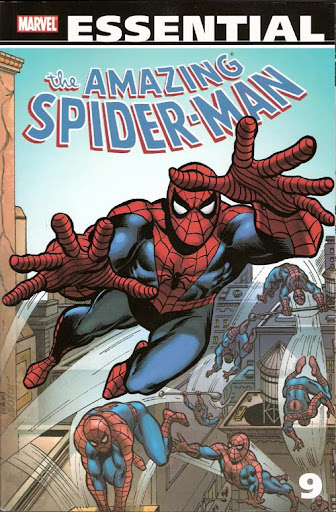
Essential Spider-Man, v. 9

Collects: Amazing Spider-Man #186-210, Amazing Spider-Man Annual #13-4, and Spectacular Spider-Man Annual #1 (1978-80)

Released: May 2009 (Marvel)

Format: 600 pages / black and white / $19.99 / ISBN: 9780785130741

What is this?: A slice of late ‘70s / early ‘80s Spider-Man that introduced the Black Cat and features the return of the Burglar who killed Uncle Ben.

The culprits: Writers Marv Wolfman and others and artists Keith Pollard, John Byrne, and others

Can you have nostalgia for something you never experienced?

Marvel sure wants you to. The Brand New Day continuity is a direct throwback to the Spider-Man you can find in Essential Spider-Man, v. 9, which reprints Amazing Spider-Man issues from 1978-80. Some readers will remember those days, and long for their return, but most of us only have second-hand evidence those days ever occurred.

The parallels between Brand New Day and v. 9 are striking. In each, there’s no MJ or other steady girlfriends, but there is poverty aplenty, Harry Osborn (and the rest of the supporting cast) hanging around, and a non-J. Jonah Jameson boss supporting Peter’s photography. Other than a healthier Aunt May and no Black Cat in BND, it almost feels like BND writer Dan Slott or editor Tom Brevoort gave pre-publication copies of Essential Spider-Man, v. 9, to the other writers and said, “This is what we’re looking for.”

Essential Spider-Man, v. 9 coverAnd v. 9 is at a level of quality the Spider-titles haven’t seen for years, so that would be good, even though I just made that anecdote up. Marv Wolfman, who wrote #186-204, was in a sweet spot in Spider-Man lore here: after the doldrums following Gwen Stacy’s death and leading into the revitalizing run of Roger Stern (who wrote #206). Wolfman brings back the Burglar and gives him a reason to have killed Ben Parker. In an interesting story that shouldn’t work but does, Wolfman slips in an unnecessary retcon, uses Mysterio and the Kingpin as blocking figures, and still writes a story that hits all the important Spider-Man notes, managing to be moving while both using past continuity and advancing the characters.

This is not an empowering book for any female readers. (Any out there? And how can I tell if those chirping crickets are female or not?) Wolfman creates the Black Cat in this volume, which is a mixed blessing; she’s a big part of the ‘80s, but although she comes across as level headed and capable in her first arc, he and David Michelinie portray her as a crazy stalker in the second. Given the way Wolfman writes Betty Brant, as a clingy ex-girlfriend who has to have a man after leaving her husband, no one was going to be giving him any awards for positive portrayals of women. Denny O’Neil, who wrote #206-10 and Annual #14, balances things (a little) by introducing Madame Web, a criminally underused supporting character. But back on the other hand, Peter also treats Deb Whitman, departmental secretary at his graduate college and occasional date, like crap no matter who was writing him.

The villains are among Spider-Man’s best: Electro, Dr. Octopus, Kraven (with Calypso!), Chameleon, the last appearance of Alistair Smythe, Man-Wolf, and the aforementioned Kingpin and Mysterio. Smythe’s attempts to kill Spider-Man and Jameson are especially good; his final plan, which involves strapping both to a bomb, is one of the better Spider-Man stories, and his attempts to use John Jameson to do his dirty work show a man who’s thought about his revenge and decided to make it as cruel as possible. (The strapping Spider-Man and Jameson show a man who has not thought things through completely.)

The long-term subplots in this book lack a satisfying end. Betty Brant’s attempts to win back Peter were wrongheaded to begin with, and Peter’s attempt at getting her to go away was cruel and almost villainous. The resolution to Jameson’s long-running bout of insanity feels … well, stupid, really, but I’ll settle for “rushed.” And Peter’s entire employment at the Globe is contained in this volume; I thought his employment at the Bugle’s competition was cut too short, as his smarmy boss at the Globe offered a nice contrast to Jameson’s fury.

(One more thing: The linked annuals — Amazing #13 and Spectacular #1 — tell a story about Dr. Octopus’s plot to steal a nuclear sub. Wolfman wrote the first part in Amazing Annual, while Bill Mantlo wrote the second. God bless Mantlo — and he should, at least once more — but seeing the two parts juxtaposed like this reveals some … stylistic excesses in Mantlo’s approach.)

Keith Pollard isn’t going to be listed among the top Spider-artists of all time, but he takes the torch handed to him by the likes of Ditko, Romita, and Andru and carries it admirably. His work looks a little like a modified version of Ross Andru’s; if there were an early house style for Spider-Man, Pollard would be an excellent example of it. His Spider-Man is athletic and flexible without being distorted or overstylized, and his supporting characters are all distinct and recognizable. (Of course, most artists could do that in those days.) Pollard also created the Black Cat’s signature costume, which you can take as a criticism or compliment.

John Byrne does a few fill in and annuals, and his work is outstanding — although I enjoyed Pollard, I would have really enjoyed seeing Byrne on Amazing rather than on Marvel Team-Up, where he had worked a little earlier. Byrne’s work in v. 9 is everything his early work was — beautiful, imaginative, stylish. Sal Buscema, Frank Miller, and John Romita, Jr., also contribute excellent work to the volume, as do Jim Starlin, Al Milgrom, Alan Weiss and Richard Buckler. Really, if you weren’t one of the best, Marvel wasn’t going to let you near Amazing Spider-Man (although technically Buckler worked on the Spectacular Annual).

There’s a lot to like in Essential Spider-Man, v. 9. And there’s a decent amount that comes across as lacking. Although I enjoyed the book throughout, I couldn’t shake a nagging feeling that it just missed being great. So it has to settle for good.

Rating: Spider-Man symbol Spider-Man symbol Spider-Man symbol Half Spider symbol (3.5 of 5)

Labels: , , , , , , , , ,

22 May 2009

Amazing Spider-Man: Brand New Day, v. 1

Collects: Amazing Spider-Man #546-51, Spider-Man: Swing Shift Director’s Cut, backup story from Venom Super Special #1 (1995, 2008)

Released: May 2008 (Marvel)

Format: 200 pages / color / $24.99 (hardcover) / ISBN: 9780785128434

What is this?: The first collection of post-reboot Spider-Man stories.

The culprits: Writers Dan Slott and Marc Guggenheim and pencilers Steve McNiven and Salvador Larrocca and friends

I’m going to get this out of the way now and then move on: Spider-Man’s “One More Day” was a stupid, stupid idea, as many others have pointed out more forcefully and in a more timely manner. Trading his marriage, his happiness, and his wife’s happiness to the devil for the life of a woman who has been terminally ill since about 1964 makes no sense; I’m sure Aunt May herself would have said, “Don’t be a halfwit, Peter.” And given that Aunt May tends to “die” every 200 issues anyway, well, I wouldn’t bet much on her surviving much past Amazing Spider-Man #600. And what the hell is Mephisto going to do with a marriage, anyway? It’s not a commodity you can sell or trade or even use as a stake in poker game.

That out of the way, I can move on — as Amazing Spider-Man itself did — to Amazing Spider-Man: Brand New Day, v. 1. In it, Peter Parker’s a hard-luck 20-something in New York City, trying to scrape by on a photographer’s income while also being an outlaw hero. His marriage with Mary Jane never happened; Harry Osborn is back from the dead, after bumming around Europe for a while (to be fair, that’s essentially how they brought back his father); and Peter Parker’s back to being a hard-luck superhero, poor and rootless.

Amazing Spider-Man: Brand New Day, v. 1 coverI came to Brand New Day with some misgivings, and I can’t say they were completely mollified. I admit there are some very good ideas here. The change of ownership at the Daily Bugle and Spider-Man’s interaction with superheroes who registered during Civil War are great plot directions; the subplot of a murder who puts Spider-tracers in the mouths of his victims is intriguing. The new villains were in the vein of Spider-Man’s old villains but without being too derivative. But this book seems all too pleased with itself sometimes, from Harry Osborn’s smug face to the Stan Lee-inspired editorial tags and narration. We’re going to back to the basics, it says, if we have to kill Stan Lee and Steve Ditko, dig up and zombify their corpses, and chain them to desks in the Marvel Bullpen so that you can get Spider-Man in the Mighty Marvel Manner!

In moving forward, Brand New Day is continually looking backwards, regressing Peter, rolling the clock back on his development, making Spider-Man a police suspect and Aunt May an activist (again), and generally trying to make it feel like the mid-‘80s (if not the ‘70s or Silver Age). But the past is gone. I am not interested in revamps, reboots (hard or soft), or reimaginings. Characters or the writers’ interpretations must grow and move forward if they’re to speak to new readers; if they don’t, the characters will die. Brand New Day wants to move forward, but it is determined to hold on to that past like a life preserver, little realizing it’s an anchor: it can steady you or give you hope, but it can’t support you.

And it’s a pity that overshadows the stories. Are they classic Spider-Man stories? Although they’re in that vein, they probably won’t feature in a Best of Spider-Man volume any time soon. But they are solid stories, with new and somewhat interesting villains (time will tell how interesting) doing unpredictable evil. There’s little confusion over the new continuity. Writers Dan Slott (Swing Shift, #546-8) and Marc Guggenheim (#549-51) do an imaginative job with the new Spider-Man setup. Editor Tom Brevoort’s manifesto, reprinted at the end of the book, has many excellent ideas: bringing back the supporting cast, creating new villains, sticking with consistent looks and characterizations on the old villains, making Spider-Man funny again. These are all excellent ideas, and they didn’t need a reboot to implement them. And the idea of the thrice-monthly Amazing with a regular rotation of writers and a head writer is an excellent plan; I hope sales remain strong enough to continue it.

Steve McNiven (#546-8) provides the pencils for the first arc, and Salvador Larroca draws the second half (#549-551). Neither really knocks me out, and I’m surprised that for such a high-profile storyline Marvel didn’t get bigger artists (nothing against McNiven or Larroca). I prefer McNiven, who seems to have a good sense of the kinetic nature of Spider-Man and gets the interesting challenge of drawing the chromatically reversed Mr. Negative. Larroca’s art seems stiffer and puffier, although that may be a result of the off-putting coloring, which seems to go out of its way to refuse to show any vibrancy. The names of the artists involved in smaller roles are better known to me: Phil Jimenez on Swing Shift and Greg Land, Phil Winslade, and Mike Deodato on some backups. John Romita, Jr., illustrates a two-page summary of the new continuity at the beginning of the story. For completists, Mark Bagley is the artist for Slott’s first Spider-Man story, a forgettable backup from Venom Super Special #1 reprinted at the end of the book.

After reading Brand New Day, I have a new respect for X-Men: Messiah CompleX. I enjoyed Brand New Day much more — much, much more, really — but as I said in the Messiah CompleX review, that book works better as a statement of what’s to come than as a book. Messiah CompleX says the future’s going to be different that what you’ve seen, so you better pay attention. Brand New Day says the future’s going to be a lot like the past, so if you want to take a snooze, you probably won’t miss much. For that reason, they average out to about the same rating.

Rating: Spider-Man symbol Spider-Man symbol Spider-Man symbol (3 of 5)

Labels: , , , , , , ,