Reviews of trade paperbacks of comic books (mostly Marvel), along with a few other semi-relevant comments / reviews.

22 July 2016

Captain America: Sam Wilson, v. 1: Not My Captain America

Collects: Captain America: Sam Wilson #1-6 (2015-6)

Released: April 2016 (Marvel)

Format: 136 pages / color / $17.99 / ISBN: 9780785196402

What is this?: Sam Wilson lets it be known he has political feelings, then takes on the Serpent Society — I mean, Serpent Solutions.

The culprits: Writer Nick Spencer, artists Daniel Acuna and Paul Renaud, and penciler Joe Bennett


First things first: if you are offended, as some reviewers on Amazon are, by politics in your Captain America comics, you should not be reading Captain America: Sam Wilson, v. 1: Not My Captain America. Sam Wilson was a social worker while he was Falcon, and he has had a vastly different upbringing from Steve Rogers. To not have Sam be more political than Steve would be a poor reading of the character, and writer Nick Spencer is completely right to have Sam take a stand on issues such as immigration.

The funny thing is that other than supporting the human rights of illegal immigrants, Sam doesn’t make any controversial pronouncements. We’re just told people are mad that he has. Spencer fills the book with anti-Wall Street sentiment, but honestly, I’m not sure many people get mad at the idea that investment bankers and stock traders are out of touch with the rest of society, often make amoral decisions more concerned with gaining money than acting ethically toward lower economic classes, and are often out of reach of the law. I think people don’t like being told that by people who have “agendas,” though, and comic-book writers who are too transparent are probably seen as people with agendas.
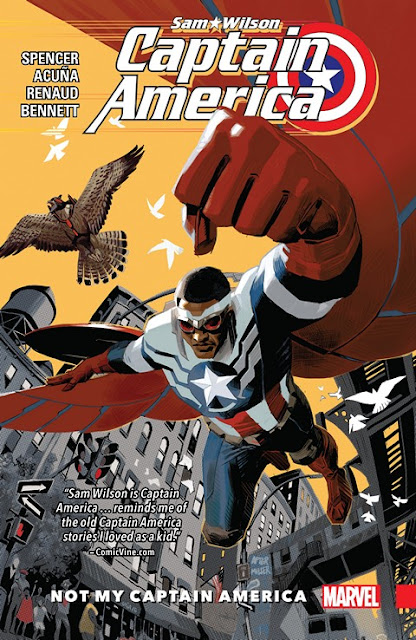
Captain America: Sam Wilson, v. 1: Not My Captain America cover And let’s face it: in accordance with Marvel’s “More than One of Everything” policy, you don’t even have to read this book if you want to read a Captain America title. Just read the other one, and you’ll be fine. Now, as for whether you should read Not My Captain America

Sam Wilson is a likeable hero, not quite at ease with his new role, and Spencer mixes Sam’s doubts with his determination. Sam is someone I want to read about, someone whose elevation to perhaps the premiere Marvel hero identity seems earned without the character being conceited about it. Spencer gives Sam a sidekick, who, despite his silly origin, seems to be the kind of sidekick Sam should have: someone with ties to Sam’s legacy and who comes from a disadvantaged and non-privileged background.

A likeable hero and the promise of a good sidekick is an excellent start, but the other choices Spencer makes are less promising. The series begins with Sam sitting between two bros from New Jersey on a commercial airline, recapping and reminiscing about what has happened in the eight-month gap following Secret Wars. OK, fine — being in public gives readers a chance to see how normal people react to Sam. But it still involves Sam spending two issues spending non-flashback time between two bros, and I think Spencer could have chosen a better venue to show the public’s opinion of Sam.

The two issues of flashback prevents the book from gaining any momentum. The first issue has non-talky bits, like Sam and his team wrapping up a Hydra cell, but it isn’t satisfying. It’s a taste of action — inconsequential, not even complete enough to intrigue. Interspersing the story with things I don’t care about, like a detailed account of Sam’s falling out with SHIELD, waters the story down; if you can’t tell an interesting story about the conflict, mention it briefly and add more depth to Sam’s battle vs. Armadillo. (How Sam handles himself against a real heavyweight brawler should be important, given that unlike Steve, Sam’s best physical attribute is agility, not strength.) If I had been buying single issues, I would have abandoned the series after one issue. It’s not until Not My Captain America’s overarching storyline begins, five pages into #2, that the book starts to capture my interest.

Sam is working with Misty Knight, a private detective who used to date Iron Fist. As far as I can tell, Misty has never associated with Captain America or Sam Wilson in the past; she has usually worked with her long-time partner Colleen Wing or some iteration of Heroes for Hire. Why is she working with Sam Wilson now? It isn’t really answered; given that we learn a great deal of stuff that isn’t all that important, why couldn’t Spencer have mentioned Misty’s motivation? Despite how great Misty is, I get the feeling she was chosen as a race-appropriate romantic interest.

Spencer also brings back two characters from Ed Brubaker‘s last run: D-Man and Diamondback. D-Man, who is generally portrayed as a goofy but usually competent hero, was killed by Brubaker in a gritty story that was uniquely unsuited for D-Man. I’m glad he’s been brought back to serve as part of Sam’s support staff, a role he fits admirably. Diamondback, an ex-member of the Serpent Society who became Steve Rogers’s girlfriend and a hero, has fallen on hard times after her fiancé died of cancer, forcing her to become a stripper to make ends meet. But she was a SHIELD agent during Brubaker’s run. Couldn’t she have fallen back on that … ?

Oh.

Oh …

This is something that got wiped out in the reordering of universes after Secret Wars, right? I … I need a moment. To think about … about the fragile nature of continuity, even in Marvel. Just … just give me a moment.

Technical Difficulties. Please Stand By.

Well, I still think “stripper” is a bit too obvious of a profession for the founder of a mercenary group called “Bad Girls.”

The villains in Not My Captain America are quite a bit better. Spencer’s decision to transform the Serpent Society into Serpent Solutions seems exciting; rather than a brawling collection of snake-themed villains (which I like), he’s turned them into a group that leases evil intellectual property to unscrupulous businessmen. Unfortunately, the idea has several holes in it, the largest of which is that most of the seventeen or so members don’t do anything other than participate in the final battle with Sam and his allies. Instead, Serpent Solutions is reduced to Viper spouting One Percenter catchphrases to executive boards of amoral corporations. Spencer gives no indication that any Serpents have created the IP Viper is peddling.

Instead, some of that IP is being produced by mad scientist Karl Malus, an old Captain America foe who recently was been eaten and crapped out by Carnage; because of that, Malus has his own symbiote. This should make him terrifying, but instead, Spencer decides to defuse the tension by having Malus turn Sam into Cap Wolf. (Steve Rogers was turned into a wolf in one of the silliest storylines of Captain America, v. 1.) It’s a dumb joke, although given that Redwing, Sam’s falcon, has a sonic weapon, I’m not sure how much of a threat Karnage Malus should present.

(I do admire that Serpent Solutions is very professional about how it handles Misty’s attempt to break into their office building: She has to sign in, and a group of thugs are sent to the first floor to meet her.)

The art is uniformly good, although having three different artists on the initial arc is never a positive sign. All three have similar restrained styles that work well together. Daniel Acuña draws #1-3, which means he’s saddled with a lot of boring flashback work; he does his best, but I’m not sure anyone could make it interesting. In #3, I wish he would have played up the visual elements of Malus’s symbiote more, since the writing fails to make Malus the creepy adversary he should be. Paul Renaud manages to make the Serpents impressive, and I enjoyed the incongruity of Viper playing golf (wearing his mask) with other executives. His Diamondback is a bit too cheesecake, but then again, she is supposed to be a stripper. Joe Bennett gets the big fight scene at the end, but even though it’s certainly competent, it doesn’t exactly answer the question of how Joaquin, a nascent superhero, can evade the Serpent Society. (Given his wings, you’d think the answer would be “flying out of reach.” You, like me, would be wrong.) It also doesn’t have the impact a storyline ending brawl between a bunch of snakes and heroes should have. Also: Whoever gave Misty that open-midriff costume — probably Acuña — has a lot to answer for.

Oh, and one last thing: If you are a publisher of superhero comics coming out of an event that frelling reorders reality, consider putting some frakking footnotes into the text so readers have an idea about what comes from previous issues (which readers can probably buy in book form!) and what the writer is creating at this moment. It seems only considerate (and an opportunity to huck your damn product).

Rating: Captain America’s shield Captain America’s shield Half of Captain America’s indestructible shield (2.5 of 5)

Labels: , , , , , , , , , , , , ,

24 June 2016

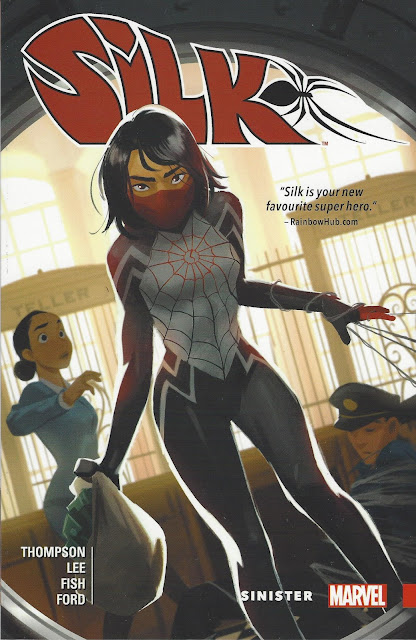
Silk, v. 1: Sinister

Collects: Silk #1-6, story from Amazing Spider-Man v. 4 #1 (2015-6)

Released: April 2016 (Marvel)

Format: 144 pages / color / $19.99 / ISBN: 9780785199571

What is this?: Silk goes undercover for SHIELD inside Black Cat’s organization as the Black Cat accumulates technology and battles against Goblin Nation while she also works for the Fact Channel and looks for her parents.

The culprits: Writer Robbie Thompson and artists Stacey Lee, Tana Ford, and Veronica Fish


I’ve been trying to write this review for a few weeks now, and I just haven’t been able to put my thoughts down. But now that I’ve published my review for Spider-Gwen, v. 1: Greater Power, I feel I have to review the latest title from the other female-led new-character series that came out of Spider-verse: Silk, v. 1: Sinister.

The review hasn’t been hard for me to write because I don’t know what I thought of the book. I enjoyed Sinster, just as I enjoyed the first volume of Silk (confusingly numbered v. 0). Silk is a solid series; it’s a series I’ll continue to read, although I’m not sure I’ll be excited about it.

Silk, v. 1: Sinister coverSilk … I don’t know. Silk has lost its new car smell, but it’s reliable and can still surprise me at times . I expect to have Silk for a long time, and I expect to remain satisfied by it. But it’s a little disconcerting how quickly how quickly it’s gone from invigorating to a solid performer.

Sinister picks up eight months after v. 0. I was concerned Silk would abandon some of the changes made at the end of The Life and Times of Cindy Moon because of Secret Wars, but I needn’t have worried. Cindy Moon has been promoted at the Fact Channel, where she works for the gruff-but-caring J. Jonah Jameson. Cindy is still looking for her parents, but she has found her brother, who’s seeking treatment after his memory loss. Cindy’s heroic identity, Silk, appears to be working for crime boss Black Cat, but that is revealed (in the first issue, so no real spoilers) to be an undercover gig for SHIELD. Since Cindy’s brother was previously affiliated with Goblin Nation, Silk has a vendetta against the green-faced tribe of kids and young punks.

Writer Robbie Thompson has established a status quo that is nearly ideal — a classic Spider-Man status quo without being obvious about it. The balance between Cindy’s personal life and work life and between Silk’s heroism and her selfish desires are fascinating. Cindy is obviously trying to fit too much into her life, but that’s what heroes do, right? And Thompson does as good job of showing that Cindy’s suffering from her attempts to run in four different ways at once; her behavior, her friends’ reactions, and her sessions with her psychiatrist all show someone who is beginning to fray.

The supporting cast is excellent, with Cindy’s work friends serving as a nice counterweight to Silk’s allies and rivals. Jameson’s faith in Silk is as touching as it is surprising. Peter Parker returns to offer his ten cents of advice; a wise choice, as Peter’s appearance serves to link the book’s continuity to the pre-Secret Wars stories and shows why Peter probably won’t be showing up very often going forward. Thompson even uses Killer Shrike, who works for Black Cat. Killer Shrike! Silk also has a mystery ally, Spectro (named only in the sketches at the back of the book), who seems primed to be the Angel to Cindy’s Buffy.

I’m not sure about Spectro; he’s mysterious without having a character. I’m really not sure about using Spider-Woman (Jessica Drew), though. Jessica presents herself as a mentor figure to Silk — they have regular brunches — but Cindy already has more effective adults she can work out her issues with: Mockingbird, who is her SHIELD partner / handler, and her psychiatrist. My resistance to Jessica’s presence may be because the two characters met in the Spider-Verse crossover, and I’m opposed to anything that reminds me of that crossover. It may also be because Jessica serves as mentor to Spider-Gwen, and I think Silk and Spider-Gwen should be differentiated as much as possible. Mostly, though, it’s the redundancy that bothers me.

I like Silk being a superhero who visits a psychiatrist, and every panel with Jessica is one that can’t be used on one of Cindy’s sessions with Dr. Sinclair. In an era in which thought bubbles and narrative text boxes have gone out of style, it’s nice that Thompson has given Cindy someone to whom she can admit her darker thoughts, her true thoughts, without fear of repercussions. (Well, there could be repercussions, but Cindy doesn’t think there will be.) That doesn’t mean she blurts out what she thinks to Dr. Sinclair; she’s still concerned about what her feelings say about her true character, as anyone would be.

I’m not convinced by Black Cat’s full transformation to ultra crime boss. Thompson has set her up as a major crime lord, one who has the resources to create an antidote to the Goblin serum. Even given that Cat has been back to being a criminal for maybe a year, Marvel time, that’s not really believable. The Goblin serum is a hard nut to crack; Spider-Man had a great deal of difficulty doing that. But Black Cat’s scientists — seen only on one page — manage to not only come up with a cure with no side effects but to aerosolize it. I’m not sure how Black Cat, a character who was a lone operator for so long, gets to build an organization like that. I can see her intimidating a small crew, but a large operation … ? Well, I suppose this is a small quibble, and my skepticism might be unfounded. After all, a year seems like a short time to build what Black Cat has, but it’s a long time in the Marvel Universe.

I love Stacey Lee’s art, and I’m sad she doesn’t do more than the first issue (plus the story from ASM). Lee’s art is fluid and clear; she has no trouble making Cindy stereotypically cute while making the Goblin Nation thugs creepy. She even (almost) makes Mockingbird’s mask look normal, which is something that Giuseppe Camuncoli completely failed to do in Spider-Man: Worldwide, v. 1. What causes a goblin glider to fail during Silk’s battle with Goblin Nation could be clearer, though.

Tana Ford’s art doesn’t match the tone Lee established in #1 and in Life and Times. Everyone Ford draws looks disheveled; everything feels unpolished and rough. Her wobbly faces look like their features are all going to start rolling away in opposite directions. (Also, Ford’s Mockingbird at the beginning of #6 looks incredibly like Songbird from Thunderbolts, which caused me to do a double-take.) Ford’s style could work for a different title, but Lee has established Silk’s look as the complete opposite. If I knew Ford was taking the title over full-time, I could get used to that — I’d have to, I suppose — but Ford draws only three issues (#2-3 and #6). Issues #4 and 5 are drawn by Veronica Fish, whose style fits wonderfully with Lee’s.

Silk is a title with a lot to like, although I admit I have to sit down and make myself write my thoughts out for me to really see it all. I have a feeling my enthusiasm for each future volumes will have a lot to do with who the artist is and how much the stories involve other Spider-women.

Rating: Spider-Man symbol Spider-Man symbol Spider-Man symbol Half Spider-Man symbol (3.5 of 5)

Labels: , , , , , , , , , , ,

20 May 2016

I Hate Fairyland,v. 1: Madly Ever After

Collects: I Hate Fairyland #1-5 (2015-6)

Released: April 2016 (Image)

Format: 128 pages / color / $9.99 / ISBN: 9781632156853

What is this?: A young girl kidnapped by Fairyland tries to find her home for 27 years, trapped physically at the same age and growing increasingly violent.

The culprit: Skottie Young


I don’t know that I’m the right audience for I Hate Fairyland, v. 1: Madly Ever After.

I mean, I thought I was. I Hate Fairyland features Gertrude, a woman in her mid-30s who has been trapped in Fairyland in a child’s unaging body for almost three decades. Unable to find the way out of Fairyland and into her own world again, Gertrude gleefully takes out her frustrations on the pastel-and-spun-sugar world around her. Unremitting violence against all those fairy-tale clichés seemed like something I would enjoy.

I Hate Fairyland coverAs it turns out, the violence gets boring. Writer / artist Skottie Young doesn’t skimp on the blood, bone, or gore as Gertrude destroys anthropomorphic heavenly bodies, anthropomorphic animals, and anthropomorphic plants. (I think she has it in for things that look or act human-like but aren’t.) For variety, she also kills some giants. Gertrude’s violence on the page is mostly perpetrated against those who can’t fight back. Perhaps that’s why the mayhem’s appeal begins to pall after an issue or two. Most of the big fights — the ones against opponents who can fight back — happen between books or off-panel. Some bits of violence don’t grow old, though; I enjoyed Gertrude’s deadly attacks against the book’s narrators, especially once the narrators started to understand the peril they were in.

For many people, Young’s art is going to be the appeal. Young’s work is hyper-cartoony, with expressions and violence amped up to 11. Nothing is too small for him to exaggerate. (Young’s work in I Hate Fairyland is an amusing counterpoint to all his variant covers for Marvel, in which he draws cute versions of characters.) There’s no doubt Young is an outstanding visual storyteller; his art is clear, and he draws admirably clear battle scenes.

So I can’t fault Young as an artist at all. On the other hand, I’m more interested in the story and jokes.

Much like with Rocket Raccoon, v. 2: Storytailer, though, I have my doubts about Young as a writer. Given that I Hate Fairyland is labeled a mature book, I wish Young had done more with Gertrude’s emotional traumas. As written, Gertrude is a shallow character mostly concerned with vengeance against a world she feels wronged her. Shallow characters are fine, if the book is entertaining other ways, but I think developing Gertrude’s character would have served the book much better.

Other than her heartbreaking introduction in #1 and a moment in #2, when it’s revealed Gertrude has the sexual urges of a woman her actual age rather than her body’s apparent age, not much is done with her longings to be normal. (Later in the issue, Gertrude gives her sidekick, Larry, a long list of things she misses from her world, but that list reads as an indictment of Fairyland.) Gertrude’s story is tragic, and I think I Hate Fairyland would be much funnier if that were exploited more than the straight mayhem.

Another concern the book does not address is whether Gertrude can’t find her way home because she is incompetent or because of her attitude. There’s a great deal of difference about how we feel toward Gertrude depending on that answer. If it’s the latter, Gertrude is somewhat justified in her hatred of Fairyland. If she’s stuck in Fairyland because she can’t follow directions or figure out riddles — and that’s the way the text leans ever-so-slightly — then she’s just a violent boob, and her suffering is something she’s earned.

Certainly some of the page space could be repurposed to develop Gertrude more. A running subplot involves Queen Cloudia trying to get rid of Gertrude, who’s making a mess of her Fairyland; since Cloudia is a ho-hum villain, trimming some of those pages would improve the book. Also, Young spends eight pages on a gag where Larry lives an entire life — building a house, getting married, having kids, then getting divorced — while Gertrude is unconscious. It’s not a bad joke, but the amount of time that actually passes is unclear, and certain parts of the gag don’t land (why does Gertrude grow a beard while unconscious? why does Larry’s wife go from happy to angrily leaving him between panels?). I think those pages could have better been used elsewhere.

One joke that does not disappoint is the appearance of Happy, a girl Queen Cloudia brings to Fairyland in issue #4 to find the way out of Fairyland before Gertrude can. (Under the laws of Fairyland, this will allow Cloudia to attack Gertrude openly.) Happy is unremittingly cheerful, and her adventures show both the sickeningly sweet and childishly kind quests Gertrude is homicidally reacting against and also the way the quests should have been approached in the first place: with patience, compassion, and with childlike wonder.

After encountering Happy’s rainbows and cheerfulness, Gertrude decides she has to up her game, which is an argument that Happy (or another competent antagonist) should have appeared earlier in the book. This prompts Gertrude to approach one of the Seven Dooms and ask for his power to confront Happy. The tests he puts Gertrude through aren’t great, but what comes out of it is very satisfying.

Other than Happy and smashing the narrators, the book’s humor is hit and miss. Frequently, the characters substitute “cute” words for obscenities, but the results are more annoying than funny: “muffin-fluffer,” “hug off,” and “plush” are clunky rather than clever curse words. The violence stops amusing after the first issue or so. On the other hand, a few jokes, like Happy’s entire existence and a series of dialogue written as “blah blah blah” (she’s actually saying “blah blah blah,” not just running her mouth), are genuinely funny.

If you’re a fan of Young, you know you want this. If you are undecided about him, I’m torn over whether to recommend the book. On one hand, the plotting and pacing is mediocre, and the humor isn’t strong enough to make up for that. On the other, the book really picks up at the end, which makes for a satisfying conclusion. It’s possible Young is finding his groove, which means the next volume might be an improvement, and the experience of reading v. 1 could be improved by what comes after.

For the moment, though, I’m sticking with a dead-center, neither-approve-or-disapprove rating.

Rating: I Hate Fairyland symbol I Hate Fairyland symbol I Hate Fairyland symbol (3 of 5)

Labels: , , , ,

06 May 2016

Spider-Man: Worldwide, v. 1

Collects: Amazing Spider-Man v. 4 #1-5 (2015-6)

Released: April 2016 (Marvel)

Format: 144 pages / color / $18.99 / ISBN: 9780785199427

What is this?: Parker Industries has offices around the world, and it looks like Peter’s finally a success. However, when PI is targeted by the Zodiac, the criminals seem to be one step ahead of Spider-Man …

The culprits: Writer Dan Slott and artist Giuseppe Camuncoli


I love the idea of Peter Parker finally succeeding. If he’s so smart — and he is, let’s face it: he invented web fluid and web shooters and electronic ankle bracelet monitors — eventually he has to achieve success in some way or die along the way. Unless you contrive an explanation for his lack of success, like a force of the universe being directed against him or him being a jerk, it makes no sense for a smart, moral person like Peter to be continuously a failure. For periods of time, yes, but not forever.

In Amazing Spider-Man: Worldwide, v. 1, Peter is the CEO of Parker Industries, which has become one of the premier technology companies in the world, with offices on three different continents. He’s working with SHIELD to keep the world safe, and he seems to have managed to keep his soul. This should be exactly what I want.

Amazing Spider-Man: Worldwide, v. 1 coverThe problem is that I don’t know that Peter is such a success.

Parker Industries and SHIELD are under assault from Zodiac. Not only is Zodiac physically raiding Parker Industries and SHIELD facilities but they are also involved in a battle of wits with the heroes. Unfortunately, writer Dan Slott doesn’t give Spider-Man very many victories, as it seems the villains win every time. Spider-Man and SHIELD get only minor victories: foiling the robbery that starts the book, defeating an attack by Goblin Nation thugs in Africa, keeping some henchmen from completing employer-insisted suicide. Zodiac defeats Parker and SHIELD almost every time, making the heroes look, well, not very competent. Maybe Peter isn’t such a success after all …

It doesn’t help that Peter built his company during an eight-month gap after the end of the latest Secret Wars series. We don’t know how Peter built his company, what decisions he chose, what compromises he had to make, or why he’s working so closely with SHIELD. His success, then, feels unearned. And that, combined with his lack of success in Worldwide, v. 1, makes me think this version of Peter Parker will be going away sooner rather than later, which is a shame.

I do like some aspects of Worldwide. Bringing back Hobie Brown, the Prowler, to be Parker Industries’ head of security and a backup Spider-Man is a nice choice; Brown was an inventor as well as someone with a costumed identity. I’m not sure Brown is qualified for either job, but I believe it’s totally a choice Peter would make. (I can also see him hiring Rocket Racer as well. Fingers crossed!) Harry Osborn makes his return under an assumed name, but since he hasn’t changed his appearance — not even his hairstyle — I can’t see that working for long. A fellow student from Peter’s college days, Philip Chang, shows up in Parker Industries’ Shanghai office, and Clayton Cole, a low-level thug Spider-Man sent to Parker Industries in the previous volume of Amazing Spider-Man, is working in PI’s New York offices.

The subplots are intriguing as well. How did Dr. Octopus end up inside the Living Brain, and what’s his long-term plan? What will Norman Osborn — or someone posing as him — do after selling weapons in Africa? Who’s wandering around in a red suit, offering to return the loved ones of Spider-Man villains? I’m looking forward to seeing these subplots play out, and I’m betting it’s going to be a combination of Dr. Octopus and Norman who bring down Parker Industries after Zodiac weakens it. (I’d almost bet PI will be Marconi Industries by the end, headed by Doc Ock’s love interest, Anna Maria Marconi.)

I don’t like the introduction of Regent to the main Marvel Universe, though. Regent was the villain in the main Spider-Man mini in Secret Wars. He made an OK villain for a series in a universe that was going to be thrown away once the miniseries was over. In the main Marvel Universe, a villain that exists to drain minor villains and eventually become a powerful threat is a waste; why kill villains to power a supervillain who will be gone once the writers hit his climactic fight, then never return? (Of course, I thought writers would have the sense to never return to Morlun, but boy, was I wrong.)

But the subplots are mostly respites from the main plot. I don’t think Zodiac works well as a Spider-Man villain; the astrology-themed criminal organization generally take on teams, and Spider-Man is a poor team player. This brings up the question of why he’s working with SHIELD — it seems a poor fit, even if he has SHIELD’s worst impulses under control. The new Scorpio’s identity is supposed to be a big deal, but even though Scorpio has an important role outside his supervillain ID in the storyline, the actual reveal falls as flat as the naming of the female villain in Spider-Island. The Human Torch flips out too easily in #3; all it takes is the news that Parker Industries has moved into the Baxter Building to set him on a fiery rampage.

I’m indifferent to Giuseppe Camuncoli’s art. Something seems off about his faces; I think he has trouble with noses, or maybe it’s the space between the eyes. Mockingbird’s mask is awful; the Human Torch’s costume has been given a bustier outline for reasons I can’t possibly imagine. His Melinda May is hardly recognizable as Ming-Na Wen, and I’m only 30 percent sure that the guy I think is Agent Coulson actually is Coulson. Still, his action is fine, and even if his Spider-Man isn’t lithe or a contorted mess — both Hobie and Peter seem stockier than the usual Spidey — he’s still recognizable. (I really enjoy the old, stubby legged spider logo on Spider-Man’s back.)

I should like Worldwide. The premise is something I’ve wanted for years, and the story itself has many trappings I enjoy. But everything about the story seems slightly off. Do I really not want Peter to be a successful CEO? Or is it the execution itself that bothers me? I’ve made it clear I think it’s the execution, but I can’t shake the feeling I might be at fault.

I’m not going to let that doubt inflate the rating, though.

Rating: Spider-Man symbol Half Spider-Man symbol (1.5 of 5)

Labels: , , , , , , , , , , , , ,