Reviews of trade paperbacks of comic books (mostly Marvel), along with a few other semi-relevant comments / reviews.

13 November 2015

Nova Classic, v. 3

Collects: Nova #20-25 and Fantastic Four #204-6 and 208-14 (1978-80)

Released: June 2014 (Marvel)

Format: 304 pages / color / $34.99 / ISBN: 9780785185529

What is this?: The last storyline of Nova’s solo title is diverted into a Fantastic Four plot, then forgotten in favor of something more interesting.

The culprits: Writer Marv Wolfman and artists Carmine Infantino, Keith Pollard, and John Byrne


One of the first superhero comic books I can remember reading is Fantastic Four #208. It was the early ‘80s, and a relative on my mother’s side gave me a stripped copy, without the cover.

The issue didn’t make me a Fantastic Four fan, although years later I was surprised to find the issue was penciled by Sal Buscema, which might account for my affection for his art. What the comic really introduced me to was the Marvel style of story: if you pick up a random issue, you’re likely to be dropped into the middle of an ongoing story that picks up threads from the previous issue and leaves others to be wrapped up by later issues.

Nova Classic, v. 3 coverFantastic Four #208 left me with so many questions. First, who the hell were these people who weren’t the Fantastic Four? Will they save Xandar from the Skrulls? Will the Fantastic Four survive their execution by old age? Can they stop the Sphinx? Is Dr. Sun as awesome as he appears?

So I bought Nova Classic, v. 3, to find the answer to those questions. (I would say that last one deserves a definite “yes,” although I needed to consult Tomb of Dracula to answer it.) Despite the name, Nova Classic, v. 3, is not a Nova book, not really; the last five issues of Nova introduce this trade, but Nova (and his supporting cast) appear in only one of the ten issues of Fantastic Four that close out the book.

To back up a bit: Nova is Richard Rider, a character introduced in his own short-lived ‘70s series (collected in the Essential Nova, one of my earliest reviews). He was created by Marv Wolfman and John Buscema (Sal’s brother) as a Spider-Man / Green Lantern hybrid: a teenager, with real teenage problems, who becomes a superhero by getting the powers of a dying space cop. The series lasted 25 issues and was cancelled mid-storyline in 1979. Fortunately, Wolfman, who was still the writer and editor of Nova, was also the writer and editor of Fantastic Four, so he inserted Nova and his cast in the middle of the then-current Fantastic Four storyline — #208, to bring this review back to the beginning.

In #204 through #206, the Fantastic Four had gone to Xandar to help defend it from the Fantastic Four’s old enemies, the shape-shifting Skrulls. The Sphinx, the villain who gathered Nova and his allies and enemies together for a space trip, wanted to use the computers of Xandar to help him end his immortality. Unfortunately, the Xandarian computers showed him how to gain immense power instead, so he headed to Earth to gain vengeance on his home planet. The Fantastic Four switched adversaries with Nova and his allies.

So Nova Classic, v. 3, is split into two halves, which touch in #208. The Nova plotline sputters out after that. Nova disappears from the book, and the story of the Champions of Xandar, as Nova and his allies are called, defending Xandar is taken over in Rom the Spaceknight (#24). Since Rom is a licensed character, that story has never been reprinted, although IDW recently acquired the comics rights to the character and probably nothing will happen in the reprint realm but we can hope?

Nova itself was not a very good series, and #20-25 are representative in that regard. The issues included have Nova outing himself to his family, which is a nice touch — Richard can’t hide it any more, and we see a brief scene of him dealing with his family’s reactions. But after that, he’s quickly roped into the Sphinx’s shenanigans, and then he’s back to fighting forgettable villains, just like the issues preceding this book. (You don’t see Nova villains other than Sphinx very often, and there’s a reason for that. Marvel also killed the rest of the Champions of Xandar — and Xandar — off panel in Avengers #260.) The only interesting bits in Nova other than Richard and his family dealing with his costumed identity are Dr. Sun facing off against the Sphinx, but that’s a brief scene without a real resolution.

The other half of Nova Classic, v. 3, on the other hand, is a decent-to-good Fantastic Four story. The Fantastic Four are called to aid the Xandarians against the Skrulls. This time, the Skrulls gain the upper hand, and three members of the Fantastic Four are captured and executed — in a sense. The Skrulls subject them to an aging ray, which will kill them in three days. It’s a needlessly cruel way to kill, but it fits the Skrulls and their hatred of the Fantastic Four. The executed heroes then escape and meet up with the Champions of Xandar on Xandar.

Once the Fantastic Four starts pursuing the Sphinx, the storyline gets a little flabby; #209 reads like a well-chosen, well-written fill-in, with the team rounding up escaped space convicts in a spaceship graveyard. It has little to do with the ongoing plot, and it introduces Reed’s idiotic robot HERBIE into the comics. After the Fantastic Four reaches Galactus and tries to convince him to fight the Sphinx, Galactus makes them spend an issue fetching him a herald, which should give the Sphinx time to destroy the Earth a few times over. Still, the individual issues are exciting, and they ramp up the tension nicely. (Except for #209.)

The ending of the storyline is a little weak. Galactus uses an ability I’ve never heard of him using to battle the Sphinx, and the solution to solving Reed, Sue, and Ben’s aging problem is to have Reed solve it after Reed has been declared too weak to do anything. The story does introduce Terrax, though, and it also has a nice Terrax-vs.-the-old-FF fight.

The art improves markedly throughout, going from Carmine Infantino’s scratchy, static drawing to the smooth lines of Keith Pollard (#204-6) and the first Fantastic Four issues drawn by John Byrne (#209-14). (Byrne and Pollard match up pretty well, in fact.) Pollard’s a little weak on the chaotic, hand-to-hand battle royales between the Fantastic Four and the Skrulls, but Byrne shows why he would be associated with Fantastic Four for years; his old versions of the team actually look like they are elderly (albeit elderly people with superpowers), and the Sphinx looks like a credible threat to Galactus. Their fight lacks any cosmic touches, but that’s OK, I suppose.

I think the best way to look at Nova Classic, v. 3, is as a Fantastic Four trade paperback with six issues of Nova bolted on. Unfortunately, $35 for a reprint of a bunch of ‘70s Fantastic Four issues is a bit steep, even if those issues do reprint the first appearance of Terrax and some nice Byrne work.

(And the book is even missing a Fantastic Four issue! In #207, Johnny Storm enrolls in New York’s dumbest college — appropriate, given that Johnny’s pretty dumb himself — and is used by the Monocle, the college’s dean who has used his advanced degree to come up with an imbecilic name, to steal Mr. Fantastic’s inventions. With all that stupidity in evidence, it’s Spider-Man who handily saves the day.)

Despite my affection for Nova Classic, v. 3, I really can’t recommend it unless you’re hunting for a Fantastic Four story that you haven’t read. In that case, it’s going to be a pleasant surprise.

Rating: Fantastic Four symbol Fantastic Four symbol Half Fantastic Four symbol (2.5 of 5)

Labels: , , , , , , , , , , ,

23 August 2013

Spider-Man: The Next Chapter, v. 3

Collects: Amazing Spider-Man v. 2 #13-9, Peter Parker: Spider-Man v. 2 #13-9, Spider-Woman v. 3 #9, and Amazing Spider-Man Annual 2000 (2000)

Released: August 2012 (Marvel)

Format: 400 pages / color / $39.99 / ISBN: 9780785159773

What is this?: Spider-Man loses everything — everything — so he can return to the status quo.

The culprits: Writer Howard Mackie, writer / artist John Byrne, and artists John Romita Jr., Graham Nolan, and others


This is how bad the Clone Saga and its aftermath were: about two years after the Clone Saga ended, Marvel decided the solution to the relative disinterest in Spider-Man was to chop the number of Spider-titles in half, relaunch the survivors (Amazing Spider-Man and Peter Parker: Spider-Man, volumes two), and have Howard Mackie write both.

To the modern reader, safely more than a decade away from that decision, having Howard Mackie writing two Spider-Man books seems insane, as incomprehensible as AOL buying Time-Warner or the Internet bubble on Wall Street. Three years after the 1998 relaunch, Mackie was done with his Spider-Man run — and done at Marvel. His alternate-reality X-title, Mutant X, ended in June 2001, a month after Amazing #29, his final Spider-Man issue. (He was replaced on Peter Parker by Paul Jenkins with #20.) After that: nothing, unless you believe he was X, the anonymous writer of The Brotherhood, which ended in March 2002. The only work Mackie has done for Marvel in the last decade is Spider-Man: The Real Clone Saga, which retold the Clone Saga as Mackie and Tom DeFalco intended. Thank God; that was a story that was screaming to be told. Or maybe the screaming was coming from somewhere else. From me, maybe.

Spider-Man: The Next Chapter, v. 3 coverBut evidently we couldn’t see Mackie’s shortcomings back then: his shoddy characterizations, his inability to see a plot or subplot through, his frequently nonsensical plots. Mackie rose to prominence with the 1990s Ghost Rider relaunch, where the fresh take on Ghost Rider, Image-era art, and grim-and-gritty characters overrode those deficiencies. I can’t speak to the exact quality of his previous Spider-Man work, but his X-Factor run (#115-49) charged headlong into incomprehensibility before everyone agreed the best remaining idea for the title was to throw Havok, the X-Factor’s team leader, into an alternate reality and follow the alternate reality Mackie hadn’t yet messed up.

I chose to start with the third volume of The Next Chapter because I already had the single issues that made up v. 1 and 2. But the choice was serendipitous, as v. 3 begins Marvel’s second, slightly more successful attempt to roll back Spider-Man to his early ‘80s settings. The calamitous Clone Saga had taught Marvel, rightly or wrongly, that Peter could not be replaced, so Marvel tried writing Mary Jane out of the comics instead. In Amazing #13, the first issue of The Next Chapter, v. 3, the passenger jet Mary Jane is traveling on explodes in mid-air.

The decision to kill Spider-Man’s wife was both bold and crassly commercial, which is probably why it appealed to those who signed off on it. It is not so appealing in execution. However, Mackie and Amazing plotter / co-writer John Byrne choose to make Peter not believe Mary Jane is dead, and that’s more interesting than weeping and moaning. His friends see it as denial, but in Spider-Man’s world, the choice is backed by some logic. Aunt May returned from the dead, as did Norman Osborn; Gwen Stacy and the Jackal were cloned. Mary Jane’s survival was possible — and in fact, she was alive, reuniting with Peter in Amazing Spider-Man v. 2 #29, a few months after The Next Chapter, v. 3, ends.

The enjoyability of The Next Chapter, v. 3, is elevated above the material itself because it contains the entire storyline, from the violent act to Peter’s eventual acceptance. Rarely do readers get a complete story when Marvel reprints a consecutive, non-storyline based section of continuity. I doubt Marvel planned the reprints that way, but I’m glad it turned out that way — especially since everything else about the story is abysmal.

Peter claims to want Mary Jane back, but he is ineffectual in his attempts to find her. I know Spider-Man isn’t the world’s greatest detective, but he doesn’t investigate Mary Jane’s alleged death or find any clues. He doesn’t try to find any of her previous stalkers, such as Venom, who might have had a grudge. He doesn’t look into the explosion. His only real investigation into her death is following up on an anonymous tip that MJ was being held in Latveria, where her plane was bound. (Why would anyone have a modeling shoot in Latveria, of all places?) He doesn’t try to find who gave him the Latverian tip or MJ’s crooked manager, who embezzled money from his client and disappeared.

It’s almost as if the reader is supposed to think Peter knows how irrational he’s being but doesn’t want any evidence to prove it. Unfortunately, nothing in the text backs up that reading — except that when Spider-Man is haunted by the deceased Harry Osborn in Amazing Spider-Man Annual 2000, he finds Harry’s return patently ridiculous, despite Harry having been dosed with the same Goblin formula that returned Norman Osborn from the dead.

A big part of the storyline’s failure is that the plot requires us to accept whatever Mackie and Byrne dish out to keep things moving or to stop them from moving. Peter’s costume and spider-shooters are stolen after he is kicked out of a flophouse, but why doesn’t Peter take better care of his Spider-equipment? Is he an idiot? (Probably, since he could have stayed with May or one of his friends, and he has no problem accepting money from her or Robbie Robertson.) Why doesn’t he work harder to find the manager who ruined his life? Why did someone want Peter to investigate in Latveria? Why re-introduce the mystery of the fifth Green Goblin, then pointedly not resolve it? In Annual 2000, why do Scrier Jr.’s gauntlets explode when they touch? What is the point of the gratuitous Marvel: The Lost Generation crossover in Amazing #16, other than to boost one of Byrne’s more forgettable ideas? Why does Venom’s bite have such an effect on Sandman, when Sandman loses mass all the time without any consequences and Venom’s bite never was so toxic before? What could possibly be in the box the airline returns to Peter and May, which convinces them of Mary Jane’s death? The answer to all these questions is You shut up.

Even when Mackie and Byrne have good ideas, their inability to commit to the idea undermines their accomplishments. In Peter Parker #16, Spider-Man runs across a half-dozen new, off-brand villains. The interaction between the villains and Spider-Man promises some laughs, with a subplot thrown into the mix; unfortunately, in less than three pages, they are gone, and Spider-Man thinks, “I feel like I’ve stepped into a Reader’s Digest version of a bad day in the life of Spider-Man.” (In contrast, a new Rocket Racer is given a big build-up, making his ignominious and off-hand defeat worth the time spent on him.) Having someone hunt down the Sinister Six, member by member, is an interesting idea, but we never get a good reason why the culprit decides to do so, or why he interrupts his vendetta halfway through to try to court his ex-wife. The ex-wife’s despair is convincing, but not enough time is invested in her thoughts to make her final fate seem believable. Sandman’s disintegration fuels some interesting stories down the line, but Mackie and Byrne are more interested in teasing a Silver-Age villain’s death than in following up on the implications.

Strangely, part of Mackie’s problem is that he can’t let go of the past. Part of the relaunch’s remit was to quietly forget the stories leading up to it. Mackie couldn’t, of course. In v. 3, he’s still dredging up stories from v. 1 of both titles. The awful crossover with Spider-Woman is saturated by references to the Gathering of Five crossover, which immediately preceded the relaunch. (To be fair, the new Spider-Woman was empowered by the crossover, but the stupid solution to defeating the villain revolves around the Gathering of the Five.) More damning, though, is his inclusion of the fifth Green Goblin, who impersonated the villain after the Clone Saga to clear Norman Osborn’s name. That Green Goblin could have been easily forgotten, but Mackie brings him up without resolving his identity, then offs the poor sap. Peter shakes his head and goes on with his life, rather than caring. In the Annual, Mackie brings up Scrier, a Clone Saga hanger-on, and the deceased Harry Osborn.

The reason why these thoughts and stories are half-formed is to give Mackie and Byrne room to tear Peter Parker’s life down. Mary Jane and her earning power are blown up, putting Spider-Man in the poorhouse. He’s single again, earning basically nothing as a dishwasher, and he has to move in with Randy Robertson to make ends meet. Strangely, the writers and Peter refuse to wallow in the protagonist’s misery. Peter is … not cheerful, but he’s not downbeat either. Partially, that is because he refuses to believe in his wife’s death; part of it is because the stories don’t spend much time on the misery of minimum-wage labor and homelessness.

Not everything is bad. Mackie and Byrne use the supporting cast; even when the supporting characters are at their most cardboard, the writers acknowledge the amount of people who care about Peter and May, which is something other writers have trouble with. Cletus Kasady’s escape from the insane asylum without his symbiote underscores that even without Carnage, Kasady is dangerous. J. Jonah Jameson getting his hands on Peter’s Spider-equipment and stopping the Bugle’s Spider-Man vendetta is interesting, although the former isn’t original. Flash’s gloriously self-aggrandizing pep talk to Peter in Peter Parker #18 is wonderful.

Cadaverous Aunt MayMore importantly, the art is very good. John Byrne, who penciled Amazing #13-8, is not at his peak, but he is more than solid throughout. John Romita Jr.’s work on Peter Parker #14-7 and 19 is very good — and considering that I generally don’t like Romita Jr.’s work, that’s saying something. His Hulk in #14 is hulking and brutish without devolving into cartoonishness, which would have been all wrong for a serious issue about Peter dealing with Mary Jane’s absence. Klaus Janson (Annual) and Lee Weeks (PP #13) are excellent on their single issues as well, with Weeks’s realistic style being an excellent choice for an issue focusing on the depowered Carnage and Janson’s slightly dated look complementing a script that concentrates on characters from Spider-Man’s recent past. On the down side, Erik Larsen’s pencils in Amazing #19 look rushed, with May’s face looking less “old” and more “cadaverous.”

This is the end of Mackie’s stranglehold on Spider-Man. Byrne bowed out with Amazing #18, and Mackie was replaced on Peter Parker after these issues. A new era was coming, and few readers looked back on Next Chapter’s false starts with any fondness. To be fair, in v. 3, the stories (and writers) did exactly what Marvel wanted them to: reboot Peter Parker to his good old days. I don’t think anyone wanted to see it done this badly, though.

Rating: Spider-Man symbol Half Spider-Man symbol (1.5 of 5)

Labels: , , , , , , , , , , ,

10 June 2009

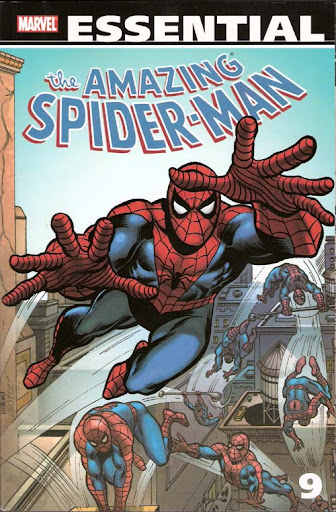
Essential Spider-Man, v. 9

Collects: Amazing Spider-Man #186-210, Amazing Spider-Man Annual #13-4, and Spectacular Spider-Man Annual #1 (1978-80)

Released: May 2009 (Marvel)

Format: 600 pages / black and white / $19.99 / ISBN: 9780785130741

What is this?: A slice of late ‘70s / early ‘80s Spider-Man that introduced the Black Cat and features the return of the Burglar who killed Uncle Ben.

The culprits: Writers Marv Wolfman and others and artists Keith Pollard, John Byrne, and others

Can you have nostalgia for something you never experienced?

Marvel sure wants you to. The Brand New Day continuity is a direct throwback to the Spider-Man you can find in Essential Spider-Man, v. 9, which reprints Amazing Spider-Man issues from 1978-80. Some readers will remember those days, and long for their return, but most of us only have second-hand evidence those days ever occurred.

The parallels between Brand New Day and v. 9 are striking. In each, there’s no MJ or other steady girlfriends, but there is poverty aplenty, Harry Osborn (and the rest of the supporting cast) hanging around, and a non-J. Jonah Jameson boss supporting Peter’s photography. Other than a healthier Aunt May and no Black Cat in BND, it almost feels like BND writer Dan Slott or editor Tom Brevoort gave pre-publication copies of Essential Spider-Man, v. 9, to the other writers and said, “This is what we’re looking for.”

Essential Spider-Man, v. 9 coverAnd v. 9 is at a level of quality the Spider-titles haven’t seen for years, so that would be good, even though I just made that anecdote up. Marv Wolfman, who wrote #186-204, was in a sweet spot in Spider-Man lore here: after the doldrums following Gwen Stacy’s death and leading into the revitalizing run of Roger Stern (who wrote #206). Wolfman brings back the Burglar and gives him a reason to have killed Ben Parker. In an interesting story that shouldn’t work but does, Wolfman slips in an unnecessary retcon, uses Mysterio and the Kingpin as blocking figures, and still writes a story that hits all the important Spider-Man notes, managing to be moving while both using past continuity and advancing the characters.

This is not an empowering book for any female readers. (Any out there? And how can I tell if those chirping crickets are female or not?) Wolfman creates the Black Cat in this volume, which is a mixed blessing; she’s a big part of the ‘80s, but although she comes across as level headed and capable in her first arc, he and David Michelinie portray her as a crazy stalker in the second. Given the way Wolfman writes Betty Brant, as a clingy ex-girlfriend who has to have a man after leaving her husband, no one was going to be giving him any awards for positive portrayals of women. Denny O’Neil, who wrote #206-10 and Annual #14, balances things (a little) by introducing Madame Web, a criminally underused supporting character. But back on the other hand, Peter also treats Deb Whitman, departmental secretary at his graduate college and occasional date, like crap no matter who was writing him.

The villains are among Spider-Man’s best: Electro, Dr. Octopus, Kraven (with Calypso!), Chameleon, the last appearance of Alistair Smythe, Man-Wolf, and the aforementioned Kingpin and Mysterio. Smythe’s attempts to kill Spider-Man and Jameson are especially good; his final plan, which involves strapping both to a bomb, is one of the better Spider-Man stories, and his attempts to use John Jameson to do his dirty work show a man who’s thought about his revenge and decided to make it as cruel as possible. (The strapping Spider-Man and Jameson show a man who has not thought things through completely.)

The long-term subplots in this book lack a satisfying end. Betty Brant’s attempts to win back Peter were wrongheaded to begin with, and Peter’s attempt at getting her to go away was cruel and almost villainous. The resolution to Jameson’s long-running bout of insanity feels … well, stupid, really, but I’ll settle for “rushed.” And Peter’s entire employment at the Globe is contained in this volume; I thought his employment at the Bugle’s competition was cut too short, as his smarmy boss at the Globe offered a nice contrast to Jameson’s fury.

(One more thing: The linked annuals — Amazing #13 and Spectacular #1 — tell a story about Dr. Octopus’s plot to steal a nuclear sub. Wolfman wrote the first part in Amazing Annual, while Bill Mantlo wrote the second. God bless Mantlo — and he should, at least once more — but seeing the two parts juxtaposed like this reveals some … stylistic excesses in Mantlo’s approach.)

Keith Pollard isn’t going to be listed among the top Spider-artists of all time, but he takes the torch handed to him by the likes of Ditko, Romita, and Andru and carries it admirably. His work looks a little like a modified version of Ross Andru’s; if there were an early house style for Spider-Man, Pollard would be an excellent example of it. His Spider-Man is athletic and flexible without being distorted or overstylized, and his supporting characters are all distinct and recognizable. (Of course, most artists could do that in those days.) Pollard also created the Black Cat’s signature costume, which you can take as a criticism or compliment.

John Byrne does a few fill in and annuals, and his work is outstanding — although I enjoyed Pollard, I would have really enjoyed seeing Byrne on Amazing rather than on Marvel Team-Up, where he had worked a little earlier. Byrne’s work in v. 9 is everything his early work was — beautiful, imaginative, stylish. Sal Buscema, Frank Miller, and John Romita, Jr., also contribute excellent work to the volume, as do Jim Starlin, Al Milgrom, Alan Weiss and Richard Buckler. Really, if you weren’t one of the best, Marvel wasn’t going to let you near Amazing Spider-Man (although technically Buckler worked on the Spectacular Annual).

There’s a lot to like in Essential Spider-Man, v. 9. And there’s a decent amount that comes across as lacking. Although I enjoyed the book throughout, I couldn’t shake a nagging feeling that it just missed being great. So it has to settle for good.

Rating: Spider-Man symbol Spider-Man symbol Spider-Man symbol Half Spider symbol (3.5 of 5)

Labels: , , , , , , , , ,

22 August 2008

Avengers West Coast: Darker than Scarlet

Collects: Avengers West Coast #51-7, 60-2 (1989-90)

Released: January 2008 (Marvel)

Format: 232 pages / color / $24.99 / ISBN: 9780785130277

I think the kindest thing I can say about Avengers West Coast: Darker than Scarlet is that it gives background to Brian Bendis’s catastrophic Avengers: Disassembled and House of M. Unfortunately, that’s not enough to recommend Darker than Scarlet, unless you’re a really big Disassembled / House of M fan. (Or Avengers West Coast fan, I suppose.)

Avengers West Coast: Darker than Scarlet coverThis is not John Byrne’s finest hour. Byrne is one of modern comics’ best writer / artists. Here, his art matches up well with the rest of his ‘90s work; not as inspired as his earlier output, perhaps, and with a slight tendency toward dated hairstyles,12 but it’s still better than the exaggerated work of most of his contemporaries, who were being lauded as “hot artists.” (There is a coloring error of some importance on p. 35, but that’s not Byrne’s fault.)

The writing — more specifically, the plotting — is the problem. Part of the difficulties lie in crossovers. Darker than Scarlet runs through, and to a certain extent is intertwined with, the Acts of Vengeance crossover. Acts of Vengeance was a loose crossover in which Loki persuaded villains to fight different adversaries who didn’t know their weaknesses13; the West Coast Avengers fought Mole Man, a Fantastic Four foe, and the U-Foes,14 the Hulk’s sparring partners. Unfortunately, the Avengers issues in which the good guys unravel Loki’s plot aren’t included in this collection, so we go from the realization that someone is behind the strange attacks to the climactic fight, and the second half of the fight with the U-Foes is in an unincluded Avengers issue. Also missing is the Scarlet Witch’s part in the Atlantis Attacks crossover, which should come between #53 and 54. Byrne even has to apologize for allowing Tigra to be in Atlantis Attacks because her subplot wasn’t wrapped up in time. (He mostly ignores the subplot in Darker than Scarlet as well.) The Scarlet Witch’s story, chronicling her coming unwound mentally, is mixed with this, as are her reunion with her father, Magneto, and her brother and enigmatic scenes with Immortus watching alternate timelines. These don’t mix together well, leaving a heterogeneous mess.

Then there’s the manipulation of the Scarlet Witch. I don’t know if this qualifies for the Women in Refrigerators discussion — it seems the opposite to me, since it’s her male relations who are killed and she gets an increase in power — but there’s no doubt Darker than Scarlet sees the culmination of seemingly gratuitous trauma for a stalwart character, putting her through the wringer, turning her “evil,” and then making her a helpless pawn of Immortus. I don’t know if this oversteps the bounds of sexism in comics — I tend not to think so, since DC was doing worse to Hal Jordan at about the same time — but it’s close enough to make me uncomfortable.

The Immortus storyline and his plans for the Scarlet Witch are laid out by Roy and Dann Thomas, who wrote the final three issues. I’ve never been that interested in Kang’s less martial self, and his plan to use the Witch as an empty vessel (while calling her his “queen”) to control 7,000 years of human history doesn’t rise beyond the level of creepy. The Legion of the Unliving aren’t very compelling, given their unreality and the fact that they disappear while some of them are winning, and Tempus the Time Giant seems silly. (It’s like central casting sent over one of Thor’s frost giants for #62, and the Thomases had to quickly get him a slight costume change and shoehorn him into the plot.) Given that the storyline is wrapped up essentially by the Scarlet Witch saying, “No,” and the Time Keepers showing up to set Immortus straight as deus ex tempo, it’s a somewhat unsatisfying conclusion to the long buildup. Paul Ryan’s art is solid, if unspectacular, and meshes with Byrne’s work.

There’s a lot of things going on in Darker than Scarlet. Unfortunately, it’s too much, too ambitious a central story to credibly tell with all the other stories competing with it.

Rating: Avengers symbol Half Avengers symbol (1.5 of 5)

Labels: , , , , , , , ,

20 February 2007

Champions Classic, v. 2

Collects: Champions #12-7, Iron Man Annual #4, Avengers #163, Super-Villain Team-Up #14, Spectacular Spider-Man #17-8 (1977-8)

Released: January 2006 (Marvel)

Format: 214 pages / color / $19.99 / ISBN: 078512098X

My wife will often point out that many titles in Marvel’s Essential line are not, by any means of the imagination, essential. Essential Ghost Rider, v. 1, is her prime example, at least until she sees me reading v. 2.

Another line of Marvel TPBs that generates the occasional misnomer is the Classics line, which reprints older Marvel titles in full color. While some might argue the forthcoming Alpha Flight Classic is a prime example of misleading advertising, I must protest on two counts: one, that Alpha Flight is a prime example of Marvel being the shizzle in the ‘80s, and two, the worst example of “Classic” is clearly the Champions (Classic). Which is, surprisingly, on its second volume.

Champions Classic v. 2 cover The first volume of Champions (Classic!) ended with the Stilt-Man fighting Black Goliath. Where I’m from, that spells awesome, but unfortunately, the Stilt-Man can’t even last one issue in the second volume. He’s barely even a distraction, and the Champions can’t even be bothered to take him out — he’s beaten up by third-stringer Black Goliath. (Such is Stilt-Man’s lot in life.)

The Champions aren’t that impressive a team. Sure, they have Hercules and Ghost Rider, but they have a pair of castoff X-Men (Iceman and Angel) and are led by the non-powered Black Widow. Yes, I know there are some Avengers teams these guys could have taken, but once the villain has tricked Hercules, there’s not much opposition there. Plus there’s little reason for them to stay together; what do the five of them have in common? They are as far away from the common man they are supposed to protect as Hercules is from sobriety or Iceman is from being interesting. (If you think I’m being harsh, let me remind you Iceman’s an accountant when he isn’t a hero.)

Although the first volume of Champions (Classic?) was plagued by the original run’s tendency to switch creators, the second has at least half the problem solved. The underrated Bill Mantlo is the writer for most of v. 2, even writing the crossover issues (except for Avengers #163, which was written by Jim Shooter). The art gets off to a roaring start as well, with John Byrne drawing #12-15. This won’t work won’t be featured in his obituary, but it’s solid enough, drawn back when Byrne was working second-string titles like Champions and Iron Fist and turning in work far exceeding the title’s worth. There’s something about his Darkstar that seems to epitomize this — she’s a minor character marked indelibly with his style, which elevates her just a little.

The rest of the art is provided by industry stalwarts: George Tuska pencils the Iron Man Annual and Avengers as well as the final issue of the Champions, Bob Hall does the Supervillain Team-Up / Champions crossover, and one of my favorites, Sal Buscema finishes the team off in a two parter in Spectacular Spider-Man.

Yet despite some very solid talent, this book never clicks. You can’t blame the crossovers because of the continuity of the creators. I hate to blame Mantlo, but you look at the book, and all the bad ink seems to lead back to him. The two-part story against Swarm, the sentient communal bee colony merged with a Nazi war criminal, is the only effective story in the book. The Iron Man Annual is a bland battle against faceless thugs, despite the presence of MODOK. (If you can’t make MODOK creepy and / or memorable, you’re doing something wrong.) The Dr. Doom / Magneto battle in Supervillain Team-Up and Champions #16 is fondly remembered in some quarters, but it is superceded by the better Emperor Doom graphic novel, and in any event, the ending doesn’t make sense. (Not to mention it has very little to do with the Champions, who are mind controlled while they’re in the story.)

The rest of the stories are forgettable. Not bad … just forgettable. The team doesn’t even get a decent sendoff; they disband off-panel after Champions #17, so Angel has to tell Peter Parker how it happens in Spectacular Spider-Man. Was cancellation a surprise? It certainly seems that way, but you’d think the writing would be on the wall. On the other hand, there was certainly a lot of guest appearances late in the title’s run, so maybe the creative team hoped that would float the title along a little farther.

Maybe it isn’t really Mantlo’s fault. Maybe it’s just time catching up with a very bad idea.

The Champions were anything but classic. The stories in Champions (Classic*) are anything but memorable.

Rating: (2 of 5)

Labels: , , , , , , , , , , ,