


Nova Classic, v. 3
Collects: Nova #20-25 and Fantastic Four #204-6 and 208-14 (1978-80)
Released: June 2014 (Marvel)
Format: 304 pages / color / $34.99 / ISBN: 9780785185529
What is this?: The last storyline of Nova’s solo title is diverted into a Fantastic Four plot, then forgotten in favor of something more interesting.
The culprits: Writer Marv Wolfman and artists Carmine Infantino, Keith Pollard, and John Byrne
One of the first superhero comic books I can remember reading is Fantastic Four #208. It was the early ‘80s, and a relative on my mother’s side gave me a stripped copy, without the cover.
The issue didn’t make me a Fantastic Four fan, although years later I was surprised to find the issue was penciled by Sal Buscema, which might account for my affection for his art. What the comic really introduced me to was the Marvel style of story: if you pick up a random issue, you’re likely to be dropped into the middle of an ongoing story that picks up threads from the previous issue and leaves others to be wrapped up by later issues.
 Fantastic Four #208 left me with so many questions. First, who the hell were these people who weren’t the Fantastic Four? Will they save Xandar from the Skrulls? Will the Fantastic Four survive their execution by old age? Can they stop the Sphinx? Is Dr. Sun as awesome as he appears?
So I bought Nova Classic, v. 3, to find the answer to those questions. (I would say that last one deserves a definite “yes,” although I needed to consult Tomb of Dracula to answer it.) Despite the name, Nova Classic, v. 3, is not a Nova book, not really; the last five issues of Nova introduce this trade, but Nova (and his supporting cast) appear in only one of the ten issues of Fantastic Four that close out the book.
To back up a bit: Nova is Richard Rider, a character introduced in his own short-lived ‘70s series (collected in the Essential Nova, one of my earliest reviews). He was created by Marv Wolfman and John Buscema (Sal’s brother) as a Spider-Man / Green Lantern hybrid: a teenager, with real teenage problems, who becomes a superhero by getting the powers of a dying space cop. The series lasted 25 issues and was cancelled mid-storyline in 1979. Fortunately, Wolfman, who was still the writer and editor of Nova, was also the writer and editor of Fantastic Four, so he inserted Nova and his cast in the middle of the then-current Fantastic Four storyline — #208, to bring this review back to the beginning.
In #204 through #206, the Fantastic Four had gone to Xandar to help defend it from the Fantastic Four’s old enemies, the shape-shifting Skrulls. The Sphinx, the villain who gathered Nova and his allies and enemies together for a space trip, wanted to use the computers of Xandar to help him end his immortality. Unfortunately, the Xandarian computers showed him how to gain immense power instead, so he headed to Earth to gain vengeance on his home planet. The Fantastic Four switched adversaries with Nova and his allies.
So Nova Classic, v. 3, is split into two halves, which touch in #208. The Nova plotline sputters out after that. Nova disappears from the book, and the story of the Champions of Xandar, as Nova and his allies are called, defending Xandar is taken over in Rom the Spaceknight (#24). Since Rom is a licensed character, that story has never been reprinted, although IDW recently acquired the comics rights to the character and probably nothing will happen in the reprint realm but we can hope?
Nova itself was not a very good series, and #20-25 are representative in that regard. The issues included have Nova outing himself to his family, which is a nice touch — Richard can’t hide it any more, and we see a brief scene of him dealing with his family’s reactions. But after that, he’s quickly roped into the Sphinx’s shenanigans, and then he’s back to fighting forgettable villains, just like the issues preceding this book. (You don’t see Nova villains other than Sphinx very often, and there’s a reason for that. Marvel also killed the rest of the Champions of Xandar — and Xandar — off panel in Avengers #260.) The only interesting bits in Nova other than Richard and his family dealing with his costumed identity are Dr. Sun facing off against the Sphinx, but that’s a brief scene without a real resolution.
The other half of Nova Classic, v. 3, on the other hand, is a decent-to-good Fantastic Four story. The Fantastic Four are called to aid the Xandarians against the Skrulls. This time, the Skrulls gain the upper hand, and three members of the Fantastic Four are captured and executed — in a sense. The Skrulls subject them to an aging ray, which will kill them in three days. It’s a needlessly cruel way to kill, but it fits the Skrulls and their hatred of the Fantastic Four. The executed heroes then escape and meet up with the Champions of Xandar on Xandar.
Once the Fantastic Four starts pursuing the Sphinx, the storyline gets a little flabby; #209 reads like a well-chosen, well-written fill-in, with the team rounding up escaped space convicts in a spaceship graveyard. It has little to do with the ongoing plot, and it introduces Reed’s idiotic robot HERBIE into the comics. After the Fantastic Four reaches Galactus and tries to convince him to fight the Sphinx, Galactus makes them spend an issue fetching him a herald, which should give the Sphinx time to destroy the Earth a few times over. Still, the individual issues are exciting, and they ramp up the tension nicely. (Except for #209.)
The ending of the storyline is a little weak. Galactus uses an ability I’ve never heard of him using to battle the Sphinx, and the solution to solving Reed, Sue, and Ben’s aging problem is to have Reed solve it after Reed has been declared too weak to do anything. The story does introduce Terrax, though, and it also has a nice Terrax-vs.-the-old-FF fight.
The art improves markedly throughout, going from Carmine Infantino’s scratchy, static drawing to the smooth lines of Keith Pollard (#204-6) and the first Fantastic Four issues drawn by John Byrne (#209-14). (Byrne and Pollard match up pretty well, in fact.) Pollard’s a little weak on the chaotic, hand-to-hand battle royales between the Fantastic Four and the Skrulls, but Byrne shows why he would be associated with Fantastic Four for years; his old versions of the team actually look like they are elderly (albeit elderly people with superpowers), and the Sphinx looks like a credible threat to Galactus. Their fight lacks any cosmic touches, but that’s OK, I suppose.
I think the best way to look at Nova Classic, v. 3, is as a Fantastic Four trade paperback with six issues of Nova bolted on. Unfortunately, $35 for a reprint of a bunch of ‘70s Fantastic Four issues is a bit steep, even if those issues do reprint the first appearance of Terrax and some nice Byrne work.
(And the book is even missing a Fantastic Four issue! In #207, Johnny Storm enrolls in New York’s dumbest college — appropriate, given that Johnny’s pretty dumb himself — and is used by the Monocle, the college’s dean who has used his advanced degree to come up with an imbecilic name, to steal Mr. Fantastic’s inventions. With all that stupidity in evidence, it’s Spider-Man who handily saves the day.)
Despite my affection for Nova Classic, v. 3, I really can’t recommend it unless you’re hunting for a Fantastic Four story that you haven’t read. In that case, it’s going to be a pleasant surprise.
Rating:

 (2.5 of 5)
Labels: 2.5, 2014 June, Carmine Infantino, Fantastic Four, John Byrne, Keith Pollard, Marv Wolfman, Marvel, Nova, Sal Buscema, Skrulls, Xandar
posted by Raoul | 11:26 PM
|
0 comments

 At the time Beginning was written, that wasn’t such a far-fetched idea. After the nonsense of Civil War and the Superhuman Registration Act, Reed looked like a borderline Fascist (and we know how much regard Fascists generally have for borders) who believed he had all the answers. His arrogance had split the team, and The New Fantastic Four had only begun the healing. And of course, if a Doom from the future was looking for a time to prey upon the other members’ uncertainty, this was it. It’s a fantastic, intriguing idea for a story, and McDuffie exploits it to its fullest.
  I want to start out with the good things about the writing in New Fantastic Four. Bringing new characters onto the team is an excellent idea, especially if it’s only for a half year of issues or so, and Black Panther has been so closely tied with the team over the years that he makes a natural candidate. I adore McDuffie’s humor in this one: nice character interactions and self-deprecating humor about themselves and about the conventions of the genre. That’s just one sentence in the review, but it should weight a lot more in the evaluation: enjoyable humor goes a long way to smooth over whatever rough spots are in the plotting. And I especially like the use of the Frightful Four as opponents in the issues bridging the two halves of New Fantastic Four; the Wizard’s plan this time was uninspired, but a more grounded set of opponents (albeit in an exotic locale) was exactly what the plot needed between the two cosmic adventures.
 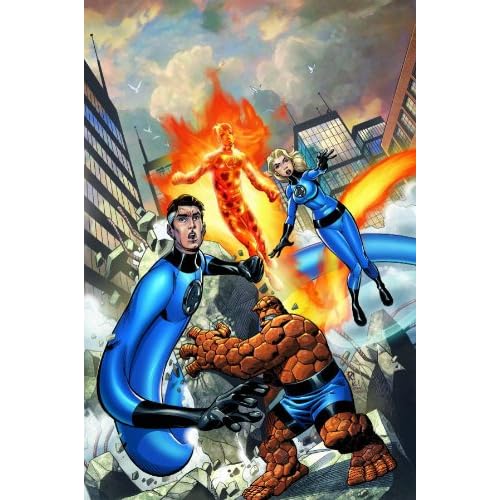 So that’s what writer Mark Waid is up against here. Poor Waid, I would think; but that’s sort of his strong point. He’s steady. Give him a superhero setup, and he’ll give you a half dozen stories on it. Sometimes they’ll be great, like his Captain America and Flash runs. He’ll rarely have a dud run. The worst that will happen is that he’ll play with the company’s toys in a largely humdrum way, then put them back where he found them. And frankly, comics will always need a lot of those guys, even though they’re not in fashion now.
 On the other hand, DeFalco is a little overindulgent of his own work. Lyja’s creation — revealed as a Skrull who had impersonated Alicia Masters and married the Human Torch — is popularly considered a low point of not only the Fantastic Four but comics in general. But DeFalco created her, and here she is. Sharon Venture, the love interest of Ben Grimm (the Thing) when DeFalco wrote the Fantastic Four, is Ben’s ex-wife. Hyperstorm, another flavorless DeFalco creation, is the villain who causes Sue’s retirement in a change in Reed’s status. None of these are great creations; DeFalco used them well, however. Well — the fight between Hyperstorm and Franklin has little of the energy or sense of import that such a battle should have, and the other fights are somewhat below the Fantastic Four’s cosmic level.
  Fantastic Four: Unstable Molecules is not the sort of thing Marvel Comics publishes very often — well, not without a theme month, anyway.