


Spider-Man: The World's Greatest Super Hero
Collects: Peter Parker: Spider-Man #156.1, Sensational Spider-Man #33.1-33.2, and Web of Spider-Man #129.1-129.2 (2012)
Released: November 2012 (Marvel)
Format: 112 pages / color / $14.99 / ISBN: 9780785165729
What is this?: Anniversary cash-in for Spider-Man’s fiftieth anniversary.
The culprits: Writers Roger Stern, Tom DeFalco, and Stuart Moore and artists Roberto de la Torre, Carlo Barberi, and Damion Scott
Is it a shameless cash grab, or is it an inconsequential, harmless story?
That’s the question I ask when I see a prominent hero headlining a limited series or trade paperback that is not part of the hero’s regular series. Is this something I might enjoy, albeit in a continuity-light manner, or is it something designed to sucker in the completists and unobservant?
I don’t think Spider-Man: The World's Greatest Super Hero is a cash grab. The numbering of the issues in the collection — continuing cancelled Spider-series with decimals — suggests Marvel wants people who don’t understand what “anniversary story” means to think of these tales as a continuation, as somehow important. Still, I can’t see anyone falling for that trap. I mean, decimals? That screams desperation.
 The stories in World’s Greatest are helpfully arranged in order of quality, so if you’d like, you can read the first story, then toss the book aside or resell it. (Note the “re” in “resell”; do not sell this book if you have not legally obtained the book through purchase or barter or as a gift. You will likely be disappointed in the results anyway.) The first story, “Old Haunts,” is written by highly regarded former Spider-Man writer Roger Stern. The second, the first of two two-parters, is “Monsters,” written by veteran Spider-Man writer Tom DeFalco. The second two-parter, “The Brooklyn Avengers,” is written by Stuart Moore, who has written a few miscellaneous Spider-stories.
Stern’s story revisits the old Acme Warehouse, which is where Spider-Man confronted the man who killed Uncle Ben. Reporter Norah Winters asks Peter to accompany her while she pokes around the old place; Peter senses something fishy and pushes Norah to give up her questioning before he investigates the place as Spider-Man. The criminals are tied to the Brand Corporation, Spider-Man rescues innocents while punishing those who try to cover up the illegal operation with explosives, Norah learns a lesson; it lacks a bit of heft, but not in a bad way. Spider-Man gets to be a hero, an old Stern-era baddie shows up to remind us about how bad it is, and life goes on. There are many worse ways to mark an anniversary …
And one of those ways is telling a story that has absolutely nothing to do with the anniversary. DeFalco’s “Monsters” is another modern Spider-tale, set in the period before Peter Parker’s fall from grace as a photog and the beginning of his romantic relationship with Carlie Cooper. (“Old Haunts” probably falls into the same time period.) “Monsters” makes no reference to the past, evokes none of Spider-Man’s dominant themes, and is as much a Carlie Cooper story as it is a Spider-Man story. That last is the most damning, given this collection’s goal.
Of the three stories in World’s Greatest, I can most easily see “Monsters” fitting into the regular series; it seems just about perfect for a Web of Spider-Man v. 1 two-parter, although ironically it was published in Sensational #33.1 and 33.2. The story is terribly earnest about human trafficking, which is better than being flip about it, but Carlie seems to be randomly chosen to be the one who cares so much. The title refers to the parallels DeFalco makes between mobster Balik Vorski, a corrupt FBI agent, and the physically mutated Vulture. If Vorski deals in human trafficking, and the FBI agent shields him from the law, then who is the real monster? The answer is all of them, of course.
“The Brooklyn Avengers,” however, is the worst kind of anniversary story: the continuity implant. The Brooklyn Avengers aren’t one of the countless current Avengers teams; they are a group of no-hopers, worse than the Great Lakes Avengers at their worst. The GLA would probably laugh at the Brooklyn Avengers, especially as one Brooklyn Avenger’s power is to generate paintballs. Spider-Man allegedly joined up with the BA early in his career and dropped them after a few missions proved they weren’t at his power or competence level; in “The Brooklyn Avengers,” a couple of members have died, and Spider-Man reunites with them to investigate their old foes.
Unfortunately, the BA don’t rise above one-note jokes, never quite gaining the humanity necessary for me to care whether they live or die. Given the team’s reactions at the end of the story, the survivors aren’t too broken up over the deaths either, even though one member had a sibling die. By the end, like Spider-Man, I don’t wish the Brooklyn Avengers ill. I just want them to go away.
The quality of the art matches the quality of writing. Roberto de la Torre gives “Old Haunts” an atmospheric look vaguely reminiscent of Michael Gaydos or Michael Lark, although de la Torre’s work is not as polished or detailed. Still, it’s exactly what a story about a fight under a warehouse calls for. Carlo Barberi’s work on “Monsters” is pretty to look at, and I like how he draws the new Vulture, but his Peter Parker is a pretty boy who looks nothing like other artists’ Peter, and I’m not sold on his portrayal of characters’ emotions. I’ll admit Damion Scott’s extremely cartoony work for “Brooklyn Avengers” fits the humorous tone Moore was going for, but I don't enjoy looking at it. The characters have cramped torsos and faces and distended limbs; something about the vivid colors and exaggerated proportions puts me in mind of graffiti, but not in a good way.
World’s Greatest is missable. If you read it, you might get a few moments enjoyment. Most likely you’ll forget it almost immediately, as even the best story rises slightly above the sea of mediocre. Save yourself the time: skip it in the first place.
Rating:

 (1.5 of 5)
Labels: 1.5, Carlo Barberi, Damion Scott, Marvel, Roberto de la Torre, Roger Stern, Spider-Man, Stuart Moore, Tom DeFalco
posted by Raoul | 12:11 AM
|
0 comments



 (1.5 of 5)


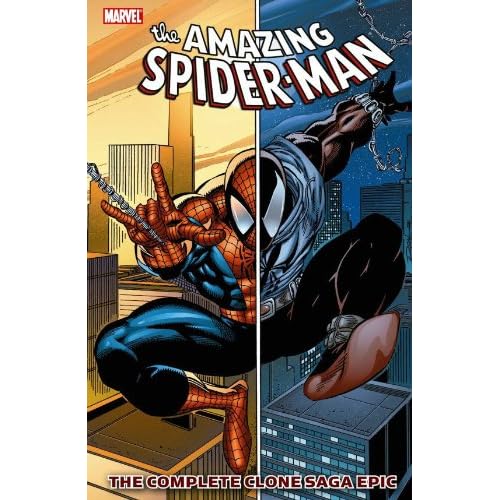 To be fair, the beginning of the Clone Saga was never what was at issue. Marvel has decided to tell the story in the order it takes place in the life of Spider-Man’s clone (Ben Reilly). This is an odd decision but a defensible one; rather than reading the stories as they were originally issued, Marvel is trying to tell a coherent story with the reprint.
 The Lost Years is also the winner in the art department. I’m not a big John Romita, Jr. fan, but his work for the miniseries is excellent — it is, by far, my favorite work of his post-‘80s portfolio. Credit has to be given to inker Klaus Janson and colorist Christie Steele; the pair give Romita’s art a gritty, washed-out look appropriate for a crime story set in a rainy city.
 Marvel has done some very good things here. The ordering of the issues is probably the best choice, as mentioned. The text page setting up the clone’s introductory crossover is much appreciated. The book also includes numerous fragments from many Spider-titles leading up to the initial crossover in which someone is rushing to New York to see May; Marvel wisely didn’t claim the book reprinted the comics the fragments came from. The afterword from J.M. DeMatteis (reprinted from the 1996 TPB of The Lost Years) is more vital than the usual nattering of a writer or artist; this is a disaster in the making, and it’s useful for readers to get a sense of how things started to fall apart.
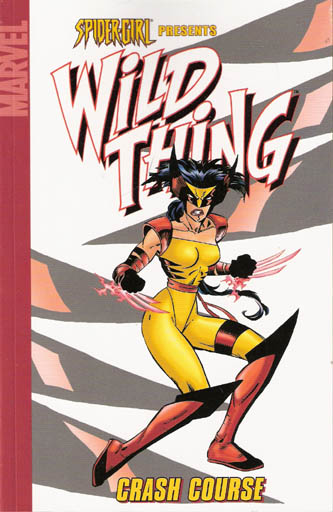 But that’s not what we get here; what we get are Rina’s uninteresting high school experiences, complete with a rich alpha female and a boy she has a crush on but barely notices her. Neither is interesting. I’m unsure what to make of Rina’s home life; both her parents are around, but it’s impossible to tell whether they’re with each other or who lives with Rina. Part of me thinks she lives with her upscale mother, while Logan lives in the woods in a fort made out of empty beer cans with Molson bottles forming the windows. But that’s my imagination; on the other hand, I’ll wager that image is more interesting than anything in Crash Course.
 Finally, May makes a decision about her love life, instead of endlessly vacillating. Mary Jane’s pregnancy finally — finally — ends. May comes closer to making her peace with Kaine, Alison Mongrain, and Felicity Hardy. We finally see Blackie Drago again. In short, the background plots seem like they are moving for once, and that injects some interest into the story. It felt as if writer Tom DeFalco was going to let some of them simmer forever.
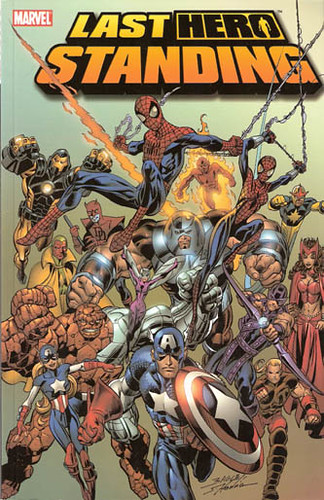 In Hero, superheroes begin disappearing — Wolverine, Spider-Man, the Thing, one of the Ladyhawks — and the other heroes blindly investigate. As more are abducted and the remaining heroes come closer to finding the truth, the missing heroes return as ‘90s version of themselves, albeit without pouches, spikes, or shoulder pads. No, they’re grittier and grimmer, and they are out for the blood of those they loosely define as villains. Meanwhile, the aged Captain America wrestles with failing abilities in an environment in which small failures could lead to death — his or another’s.
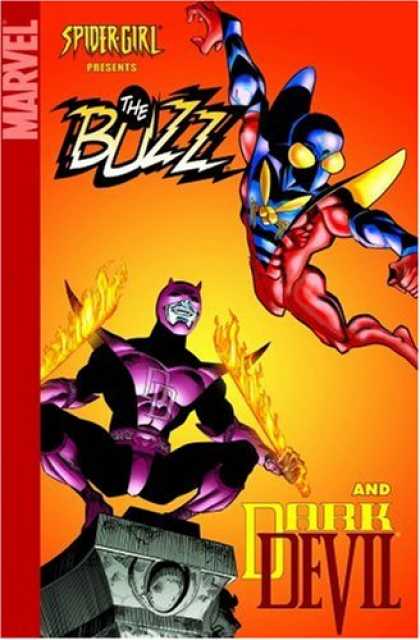 So that leaves the question of whether Buzz and Darkdevil is forgettable or fun, and it’s a split decision. This digest is meant to appeal to hardcore M2-Universe fans, what few there are: the kind of people who have been curious as to what Darkdevil’s deal is. (Until I read this, I never really considered the Buzz to have much of a mysterious backstory.) The usual caveat is M2 stories appeal to those who enjoy old-school comic-book stories, but that’s not really the case here. The Buzz is that sort of story, a fun little bit of fluff full of team ups, mistaken identities, and a classic villain using his only pseudonym. It’s not going to get written up as one of the great stories of the decade, but it is an enjoyable example of the genre; it would fit into the ‘70s / ‘80s Marvel output with no problems.
 And DeFalco’s setting up even more plotlines, with Flash and the Black Cat’s daughter Felicity in Midtown High and their difficulties with their son, Gene. A former Spider-Woman and surprise reveal comes to see Peter about the new Spider-Man. The soap operas at May’s high school are a little tiresome; other than May’s relationships (none at the moment) and the amusing Moose / Courtney pairing (dimwit Moose thinks dumpy Courtney is Spider-Girl), I just don’t care.

 (2.5 of 5)
 On the other hand, DeFalco is a little overindulgent of his own work. Lyja’s creation — revealed as a Skrull who had impersonated Alicia Masters and married the Human Torch — is popularly considered a low point of not only the Fantastic Four but comics in general. But DeFalco created her, and here she is. Sharon Venture, the love interest of Ben Grimm (the Thing) when DeFalco wrote the Fantastic Four, is Ben’s ex-wife. Hyperstorm, another flavorless DeFalco creation, is the villain who causes Sue’s retirement in a change in Reed’s status. None of these are great creations; DeFalco used them well, however. Well — the fight between Hyperstorm and Franklin has little of the energy or sense of import that such a battle should have, and the other fights are somewhat below the Fantastic Four’s cosmic level.
 But DeFalco and penciller / co-plotter Ron Lim have to keep the major players unfettered because the book ends with a major question: what happened to the original Avengers? That’s the strong point of the book, the hints of what happened between the divergent point of the “normal” Marvel Universe and the M2 Universe; wars between Namor and Dr. Doom, Dr. Strange being stripped of his role as the Sorcerer Supreme, how Bruce Banner got the Hulk under control. It’s a lot of intrigue for six issues.

 Spider-Girl is Marvel’s little title that could. Based on an issue of What If? (v. 2), Spider-Girl is the last survivor of a doomed comic line (M2) that focused on characters about a generation later than the current Marvel Universe. This continuity is dominated by the offspring of current heroes, and Spider-Girl is May Parker, daughter of Spider-Man.