Reviews of trade paperbacks of comic books (mostly Marvel), along with a few other semi-relevant comments / reviews.

25 May 2012

Young Allies, v. 1

Collects: Young Allies #1-6, Firestar (v. 2) #1, and the Gravity story from Age of Heroes #2 (2010-1)

Released: February 2011 (Marvel)

Format: 192 pages / color / $24.99 / ISBN: 9780785148685

What is this?: A bunch of young heroes loosely collaborate to battle the Bastards of Evil.

The culprits: Writer Sean McKeever and artists David Baldeón and Emma Rios


I was tempted, given my recent glowing review of Nomad, to give Young Allies a 4-of-5 rating and call it a day. After all, it has the same writer (Sean McKeever), the same artist (David Baldeón), and features one of the same characters (the eponymous Nomad). But unfortunately, Young Allies is not the unqualified success that Nomad was.

Young Allies is not quite a team book; as McKeever points out in his afterword, which serves as an epitaph for the series, the book was supposed to be an ensemble piece. A non-team, if you will. It was a way, according to McKeever, to set this book apart from other books. But ensemble books have to work hard to establish their own character, and in a book with Firestar, Nomad, Araña, Gravity, and a new Toro, there aren’t enough strong characters or interesting interactions to give the book a strong identity. Team-up books and books with rotating casts are hard sells these days without a strong brand identity. Even back when comics sold hundreds of thousands of copies per issue, the Defenders (the original non-team) survived on its strong central characters, endearing yet slightly creepy weirdness, and inertia. Young Allies has none of that. Maybe McKeever could have made it work; I would have liked to have seen him try. But none of these characters gave the series the oomph it needed.

Young Allies coverThe name didn’t help. The heroes aren’t officially ever called the “Young Allies,” but McKeever works hard in #5 to get the name to stick: Captain America compares the youngsters to the Young Allies he knew in World War II, and Nomad mentions founding a Young Allies team on her homeworld. And there is a bit of sense to it; the book does have a Toro and a (former) Bucky, just like the original Young Allies. But then you wonder what the rest of the group has to do with a team name that last had an ongoing series in 1946. Araña, who becomes Spider-Girl by the end of the book, is present because she’s friends with Nomad, but Firestar and Gravity … they have nothing to do with the Young Allies concept or even Toro, Nomad, or Spider-Girl. They’re in their own plotline, and it almost feels like they’re in their own book.

That’s the problem with Young Allies, I think. In Nomad, McKeever showed he had a handle on teenagers and high school, and in Gravity, he did a good job with a newbie college hero. But if Buffy the Vampire Slayer taught us anything, it’s that the problems (and metaphors) of high school aren’t the same as the problems (and metaphors) of college. Nomad and Araña, high schoolers both, feel like the central characters of the book. Certainly Nomad is the pivot the Young Allies name is supposed to turn on. But the problems and feel of this book is more collegiate, more Peter Parker in college than Peter Parker in high school. It doesn’t have that structure, that feeling of constriction that high school has. All the kids have freedom, which would play to Gravity and Firestar’s setup rather than the high schoolers’. But Firestar’s too wrapped up in her own problems of identity and recovering from cancer to add much to the ensemble, and Gravity’s sudden infatuation with Firestar (and his deep-seated desire for heroism) keep him from being very interesting.

I had trouble figuring out Gravity’s status quo at the beginning of the book. I’ve read his previous appearances in his own mini, Beyond!, and Fantastic Four: The New Fantastic Four. Still, I couldn’t figure out why he was in Wisconsin again at the beginning of the story (because McKeever, I suppose) or what his relationship status with Lauren, the girlfriend who meant so much to him in Gravity and Beyond!, was. Nor was I clear about when Araña and Nomad became crimefighting partners, although that was less important. The disappointing thing is that there are summaries of Gravity’s, Nomad’s, and Araña’s histories included in the book; unfortunately, they are at the end, where they aren’t obviously useful. If you want readers to know about the characters they’re going to be reading about, background information needs to be up front. The Firestar one-shot does a good job of setting up her status quo, though — so well the character background at the beginning of the issue is almost redundant. Almost. It’s still appreciated, although issue numbers would have been nice in all of the character summaries.

So, to sum up: McKeever has given us a book with an unclear and not quite compelling hook, with characters who aren’t quite strong enough to support a book. What does he do well, then?

The villains — the Bastards of Evil. Even beyond the name, they stand out. Second-generation supervillains with a different sensibility than their parents, the Bastards are easily the highlights of the book, and I wouldn’t mind seeing these characters (or the concept) brought back in some other seires. The bastards are just as prone to grandiose grandstanding as their forebears, but they are Internet savvy and have daddy issues. The Bastards are teens, and McKeever gives them the casual cruelty of teens — stereotypically so, at times. Their attitude toward technology and the world set them far enough apart from the rest of Marvel’s villains to give them a feeling of uniqueness and makes them a good foil for the Young Allies.

I praised David Baldeón’s work in Nomad, and it’s much the same here. The feel is a little different, though; for some reason, his art works better in a high-school book than with the freedom the characters in Young Allies possess. Perhaps it’s because the similarity of his facial types emphasized the conformity of high school in Nomad. Perhaps it’s because his characters have a restrained sexuality, which works well with high school students but not so well with Emma Frost — or college students, really. (My God — I can’t believe I’m complaining about a lack of cheesecake. This is a very sad day for me.) Still, he’s an excellent artist, able to handle conversation and action easily. I wasn’t blown away by his designs for the Bastards, but since he’s working from their parents’ design, I wasn’t expecting to be. I was disappointed that he contributed none of the covers, which were each in a very different style than his interiors. I really didn’t like Emma Rios’s art for the Firestar one-shot, but that might be my prejudice against manga-influenced art. Or it could be the faces — no matter how strong an artist’s storytelling chops are, looking at weird faces on every page eventually wears away the pleasure centers of my brain. It’s a problem with Frank Quitely for me, and Angelica’s widely set, dead eyes are the problem here.

I want to like Young Allies, but after setting aside the Bastards of Evil, I’m left with a feeling of absence, sensing a lack rather than a presence. Perhaps my expectations were too high. Perhaps the book is missing a heart, something that will take its not unpleasing parts and make them into a satisfying whole. Whatever the reason, though, Young Allies falls short.

Rating: Marvel symbol Marvel symbol (2 of 5)

Labels: , , , , , , , , , , ,

23 April 2012

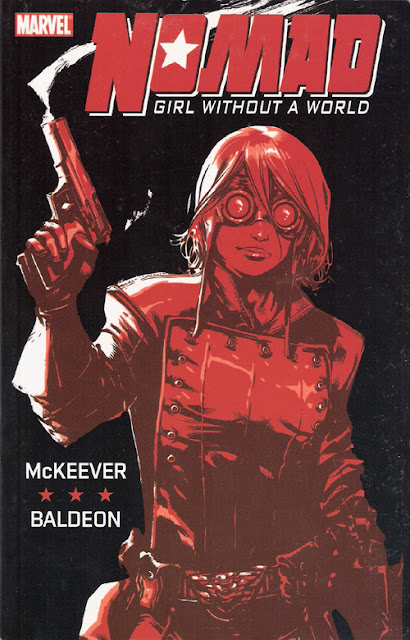
Nomad: Girl without a World

Collects: Nomad #1-4 and a story from Captain America #600 (2009-10)

Released: March 2010 (Marvel)

Format: pages / color / $14.99 / ISBN: 9780785144199

What is this?: Captain America’s sidekick from the Heroes Reborn universe tries to fit into the normal Marvel Universe

The culprits: Writer Sean McKeever and artist David Baldeon


I’ve discussed Marvel’s lack of success with series starring newer characters and the relentless use of the same old concepts by Marvel and DC. Sometimes, however, reusing old ideas can win a deserving new character a series (or miniseries) that otherwise wouldn’t be published.

Take, for instance, Nomad: Girl without a World. “Superhero’s sidekick from a parallel world” is not a concept that sets fans’ hearts afire. It’s a workable idea, but any time you have parallel worlds or alternate universes or possible futures, readers drift away.

Nomad: Girl without a World coverThe character of Bucky (Rikki Barnes) from the Heroes Reborn universe isn’t one fans were clamoring to see more of. But given the popularity of Captain America around the time of the original’s “death,” writer Sean McKeever was given a chance to tell what happens when an alternate version of Captain America’s sidekick tries to fit into an entirely different world, one where “her” Cap has died and been replaced.

Bucky, who becomes Nomad early in Girl without a World, is not a McKeever creation. (You can tell because she has nothing to do with Wisconsin.) Instead, she is a Rob Liefeld and Jeph Loeb character, created for a maligned mid-‘90s event. She is the definition of a throw-away character; no one would have complained if she had never been seen again. But McKeever does the responsible thing and recycles the character here and in Young Allies. And he manages to tell an interesting story, one that is well constructed and enjoyable. I actually cared about Rikki by the end of Nomad. I want to know what happened to her next — although given the quick cancellation of Young Allies, I may be alone in that desire.

McKeever tells a simple story — one I could imagine seeing in Spider-Girl, or given the throwback villains, Nova (v. 1). Something strange is happening in Rikki’s school, as students from different social strata band together to impose their version of order on the school in the name of a school presidential candidate. Rikki investigates and finds far more than she bargained for.

McKeever does a good job isolating Rikki throughout the book. Her only friend in this world is John Barnes, the counterpart of her brother from the Heroes Reborn world. When she reaches out to make friends in the superhero community she is either rebuffed, as Black Widow does when Rikki tries to talk to the new Cap, or she can't seem to capitalize on her meetings with friendlier heroes, like Patriot and Falcon. Like most teenagers, she feels separate from everyone else, and her alternate-world origins give her a better reason than most; when she is separated from John, she feels completely alone. Her mysterious benefactor, who gives her the Nomad costume, and the mental manipulations of Nomad’s villain makes her think the adult world she’s trying to fit into is making all her decisions for her. The conflict between Nomad’s teen world and the adult she finds herself fighting her way into makes a good parallel to the student activism and teen suffrage subplots in the background.

Needles to say, I think McKeever does a great job with teenage heroes, and I think it’s a shame Young Allies was cancelled so quickly.

Nomad is not without its faults, of course. Flagsmasher shows up as a random villain, and even the footnote listing his recent appearances seems to say he’s a bit overused — he’s fought the Runaways, the Liberteens (in Avengers: The Initiative), and Araña. (Issue numbers would have been nice.) I doubt if any of those used Flagsmasher as anything but a throwaway villain; they could have fought anyone. A more serious complaint is that the death at the end of the story feels gratuitous; it’s a death meant to give the story an emotional punch it didn’t need or to get the character of Rikki out of a plot-related bind. Still, these are small complaints.

I enjoyed David Baldeón’s artwork. Really, it’s everything I could ask for from an artist. The teen characters aren’t oversexualized — or sexualized at all, really. Characters are easily distinguishable, despite the similar, almost uniform, facial shape his characters have. Action scenes are dynamic and easy to follow. There’s nothing bizarre to distract the eye or mind from the story. Baldeón’s pencils aren’t flashy, but I love them.

For some reason, Marvel published the Nomad TPB at an odd size. It’s not the standard trade paperback size, and it’s not as small as a digest book. Nomad is similar to those teen titles that Marvel reprinted as digests in the early 21st century (Runaways, Araña, Spider-Girl, etc.), but for some reason, Marvel chose to reprint Nomad at 8¾ x 5¾ inches. Had Marvel abandoned the digest size by the time it published Nomad in March 2010? The last non-Marvel Adventures digest I can find is Thor and the Warriors Four, which was published in October 2010; two Runaways volumes were also published as digests between Nomad’s publication in March 2010 and Warriors Four. So if digests were on their way out, why not choose to print Nomad at full trade paperback size (10 1/8 x 6½ inches)? The smaller size might be cheaper, but it surely ensured Nomad was more easily lost in the shuffle. (Nomad was already out of print by the end of 2011.)

McKeever’s grasp of what it’s like to be a teen is excellent, and the story is simple but satisfying. Baldeón’s art is perfect for the story. It’s a great book, if you can find it.

Rating: 5 of 5 Captain America’s shield Captain America’s shield Captain America’s shield Captain America’s shield Captain America’s shield

Labels: , , , , , , ,

08 March 2011

The Quarter Bin: Nomad: Girl without a World

Trade paperbacks and — God forbid — hardbacks are a big risk; dropping $14.99 to $34.99 on material you’re not sure about can lead to buyer’s remorse and bitter, bitter recriminations. Why didn’t someone warn you that Captain America and the Falcon, v. 1: Two Americas was so bad? A sample would have warned you, but you had to order the whole thing.

Well, I’m not made of money either. So I’m trying out that sampling approach in The Quarter Bin. Recent comics that have lower promotional prices, are Free Comic Book Day giveaways, or I have found in that holy of holies, the Quarter Bin, get a quick review and a recommendation on whether it might be worthwhile to pick up the trade. So, without further ado, we have …

The Issue: Nomad: Girl without a World #1 (November 2009, Marvel)

The Culprits: Written by Sean McKeever, art by David Baldeon

The Hook: Rikki Barnes, Captain America’s sidekick from the Heroes Reborn universe, tries to adjust to high school life on a new planet in Marvel’s New York.

Collected in: Nomad: Girl without a World

Nomad: Girl without a World cover

Strengths: McKeever writes a simple, grounded story of heroics from an unpowered teenage hero with something to prove. The story charmingly starts with high school weirdness, then quickly dives into something much darker. Baldeon’s art is clear, attractive, and without any annoying tics; his Rikki looks like a high-school student instead of a pneumatic acrobat — helpfully played by the Black Widow. Nice cliffhanger.

Weaknesses: Potentially confusing backstory for the title character doesn’t really fit with high-school supervillain drama. The scene with Rikki and the Black Widow doesn’t quite work — the Black Widow’s desire to keep Rikki from the new Captain America feels strange. Rob Liefeld artwork on the title page. Gratuitous ass shot of the Black Widow.

Mitigation: Backstory is kept in the background, for the most part. Could be a payoff for the scene between Black Widow and Rikki later in the series. The Liefeld artwork is for just one page, and it makes Baldeon’s work look even better. Ass shot is only one panel.

Judgment: I’m definitely interested in this one. Make no mistake, Rikki’s background is a problem, but McKeever mentions it as little as possible while making sure readers know he still remembers it. Rikki is more down to earth than other Marvel heroes; she has no powers, only training, and it shows in her adventures, keeping her both a lovable underdog but not incapable of winning a fight. I’m eager to know what’s behind the sinister class elections — I’m betting on a junior varsity Hate Monger, but that’s just a guess. And the cliffhanger, in which it’s hinted Rikki might have an ally, is nice as well.

Hardcover, TPB, or Nothing? There’s no hardcover of this one, so that makes it easy: I’ll have to read the TPB.

Labels: , , , , , ,

24 March 2009

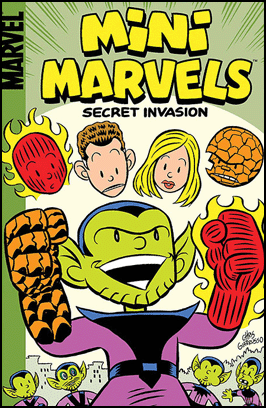
Mini Marvels: Secret Invasion

Collects: Various Mini Marvels strips (2001-9)

Released: February 2009 (Marvel)

Format: 96 pages / color digest / $9.99 / ISBN: 9780785137177

What is this?: More fun with little Spidey and the rest of the Mini Marvels as they take on Civil War, World War Hulk, and other stories.

The culprits: Chris Giarusso with a few other contributing writers

I really enjoyed the first Mini Marvels volume, so when I heard about Mini Marvels: Secret Invasion, I was really excited. As it turns out, my excitement was well placed. Chris Giarrusso, who drew all the stories and wrote most of them as well, has an outstanding touch with the Mini Marvel characters, who are pint-sized versions of Marvel heroes.

Giarrusso is at his best when his Mini Marvels are reliving Marvel history. The first story, “Conspicuous Invasion,” retells Fantastic Four #2 and #18, the team’s first contact with the Skrulls and the debut of the Super Skrull. It’s amazing how much humor Giarrusso manages to squeeze from a relatively straight retelling of Marvel’s stories, with only a few detours for extra jokes. In another writer’s hands, this could come across as mocking Stan Lee’s early whip-quick plotting, but here Lee’s original becomes part of the warped logic of the Mini Marvel world. His stories lampooning the return of Thor and World War Hulk are similarly funny, although they go off the plot more for their laughs.

Mini Marvels: Secret Invasion coverPerhaps the best story in the bunch, however, is “Hawkeye and the Beanstalk,” which crosses the first Galactus story in Fantastic Four #48-50 with “Jack in the Beanstalk,” as Hawkeye tries to get superpowers. Giarrusso has the enthusiastic but not terribly bright Hawkeye blunder through the story, managing to outwit Galactus and the overbearing Iron Man to save the Earth and get cosmic power. (Interestingly, Giarrusso’s Silver Surfer looks a lot like Jeff Smith’s Bone, without the large nose.)

In this volume, other writers get a shot at the Mini Marvels, with Giarrusso providing the distinctive and deceptively simple art. Marc Sumerak writes a Civil War parody, featuring Spidey babysitting Power Pack; Sean McKeever brings in Firestar and Iceman in “Spidey and His Amazing Co-Workers”; Paul Tobin contributes a pair of Hulk / Power Pack stories, introducing the TV show “Dr. Hawkeye, MD” to the Mini Marvels world; and Audrey Loeb has a series of Green / Red / Blue Hulk one pagers. Most of these are a little short of Giarrusso’s work but still funny. Sumerak’s Civil War story, the longest of the non-Giarrusso tales, lags when Spidey is actually babysitting but picks up when it touches on Civil War itself.

It’s the details in Giarrusso’s art that drive the humor home. For instance, in one scene, Hawkeye talks to Quicksilver while Quicksilver does dishes; the background goes from a sink full of dirty dishes to a drainer full of clean dishes to an empty drainer, as Quicksilver completes the task between panels without either character calling attention to the fact. In one of the Hulk stories, the multicolored Hulks play on a stack of luggage; when the luggage is scattered and the suitcases fly open, all you see are torn Hulk pants. Or Ms. Lion the dog from the “Spider-Man and His Amazing Friends” TV show being a level boss in a video game Spidey plays instead of working his paper route with Firestar and Iceman.

This isn’t quite as good as the first Mini Marvels volume, and I still think $9.99, the new price for Marvel digests, is a little high for this slim volume. The book does reprint a few of Giarrusso’s older strips, which is a nice bonus, but it doesn’t make up for the price.

Mini Marvels: Secret Invasion is worth buying — and it’s still worth buying even though Amazon.com doesn’t seem to have it — and I’m looking forward to Giarrusso’s Image digest, G-Man, v. 1: Learning to Fly, as well as his future Mini Marvels work.

Rating: Marvel symbol Marvel symbol Marvel symbol Marvel symbol (4 of 5)

Labels: , , , , , , ,

13 June 2008

Spider-Girl, v. 7: Betrayed

Collects: Spider-Girl #34-8, 51 (2001, 2002)

Released: November 2006 (Marvel)

Format: 144 pages / color digest / $7.99 / ISBN: 9780785121572

Despite the name, there seems to be a singular lack of betrayal in Spider-Girl, v. 6: Betrayed.

Betrayal of any of the protagonists, anyway. Writer Tom DeFalco spends the book amiably advancing plotlines — the second Spider-Man, Spider-Girl’s new power, Normie Osborn’s career plans, Raptor’s rehabilitation, Phil Urich’s aspirations. It makes for a surprisingly low-key volume, especially given the incipient gang war.

Spider-Girl, v. 6: Betrayed coverAnd DeFalco’s setting up even more plotlines, with Flash and the Black Cat’s daughter Felicity in Midtown High and their difficulties with their son, Gene. A former Spider-Woman and surprise reveal comes to see Peter about the new Spider-Man. The soap operas at May’s high school are a little tiresome; other than May’s relationships (none at the moment) and the amusing Moose / Courtney pairing (dimwit Moose thinks dumpy Courtney is Spider-Girl), I just don’t care.

This volume also includes a fill-in issue, #51, by Sean McKeever and Casey Jones, about a freshman with a crush on May. He writes her a mash note just before his family moves away (to Northern Plains — Wisconsin, one supposes, this being written by McKeever). Mostly forgettable, even the fight between Spider-Girl and a female Electro.

And that’s the problem with this volume, in a nutshell. Nothing’s really at stake, there’s a lot of fighting, and I can’t be bothered to care about the villains. Funny Face and Crazy 8 are a little too “wacky” for me, and Mr. Nobody is a little too knowing of the conventions of the genre. Canis is interesting, though, in a Lobo Brothers rip-off sort of way.

Pat Olliffe provides his usual level of art; having to spends so much time on Crazy 8 and Funny Face doesn’t’ do him any favors, although Felicity and Felicia Hardy are impressive (and not in a cheesecake way, either). There is a color separation problem on several pages late in my copy of the book, although it doesn’t interfere with the comprehension.

Unless you’re thrilled by Funny Face, Crazy 8, and more Phil Urich Golden Goblin, the surprise Spider-Woman revelation is about the only outstanding moment in Betrayed.

Rating: Spider-Man symbol Spider-Man symbol Half spider symbol (2.5 of 5)

Labels: , , , , , ,

11 July 2006

Sentinel, v. 3: Past Imperfect

Collects: Sentinel (v. 2) #1-5 (2006)

Released: May 2006 (Marvel)

Sean McKeever gets the chance to finish the loose ends from his Sentinel series in this volume. This is probably the last of the series, which did poorly in sales as individual issues. But it was also part of Marvel’s digest line, which they heavily pushed at bookstores and contained many low-selling series, such as Runaways.

This does, for the most part, exactly what it’s supposed to: finish off Juston’s quest to find his mother. Juston’s search for his mother was the teaser at the end of Sentinel, v. 2: No Hero, a strange ending to a clearly cancelled series. Juston also becomes closer to his father and brother, finishing the transition from bratty teen at the beginning of the story to mature member of the family. He also makes his choices in his personal life, with his “girlfriend” Ashleigh Nichols getting what she deserves. That said, some of those choices seem arbitrary from his perspective, even if the reader knows they are the correct decisions.

Disappointingly, however, Past Imperfect leaves the moral questions about Juston’s use of the Sentinel unanswered. Yes, Juston does heroic acts with the Sentinel and promises to do more, but it doesn’t come to grips with his horribly selfish acts from No Hero. There is a parallel with Past Imperfect’s villains, Sen. Knudsen and Col. Hunt, who used the Sentinel to murder a man and use a newer model to try to destroy Juston and his Sentinel. Yes, their use of the Sentinel is unforgivable, while Juston is merely selfish; they continue to use the technology for evil, while Juston wants to use his for good. But being better than evil isn’t enough, in this situation.

Udon Studios, in the persons of Joe Vriens and Scott Hepburn, provide the art. Stereotypically, their manga-influenced style is perfect for big robots, and as always, they do an excellent job with the big robot. This time they get to draw a Sentinel vs. Sentinel fight and do a pretty good job with it. That’s a majority of the work, in this case, both in the sense that it’s the most important part of the art and seemingly the content of more than half the pages. The other characters are consistent with the previous two volumes; you may quibble with the manga-style designs, such as Jessie’s little hat and all the kids’ hair, but it’s now set as Sentinel’s style.

If you liked the first two volumes of the series, then you’re likely to enjoy Past Imperfect, even if it is flawed at times.

Grade: B-

Labels: , , , , , , ,

08 May 2006

Inhumans, v. 1: Culture Shock

Collects: Inhumans (v. 4) #1-6 (2003)

Released: March 2005 (Marvel)

In Culture Shock, writer Sean McKeever and artist Matthew Clark build on the end of the Jenkins / Lee Inhumans mini-series, which was an Eisner-winning success for Marvel. But while that series focused on the internal politics of the Inhuman royal family as it tried to deal with humans, McKeever and Clark take five young Inhumans, some of whom were in the Jenkins / Lee series, and make them part of a trial cultural integration in America. Only one of the five, Alaris, is pleased to be sent on the mission, and the others are left looking to make sense of this strange mission with a savage, backward culture.

In Attilan, San is the primary viewpoint character, and rightly so. His confusion over why he was sent to deal with humans is piled atop a more personal confusion; his exposure to the Terigen Mists transform him from a strong, handsome young soldier-to-be to a weakened, hideous artist. He no longer knows who he is. His struggles with his new form are understandable and moving. But when the action moves to Earth, San gets lost behind some of the others.

Once the five start living at the University of Wisconsin (McKeever has put references to his native Wisconsin in two other Marvel series, Gravity and Sentinel), Alaris, Jolen, and Nahrees push San out of the foreground. Alaris is big, dumb, and sincerely likes humanity; Jolen hates humans but hides it and wants to rekindle a relationship with Nahrees; and Nahrees … well, she’s hard to get a handle on. She’s meant to be contemptuous of those around her, fellow Inhumans included. But her icy exterior breaks early and often; is it characterization or writing flaw? It could be either, although I lean toward the latter, given that Narhees’s snottiness is her defining characteristic, and to toss it aside so quickly seems a mistake. But this is one of those character issues that can truly only be examined by exploring the rest of the series, which isn’t in this book.

My main complaint with the Culture Shock is that is a bit too wacky for my tastes. The Inhumans aren’t the Japanese or even Latverians; they aren’t even from our planet any more. They have been separated from humanity through millennia of genetic differences and isolation. (In fact, I think Latverians would have worked much better than the obviously inhuman Inhumans.) Alaris is the only wacky personality, yet the plot still seems too Perfect Strangers: all the Inhumans have to work on campus because Alaris is scammed out of his money, the Inhumans live on Frat Row, pot heads ask Jolen if he can truly grow any plant, etc. I expect Alaris to do the Dance of Joy with every page. It’s out of character given San’s identity struggles and Jolen’s dark personality.

Culture Shock is in the digest format, although it is printed on paper that is superior to the other Marvel digests. The art improves from the change, and the book is noticeably thinner. Culture Shock Also differs from the other digests I have read in that it has bonus features: character sketches and McKeever’s story pitch. The latter is useful in pointing at what McKeever was aiming at, although it also shows that he perhaps watches a few too many teen movies.

This volume of the Inhumans — currently the last one — ran only 12 issues, and this is the only reprint of any of those volume. So if you do enjoy this book, well, prepare to hunt down the floppies or wait …

Grade: C+

Labels: , , , ,