Reviews of trade paperbacks of comic books (mostly Marvel), along with a few other semi-relevant comments / reviews.

26 August 2016

Vision, v. 1: Little Worse than a Man

Collects: Vision v. 3 #1-6 (2016)

Released: June 2016 (Marvel)

Format: 136 pages / color / $17.99 / ISBN: 9780785196570

What is this?: Vision creates a synthezoid family in his own image, and while they try to assimilate into suburbia, it all goes wrong immediately.

The culprits: Writer Tom King and artist Gabriel Hernandez Walta


Vision, v. 1: Little Worse than a Man is one of the rare dramatic superhero books that lives up to its hype.

The Vision is a synthezoid, an artificial life form. He tried to have a normal family decades ago with the Scarlet Witch. It did not go well, for various complicated and retconny reasons, but that experience makes the Vision one of the superheroes who is best adapted to domesticity. It’s little wonder, then, that in Little Worse he has decided to create a new family, and rather than wander down the biological road again, he has created a family — wife, teenage daughter and son — in his own synthetic image.

Vision, v. 1: Little Worse than a Man coverWhat follows is a fascinating and complicated look at the Vision and whether it’s possible for someone like him to be normal in any way.

The problems that beset the Visions do not feel contrived. An attack by the Grim Reaper is the inciting event of the breakdown of the Visions’ suburban life; given the Reaper’s hatred of Vision — the Vision’s brains patterns are based on Reaper’s brother, Wonder Man, and Reaper believes Vision to be an impostor — his assault is a logical starting point for any title featuring Vision. The rest of the story follows from there, with the goal of normalcy dropped in favor of being a functional family. Each complication in the story is compelling, leaving the reader waiting for the next calamity to befall the protagonists.

Writer Tom King does an excellent job giving each of the Visions a distinct personality and arc. Well, Vin, the son, doesn’t have much of an arc; he ruminates over equality and his own nature in somewhat awkward but not implausible ways, and I don’t believe the one plot-related decision he makes. But Vision, Virginia, and Viv each have their own separate troubles, despite all their similarities. The Vision thinks the situation he has created is controllable, and despite the difficulties, he can make things right. Virginia, his wife, has made decisions calculated to keep her family safe, but they have all gone wrong. Viv, the daughter, comes closest to fitting in because one person values her differences and isn’t intimidated, not because of anything she does.

Striving for normalcy isn’t unusual, but it’s a self-defeating proposition in this case. The Visions themselves make no attempt to disguise their non-organic nature, nor do they attempt to assimilate; they buy a suburban house, go to suburban schools, and imitate suburban domesticity, but that isn’t enough to gain them acceptance. They stick out like walnuts in banana bread, and they are about as welcome. The house tour Virginia gives the neighbors at the beginning of the first issue shows a house filled with exotic memorabilia from the Vision’s life and career: a stringless Wakandan piano, a flying water vase from the planet Zenn-La, an everbloom plant from Wundagore, a lighter used to read a map before D-Day, a gift from Captain America. Extraordinary furnishings of an extraordinary family.

Gabriel Hernandez Walta makes these fantastic artifacts look quite normal. The piano has no expensive fillips (except perhaps for a lid shaped like a panther); the everbloom is a shaggy evergreen, and the lighter is just a dented lighter. The vase is a floating blob, barely recognizable as a vase. Give that the water vase and everbloom are, in essence, useless, this decision to make them look mundane makes sense. Why would anyone want to own these things?

Everything in Walta’s work is muted, partially because of the restrained color palette used by colorist Jordie Bellaire. The restrained artwork — no superhero excesses for Walta — and the washed-out colors help give the book a feeling of a ‘50s sitcom, which goes along with the nuclear family that the Vision has constructed to live in his oversized suburban house. Walta draws Vision’s perfect suburban world — perfect house, perfect teenage kids, and a perfect Martha Stewart housewife, complete with an apron — with little embellishment. Walta and Bellaire’s work cast a pall over the book; it’s not hard to believe that the people in this ostensibly perfect world are all trapped and depressed, and escape is the only way to be happy again. Despite the synthezoids’ blank eyes and robotic features, their emotions — sadness, isolation, confusion — are plain to see, and that’s to Walta’s credit.

Should the Vision and his family try to fit in more? That’s not a question Little Worse tries to answer, unless that answer is found in the racism that surrounds the Visions. Many of their neighbors are uneasy about them because they are different; some of them couch this in a fear that the Visions are “dangerous.” The temptation to make a parallel between white-bread communities fearing “dangerous,” darker-skinned newcomers is obvious, but the locals have a point: the Visions are dangerous, in their way. Still, the community is primed to be fearful of the Visions, or at least to not accept them. A pair of local kids, for instance, spraypaint robot slurs on the Visions’ garage, even though they have to research which obscure slur to use. The local high school’s previous nickname, “Redskins,” operates in two different ways: the word is an insult toward Native Americans, yes, but it also foreshadows the locals having trouble seeing the Visions (who have red “skin”) as humans. Changing the school’s nickname to Patriots doesn’t change perception immediately.

On the other hand, Vision uses his superhero privilege to escape trouble when dealing with authority figures. He tells the principal at his children’s school and a police detective that he has saved the world “37 times,” and when he’s being interviewed by the detective, the specific events are enumerated between panels. (Several are labeled “Ultron — again,” which made me laugh.) The two events feel different; with the principal, Vision is using his heroism to gain equal treatment for himself and his family, but with the detective, he uses it to assert his superiority — somewhere between “I shouldn’t have to answer your questions” to “My life of service should mean you believe me.”

King uses the final issue to discuss the central theme of the book: Can the Vision, a being ruled by logical, programmed responses to the world, create a family and be happy / normal in a human, illogical world? The narration frames this in terms of a computer programming concept, P vs. NP. P is all the problems a computer can solve in a reasonable amount of time, the problems that can be solved with an algorithm or shortcut or program. NP is all the problems that cannot be solved that way. Is the Vision’s quest P or NP? King asks. (He also answers it.) What happens if the Vision decides it’s NP?

It’s an interesting question, although it would have had more of an impact had it been made earlier in the book and not have been fairly convincingly answered. (This is more of a criticism of the trade paperback form; from King’s view, the question is asked halfway through the series.) On the other hand, King also identifies the narrator, who is explaining and answering the P vs. NP question, and it’s possible that we shouldn’t believe the cat-murdering old woman. Despite the omniscient tone of her narration, she doesn’t know everything, but I’m not sure whether King is trying to add a bit of ambiguity to the story. If not, I think making the narrator a character in the story is a bit of a mistake, but I’ll find out only by reading Vision, v. 2: Little Better than a Beast.

And I’m definitely going to do that. I recommend it — and this volume — to readers. It’s one of the rare lessons that despite the huge canvas that superhero comics gives creators, it’s often the smaller stories, the ones with lower but more personal stakes, that are the most satisfying.

Rating: Avengers symbol Avengers symbol Avengers symbol Avengers symbol Avengers symbol (5 of 5)

Labels: , , , , , , , , , ,

14 May 2016

Giant Days, v. 1

Collects: Giant Days #1-4 (2015)

Released: November 2015 (Boom! Box)

Format: 128 pages / color / $9.99 / ISBN: 9781608867899

What is this?: Esther, Susan, and Daisy deal with their first semester of college, and all its attendant problems: boys, the flu, boys, idiot university administrators, idiot boys, and girls.

The culprits: Written by John Allison and drawn by Lissa Treiman


I’ve followed John Allison’s web comics since the beginning of the century: through most of Bobbins, all of Scary Go Round, and everything to date of Bad Machinery. (Allison admits the weight of the comics he’s put out over 18 years is a bit daunting, so he wrote out a chronology / background of his universe of strips.) I’m a big fan of his strips, which have evolved away from strict joke-a-day comics and into more structured, long-term storylines that manage to combine humor, drama, and well-drawn characters. I can’t think of a webcomic writer I’ve followed as long as Allison.

I’m not trying to present myself as an uber-fan of Allison’s, although I admit to buying t-shirts and dish towels from Allison’s Topatco store, if that tells you something. I’m admitting all this to state my biases before I say Giant Days, v. 1, by Allison and Lissa Treiman is one of the best trade paperbacks I’ve read in ages. It is consistently funny, occasionally touching, and always entertaining.

Giant Days, v. 1 coverIt’s not necessary to have read any of Allison’s work to understand what’s going on in Giant Days. Allison introduces the reader quickly and efficiently to Esther de Groot, Susan Ptolemy, and Daisy Wooten, who have met as freshmen at a British university and have become fast friends. (Their earlier adventures, mentioned on page 2 of issue #1, were released as webcomics on Allison’s site, but they seem to have disappeared online. You can buy them at Allison’s Topatco store, though.) Daisy is home-schooled and naïve, quite fond of her grandmother; Susan is pre-med and determinedly practical. Esther, a featured character in Scary Go Round, is a pale Goth surrounded by a drama field.

I love all the characters in Giant Days. Do I like them so much because I’ve read them before? I dunno. Other than Esther, though, I haven’t read many stories featuring htem. I identify with the mousy Daisy and logical Susan; I can’t help being entranced by the spectacle that is Dark Esther, even if I’m still miffed she cheated on The Boy between Scary Go Round and Giant Days. I sympathize with McGraw, a former friend of Susan’s who rejected her romantic advances. I kinda sympathize with Ed Gemmell, who pines for Esther, but Esther is so out of Ed’s league his head would probably explode if she ever paid him the kind of attention he desires. (That’s not a slight on Ed; remember, Esther has that drama field around her.)

For those who have read Scary Go Round, Giant Days is much more grounded. SGR had plotlines that included bringing a cast member back from the dead, first as a zombie, then fully resurrected as a normal human; that cast member’s sister was transformed into a six-foot Amazon by spoiled off-brand Pepto-Bismol, then ensnared with a magic spell by a villainous headmaster and sent to hell by a different spell that wiped them both from everyone’s memory. Giant Days is a straightforward story of college life, although the stories are exaggerated in the way that all comedies are.

The biggest difference from Allison’s online work is that he isn’t providing the art. Instead, Treiman draws Allison’s creations, and the result is weird — an outstanding weird, but weird nonetheless. Treiman is a great artist, with a beautiful, fluid style and a great comic touch. Her art is vastly different than Allison’s, taking Allison’s character designs, then making the cast her own. She also has a great sense of when to exaggerate features and reactions, always going far enough but never so far that the characters seem to belong in a cartoon.

Allison’s work as a daily comic strip writer shows here. His later two webcomics have had long arcs while maintaining a steady stream of humor, and he adapts that approach to individual comic issues. Each issue is a complete story, with enough loose ends and character work to lead into the next issue, but Allison always remembers to be funny. The jokes are earned, never cheap jokes put into the mouth of a character who wouldn’t say it.

My only complaint is the ending of #3. Even by Giant Days’ / Allison-verse’s logic, I don’t think maternal displeasure has much effect on the kind of bros who objectify women. I admit, the bros’ comeuppance is welcome, but any sort of retribution they receive would be pleasing. Vengeance the protagonists participated in would have been even more satisfying.

My recommendation is to read / buy / steal / demand Giant Days. I feel remiss that I haven’t recommended it earlier, but, well — I blame my retailer, and he probably blames Diamond. I ordered it in January, and after four months of not getting the book, I took matters into my own hands and bought it from Amazon. Don’t make the same mistake I did. Go get Giant Days now.

Rating: Giant Days symbol Giant Days symbol Giant Days symbol Giant Days symbol Giant Days symbol (5 of 5)

Labels: , , , , , , , , , ,

04 January 2013

Daytripper

Collects: Daytripper #1-10 (2010)

Released: February 2011 (DC / Vertigo)

Format: 256 pages / color / $19.99 / ISBN:

What is this?: A Brazilian man faces the pivotal days of his life — and dies every time.

The culprits: Fábio Moon and Gabriel Bá


I do not often read comics like Daytripper — that is, comics that aren’t superhero-based or heavily based on some sci-fi / fantasy concept. If I were a more reflective man, Daytripper’s status as the best trade paperback I read in 2012 might cause me to re-examine my reading choices. (It won’t, though.)

Still, Fábio Moon and Gabriel Bá’s Vertigo book is the most engrossing comic I’ve read in years. Daytripper chronicles the life of obituary writer Brás de Olivias Dominguez as he struggles to become a novelist, like his famous father. Moon and Bá show one important event in Brás’s life per issue; at the end of each, Brás dies.

Daytripper coverAnd in the next issue, it’s another day, either in Brás’s future or past, and he lives again.

Each death gives Bá and Moon a chance to show how Brás’s life would have been perceived had he died at that moment, through the medium of an obituary. Success, failure, artist, pretender — all those labels depend on flukes, accidents of time and place. Each story examines life and death with charming narration of surprising depth, and Brás’s deaths are never mined for cheap pathos or laughs. Despite the constant presence of death and the evaluation of a life, Daytripper isn’t depressing; in the end, the book is uplifting, hopeful.

Part of the reason Daytripper isn’t just a maundering journey through one man’s frequently interrupted life is the ending, a surprisingly sweet one. But a larger part of the reason is that Brás is always moving forward. Each issue features a pivotal moment for Brás, and when he hits that pivot, he’s always moving, never frozen by fear or lack of desire. Brás is easy to like because of his hope and desires; he may not be an unstoppable force or mighty hero, but he’s not a modern protagonists filled with angst and ambivalence, like one of novelist Charles Yu’s characters.

I don’t know who did the art; the book gives no specific credits to either Moon or Bá. Whoever held the pencils and pens, the art is wonderful — evocative, as capable of telling the story as the words (sometimes, more so). The characters’ expressions are detailed and subtle. The style is representative without being slavishly literal. The color palette is well chosen for each issue. Although I don’t necessarily want to read more comics in this literary vein, I need to seek out more of this art … although even this art won’t aid stories it isn’t suited for or I don’t care for (such as Casanova).

I can’t fully express how much I liked this book. The simplicity of its concept, explored through an almost lyrical pairing of art and words, make Daytripper an outstanding comic. I’m disappointed it took me two years to find Daytripper, even though I knew about the title from a review of #1 on House to Astonish. However, I’m happy I have read it.

Rating: Vertigo symbol Vertigo symbol Vertigo symbol Vertigo symbol Vertigo symbol (5 of 5)

Labels: , , , , , ,

23 April 2012

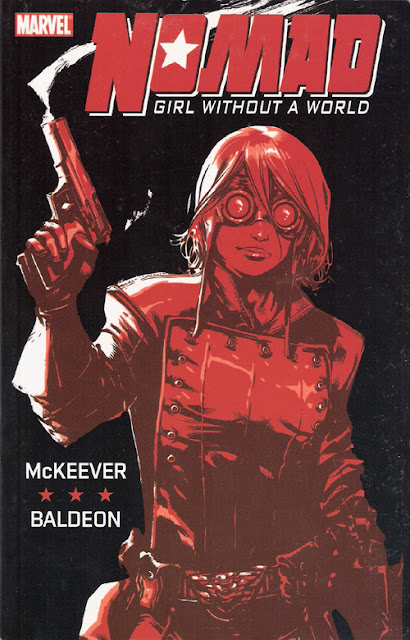
Nomad: Girl without a World

Collects: Nomad #1-4 and a story from Captain America #600 (2009-10)

Released: March 2010 (Marvel)

Format: pages / color / $14.99 / ISBN: 9780785144199

What is this?: Captain America’s sidekick from the Heroes Reborn universe tries to fit into the normal Marvel Universe

The culprits: Writer Sean McKeever and artist David Baldeon


I’ve discussed Marvel’s lack of success with series starring newer characters and the relentless use of the same old concepts by Marvel and DC. Sometimes, however, reusing old ideas can win a deserving new character a series (or miniseries) that otherwise wouldn’t be published.

Take, for instance, Nomad: Girl without a World. “Superhero’s sidekick from a parallel world” is not a concept that sets fans’ hearts afire. It’s a workable idea, but any time you have parallel worlds or alternate universes or possible futures, readers drift away.

Nomad: Girl without a World coverThe character of Bucky (Rikki Barnes) from the Heroes Reborn universe isn’t one fans were clamoring to see more of. But given the popularity of Captain America around the time of the original’s “death,” writer Sean McKeever was given a chance to tell what happens when an alternate version of Captain America’s sidekick tries to fit into an entirely different world, one where “her” Cap has died and been replaced.

Bucky, who becomes Nomad early in Girl without a World, is not a McKeever creation. (You can tell because she has nothing to do with Wisconsin.) Instead, she is a Rob Liefeld and Jeph Loeb character, created for a maligned mid-‘90s event. She is the definition of a throw-away character; no one would have complained if she had never been seen again. But McKeever does the responsible thing and recycles the character here and in Young Allies. And he manages to tell an interesting story, one that is well constructed and enjoyable. I actually cared about Rikki by the end of Nomad. I want to know what happened to her next — although given the quick cancellation of Young Allies, I may be alone in that desire.

McKeever tells a simple story — one I could imagine seeing in Spider-Girl, or given the throwback villains, Nova (v. 1). Something strange is happening in Rikki’s school, as students from different social strata band together to impose their version of order on the school in the name of a school presidential candidate. Rikki investigates and finds far more than she bargained for.

McKeever does a good job isolating Rikki throughout the book. Her only friend in this world is John Barnes, the counterpart of her brother from the Heroes Reborn world. When she reaches out to make friends in the superhero community she is either rebuffed, as Black Widow does when Rikki tries to talk to the new Cap, or she can't seem to capitalize on her meetings with friendlier heroes, like Patriot and Falcon. Like most teenagers, she feels separate from everyone else, and her alternate-world origins give her a better reason than most; when she is separated from John, she feels completely alone. Her mysterious benefactor, who gives her the Nomad costume, and the mental manipulations of Nomad’s villain makes her think the adult world she’s trying to fit into is making all her decisions for her. The conflict between Nomad’s teen world and the adult she finds herself fighting her way into makes a good parallel to the student activism and teen suffrage subplots in the background.

Needles to say, I think McKeever does a great job with teenage heroes, and I think it’s a shame Young Allies was cancelled so quickly.

Nomad is not without its faults, of course. Flagsmasher shows up as a random villain, and even the footnote listing his recent appearances seems to say he’s a bit overused — he’s fought the Runaways, the Liberteens (in Avengers: The Initiative), and Araña. (Issue numbers would have been nice.) I doubt if any of those used Flagsmasher as anything but a throwaway villain; they could have fought anyone. A more serious complaint is that the death at the end of the story feels gratuitous; it’s a death meant to give the story an emotional punch it didn’t need or to get the character of Rikki out of a plot-related bind. Still, these are small complaints.

I enjoyed David Baldeón’s artwork. Really, it’s everything I could ask for from an artist. The teen characters aren’t oversexualized — or sexualized at all, really. Characters are easily distinguishable, despite the similar, almost uniform, facial shape his characters have. Action scenes are dynamic and easy to follow. There’s nothing bizarre to distract the eye or mind from the story. Baldeón’s pencils aren’t flashy, but I love them.

For some reason, Marvel published the Nomad TPB at an odd size. It’s not the standard trade paperback size, and it’s not as small as a digest book. Nomad is similar to those teen titles that Marvel reprinted as digests in the early 21st century (Runaways, Araña, Spider-Girl, etc.), but for some reason, Marvel chose to reprint Nomad at 8¾ x 5¾ inches. Had Marvel abandoned the digest size by the time it published Nomad in March 2010? The last non-Marvel Adventures digest I can find is Thor and the Warriors Four, which was published in October 2010; two Runaways volumes were also published as digests between Nomad’s publication in March 2010 and Warriors Four. So if digests were on their way out, why not choose to print Nomad at full trade paperback size (10 1/8 x 6½ inches)? The smaller size might be cheaper, but it surely ensured Nomad was more easily lost in the shuffle. (Nomad was already out of print by the end of 2011.)

McKeever’s grasp of what it’s like to be a teen is excellent, and the story is simple but satisfying. Baldeón’s art is perfect for the story. It’s a great book, if you can find it.

Rating: 5 of 5 Captain America’s shield Captain America’s shield Captain America’s shield Captain America’s shield Captain America’s shield

Labels: , , , , , , ,

10 April 2009

Maus: A Survivor's Tale, v. 1: My Father Bleeds History

Collects: Maus stories from Raw #1-8 (1980-6)

Released: August 1986 (Pantheon)

Format: 160 pages / black and white / $14.95 / ISBN: 9780394747231

What is this?: Art Spiegelman uses not-so-funny funny animals to tell the story of his father, a Jew in Nazi-occupied Poland.

Along with The Dark Knight Returns and Watchmen, Maus is one of the three pillars of the “greatest comic-book story” argument, the one comic book fans trot out to meet the argument that all comic books are are superhero stories. It is a story of the Holocaust and one family’s struggle to stay alive. In 1992, Maus won a special Pulitzer; it and author Art Spiegelman have drawn very high praise from Alan Moore. There is no doubting Maus is a formidable work.

Maus: A Survivor’s Tale, v. 1: My Father Bleeds History coverSo then: Maus I: A Survivor’s Tale: My Father Bleeds History is the first of two volumes of Maus. Spiegelman weaves two threads together: his father’s retelling of his family’s life in Poland in the late ‘30s / early ‘40s and Speigelman’s relationship to his father. The Spiegelmans’ story is a thoroughly crushing one; anyone who knows any history knows that no matter how bad Vladek and Anja Spiegelman have it, it will get worse. (Even if you don’t know history, the title of v. 2, And Here My Troubles Began, will give you a hint.) No hope is offered; the story is told in the voice of Vladek, Spiegelman’s father, a pessimistic old Jew who knows the depths his story will sink to even better than we do. Vladek doesn’t seem to understand or value the heroism he exhibits to keep himself and his wife alive. The reader must watch Vladek sell more and more possessions, take more and more chances, watch friends and family get captured and sent away, until the inevitable happens.

To break up this long march into atrocity, Spiegelman includes interludes with his adult self and his father. Their conflict begins as seemingly the standard generational struggle, amplified by the hardships Vladek endured, while Spiegelman has grown up in a relatively stable and secure environment. But as the story goes on, there is more; the reader begins to suspect there is something beyond Vladek’s stereotypical kvetching, parsimonious Jewish exterior, and Spiegelman reveals some of his true difficulties with his father. It is completely different type of story than Vladek’s Holocaust memoir, but since the Holocaust helped form Vladek’s relationship with his son, the two stories dovetail well.

All the characters, past and present, are depicted as anthropomorphic animals, with each race being a different species — Jews are mice, Germans are cats, and Poles are pigs (although cartoony pigs, not dirty farmyard swine). Spiegelman made this decision because the Germans referred to the Jews as “vermin” and the Poles as “swine”; the art shows the absurdity of the claim. When Vladek or another Jew attempts to pass himself off as a Pole, Spiegelman ties a simple pig mask around their face. The artifice is simple yet effective. The story is so human that the reader quickly forgets it is being told through animals; the symbol of the animals is understood while the inner humanity is remembered.

As I read v. 1, I always felt as if I were missing something. My mind kept going between two extremes: Maus is an absorbing tale told well, but haven’t I seen this somewhere before? It made me doubt my own maturity, and in the end, I felt Spiegelman’s style had thrown me. Whereas complexity and richness have made Watchmen one of the greatest comic-book stories, Maus excels with a story that is spare and bleak. There is no color — an artistic as well as a financial concern, certainly. Seeing simplicity, I searched for complexity in the wrong places: the story, the characters of Vladek and Anja. That’s not where the richness and reward are; they’re in the style, the artifice, and the fact that the story was told at all.

Rating: (5 of 5)

Labels: , , , , ,

19 September 2008

Watchmen

Collects: Watchmen #1-12 (1985-6)

Released: September 1987 (DC)

Format: 416 pages / color / $19.99 / ISBN: 978-0930289232

Much more than Zot!, Watchmen is critically bulletproof. Its greatness as a work of comic art is relatively uncontested, even in the contentious world of online comic fandom. It is one of the three titles frequently nominated for the position of greatest comic story ever told (The Dark Knight Returns and Maus being the other two).

I don’t know if Watchmen is the best; I haven’t read Maus or dozens of other stories that might qualify. I know it isn’t my favorite comic story of all time. But I can’t think of a comic that’s better.

Watchmen coverWatchmen, for those of you who haven’t read it, is set in a world with real costumed heroes. However, most of the costumed heroes, masked vigilantes who lack superpowers, are outlawed; only the ultraviolent Comedian and the detached Doctor Manhattan, who work for the government, are allowed to operate legally. The story begins with the death of the Comedian. Rorschach, a right-wing, unbalanced vigilante who ignores the ban, thinks the Comedian’s death is part of a conspiracy to kill heroes. The other former heroes generally disagree, but Rorschach continues his investigation.

This synopsis does not do Watchmen justice, of course. Writer Alan Moore created a deeply detailed alternate 1985. Electric cars and non-polluting airships are the norm. Doctor Manhattan — who has vast reality manipulation powers and is the only person to have an actual superpower — has given America a vast strategic advantage on the world stage, since the Soviets have no counter for an actual superman. America won the Vietnam War when Manhattan took a hand in the fighting, and Nixon’s still president. Pirate stories dominate comic books, since real costumed heroes made people less likely to find superheroes escapist. Still, most people seem as miserable as they are in our world, despite that world’s advantages.

Much has been said about Alan Moore’s genius, and it’s on full display here. Moore not only invents a fully realized world, he creates characters with more depth and emotions than most comic-book writers could instill in five years of writing. To me, that’s the real strength of Watchmen — not the plotting, not the conspiracy story (although I like conspiracy stories, and this is an excellent one), and not the art (although Dave Gibbons does a great job). Rorschach is crazy, violent, morally uncompromising, and a thoroughly unpleasant person, but Moore makes him exciting and interesting despite all this. So exciting and interesting that he and his laser-focused world viewpoint are many readers’ favorite part of the book. But there’s also the violent cynicism of the Comedian, a brute who nevertheless has deep insight into humanity’s failings and steals most of the scenes he’s in — despite being dead before Watchmen begins. Doctor Manhattan’s amoral reserve flows logically from the detached, easily manipulated watchmaker-cum-physicist he was before he became a superhero. And the villain … I’m not sure there’s another master planner in comics that I hate so much. Even minor characters, such as the psychologist who treats Rorschach and a newsvendor, also have indelible personalities.

Most writers would give their eyeteeth to have created a Rorschach or Comedian; Moore created both, out of whole cloth, then let the world of Watchmen go. There were no spinoffs, no TV series, no Watchmen Babies15 — and that has made the story strong. There is nothing to water it down, unlike The Dark Knight Returns or any of the longstanding major comic-book characters’ stories. The characters and the world of Watchmen exist only in twelve issues, one trade paperback. And that’s it. Completeness, which is something we never get … ironically, it’s also the point of Doctor Manhattan’s final comment to former vigilante Ozymandius.

There’s also a lightness of touch, avoiding the black-and-white viewpoint common to comics. The villain’s evil deeds at times seem almost secondary in importance to the extreme moral bind he puts the heroes in. Moore has little sympathy, I believe, for Rorschach and his right-wing conspiracies (and his absolutisms), but he and his fellow extreme conservative the Comedian find and understand more of the truth than anyone else. Ozymandius, whose politics are probably much closer to Moore’s own, is blithely unconcerned with the conspiracy’s underpinnings. The ending is steeped in moral compromise. No one is a complete hero; the world won’t allow it.

Moore and Gibbons work together well, almost seamlessly at times. Between them, they cram details into panels that would make modern artists blanch. Despite working in smaller panels than most of today’s artists, Gibbons doesn’t flinch at detail, at expressions, at backgrounds. There’s a wealth of detail in almost every panel. That isn’t a luxury, however: Moore’s writing seems to demand it, rather than being background jokes as Gene Ha16 provides in his collaboration with Moore, Top 10.

I praised the characters, but what really elevates Watchmen to the status of high art rather than just an outstanding story are the themes. They repeat throughout the story, amplify, touch or transfer to other characters. Rorschach’s blots, the radioactivity symbol, clockwork — they appear in unexpected places, surprising the reader with their connections. Moore makes apt allusions to everything from the Bible to classical literature to Bob Dylan. It is Moore at the height of his powers, with an artist capable of keeping up with him.

The only real complaint I have are the garish colors; Watchmen is filled with oranges, greens, and purples. At times, it’s putrescent and hard to read. I understand why, I think: this is a world that is sick but doesn’t and can’t acknowledge it, even as the decay is working its way to the surface. Also, surrounding heroes of the night with ugly, eye-catching colors instead of the blackness they prefer is a perfect symbol of the garishness of costumed heroism — it attracts attention rather than efficiently blending into the shadows.

But that’s a minor grievance; others have put more vitriol and thought into the matter. Some complain about the pirate story read at the newsstand by a young man, which Moore intercuts frequently with the main story. I think it’s woven into the story brilliantly, its themes (if not its images) fitting into the main story like a key in a lock. Also, the story is, itself, brilliant. Others find the text pieces at the end of each issue distracting, but they fill in the corners of the Watchmen universe, particularly excerpts from Under the Hood, a tell-all biography from one of the first generation of heroes.

Others complain about not believing the ending, that the grand conspiracy would not accomplish its goal. That’s OK; Moore doesn’t think that state will last long, and it’s possible nothing is resolved in the end.

It is, admittedly, old fashioned. It was written in the year it was set, 1985, and it reflects many of the tropes and ideas comics had accumulated up to that point. There are few, if any, splash pages, and Gibbons lays out pages in 3x3 grids. Occasionally, a panel will fill an entire row or column, but 3x3 rules the day. The roles and some of the designs of the heroes are based on characters from the Golden or Silver Age; famously, Rorschach was based on Steve Ditko creations the Question and Mr. A, while Nite Owl was influenced by Blue Beetle and Batman. The heroes themselves fill archetypes: genius, detective, polymath genius, alien, token girl.

Moore’s goals for Watchmen seem to be to take elements of past — to revel in those elements — and forge something new, something that hadn’t been seen before, something to build on for the future. In the story, this is seen in Ozymandius deciding to end his successful line of Nostalgia perfume and replace it with Millenium, followed by a forward-looking advertising campaign. Like Ozymandius, Moore tried to close out the old, successful model and introduce a new model, and even if few followed his lead, he succeeded beyond anyone’s wildest dreams.

Well, maybe not his own.

Rating: Watchmen smiley face Watchmen smiley face Watchmen smiley face Watchmen smiley face Watchmen smiley face (5 of 5)

Labels: , , , , ,

26 March 2008

Runaways, v. 6: Parental Guidance

Collects: Runaways v. 2 #13-18 (2006)

Released: October 2006 (Marvel)

Format: 144-page digest / color / $7.99 / ISBN: 0785119523

I always look forward to the next volume of Runaways, and Runaways, v. 6: Parental Guidance gives me no reason to change that.

Writer Brian K. Vaughan has created and sustained a teen drama mixed with superheroics that doesn’t disappoint. In Parental Guidance, Vaughan wraps up the “new Pride” storyline he began in Runways, v. 4: True Believers. Everything comes together as the team falls apart,1 picking up all the bits and pieces from True Believers and Runaways, v. 5: Escape to New York and wedding them into a moving finale.

Runaways, v. 6: Parental Guidance cover In the first story, Molly gets a chance to shine as she’s thrown into a group of pre-teen runaways and immediately has to become their leader in a rebellion against the Proctor, the Fagin-like adult controlling them. Molly, shown at her most mature, immediately after reveals her childhood vulnerabilities. It’s not unmissable, but it is entertaining with an ending that is moving without being precious.

The rest of the book reveals the mystery of the new Pride, which is out to take vengeance on the Runaways. The new Pride is more clever than powerful, but they still manage to be more than a match for the heroes. The Runaways’ problems come almost as much from themselves as the New Pride,2 with the new Pride exploiting their adversaries weaknesses. Vaughan doesn’t sacrifice characterization for the sake of plot or a joke — although it helps that his characters are meant to be witty and clever with the blind spots of teenagers.

Artist Adrian Alphona does an excellent job as always; it’s an indictment of the comics industry as much as a compliment to Alphona to say he can consistently draw women with body types somewhere between “anorexic” and “orca.” He can also go from relatively realistic to the fantastic world of the Gibborim, the giant angels who backed the first Pride, with ease. Unfortunately, the digest size has consistently muddied his artwork — any darkness seems to come out as too dark, obscuring the subtleties of Alphona’s work.

All this, plus an emotional ending I won’t spoil — this is about as good as it gets.

Rating: (5 of 5)

Labels: , , , , ,