Reviews of trade paperbacks of comic books (mostly Marvel), along with a few other semi-relevant comments / reviews.

26 August 2016

Vision, v. 1: Little Worse than a Man

Collects: Vision v. 3 #1-6 (2016)

Released: June 2016 (Marvel)

Format: 136 pages / color / $17.99 / ISBN: 9780785196570

What is this?: Vision creates a synthezoid family in his own image, and while they try to assimilate into suburbia, it all goes wrong immediately.

The culprits: Writer Tom King and artist Gabriel Hernandez Walta


Vision, v. 1: Little Worse than a Man is one of the rare dramatic superhero books that lives up to its hype.

The Vision is a synthezoid, an artificial life form. He tried to have a normal family decades ago with the Scarlet Witch. It did not go well, for various complicated and retconny reasons, but that experience makes the Vision one of the superheroes who is best adapted to domesticity. It’s little wonder, then, that in Little Worse he has decided to create a new family, and rather than wander down the biological road again, he has created a family — wife, teenage daughter and son — in his own synthetic image.

Vision, v. 1: Little Worse than a Man coverWhat follows is a fascinating and complicated look at the Vision and whether it’s possible for someone like him to be normal in any way.

The problems that beset the Visions do not feel contrived. An attack by the Grim Reaper is the inciting event of the breakdown of the Visions’ suburban life; given the Reaper’s hatred of Vision — the Vision’s brains patterns are based on Reaper’s brother, Wonder Man, and Reaper believes Vision to be an impostor — his assault is a logical starting point for any title featuring Vision. The rest of the story follows from there, with the goal of normalcy dropped in favor of being a functional family. Each complication in the story is compelling, leaving the reader waiting for the next calamity to befall the protagonists.

Writer Tom King does an excellent job giving each of the Visions a distinct personality and arc. Well, Vin, the son, doesn’t have much of an arc; he ruminates over equality and his own nature in somewhat awkward but not implausible ways, and I don’t believe the one plot-related decision he makes. But Vision, Virginia, and Viv each have their own separate troubles, despite all their similarities. The Vision thinks the situation he has created is controllable, and despite the difficulties, he can make things right. Virginia, his wife, has made decisions calculated to keep her family safe, but they have all gone wrong. Viv, the daughter, comes closest to fitting in because one person values her differences and isn’t intimidated, not because of anything she does.

Striving for normalcy isn’t unusual, but it’s a self-defeating proposition in this case. The Visions themselves make no attempt to disguise their non-organic nature, nor do they attempt to assimilate; they buy a suburban house, go to suburban schools, and imitate suburban domesticity, but that isn’t enough to gain them acceptance. They stick out like walnuts in banana bread, and they are about as welcome. The house tour Virginia gives the neighbors at the beginning of the first issue shows a house filled with exotic memorabilia from the Vision’s life and career: a stringless Wakandan piano, a flying water vase from the planet Zenn-La, an everbloom plant from Wundagore, a lighter used to read a map before D-Day, a gift from Captain America. Extraordinary furnishings of an extraordinary family.

Gabriel Hernandez Walta makes these fantastic artifacts look quite normal. The piano has no expensive fillips (except perhaps for a lid shaped like a panther); the everbloom is a shaggy evergreen, and the lighter is just a dented lighter. The vase is a floating blob, barely recognizable as a vase. Give that the water vase and everbloom are, in essence, useless, this decision to make them look mundane makes sense. Why would anyone want to own these things?

Everything in Walta’s work is muted, partially because of the restrained color palette used by colorist Jordie Bellaire. The restrained artwork — no superhero excesses for Walta — and the washed-out colors help give the book a feeling of a ‘50s sitcom, which goes along with the nuclear family that the Vision has constructed to live in his oversized suburban house. Walta draws Vision’s perfect suburban world — perfect house, perfect teenage kids, and a perfect Martha Stewart housewife, complete with an apron — with little embellishment. Walta and Bellaire’s work cast a pall over the book; it’s not hard to believe that the people in this ostensibly perfect world are all trapped and depressed, and escape is the only way to be happy again. Despite the synthezoids’ blank eyes and robotic features, their emotions — sadness, isolation, confusion — are plain to see, and that’s to Walta’s credit.

Should the Vision and his family try to fit in more? That’s not a question Little Worse tries to answer, unless that answer is found in the racism that surrounds the Visions. Many of their neighbors are uneasy about them because they are different; some of them couch this in a fear that the Visions are “dangerous.” The temptation to make a parallel between white-bread communities fearing “dangerous,” darker-skinned newcomers is obvious, but the locals have a point: the Visions are dangerous, in their way. Still, the community is primed to be fearful of the Visions, or at least to not accept them. A pair of local kids, for instance, spraypaint robot slurs on the Visions’ garage, even though they have to research which obscure slur to use. The local high school’s previous nickname, “Redskins,” operates in two different ways: the word is an insult toward Native Americans, yes, but it also foreshadows the locals having trouble seeing the Visions (who have red “skin”) as humans. Changing the school’s nickname to Patriots doesn’t change perception immediately.

On the other hand, Vision uses his superhero privilege to escape trouble when dealing with authority figures. He tells the principal at his children’s school and a police detective that he has saved the world “37 times,” and when he’s being interviewed by the detective, the specific events are enumerated between panels. (Several are labeled “Ultron — again,” which made me laugh.) The two events feel different; with the principal, Vision is using his heroism to gain equal treatment for himself and his family, but with the detective, he uses it to assert his superiority — somewhere between “I shouldn’t have to answer your questions” to “My life of service should mean you believe me.”

King uses the final issue to discuss the central theme of the book: Can the Vision, a being ruled by logical, programmed responses to the world, create a family and be happy / normal in a human, illogical world? The narration frames this in terms of a computer programming concept, P vs. NP. P is all the problems a computer can solve in a reasonable amount of time, the problems that can be solved with an algorithm or shortcut or program. NP is all the problems that cannot be solved that way. Is the Vision’s quest P or NP? King asks. (He also answers it.) What happens if the Vision decides it’s NP?

It’s an interesting question, although it would have had more of an impact had it been made earlier in the book and not have been fairly convincingly answered. (This is more of a criticism of the trade paperback form; from King’s view, the question is asked halfway through the series.) On the other hand, King also identifies the narrator, who is explaining and answering the P vs. NP question, and it’s possible that we shouldn’t believe the cat-murdering old woman. Despite the omniscient tone of her narration, she doesn’t know everything, but I’m not sure whether King is trying to add a bit of ambiguity to the story. If not, I think making the narrator a character in the story is a bit of a mistake, but I’ll find out only by reading Vision, v. 2: Little Better than a Beast.

And I’m definitely going to do that. I recommend it — and this volume — to readers. It’s one of the rare lessons that despite the huge canvas that superhero comics gives creators, it’s often the smaller stories, the ones with lower but more personal stakes, that are the most satisfying.

Rating: Avengers symbol Avengers symbol Avengers symbol Avengers symbol Avengers symbol (5 of 5)

Labels: , , , , , , , , , ,

20 August 2016

Patsy Walker, a.k.a. Hellcat!, v. 1: Hooked on a Feline

Collects: Patsy Walker, a.k.a. Hellcat #1-6 (2016)

Released: June 2016 (Marvel)

Format: 136 pages / color / $17.99 / ISBN: 9781302900359

What is this?: After being let go from her private investigating job, Patsy Walker (the superhero Hellcat) comes up with a new business idea but has to deal with particularly feckless villains.

The culprits: Writer Kate Leth and artists Brittney L. Williams (#1-5) and Natasha Allegri (#6)


Last week, I praised Squirrel Girl in general and the latest volume of the series, Squirrel, You Really Got Me Now, specifically. This week, I’ll go from one animal-themed Marvel superhero humor book to another …

Patsy Walker, a.k.a. Hellcat!, v. 1: Hooked on a Feline follows Patsy Walker, last seen as She-Hulk’s private investigator in the recent short-lived She-Hulk series. But at the beginning of Feline, She-Hulk has to let Patsy go, and to support herself, Patsy comes up with a new idea: a super-powered temp agency, matching those with powers with jobs that suit those powers.

Patsy Walker, a.k.a. Hellcat!: Hooked on a Feline coverPatsy triumphantly presents at the beginning and end of #1, at least, but we see very little of the execution in the rest of Feline, save for a recommendation to an adversary and a page of bookkeeping in #6. In other words, it takes five issues before she even begins working on her grand plan, and that’s indicative of the book’s level of focus.

Writer Kate Leth makes the wise decision to not get into Patsy’s history as Hellcat, since Hellcat continuity is a bit involved. After all, any story in which you say, “I spent some time dead” will tend to derail the narrative a bit. Leth leaves nothing relevant out and retains enough plot hooks to give herself a lot of potential storylines.

Unfortuately, Leth can’t seem to focus on any idea. As I mentioned, she avoids Patsy’s business idea — the idea presented in literally the series’ first panel — for most of the book. The book’s largest conflict is the decision by her former teen rival, Hedy Wolfe, to reprint the romance comics Patsy’s mother wrote and based on the lives of Patsy and her friends. This should be a story that develops throughout the book, but five issues after the conflict is introduced, I have no idea whether Hedy had any right to reprint the stories without notifying or gaining permission from Patsy. She-Hulk, Patsy’s lawyer, says Hedy doesn’t have a case, but Hedy clearly has a contract — literally, she possesses a piece of paper with “CONTRACT” written across the top of it — that she puts a lot of faith in. Then again, Hedy hires a private investigator (Jessica Jones) to dig up dirt on Patsy, so maybe she realizes her case isn’t so great. The one face-to-face interaction between Patsy and Hedy is a great moment of tension, with Hedy insulting Patsy and Patsy coming up empty in response. The book could have used more close-quarters conflict between the two.

Leth and artists Brittney Williams (#1-5) and Natasha Allegri (#6) are trying for a breezy, fun tone, which explains why the story might lack focus. But for this concept to work, Feline has to be funny, and it just doesn’t.

Take, for instance, issue #2, in which Patsy gets a job working retail — for “research,” she says, although all I can see that she learns is that she’s awful at working retail. She can’t relate to the customers or the merchandise at the hip-but-cheap clothing store she works at; she’s baffled by the garments’ logos and the customers’ reasonable requests. She’s constantly interrupted by friends and enemies, keeping her from getting any work done. Her cluelessness and poor results are frustrating rather than funny. By the end of the issue, I would have preferred to follow the adventures of the supervisor who gave Patsy the firing she so richly deserved.

The closest thread Feline has to an overall arc is the threat of Casiolena, an exiled Asgardian who entices various low-powered superhumans into committing crimes. Casiolena is an ineffectual villain, and that’s supposed to be funny, but she comes across as more petulant than humorous. She wants inspire superhumans to sow chaos, destabilizing New York, but she’s too lazy to do a good job or research the Midgardian quirks she needs to know to be successful. Hellcat and Valkyrie don’t take her seriously, even when Casiolena has captured them both, and the villainess makes unachievable promises to her aspiring minions. As soon as the heroes reveal that Casiolena’s promises can’t be fulfilled, her movement falls apart, and she’s easily captured.

The superhumans who turn to crime at Casiolena’s call aren’t bad people. They’re just … well, maybe they are bad people, in a banal way. They turn to crime as a shortcut to making their lives better, and that’s a horrible choice. None of them seem to be in desperate straits; they appear to prefer to work legitimately, but if legal work is not simple to find, crime’s fine. Patsy goes easy on them, which I don’t mind; the more quickly they get off the page, the more quickly I can forget about them forever.

Well, maybe not all of them — I do like the design of Bailey, a minor adversary who has a handbag of infinite capacity. She looks like a cute witch wearing bike shorts, and while I’m not sure how that fits thematically with “bag of holding,” I’m not the artist! And it’s good that I’m not the artist because I’m bad at drawing.

On the other hand, I’m not fond of Williams’s art, either. In the one opportunity she has to cut loose, the book’s big fight scene in #5, she fails to make an impression. Her tight, careful line and cartoony exaggeration does seem well suited for broad character work, and if the book were funnier, perhaps the art would mesh well with the story. But her detail-oriented art often makes her panels seem to cramped, and I don’t understand her visual vocabulary, at times; for instance, I can’t figure out what it means when Patsy suddenly shrinks to two-thirds size and shows her pointed teeth. (Is she feisty? Angry? Adorable? All of these? What does it mean?) Her Howard the Duck is misshapen, and her Hedy … When she comes to mock Patsy at her retail job, Hedy does not dress in a way that says, “I have room to mock those who work at the mall.” Instead, she looks like she should be picking up the kids at soccer practice in 20 minutes. That’s not how Hedy would dress on her way to insult Patsy.

I won’t discuss Allegre’s art in #6, as it makes me irrationally angry. Let’s just say that any comic that makes Arcade look like a cute teenager and She-Hulk appear unimpressive has a problem.

I do like Williams’s She-Hulk, though: she’s large without being grotesque, physically impressive without losing her attractiveness. The supporting cast and cameos from the rest of the Marvel Universe are the most appealing part of the book, actually; She-Hulk is a great friend to Patsy while being allowed to get angry at her, and the scenes with Howard the Duck (art aside), Dr. Strange, and Jessica Jones are all effective. The scene in which Patsy texts all her female friends, leading them to believe she’s in danger when all she wants is a consolation burger with them after getting fired, is a good illustration of why I would prefer to read about almost anyone in this book other than Patsy: they all excuse her mistake with a shrug. They realize you just have to put up with that nonsense with Patsy, which I do not want to do. She has a good heart, but she’s not that interesting or fun to be around.

And honestly, what kind of person gets a tattoo of themselves? And not a representative one, but a sort of a manga-version of their alter ego? I mean, Alex Rodriguez, who just retired from his baseball career, was seen as a narcissist, but I bet even he did not have a manga-style tattoo of himself in his Yankees uniform.

Rating: Defenders symbol Half Defenders symbol (1.5 of 5)

Labels: , , , , , , , , ,

08 July 2016

Moon Girl and Devil Dinosaur, v. 1: BFF

Collects: Moon Girl and Devil Dinosaur #1-6 (2016)

Released: June 2016 (Marvel)

Format: 136 pages / color / $17.99 / ISBN: 9781302900052

What is this?: A girl with the Inhuman gene finds a Kree device coveted by time-lost cavemen, who are pursued by Devil Dinosaur, a literal dinosaur.

The culprits: Written by Amy M. Reeder and Brandon Montclare and penciled by Natacha Bustos


I can’t say I’ve ever been enchanted by the idea of Devil Dinosaur.

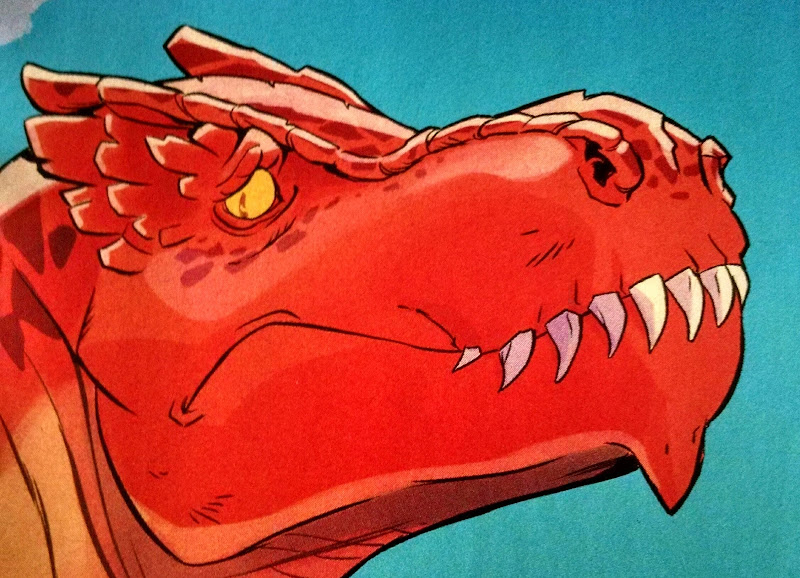
I mean, yes, I get the appeal: giant red T-Rex. But I’m not a big fan of high-concept ideas that go nowhere, and eventually the appeal of what amounts to a giant carnivorous (within the bounds of the Comics Code Authority) horse / dog has to wear thin after a while. It’s not like Devil Dinosaur has a huge range of emotions by himself (herself?).

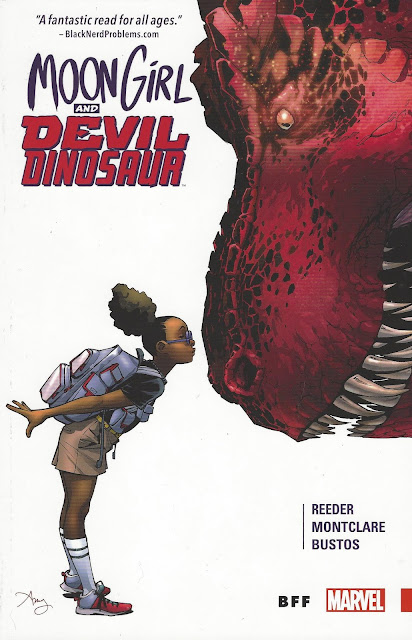
Moon Girl and Devil Dinosaur, v. 1: BFF coverBut I decided to give Moon Girl and Devil Dinosaur, v. 1: BFF a shot, and I’m glad I did.

Writers Amy Reeder and Brandon Montclare create a sympathetic lead in Lunella Lafayette, a grade-school genius (her age is unclear) who is trying to keep her Inhuman gene from expressing. Unfortunately, she’s surrounded by those not only of lesser intellect but also of much greater obliviousness. Her parents want her to be normal, which she clearly is not; her science teacher (or maybe her only teacher, who knows) teaches the students as if they are half-wits and is not prepared to deal with a gifted child. The token jock, Coach Hrbek, picks up an alien artifact as if it is a basketball.

It’s always easy to make the smart, picked-on kid sympathetic, and Lunella is no different. She has been rejected by the Future Foundation and other gifted schools, showing that while she’s very smart, she’s not considered Marvel Universe elite yet. Those schools would be Lunella’s ticket out of the unfair world she lives in, where she has to endure her underprepared teachers and classmates’ taunts (including the convenient nickname “Moon Girl”) in class. Outside the classroom, she retreats into her own world. It’s all by the book, but damned if I didn’t fall for it.

Lunella’s antagonists, the Killing Folk, are the standouts of the book. The Killing Folk are primitive humans who are the archenemies of Devil Dinosaur’s original sidekick, Moon Boy. In the distant past, Moon Boy manages to send the Killing Folk away, saving his people — the Small Folk — as he himself dies. Moon Boy has only delayed the problem, though, as the Killing Folk appear in the present and continue their dominance displays as soon as they acclimatize to the modern world. They are ridiculous — there’s no way they should dominate the Yancy Street Gang and New York police so quickly — but Reeder and Montclare use that to their benefit. To the people of Lunella’s neighborhood, the Killing Folk are just another gang, and the Killing Folk do their best to fulfill that explanation: after all, they’re terrorizing the Small Folk again, just like they did in their own time, and if that requires wearing hoodies and flashing gang signs, they are up for it.

The Killing Folk are in pursuit of what they call “the Nightstone,” although Lunella, who found it before they arrived, surmises it’s a Kree Omni-Wave Projector. Lunella hopes she’ll be able to use the projector to somehow suppress her Inhuman genes. This quest is a tricky point, literally and figuratively, that the writers don’t engage with. Twenty or more years ago, Lunella would have been afraid her mutant gene would express. That’s an easier metaphor for the reader to parse: as mutant powers come out in adolescence, mutancy goes along with puberty, a general change from child the person was to adult they will become. But the Inhuman gene might not ever express if the bearer doesn’t come in contact with Terrigen mist. Does that make the Inhuman gene more like a gene that triggers cancer, something that should be avoided if possible? Or is it still like the X-gene, a natural part of personal evolution?

How am I supposed to feel about Lunella’s quest? I don’t know. Lunella simply doesn’t want to go through the Inhuman change, which doesn’t clarify matters, and her parents don’t seem that troubled by it. Lunella’s motivations seem reasonable — I don’t know that I would want to be radically changed — but if Inhumans are the 21st-century mutants, then she should make her peace with it. Man, I’m confused, and not in a good way.

Devil Dinosaur makes his appearance pursuing the Killing Folk from the past into the present. Unfortunately, Devil Dinosaur is the book’s weak point. The scenes with Devil are the weakest — except perhaps his fight with the Hulk in #4 — in the book. Nothing is surprising about his meeting with Lunella or their interactions after that; of course Lunella dislikes him at first, and of course they become friends. After the Hulk captures DD, of course she springs him. It’s Buddy Cop 101, and it’s a bit tiresome. DD is at best a friendly dog, but he has little character beyond that.

And despite all the good things in BFF — and they are considerable — the big red doughnut hole in the center of the book holds it back considerably. I want to like the book more, but when Clifford Rex galumphs onto the page, the book’s development grinds to a halt for an action set piece, robbing Lunella’s story of momentum.

It’s not the artist’s fault those action scenes make the book drag, though. Natacha Bustos does a great job: her art is so clear, so precise, so … perfect. Her designs for the Killer Folk are great and make them a treat every time they show up. Occasionally, I find I have questions — how old are Lunella and her classmates, exactly? How did the fire at school start? (After I puzzled out that it was the careless use of matches in the girls’ bathroom, I was left with the question of how a porcelain floor catches fire and burns a classroom some distance away, but that’s a script problem, most likely.) Colorist Tamra Bonvillain gives the book a bright, optimistic color scheme that’s perfect for a young genius.

The brief appearance of the new Hulk in #4 is a separate problem from the rest of the book. Reeder and Montclare do their best to make the Cho Hulk unsympathetic: he’s vain, too cocksure, and learns nothing, which is always a problem for an intelligent protagonist. I realize they were trying to make Cho another adult who won’t listen to or help Lunella, forcing her to rely on her own wits to survive, but I’m also assuming their characterization of the new Hulk is accurate. If so, they considerably dampened my desire to read Totally Awesome Hulk, v. 1: Cho Time. I suppose Cho’s unappealing presence could be seen as a survival strategy for Moon Girl and Devil Dinosaur, driving the audience away from a competing new book.

I want to like Moon Girl and Devil Dinosaur, but I can’t help but think the book would be better off if Lunella was cut loose from the “Moon Girl” nonsense and Devil Dinosaur and left to her own devices. I’ll probably pick up v. 2, but that’s mostly because of the cliffhanger at the end of BFF

Rating: Devil Dinosaur symbol Devil Dinosaur symbol Devil Dinosaur symbol (3 of 5)

Labels: , , , , , , , , , , ,