Reviews of trade paperbacks of comic books (mostly Marvel), along with a few other semi-relevant comments / reviews.

20 August 2016

Patsy Walker, a.k.a. Hellcat!, v. 1: Hooked on a Feline

Collects: Patsy Walker, a.k.a. Hellcat #1-6 (2016)

Released: June 2016 (Marvel)

Format: 136 pages / color / $17.99 / ISBN: 9781302900359

What is this?: After being let go from her private investigating job, Patsy Walker (the superhero Hellcat) comes up with a new business idea but has to deal with particularly feckless villains.

The culprits: Writer Kate Leth and artists Brittney L. Williams (#1-5) and Natasha Allegri (#6)


Last week, I praised Squirrel Girl in general and the latest volume of the series, Squirrel, You Really Got Me Now, specifically. This week, I’ll go from one animal-themed Marvel superhero humor book to another …

Patsy Walker, a.k.a. Hellcat!, v. 1: Hooked on a Feline follows Patsy Walker, last seen as She-Hulk’s private investigator in the recent short-lived She-Hulk series. But at the beginning of Feline, She-Hulk has to let Patsy go, and to support herself, Patsy comes up with a new idea: a super-powered temp agency, matching those with powers with jobs that suit those powers.

Patsy Walker, a.k.a. Hellcat!: Hooked on a Feline coverPatsy triumphantly presents at the beginning and end of #1, at least, but we see very little of the execution in the rest of Feline, save for a recommendation to an adversary and a page of bookkeeping in #6. In other words, it takes five issues before she even begins working on her grand plan, and that’s indicative of the book’s level of focus.

Writer Kate Leth makes the wise decision to not get into Patsy’s history as Hellcat, since Hellcat continuity is a bit involved. After all, any story in which you say, “I spent some time dead” will tend to derail the narrative a bit. Leth leaves nothing relevant out and retains enough plot hooks to give herself a lot of potential storylines.

Unfortuately, Leth can’t seem to focus on any idea. As I mentioned, she avoids Patsy’s business idea — the idea presented in literally the series’ first panel — for most of the book. The book’s largest conflict is the decision by her former teen rival, Hedy Wolfe, to reprint the romance comics Patsy’s mother wrote and based on the lives of Patsy and her friends. This should be a story that develops throughout the book, but five issues after the conflict is introduced, I have no idea whether Hedy had any right to reprint the stories without notifying or gaining permission from Patsy. She-Hulk, Patsy’s lawyer, says Hedy doesn’t have a case, but Hedy clearly has a contract — literally, she possesses a piece of paper with “CONTRACT” written across the top of it — that she puts a lot of faith in. Then again, Hedy hires a private investigator (Jessica Jones) to dig up dirt on Patsy, so maybe she realizes her case isn’t so great. The one face-to-face interaction between Patsy and Hedy is a great moment of tension, with Hedy insulting Patsy and Patsy coming up empty in response. The book could have used more close-quarters conflict between the two.

Leth and artists Brittney Williams (#1-5) and Natasha Allegri (#6) are trying for a breezy, fun tone, which explains why the story might lack focus. But for this concept to work, Feline has to be funny, and it just doesn’t.

Take, for instance, issue #2, in which Patsy gets a job working retail — for “research,” she says, although all I can see that she learns is that she’s awful at working retail. She can’t relate to the customers or the merchandise at the hip-but-cheap clothing store she works at; she’s baffled by the garments’ logos and the customers’ reasonable requests. She’s constantly interrupted by friends and enemies, keeping her from getting any work done. Her cluelessness and poor results are frustrating rather than funny. By the end of the issue, I would have preferred to follow the adventures of the supervisor who gave Patsy the firing she so richly deserved.

The closest thread Feline has to an overall arc is the threat of Casiolena, an exiled Asgardian who entices various low-powered superhumans into committing crimes. Casiolena is an ineffectual villain, and that’s supposed to be funny, but she comes across as more petulant than humorous. She wants inspire superhumans to sow chaos, destabilizing New York, but she’s too lazy to do a good job or research the Midgardian quirks she needs to know to be successful. Hellcat and Valkyrie don’t take her seriously, even when Casiolena has captured them both, and the villainess makes unachievable promises to her aspiring minions. As soon as the heroes reveal that Casiolena’s promises can’t be fulfilled, her movement falls apart, and she’s easily captured.

The superhumans who turn to crime at Casiolena’s call aren’t bad people. They’re just … well, maybe they are bad people, in a banal way. They turn to crime as a shortcut to making their lives better, and that’s a horrible choice. None of them seem to be in desperate straits; they appear to prefer to work legitimately, but if legal work is not simple to find, crime’s fine. Patsy goes easy on them, which I don’t mind; the more quickly they get off the page, the more quickly I can forget about them forever.

Well, maybe not all of them — I do like the design of Bailey, a minor adversary who has a handbag of infinite capacity. She looks like a cute witch wearing bike shorts, and while I’m not sure how that fits thematically with “bag of holding,” I’m not the artist! And it’s good that I’m not the artist because I’m bad at drawing.

On the other hand, I’m not fond of Williams’s art, either. In the one opportunity she has to cut loose, the book’s big fight scene in #5, she fails to make an impression. Her tight, careful line and cartoony exaggeration does seem well suited for broad character work, and if the book were funnier, perhaps the art would mesh well with the story. But her detail-oriented art often makes her panels seem to cramped, and I don’t understand her visual vocabulary, at times; for instance, I can’t figure out what it means when Patsy suddenly shrinks to two-thirds size and shows her pointed teeth. (Is she feisty? Angry? Adorable? All of these? What does it mean?) Her Howard the Duck is misshapen, and her Hedy … When she comes to mock Patsy at her retail job, Hedy does not dress in a way that says, “I have room to mock those who work at the mall.” Instead, she looks like she should be picking up the kids at soccer practice in 20 minutes. That’s not how Hedy would dress on her way to insult Patsy.

I won’t discuss Allegre’s art in #6, as it makes me irrationally angry. Let’s just say that any comic that makes Arcade look like a cute teenager and She-Hulk appear unimpressive has a problem.

I do like Williams’s She-Hulk, though: she’s large without being grotesque, physically impressive without losing her attractiveness. The supporting cast and cameos from the rest of the Marvel Universe are the most appealing part of the book, actually; She-Hulk is a great friend to Patsy while being allowed to get angry at her, and the scenes with Howard the Duck (art aside), Dr. Strange, and Jessica Jones are all effective. The scene in which Patsy texts all her female friends, leading them to believe she’s in danger when all she wants is a consolation burger with them after getting fired, is a good illustration of why I would prefer to read about almost anyone in this book other than Patsy: they all excuse her mistake with a shrug. They realize you just have to put up with that nonsense with Patsy, which I do not want to do. She has a good heart, but she’s not that interesting or fun to be around.

And honestly, what kind of person gets a tattoo of themselves? And not a representative one, but a sort of a manga-version of their alter ego? I mean, Alex Rodriguez, who just retired from his baseball career, was seen as a narcissist, but I bet even he did not have a manga-style tattoo of himself in his Yankees uniform.

Rating: Defenders symbol Half Defenders symbol (1.5 of 5)

Labels: , , , , , , , , ,

24 June 2012

Essential Defenders, v. 6

Collects: Defenders #107-25, Marvel Team-Up #119, and Avengers Annual #11 (1982-3)

Released: September 2011 (Marvel)

Format: 528 pages / black and white / $19.99 / ISBN: 9780785157540

What is this?: The Defenders spiral toward the non-team’s dissolution.

The culprits: Writers J.M. DeMatteis and artist Don Perlin


A couple of weeks ago I reviewed Batman: The Court of Owls, a recent title that might be of interest to a general audience. Last week, it was Chronicles of Conan, v. 21: Blood of the Titan and Other Stories, which — since it reprints stories almost 30 years old — has a more limited appeal. This week I remain in the past, turning my back on relevance with Essential Defenders, v. 6, another set of early ‘80s stories from late in the title’s run.

Not that I think there’s anything wrong with looking at a random slice of issues from near the end of Defenders. Every title has troughs and crests in quality; Defenders certainly had high points well after issue #1 in ‘72. I liked parts of Essential Defenders, v. 5, even if the previous volume was a bit weak. There’s no reason why some of the greatest Defenders issues couldn’t have been released in the early ‘80s, between #107-25.

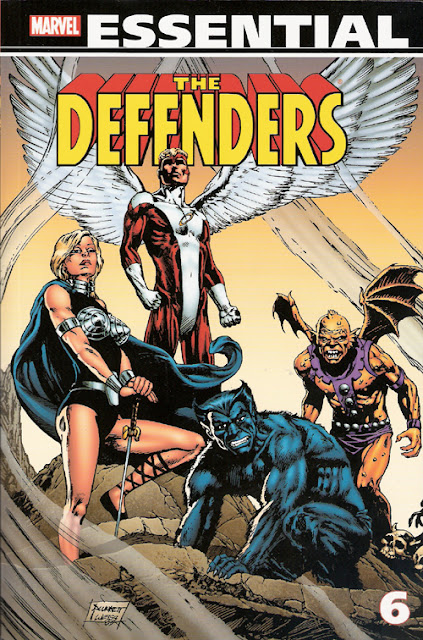
Essential Defenders, v. 6 coverBut are there great issues in there? No, not really. Could’ve been, though.

J.M. DeMatteis wrote all but one issue in this collection (Steven Grant wrote #119, a flashback issue that has all the hallmarks of an inventory story that had to be used before the title’s status quo changed). DeMatteis is best known — to me, at least — for writing psychological Spider-Man stories, like Kraven’s Last Hunt and The Child Within (Spectacular Spider-Man #178-84). Basically, if you wanted a story where a Spider-Man villain cries about a difficult / tragic childhood, DeMatteis was your man.

In v. 6 DeMatteis concentrates on the theme of identity, potentially an interesting idea on a non-team in which few members can define themselves in terms of the team. Valkyrie seems to die, but she returns in a new / old Asgardian body — her original, not the one she co-opted because of the Enchantress’s spell that brought her to Midgard in the first place. She looks the same — of course; it’s magic — but everyone talks about how different she seems emotionally. DeMatteis devotes a story to Devil Slayer’s issues — Devil Slayer, everyone’s favorite Marine / alcoholic / hitman / cultist / supernatural killer with a teleportation cloak. The story involves hallucinations and drinking and many, many manly tears. Hellcat goes on a journey to discover if she’s really the daughter of the devil; Nighthawk deals with mind control and implanted memories; Hellstrom finds a double has taken the life he abandoned at District University in Washington.

Some of these are interesting in concept, such as Valkyrie’s transformation or the glimpse of the supporting cast Hellstrom abandoned in Son of Satan (reprinted in Essential Marvel Horror, v. 1). But few are interesting in execution, with the low point being in #116, in which new character Overmind seems to be trying to make the lonely Dr. Strange more miserable by showing him couples in love (or struggling with love).

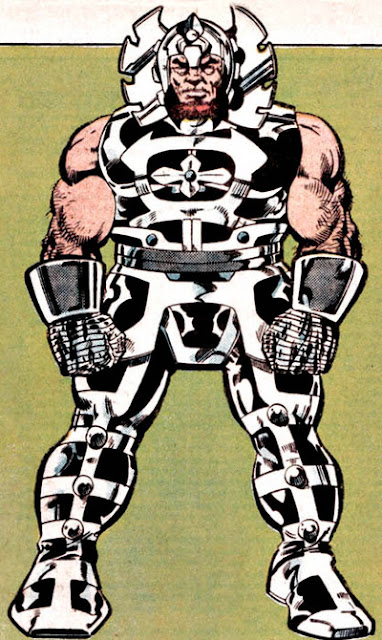
OvermindThe Overmind is symptomatic of the book’s biggest problem. It isn’t that the telepathic lug is little more than a vivid visual and a power set; many characters start that way and still go on to long lives. But he’s a big part of the book straying from its roots. The Defenders are a non-team, which causes a fluid membership. Characters come and go, yes, but most of the solid core remains: Dr. Strange, Hulk, Hellcat, Nighthawk, and Valkyrie. DeMatteis forcefully pushes most of those characters aside by the end of v. 6, but you can see them slowly being edged out before that. Beast, former X-Man and Avenger, is the instigator, pushing for more conformity and becoming “leader” of the team by #125. He makes the defenders into the de facto first X-Men spinoff by adding Angel and Iceman to the roster. By the end, only Beast and Gargoyle remain from #107; Valkyrie is with the team as well, but as mentioned above, it’s ostensibly a different Valkyrie.

To effect this changeover, DeMatteis wastes considerable pages over the final four issues on a vague prophecy that shuffles the Big 4 Defenders (Strange, Hulk, Namor, and Silver Surfer) off stage. To do this, he gives resolution to previous writer Steve Gerber‘s “Elf with a Gun” story. There was never any sense behind the “subplot” — Gerber wrote one-page vignettes of an Elf shooting people, apparently without any purpose behind it — but DeMatteis retroactively gives those bits of silliness meaning. It does not improve the previous installments, and tying the Elf to an attempt to write out long-term Defenders does no favors to DeMatteis’s story either.

Robbing that story of its whimsy is somewhat fitting for this volume; most of the strange, silly fun of the Defenders is missing inv. 6, replaced by DeMatteis’s heavy introspection. I don’t know whether the new direction DeMatteis wrenched the book toward was his or editorial’s, but it ill suits the book. It’s all a bit too obvious, too heavy handed for a freewheeling, fluid book like the Defenders.

Looking of the review so far, it sounds like this book is a completely failure, or nearly so. But there are some enjoyable moments. As I mentioned, Hellstrom finding someone has picked up his discarded life at District University is a neat idea and symbolically suggests the nature of a shared universe. Grant’s fill-in reminds readers of vintage Defenders — it’s set between #68 and 69, actually — and even if it is a bit tried and true, it does have Sal Buscema pencils, so I can forgive the story for not being the most innovative. DeMatteis obviously enjoys writing the Beast, and even if this isn’t my favorite interpretation of the character, he is still frequently amusing. The funniest issue is #115, in which Beast, Valkyrie, Gargoyle, and Namor are thrown into a faux-Seuss dimension; I wish Namor could have vented his frustration on the overly sweet homages, but sadly, it was a Code-approved comic.

Still, that’s not enough to let me recommend v. 6 — nowhere close, really. If you really like Beast or think previous volumes of the Essential Defenders were a touch too silly or weird, then this might be for you. Otherwise …

Or maybe if you’re a Don Perlin fan — I haven’t met any of those, but I think they’re probably out there. Perlin, who drew most of the issues in v. 6, is … fine: competent, dependable, not prone to drown in any stylistic excuses. His name probably sold few books in his time, but he was a Marvel mainstay for a reason, and you can see that reason throughout v. 6.

Given that #125 ifs the first issue of the New Defenders, you might think this (or the next volume) is a good jumping on point. Not so fast, Alphonse; you have to look at what you leap into. The New Defenders are not that fondly remembered — a 27-issue run that ended when Iceman, Beast, and Angel were needed for the launch of X-Factor, and the rest of the team was unceremoniously jettisoned into the Great Beyond. You could jump on there. Would you want to? And if you wanted to, why not do it in color with the New Defenders trade paperback, which reprints #122-31? Even I, completist that I am, have decided to end my Defenders collection with this volume. I don’t think it’s much of a decision, though, as there is little chance the New Defenders will get an Essential of its own.

Essential Defenders, v. 6, has little to recommend it beyond its value to completists. Pass on it unless you’re really into the non-team.

Rating: Defenders symbol Half Defenders symbol (1.5 of 5)

Labels: , , , , , , , , , , , ,

05 September 2008

Essential Defenders, v. 4

Collects: Defenders #61-91 (1978-81)

Released: July 2008 (Marvel)

Format: 584 pages / black and white / $16.99 / ISBN: 9780785130611

It’s probably safe to say that the Essential Defenders, v. 4 is not the Defenders you remember.

There’s none of the inspired Steve Gerber madness, the stuff that made Gerber and the comics he worked on intensely interesting and occasionally baffling in the ‘70s. It never has the Big 4 — Silver Surfer, Namor, Dr. Strange, and the Hulk — together at once, although it does have the latter three a few times. But Namor shows up only reluctantly, it seems, and Dr. Strange appears in less than half the book. Heck, his apprentice / lover Clea seems to be around as much. And it’s not quite what it would become, with a full cast of B-level heroes (Son of Satan, Gargoyle, Demon Slayer, Beast, etc.).

Essential Defenders 4 coverSo for the most part, you have Nighthawk, Valkyrie, Hellcat, and the Hulk. These are great characters,although the modern Marvel Universe seems to do just fine without them. (The Hulk in this era of The Defenders — simple, touchy, and bean-loving — is not the current incarnation of the Jade Giant.) But they are all seemingly supporting characters, none of whom can support a title. I mean, the Hulk had his own comic, so he could obviously drive a plot, but when he goes, he goes alone. There’s no one stable on this non-team, perhaps by desire, and there’s no one for the team to rally around or be the leader in tough times. (Nighthawk pointedly shoves that obligation away repeatedly.) There’s a reason the X-Men have almost always had either Cyclops or Colossus, despite both of them being as dull as Point Barrow in January.

Writers Ed Hannigan and David Anthony Kraft hatch some good ideas here — excellent ideas, actually. The Mandrill storyline is the best, stretching throughout the volume. Mandrill, the mutant man-ape who can control any female who breathes his pheromones, is a creepy villain who is underplayed (and underused); I can’t tell whether this is because going all out with his powers would be too unsettling for kids (or adults, really) or would have violated the Comics Code. In any event, it’s fascinating to watch Valkyrie’s struggle against a villain simple biology has made an easy target for male heroes but near impossible for her to defeat. Her rage and frustration are nicely played.

A confrontation between Black Panther and Namor is interesting, for no other reason than I don’t think the two rulers had ever clashed before, but the near war between their two nations gets overlooked in the Marvel Universe proper because it happened in Defenders. The “Defenders for a Day” story, in which hanger-on Dollar Bill throws open Defenders membership to anyone, starts off with the chaos of a dozen or two unaffiliated superheroes showing up at Defenders HQ but disappointingly ends with an ineffectual fight against supervillains and petulant heroes.

Unfortunately, there’s a lot of ideas that fall flat. I don’t care about the Defenders battling the Unnameable, although I am interested in what Hannigan has against — or for — Houghton-Mifflin. (He uses the company’s name, written backwards, as a foreign language.) When Lunatik went from some weird vigilante to fragments of an interstellar pirate prince, I stopped caring. Foolkiller just doesn’t quite work in the Defenders framework — should a guy with a ray gun really be such a challenge? — and although I’m sure Omega the Unknown’s story deserved to be finished, I wish it hadn’t been dragged into Defenders, even if Ruby Thursday was used to help finish it up. Nighthawk’s millionaire playboy identity is investigated by federal agents, but that story has already been done in Defenders. I don’t care about Valkyrie’s duties in Valhalla; although her interactions with our world are interesting, I don’t care about the war among the Asgardians, especially since it seems to be between Hela (the good guy!) and some upstart. A war in Asgard without Thor or Odin or Loki is pointless.

And there’s only so much of Hellcat’s “golly-whillikers-gee-whiz-shucks” dialogue I can take before I just pray someone beats the cornball right out of her.

The art comes mainly from Herb Trimpe and Don Perlin. Trimpe’s art is good, and as one of the definitive Hulk artists, he’s a good fit for the title. However, his run is marred by multiple inkers and is a good study in the effect different inkers can have on the same penciller. Perlin is a solid ‘70s / ‘80s artist, although perhaps not quite the equal of Trimpe. There’s also a few issues by Sal Buscema, and any chance to see him draw the Hulk is always a bonus.

I want to recommend this book, but I feel it’s missing something. It feels ragged, sometimes; the transitions between status quos aren’t quite as smooth as they should be. It also feels like it’s still having a bit of a hangover from Gerber’s days. It has big ideas that it can’t quite deliver on. To be fair, however, this book was quite forward thinking for its day, featuring strong, independent female leads in the ‘70s. (Not quite as strong as Chris Claremont women — there is such a thing as going too far, after all.)

Still, it falls short of being excellent.

Rating: Defenders symbol Defenders symbol (2 of 5)

Labels: , , , , , , , , , , , ,