Reviews of trade paperbacks of comic books (mostly Marvel), along with a few other semi-relevant comments / reviews.

24 June 2012

Essential Defenders, v. 6

Collects: Defenders #107-25, Marvel Team-Up #119, and Avengers Annual #11 (1982-3)

Released: September 2011 (Marvel)

Format: 528 pages / black and white / $19.99 / ISBN: 9780785157540

What is this?: The Defenders spiral toward the non-team’s dissolution.

The culprits: Writers J.M. DeMatteis and artist Don Perlin


A couple of weeks ago I reviewed Batman: The Court of Owls, a recent title that might be of interest to a general audience. Last week, it was Chronicles of Conan, v. 21: Blood of the Titan and Other Stories, which — since it reprints stories almost 30 years old — has a more limited appeal. This week I remain in the past, turning my back on relevance with Essential Defenders, v. 6, another set of early ‘80s stories from late in the title’s run.

Not that I think there’s anything wrong with looking at a random slice of issues from near the end of Defenders. Every title has troughs and crests in quality; Defenders certainly had high points well after issue #1 in ‘72. I liked parts of Essential Defenders, v. 5, even if the previous volume was a bit weak. There’s no reason why some of the greatest Defenders issues couldn’t have been released in the early ‘80s, between #107-25.
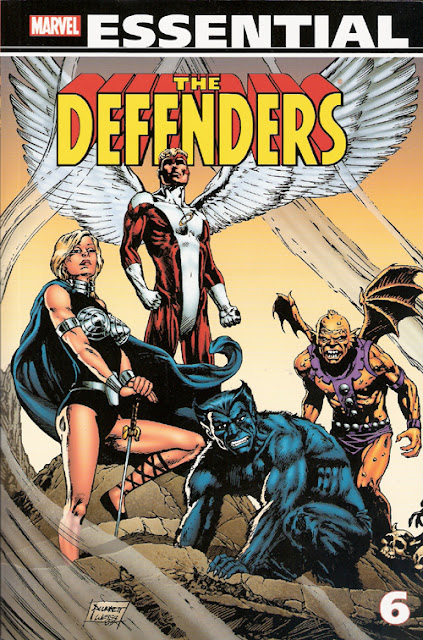
Essential Defenders, v. 6 coverBut are there great issues in there? No, not really. Could’ve been, though.

J.M. DeMatteis wrote all but one issue in this collection (Steven Grant wrote #119, a flashback issue that has all the hallmarks of an inventory story that had to be used before the title’s status quo changed). DeMatteis is best known — to me, at least — for writing psychological Spider-Man stories, like Kraven’s Last Hunt and The Child Within (Spectacular Spider-Man #178-84). Basically, if you wanted a story where a Spider-Man villain cries about a difficult / tragic childhood, DeMatteis was your man.

In v. 6 DeMatteis concentrates on the theme of identity, potentially an interesting idea on a non-team in which few members can define themselves in terms of the team. Valkyrie seems to die, but she returns in a new / old Asgardian body — her original, not the one she co-opted because of the Enchantress’s spell that brought her to Midgard in the first place. She looks the same — of course; it’s magic — but everyone talks about how different she seems emotionally. DeMatteis devotes a story to Devil Slayer’s issues — Devil Slayer, everyone’s favorite Marine / alcoholic / hitman / cultist / supernatural killer with a teleportation cloak. The story involves hallucinations and drinking and many, many manly tears. Hellcat goes on a journey to discover if she’s really the daughter of the devil; Nighthawk deals with mind control and implanted memories; Hellstrom finds a double has taken the life he abandoned at District University in Washington.

Some of these are interesting in concept, such as Valkyrie’s transformation or the glimpse of the supporting cast Hellstrom abandoned in Son of Satan (reprinted in Essential Marvel Horror, v. 1). But few are interesting in execution, with the low point being in #116, in which new character Overmind seems to be trying to make the lonely Dr. Strange more miserable by showing him couples in love (or struggling with love).
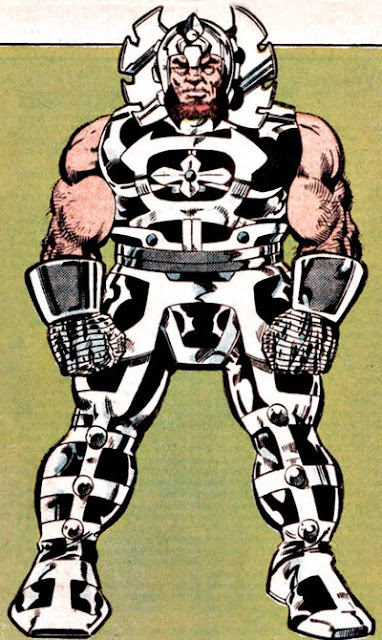
OvermindThe Overmind is symptomatic of the book’s biggest problem. It isn’t that the telepathic lug is little more than a vivid visual and a power set; many characters start that way and still go on to long lives. But he’s a big part of the book straying from its roots. The Defenders are a non-team, which causes a fluid membership. Characters come and go, yes, but most of the solid core remains: Dr. Strange, Hulk, Hellcat, Nighthawk, and Valkyrie. DeMatteis forcefully pushes most of those characters aside by the end of v. 6, but you can see them slowly being edged out before that. Beast, former X-Man and Avenger, is the instigator, pushing for more conformity and becoming “leader” of the team by #125. He makes the defenders into the de facto first X-Men spinoff by adding Angel and Iceman to the roster. By the end, only Beast and Gargoyle remain from #107; Valkyrie is with the team as well, but as mentioned above, it’s ostensibly a different Valkyrie.

To effect this changeover, DeMatteis wastes considerable pages over the final four issues on a vague prophecy that shuffles the Big 4 Defenders (Strange, Hulk, Namor, and Silver Surfer) off stage. To do this, he gives resolution to previous writer Steve Gerber‘s “Elf with a Gun” story. There was never any sense behind the “subplot” — Gerber wrote one-page vignettes of an Elf shooting people, apparently without any purpose behind it — but DeMatteis retroactively gives those bits of silliness meaning. It does not improve the previous installments, and tying the Elf to an attempt to write out long-term Defenders does no favors to DeMatteis’s story either.

Robbing that story of its whimsy is somewhat fitting for this volume; most of the strange, silly fun of the Defenders is missing inv. 6, replaced by DeMatteis’s heavy introspection. I don’t know whether the new direction DeMatteis wrenched the book toward was his or editorial’s, but it ill suits the book. It’s all a bit too obvious, too heavy handed for a freewheeling, fluid book like the Defenders.

Looking of the review so far, it sounds like this book is a completely failure, or nearly so. But there are some enjoyable moments. As I mentioned, Hellstrom finding someone has picked up his discarded life at District University is a neat idea and symbolically suggests the nature of a shared universe. Grant’s fill-in reminds readers of vintage Defenders — it’s set between #68 and 69, actually — and even if it is a bit tried and true, it does have Sal Buscema pencils, so I can forgive the story for not being the most innovative. DeMatteis obviously enjoys writing the Beast, and even if this isn’t my favorite interpretation of the character, he is still frequently amusing. The funniest issue is #115, in which Beast, Valkyrie, Gargoyle, and Namor are thrown into a faux-Seuss dimension; I wish Namor could have vented his frustration on the overly sweet homages, but sadly, it was a Code-approved comic.

Still, that’s not enough to let me recommend v. 6 — nowhere close, really. If you really like Beast or think previous volumes of the Essential Defenders were a touch too silly or weird, then this might be for you. Otherwise …

Or maybe if you’re a Don Perlin fan — I haven’t met any of those, but I think they’re probably out there. Perlin, who drew most of the issues in v. 6, is … fine: competent, dependable, not prone to drown in any stylistic excuses. His name probably sold few books in his time, but he was a Marvel mainstay for a reason, and you can see that reason throughout v. 6.

Given that #125 ifs the first issue of the New Defenders, you might think this (or the next volume) is a good jumping on point. Not so fast, Alphonse; you have to look at what you leap into. The New Defenders are not that fondly remembered — a 27-issue run that ended when Iceman, Beast, and Angel were needed for the launch of X-Factor, and the rest of the team was unceremoniously jettisoned into the Great Beyond. You could jump on there. Would you want to? And if you wanted to, why not do it in color with the New Defenders trade paperback, which reprints #122-31? Even I, completist that I am, have decided to end my Defenders collection with this volume. I don’t think it’s much of a decision, though, as there is little chance the New Defenders will get an Essential of its own.

Essential Defenders, v. 6, has little to recommend it beyond its value to completists. Pass on it unless you’re really into the non-team.

Rating: Defenders symbol Half Defenders symbol (1.5 of 5)

Labels: , , , , , , , , , , , ,

28 April 2012

Marvel Firsts: The 1970s, v. 1

Collects: Amazing Adventures #1, 11, and 18; Savage Tales #1; Marvel Spotlight #1-2 and 5; Marvel Feature #1, Marvel Premiere #1; Tomb of Dracula #1; Hero for Hire #1; Combat Kelly & the Deadly Dozen #1; Outlaw Kid #10; Gunhawks #1; The Cat #1; Shanna the She-Devil #1; and Monster of Frankenstein #1 (1970-3)

Released: January 2012 (Marvel)

Format: 392 pages / color (except one b-&-w story) / $29.99 / ISBN: 9780785163800

What is this?: The first issues of the hottest new comic books that early 1970s Marvel has to offer.

The culprits: Too many to list, but writers Roy Thomas and Gary Friedrich show up a lot, as does artist Mike Ploog.


Grab-bag books, like Marvel Firsts: The 1970s, v. 1, are a tough sell. I think most readers are looking for a book united by plot rather than looser themes, such as date or character. Still, I was looking forward to reading the stories included in Marvel Firsts.

I have read many of the stories before in the first volumes of Essential series: Killraven (Amazing Adventures #18), Tomb of Dracula (#1), Power Man (Hero for Hire #1), Ghost Rider (Marvel Spotlight #5), Defenders (Marvel Feature #1). Still, the other stories held some interest. The book, I hoped, would give a glimpse into how Marvel was trying to expand its line in the first few years of the 1970s.

The collection kicks off with Amazing Adventures #1, which seems as natural an idea as there could have been in the Marvel Universe at the time: a book with a Black Widow story and an Inhumans story. It’s a good start, too, with the Inhumans story written by Stan Lee and drawn by Jack Kirby; the Black Widow story is drawn by John Buscema. But from there, Marvel goes in a different direction; there are only three more straightforward superhero stories included: the Defenders in Marvel Feature #1, the Cat in The Cat #1, and Power Man in Hero for Hire #1, and even Hero for Hire isn’t a pure superhero title, as tinged as it is by the Blaxploitation genre.

Marvel Firsts: The 1970s, v. 1 coverThe two major genres Marvel was pushing into at the time were horror and westerns. On the horror side, Tomb of Dracula #1 started a long-running title, and it is the best story in the book; it’s hard to read the tale, with Gene Colan‘s atmospheric pencils, and not want to know what comes next. Monster of Frankenstein #1 is a less successful attempt to revive a 19th-century classic monster; whereas Tomb of Dracula leaps from the end of Stoker’s novel to the ‘70s, with Dracula being an active character in the book, Monster of Frankenstein is set at the end of the 1800s, and the monster is inanimate throughout. A quicker start would have helped generate interest. Rounding out the Universal movie monster troika is the Wolfman — well, “Werewolf by Night,” in Marvel Spotlight #2. It’s a competent story, playing on themes of family, curses, and the animal inside, but unlike Tomb of Dracula, it doesn’t have Colan’s art to balance its typically ‘70s wordiness.

Some might consider Ghost Rider a superhero (all right, he is), but his origin in Marvel Spotlight #5 is definitely a horror story — horrific deaths, Satanic rituals, a flawed deal with the devil, a curse … yep, that’s horror, no matter how nonsensical the plot is. I’m lukewarm on Mike Ploog‘s art, but the visuals are striking. Savage Tales #1 is a simple but satisfying black-and-white story featuring the first appearance of Man-Thing, written by Roy Thomas and Gerry Conway. (They also collaborated on Tomb of Dracula #1.) Marvel used the magazine format to get impressive art from Gray Morrow; I was familiar with Colan, but Morrow’s art caught me pleasantly by surprise. Conway so liked the idea of a scientist using a formula on himself to keep it from falling into the wrong hands that he used it again in Amazing Adventures #11, in which the X-Men’s Beast transforms himself into a hairy monster. Beast was a hero before his solo stories and a hero after he embraced his transformation, but this is a horror story — right down to a “what have I done?” moment.

The Western was back in the early ‘70s, but there was less variety in the content than there were in the horror stories. Your options were a conflicted Native American (Red Wolf in Marvel Spotlight #1), a former slave and slave owner teaming up (Gunhawks in Gunhawks #1), or a young white guy (Outlaw Kid in Outlaw Kid #10). As you might guess, the books with non-white protagonists are painfully earnest and at times a bit uncomfortable. For instance, Marvel Spotlight #1 is full of pseudo-Indian mysticism, with little to recommend it but the race of Red Wolf, its protagonist. I don’t doubt that some slaves, like Reno Jones in Gunhawks, were treated well enough they might fight against their own interests and hold no ill will against their former masters. But in the long term, it’s problematic — Reno is atypical, and his own self-image eventually has to reflect that. Still, the story of young gunslingers Reno and Kid Cassidy is the most entertaining of the Westerns, with some nice banter between the leads, and Reno and Kid are treated as equals. Outlaw Kid #10’s cover promises a “Western Spider-Man,” and it delivers: the young Outlaw Kid takes on corruption in his home town in a mask, making him seem like a criminal, against the wishes of his blind, pacifist father. It doesn’t catch the magic of Spider-Man, but that’s a high standard, and Outlaw Kid is mostly inoffensive.

Other genres in the book include war, jungle, and sci-fi comics. Combat Kelly and the Deadly Dozen, a Sgt. Fury spinoff, shows why war comics were on the way out, despite the cast’s racial diversity and the inclusion of a female soldier. (Of course, the cast is much too large, and the woman ties her uniform shirt at her sternum to expose her midriff.) Shanna the She-Devil is fine but seems mostly an excuse for George Tuska to draw exotic animals and a woman wearing a leopard skin swimsuit. (Shanna made the outfit herself from a leopard massacred in her zoo so that she could gain “sight-scent recognitions with [the leopard’s] cubs.” Grisly.) Marvel Premiere #1 is nearly as exciting as you would expect a sci-fi story featuring Adam Warlock and the High Evolutionary gabbing to be. Amazing Adventures #18 sets up Killraven’s War of the Words backstory with remarkable efficiency and imagination, although some of its trappings come across as ridiculous today (and I suspect did in 1973, as well).

You would think Marvel would hardly need an excuse to praise their diversity in genre, gender, and race. But they don’t, and that’s my biggest disappointment with Marvel Firsts. I wanted introductory essays. I wanted context. I wanted timelines, charts, figures — something to pull this disparate set of comics together. It didn’t have to be elaborate; it just needed to exist. There is a little provided; each issue gets a flat sentence or two about the title, date, and character (“Amazing Adventures #11, published in December 1970, switched focus from Black Widow and the Inhumans, becoming the first ongoing series for a heavily revamped Beast, formerly of the X-Men”). Between the chronologically ordered issues are pages showing the covers of Marvel’s contemporary new series, with a brief sentence about each (usually, genre, title, date, and whether it was a reprint series). Still, I would like to know more. When did these series end? How many issues did they last? Was there anything interesting about them — I mean, is there a good reason the cover of humor comic Harvey #1 looked like Archie with Marvel trade dress pasted on it? I’d be willing to pay a bit more for this, or Amazing Adventures #18 could have been shifted to Marvel Firsts: The 1970s, v. 2.

As a random slice of Marvel at one of its most diverse times, Marvel Firsts: The 1970s, v. 1, is pretty impressive. I haven’t harped on it, but it’s remarkable how many of the protagonists aren’t just the same old white guys; Black Widow was an established character who got her own series, and the Cat (later Tigra), Power Man, and Shanna the She-Devil were created for their series. At least three members of the Deadly Dozen were not white (and one was not male), and Reno Jones of Gunhawks and Red Wolf weren’t white either. Most of these characters fell flat on their faces — only Power Man kept his series for very long — but you have to applaud Marvel for trying.

It’s unfortunate that most of the art and writing in Marvel Firsts cannot match the best of Marvel at the time, but given that many of these titles shifted their emphasis frequently or were second-tier to begin with, it’s understandable the top talent weren’t assigned to these stories, and those who were weren’t inspired to turn in their top work. It’s also sad that Conan the Barbarian #1 couldn’t be included because of legal reasons (not that the book mentioned this). And I wish there would have been more context. But it’s not wise to focus on what isn’t here; what is here is a collection of frequently enjoyable stories — although occasionally that enjoyment comes from how badly the stories have aged (or how badly they were told in the first place).

Rating: 2.5 of 5 Marvel symbol Marvel symbol Half Marvel symbol

Labels: , , , , , , , , , , , , , , , , ,

04 February 2011

X-Men / SWORD: No Time to Breathe

Collects: SWORD #1-5 (2010)

Released: June 2010 (Marvel)

Format: 128 pages / color / $15.99 / ISBN: 9780785140764

What is this?: Abigail Brand runs SWORD, an organization on a station floating high above the Earth to keep the planet safe from aliens (and aliens safe from Earth).

The culprits: Writer Kieron Gillen and penciler Steve Sanders

X-Men / SWORD: No Time to Breathe was a last minute fill in for this week’s review. After my local library / librarian left me in the lurch, I looked through my reading list and selected SWORD to fill in the gap.

I had no recollection of ever reading any of writer Kieron Gillen’s other work, but after consulting my records, I remembered having previously enjoyed his work in the smashup TPB Dark Avengers: Ares. Gillen wrote the three-issue Dark Avengers: Ares miniseries, and I had been impressed by both the book’s violence and mythological feel and the characters’ depth and psychopathy.

X-Men / SWORD: No Time to Breathe coverSWORD is also a violent book, but not in the same way as Ares. Whereas Ares was the violence of war and the men who can’t keep themselves from fighting, SWORD’s violence is expressed as an action-filled space opera. There are coups, a bounty hunter, counterrevolutions, abductions, a fire-breathing space dragon, attempted genocides, battles for a space station, eye trauma, prison breaks, and several cases of explosive decompression, along with a few standard superhero type fights. Add that to a thief, romance, hard drinking (the dragon again), a ne’er-do-well brother, and a sense of humor that manages to fill the little space not devoted to the plot, and it becomes obvious No Time to Breathe is not just a subtitle but a warning to readers: this plot moves at a near-relativistic pace, and you better be ready for it.

Yes, that’s a bit of hyperbole, but there really are four different plot threads unspooling through SWORD, and there’s not enough time slow the pace. It becomes a little offputting when read all at once, although I can imagine that in monthly form it was a treat. This is certainly no decompression-fest,53 and the humor gives Gillen a chance to put some distractions into the story, if not giving readers a break from the pace.

Gillen’s characters are fun, and he has the advantage of being having mostly a blank slate. Beast, of course, has almost a half century behind him, but if you remember he’s light hearted, smart, athletic, and a decent scientist (by Marvel standards), you’ll be OK. (There was a reason he was one of Scott Lobdell’s favorites when he wrote X-Men.) Agent Brand hadn’t been established as much more than a half-alien hardass, and Lockheed … well, this isn’t quite the Lockheed we’ve read about before, with the alien dragon suffering from depression at the loss of Kitty Pryde. Death’s Head has a history in the Marvel Universe, but since he appeared mostly in Transformers and Marvel UK, most readers don’t know it. And Henry Peter Gyrich is a bureaucratic butthead. …

… OK, most of the lead cast is established to some degree. Most of the rest are one-note aliens or SWORD staffers. However, there is one standout character: Unit, a robot that SWORD keeps locked up as if he were a cybernetic version of Hannibal Lecter. He seems to have those sort of deep insights that Lecter had into his jailers, even the ones he hasn’t met. Unit is kept locked up under the most stringent conditions SWORD has; he’s the product of a civilization that wanted to make the universe perfect and were willing to do awful things to achieve the goal. Unit’s creators have been destroyed, but Unit is still playing a long game to finish his creators’ plan. And that’s what’s creepy about Unit; his insights are annoying, but his ability to look dozens of steps ahead to wait for and create the perfect chance to accomplish what his creators could not is chilling.

I haven’t read anything by penciler Steven Sanders, but I enjoyed his work in SWORD. It took me a while to get used to his Agent Brand — the sunglasses were not quite what I was used to, and she was a bit top heavy — and the new post-Grant Morrison design of the Beast always strikes me as wrong (as it does cover artist John Cassaday — the shape of the Beast’s skull on the cover looks nothing like it does in the interior artwork, where it more closely resembles the many long-faced aliens). But I got used it, and by the end, I had to admit it was a neat trick for Sanders to match the plot’s extremely brisk pace and Gillen’s sense of humor.

It’s a shame that SWORD didn’t last longer, although it’s not a surprise. The TPB tries to weld “X-Men” onto the title, but it’s not an X-book — yes, Beast is a lead / supporting character in the book, as is Kitty Pryde’s dragon Lockheed, and Cyclops, Emma Frost, Warlock, and what I believe is Doug Ramsey make cameos, but that’s not enough. It’s a book with a sense of humor and a largely unknown cast of characters set outside New York / major team books’ circle, written by a man best known for an indy / non-superhero book (Phonogram) and penciled by an artist without much name recognition. Yes, Gillen has become a major writer for Marvel — his Thor run was roughly concurrent with SWORD’s run, and now he’s writing Generation Hope and Uncanny X-Men — but at the time, this was a recipe for low sales and early cancellation. And that’s exactly what happened.

Rating: X-Men symbol X-Men symbol X-Men symbol X-Men symbol Half X-Men symbol (4.5 of 5)

Labels: , , , , , , , , ,