


Marvel Firsts: The 1970s, v. 1
Collects: Amazing Adventures #1, 11, and 18; Savage Tales #1; Marvel Spotlight #1-2 and 5; Marvel Feature #1, Marvel Premiere #1; Tomb of Dracula #1; Hero for Hire #1; Combat Kelly & the Deadly Dozen #1; Outlaw Kid #10; Gunhawks #1; The Cat #1; Shanna the She-Devil #1; and Monster of Frankenstein #1 (1970-3)
Released: January 2012 (Marvel)
Format: 392 pages / color (except one b-&-w story) / $29.99 / ISBN: 9780785163800
What is this?: The first issues of the hottest new comic books that early 1970s Marvel has to offer.
The culprits: Too many to list, but writers Roy Thomas and Gary Friedrich show up a lot, as does artist Mike Ploog.
Grab-bag books, like Marvel Firsts: The 1970s, v. 1, are a tough sell. I think most readers are looking for a book united by plot rather than looser themes, such as date or character. Still, I was looking forward to reading the stories included in Marvel Firsts.
I have read many of the stories before in the first volumes of Essential series: Killraven (Amazing Adventures #18), Tomb of Dracula (#1), Power Man (Hero for Hire #1), Ghost Rider (Marvel Spotlight #5), Defenders (Marvel Feature #1). Still, the other stories held some interest. The book, I hoped, would give a glimpse into how Marvel was trying to expand its line in the first few years of the 1970s.
The collection kicks off with Amazing Adventures #1, which seems as natural an idea as there could have been in the Marvel Universe at the time: a book with a Black Widow story and an Inhumans story. It’s a good start, too, with the Inhumans story written by Stan Lee and drawn by Jack Kirby; the Black Widow story is drawn by John Buscema. But from there, Marvel goes in a different direction; there are only three more straightforward superhero stories included: the Defenders in Marvel Feature #1, the Cat in The Cat #1, and Power Man in Hero for Hire #1, and even Hero for Hire isn’t a pure superhero title, as tinged as it is by the Blaxploitation genre.
 The two major genres Marvel was pushing into at the time were horror and westerns. On the horror side, Tomb of Dracula #1 started a long-running title, and it is the best story in the book; it’s hard to read the tale, with Gene Colan‘s atmospheric pencils, and not want to know what comes next. Monster of Frankenstein #1 is a less successful attempt to revive a 19th-century classic monster; whereas Tomb of Dracula leaps from the end of Stoker’s novel to the ‘70s, with Dracula being an active character in the book, Monster of Frankenstein is set at the end of the 1800s, and the monster is inanimate throughout. A quicker start would have helped generate interest. Rounding out the Universal movie monster troika is the Wolfman — well, “Werewolf by Night,” in Marvel Spotlight #2. It’s a competent story, playing on themes of family, curses, and the animal inside, but unlike Tomb of Dracula, it doesn’t have Colan’s art to balance its typically ‘70s wordiness.
Some might consider Ghost Rider a superhero (all right, he is), but his origin in Marvel Spotlight #5 is definitely a horror story — horrific deaths, Satanic rituals, a flawed deal with the devil, a curse … yep, that’s horror, no matter how nonsensical the plot is. I’m lukewarm on Mike Ploog‘s art, but the visuals are striking. Savage Tales #1 is a simple but satisfying black-and-white story featuring the first appearance of Man-Thing, written by Roy Thomas and Gerry Conway. (They also collaborated on Tomb of Dracula #1.) Marvel used the magazine format to get impressive art from Gray Morrow; I was familiar with Colan, but Morrow’s art caught me pleasantly by surprise. Conway so liked the idea of a scientist using a formula on himself to keep it from falling into the wrong hands that he used it again in Amazing Adventures #11, in which the X-Men’s Beast transforms himself into a hairy monster. Beast was a hero before his solo stories and a hero after he embraced his transformation, but this is a horror story — right down to a “what have I done?” moment.
The Western was back in the early ‘70s, but there was less variety in the content than there were in the horror stories. Your options were a conflicted Native American (Red Wolf in Marvel Spotlight #1), a former slave and slave owner teaming up (Gunhawks in Gunhawks #1), or a young white guy (Outlaw Kid in Outlaw Kid #10). As you might guess, the books with non-white protagonists are painfully earnest and at times a bit uncomfortable. For instance, Marvel Spotlight #1 is full of pseudo-Indian mysticism, with little to recommend it but the race of Red Wolf, its protagonist. I don’t doubt that some slaves, like Reno Jones in Gunhawks, were treated well enough they might fight against their own interests and hold no ill will against their former masters. But in the long term, it’s problematic — Reno is atypical, and his own self-image eventually has to reflect that. Still, the story of young gunslingers Reno and Kid Cassidy is the most entertaining of the Westerns, with some nice banter between the leads, and Reno and Kid are treated as equals. Outlaw Kid #10’s cover promises a “Western Spider-Man,” and it delivers: the young Outlaw Kid takes on corruption in his home town in a mask, making him seem like a criminal, against the wishes of his blind, pacifist father. It doesn’t catch the magic of Spider-Man, but that’s a high standard, and Outlaw Kid is mostly inoffensive.
Other genres in the book include war, jungle, and sci-fi comics. Combat Kelly and the Deadly Dozen, a Sgt. Fury spinoff, shows why war comics were on the way out, despite the cast’s racial diversity and the inclusion of a female soldier. (Of course, the cast is much too large, and the woman ties her uniform shirt at her sternum to expose her midriff.) Shanna the She-Devil is fine but seems mostly an excuse for George Tuska to draw exotic animals and a woman wearing a leopard skin swimsuit. (Shanna made the outfit herself from a leopard massacred in her zoo so that she could gain “sight-scent recognitions with [the leopard’s] cubs.” Grisly.) Marvel Premiere #1 is nearly as exciting as you would expect a sci-fi story featuring Adam Warlock and the High Evolutionary gabbing to be. Amazing Adventures #18 sets up Killraven’s War of the Words backstory with remarkable efficiency and imagination, although some of its trappings come across as ridiculous today (and I suspect did in 1973, as well).
You would think Marvel would hardly need an excuse to praise their diversity in genre, gender, and race. But they don’t, and that’s my biggest disappointment with Marvel Firsts. I wanted introductory essays. I wanted context. I wanted timelines, charts, figures — something to pull this disparate set of comics together. It didn’t have to be elaborate; it just needed to exist. There is a little provided; each issue gets a flat sentence or two about the title, date, and character (“Amazing Adventures #11, published in December 1970, switched focus from Black Widow and the Inhumans, becoming the first ongoing series for a heavily revamped Beast, formerly of the X-Men”). Between the chronologically ordered issues are pages showing the covers of Marvel’s contemporary new series, with a brief sentence about each (usually, genre, title, date, and whether it was a reprint series). Still, I would like to know more. When did these series end? How many issues did they last? Was there anything interesting about them — I mean, is there a good reason the cover of humor comic Harvey #1 looked like Archie with Marvel trade dress pasted on it? I’d be willing to pay a bit more for this, or Amazing Adventures #18 could have been shifted to Marvel Firsts: The 1970s, v. 2.
As a random slice of Marvel at one of its most diverse times, Marvel Firsts: The 1970s, v. 1, is pretty impressive. I haven’t harped on it, but it’s remarkable how many of the protagonists aren’t just the same old white guys; Black Widow was an established character who got her own series, and the Cat (later Tigra), Power Man, and Shanna the She-Devil were created for their series. At least three members of the Deadly Dozen were not white (and one was not male), and Reno Jones of Gunhawks and Red Wolf weren’t white either. Most of these characters fell flat on their faces — only Power Man kept his series for very long — but you have to applaud Marvel for trying.
It’s unfortunate that most of the art and writing in Marvel Firsts cannot match the best of Marvel at the time, but given that many of these titles shifted their emphasis frequently or were second-tier to begin with, it’s understandable the top talent weren’t assigned to these stories, and those who were weren’t inspired to turn in their top work. It’s also sad that Conan the Barbarian #1 couldn’t be included because of legal reasons (not that the book mentioned this). And I wish there would have been more context. But it’s not wise to focus on what isn’t here; what is here is a collection of frequently enjoyable stories — although occasionally that enjoyment comes from how badly the stories have aged (or how badly they were told in the first place).
Rating: 2.5 of 5


Labels: 2.5, 2012 January, Beast, Cat, Dracula, Gene Colan, Ghost Rider, Gray Morrow, Gunhawks, Killraven, Man-Thing, Marvel, Outlaw Kid, Power Man, Red Wolf, Roy Thomas, Shanna, Werewolf by Night
posted by Raoul | 3:29 AM
|
2 comments

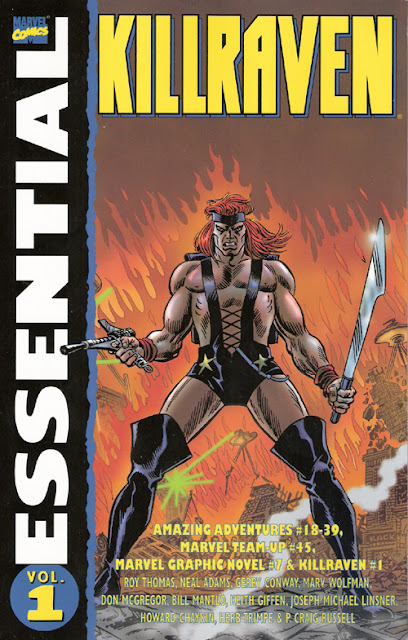 Wait. That last one wasn’t on TV. And that’s where writer Don McGregor, who took over with Amazing Adventures #21, makes Killraven something other than a needless continuation of a sci-fi classic. His stories have babies eaten as delicacies, forced breeding, and humans tortured, warped, and killed for no real reason. Yes, the casualty rate for Killraven’s band of Freemen is absurdly low, but even they are touched by loss, and why are you complaining? This was a comic book meant for kids, and they’re talking about eating babies because they’re yummy.