Reviews of trade paperbacks of comic books (mostly Marvel), along with a few other semi-relevant comments / reviews.

14 October 2016

Power Man and Iron Fist, v. 1: The Boys Are Back in Town

Collects: Power Man & Iron Fist v. 3 #1-5 (2016)

Released: September 2016 (Marvel)

Format: 112 pages / color / $15.99 / ISBN: 9781302901141

What is this?: Luke Cage and Iron Fist help an old friend by “recovering” a necklace, but the necklace is enchanted, and the old friend uses it for a crime spree. Plus: Are Danny and Luke back together? Like, for good?

The culprits: Writer David Walker and artists Sanford Greene and Flaviano


In Power Man and Iron Fist, v. 1: The Boys Are Back in Town, everyone is obsessed with whether Luke Cage and Iron Fist (Danny Rand) are back together. Have they reunited? They’ve been working together; obviously they’re back together. Why don’t they just admit it? The story is as relentless with questions about their relationship status as a ’shippers’ message board.

Back in Town is obviously attempting to cement Power Man and Iron Fist as a big deal in the Marvel Universe, even though it’s uncertain whether Luke Cage is Power Man any more. (The presence of a new Power Man, even one who has worked with Danny before, is not a barrier to Luke reusing the name, a fact pointed out by two Spider-Women as they watch the duo fight second-rate villains.) The book is pushing the importance of Power Man and Iron Fist as heroes, as everyone — fans, villains, other heroes, and Luke’s wife — are speculating on the two reuniting with differing levels of enthusiasm.

I’m not saying Power Man and Iron Fist aren’t cool. I’m saying the duo have never seemed that popular within the Marvel Universe.

Power Man and Iron Fist, v. 1: The Boys Are Back in Town coverBut on the other hand, writer David Walker and artist Sanford Greene, who draws #1-4, undercut that idea. Everyone acts as if Luke and Danny are a big deal, but the magical item that fuels the first arc is specifically one that only works with powerless wielders. The villains the pair fight are low-rent at best; as much as I enjoy Gorilla Man (Arthur Nagan version), he’s not someone you throw at a hero you’re trying to show is important.

Rather than representing the book Walker’s trying to sell to readers, Greene’s art does a decent job representing the book as it is. Greene’s art does not depict a world of front-line superheroes. I admit Green’s Cage dresses sharply; he’s certainly a cut above everything else in the book, although he’s not dressed like a hero. On the other hand, I have no idea why Iron Fist is wearing a high-collared track suit. Overall, the art has a loose, non-mainstream look to it, one that exaggerates violence by making recipients of punches rubber-faced. This is the look of a book that’s on the fringes of the Marvel superhero universe. It’s not low quality, but it’s not a look that says, “This is a book featuring two very popular heroes in it.”

Even colorist Lee Loughridge contributes to this diminution of the leads. The world of Cage and Iron Fist isn’t decorated with the bright colors of superheroes or even strong, clear colors. The pages are muddy and grimy: mustard yellows and browns, muted purples. Even Danny is not in his usual colors; instead of his usual green costume or the white one from the previous volume of PM&IF, he’s wearing a reddish-brown tracksuit. It’s not even the bright red of that his costume turns when he turns evil. Its color is too boring to say anything about Danny — except, perhaps, that he’s boring, and that’s not what anyone wants.

The actual story has Luke and Danny helping their former office assistant, Jennie Royce, after she is released from prison. After being thrown in prison for murdering her abusive boyfriend, Royce asked for Iron Fist’s help in the previous Power Man and Iron Fist series, one that featured Victor Alvarez, the second Power Man. The duo discovered Royce was possessed at the time; the story ends with Danny saying She-Hulk, who is a lawyer, “almost guaranteeing an acquittal.” Back in Town glosses over this, mentioning the possession and murder a few times but never mentioning what book the story appeared in.

Oops! Looks like She-Hulk spoke too soon (although it also looks like everyone’s forgotten what she said). Jennie’s out on probation, not acquitted, and she wants Luke and Danny to get her grandmother’s necklace back from Tombstone. They take it back easily, but instead of being a family heirloom, the necklace is a magic device that gives power to the powerless. Luke and Danny have to deal with the consequences of that, with Danny willing to rob a gangster on her say-so and not believing Royce lied to them. (In the previous volume, he’s willing to believe Royce killed her boyfriend; he investigates before giving his opinion on Royce’s innocence. Perhaps that’s why the previous volume isn’t footnoted.)

This book has a glimpse into the secret world of supervillains that I’ve wanted for quite some time now. The world in Back in Town is a lovely slice of New York inhabited by villains who communicate with each other, spread rumors, and generally complain about each other and heroes. I want to read more of this world in which people know the villainess Nekra by her first and last names (Nekra Sinclair), where Tombstone has two incompetent henchmen who can’t understand his whispering speech, where a strip-mall wizard named Señor Magico calls Dr. Strange a “pendejo” and claims he knows much more than the Sorcerer Supreme. The book also brings back Black Mariah as Royce’s partner-in-crime, and it’s a good choice; her previous (rare) appearances indicate she’s exactly the right person to help Royce: underestimated, familiar with New York’s gangs, and on the lookout for quick grabs for cash.

On the other hand, it’s not that Luke and Danny are dull, but when they are the only two characters on the page, the book gets a little less interesting. The villains get all the best lines, naturally. Luke’s minced oaths, like substituting “fiddle-faddle” for curse words out of his wife’s concern for their daughter’s vocabulary, are funny, but they aren’t enough to cover the pair’s squabbling about whether they are a couple again. A team! Not a couple. A team.

Luke’s wife, Jessica Jones, is a problem in Back in Town. For the first three issues, she’s a shrew, complaining about her husband destroying his shirts while accompanying Danny. It’s sitcom characterization; she’s the nagging wife of every screw-up husband in every sitcom ever. Matters improve somewhat in the two issues, but she’s in a total of two panels in those issues, so it’s hard to say definitively that she’s turned a corner.

Royce is a problem as well. Her powerlessness is a major part of the story; the necklace won’t work for someone who has power. We’re supposed to feel some sort of connection to Royce’s plight, but we’re not given enough time and information to build that relationship with the character, especially given how little we’re informed about the story in which she was incarcerated. (The book seemed to have enough room for this line of development.) What little characterization we get about Royce suggests not that she’s a figure who should be pitied for how she’s been pushed around but someone who has willingly decided to pull a caper after her release, inspired and abetted by better criminals she met in prison. The book tries so little to tie her to Danny and Luke’s past that we never see her in the same flashbacks as the Heroes for Hire. Danny feels guilty about her time in prison; that’s clear. But what Royce feels is more ambiguous, and not the good kind of ambiguous.

Despite all the negative things I’ve said about Back in Town, I enjoyed the book overall. I’m looking forward to the second volume, where hopefully the will-they / won’t-they nonsense and the bad Jessica will be gone and the ground-level villainy and heroism will be front and center. (Also: stop trying to convince me about how important the characters are.) With all the shortcomings the book has, though, I’m not sure I can recommend it until the second volume shows which way the series is going to go.

Rating: Marvel symbol Marvel symbol Half Marvel symbol (2.5 of 5)

Labels: , , , , , , , , , , , ,

29 January 2016

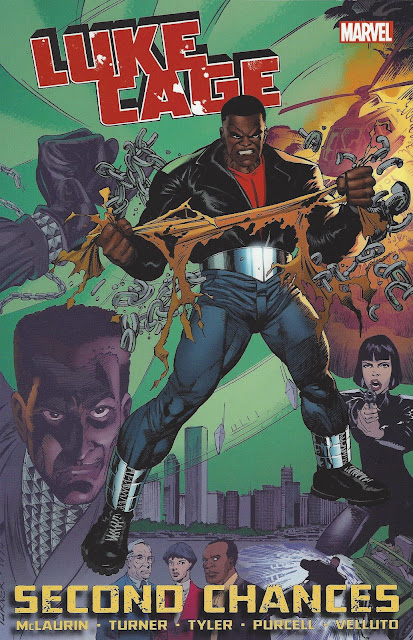
Luke Cage: Second Chances, v. 1

Collects: Cage #1-12, story from Marvel Comic Presents #82 (1992-3)

Released: September 2015 (Marvel)

Format: 320 pages / color / $34.99 / ISBN: 9780785192985

What is this?: Luke Cage takes his solo Hero for Hire business to the Windy City, where he allows a newspaper access to his cases.

The culprits: Writer Marcus McLaurin and penciler Dwayne Turner


Luke Cage, v. 1: Second Chances, v. 1 is 320 pages long, but it easily feels double that length. Reading each page is the equivalent of watching the minute hand on the clock in algebra class: You know you’re getting closer to the end, but you swear to Yeenoghu that you saw that hand move backwards at least once.

Cage, which premiered in 1992, returned Luke Cage to circulation for the first time since Power Man & Iron Fist ended in 1986. That absence is a crime; Luke Cage is too good a character to languish for more than half a decade, and returning Cage to the Marvel Universe is by far Cage’s greatest achievement.

Luke Cage: Second Chances, v. 1 coverWriter Marcus McLaurin and artist Dwayne Turner decided to update Cage for the ‘90s, which is a good idea. Turner’s modifications are largely successful. Turner gets rid of the afro, yellow shirt, tiara, and chain belt; the new Cage has close-cropped hair, no headgear of any sort, a tucked-in jacket that’s open in a deep V across the chest, and a large metal belt. It’s a good look overall, although the belt looks a lot like an upscaled version of Cage’s old tiara, hung around his waist. But McLaurin’s changes are just as dated today as Cage’s original trappings. The exclamation “Sweet Christmas!” is gone, although other characters use the not-at-all stupid minced oath “Dag!” Cage confronts evil rappers and street gangs, has an “attitude,” and uses ‘90s slang. The book is peppered with random references to mutants. In the end, the book could not be more ‘90s if it tried.

Another part of Cage’s ‘70s past that is jettisoned is his sleazy Times Square environs. Cage is primarily set in Chicago, which should make me like the book more. I’m a sucker for Marvel stories set somewhere other than New York; that’s one reason I enjoy Hulk stories. But as cartoonish as Luke Cage sometimes was in previous series, his setting was important and had an effect on the character. Cage, on the other hand, might as well be set in Minneapolis or Salt Lake City or Portland or any city with a few large buildings downtown. Chicago is a non-entity in this book, and neither the writing nor the art gives any indication Cage has set up shop in the US’s third-largest city.

During Second Chances, Cage is repeatedly harassed by Hardcore, a new villain created by Turner and McLaurin for this series. Unfortunately, Hardcore is an inadequate foil for Cage. He is, essentially, a middle manager, hampered by his boss’s restrictions and his underlings’ incompetence. Hardcore’s only offensive capability — a taser chain — is no threat to Cage. His personality, encapsulated by the occasional familiar quotation he flings at his adversaries and a Southern accent he often forgets to use, is not worth discussing.

Who is Hardcore working for? I’m going to spoil it for you, because it doesn’t matter: Cruz Bushmaster, son of Cage’s old enemy, Bushmaster. Why doesn’t it matter? Cruz appears only in #12, when his plan comes to fruition. He gains Cage’s powers, only to have them sucked dry by his apparently reborn father, who himself seems to die a few pages later in a fight with Cage and Iron Fist. It’s a pointless ending: second-rate villains disposed of in a second-rate story.

Turner and McLaurin made the excellent choice to use Dakota North, a private investigator who had made only a few appearances previous to Cage. Cage has no formal investigatory experience and no time for subtlety, so a character who can actually figure things out is a welcome addition to the cast. However, most of North’s investigations are about Cage himself and his family; she doesn’t help Cage much, and her investigations have little to do with the overall plot. Unfortunately, Turner draws her as an anatomical freak: impssibly thin but busty, long-legged, and wearing tight clothing. I realize that’s sadly not unusual for comics, but Turner also draws her clothes as dark, tight, and otherwise boring. Given that North was once a fashion model, she should never wear boring clothes.

The rest of the supporting cast is dull. Jeryn Hogarth, Heroes for Hire’s attorney, pops up but does nothing interesting. Analisa Medina, editor of the newspaper that follows Cage, is a nonentity. Mickey Hamilton, a photographer, follows Cage around, drops hints about Cage’s father, and serves as someone for Cage to rescue. We learn nothing about Mickey’s personal life or why he makes the choices he does. Troop, an orphan Cage takes in, has a character arc, but it’s a predictable one: he depends on Cage, Cage fails him, and then he joins a gang to get revenge on Cage. Given how much sympathy the book has for Troop, you can probably guess what he does when the gang sets a trap for Cage.

Even characters making guest appearances are dull. Cage’s last interesting client is in #2. The last interesting villain (Kickback) is in #4, and he’s not that interesting; his ability to time travel three minutes into the past or future allows for some interesting causal loops, but Kickback himself gets a complete character change between issues #3 and #4. Many innocents are subjected to the Power Man process, which eventually kills them, but they come and go like mayflies while Hardcase lingers on …

Some of the blame must fall on how Cage himself acts. He makes no strong attachments, other than Troop, pushing everyone else away. When Troop leaves, Cage is alone, with only his brash attitude and surliness for companionship despite living in the metropolis of Chicago. Despite having little trouble romantically in his previous series, he doesn’t date, and his only flirtation is with Medina. (That relationship goes nowhere.) Cage even bristles at the presence of Iron Fist, showing no interest in teaming up — or even being friendly to him.

I had planned on buying Second Chances, v. 2, but now I fear that book’s release. I realize Marvel wants more material featuring Cage out before his Netflix series is released, but it would be better to bury this series. Reading Second Chances, v. 1 is like being afflicted with a cold that won’t go away, one that doesn’t even give you entertaining fever dreams.

Rating: 0.5 of 5

Labels: , , , , , , , ,

28 April 2012

Marvel Firsts: The 1970s, v. 1

Collects: Amazing Adventures #1, 11, and 18; Savage Tales #1; Marvel Spotlight #1-2 and 5; Marvel Feature #1, Marvel Premiere #1; Tomb of Dracula #1; Hero for Hire #1; Combat Kelly & the Deadly Dozen #1; Outlaw Kid #10; Gunhawks #1; The Cat #1; Shanna the She-Devil #1; and Monster of Frankenstein #1 (1970-3)

Released: January 2012 (Marvel)

Format: 392 pages / color (except one b-&-w story) / $29.99 / ISBN: 9780785163800

What is this?: The first issues of the hottest new comic books that early 1970s Marvel has to offer.

The culprits: Too many to list, but writers Roy Thomas and Gary Friedrich show up a lot, as does artist Mike Ploog.


Grab-bag books, like Marvel Firsts: The 1970s, v. 1, are a tough sell. I think most readers are looking for a book united by plot rather than looser themes, such as date or character. Still, I was looking forward to reading the stories included in Marvel Firsts.

I have read many of the stories before in the first volumes of Essential series: Killraven (Amazing Adventures #18), Tomb of Dracula (#1), Power Man (Hero for Hire #1), Ghost Rider (Marvel Spotlight #5), Defenders (Marvel Feature #1). Still, the other stories held some interest. The book, I hoped, would give a glimpse into how Marvel was trying to expand its line in the first few years of the 1970s.

The collection kicks off with Amazing Adventures #1, which seems as natural an idea as there could have been in the Marvel Universe at the time: a book with a Black Widow story and an Inhumans story. It’s a good start, too, with the Inhumans story written by Stan Lee and drawn by Jack Kirby; the Black Widow story is drawn by John Buscema. But from there, Marvel goes in a different direction; there are only three more straightforward superhero stories included: the Defenders in Marvel Feature #1, the Cat in The Cat #1, and Power Man in Hero for Hire #1, and even Hero for Hire isn’t a pure superhero title, as tinged as it is by the Blaxploitation genre.

Marvel Firsts: The 1970s, v. 1 coverThe two major genres Marvel was pushing into at the time were horror and westerns. On the horror side, Tomb of Dracula #1 started a long-running title, and it is the best story in the book; it’s hard to read the tale, with Gene Colan‘s atmospheric pencils, and not want to know what comes next. Monster of Frankenstein #1 is a less successful attempt to revive a 19th-century classic monster; whereas Tomb of Dracula leaps from the end of Stoker’s novel to the ‘70s, with Dracula being an active character in the book, Monster of Frankenstein is set at the end of the 1800s, and the monster is inanimate throughout. A quicker start would have helped generate interest. Rounding out the Universal movie monster troika is the Wolfman — well, “Werewolf by Night,” in Marvel Spotlight #2. It’s a competent story, playing on themes of family, curses, and the animal inside, but unlike Tomb of Dracula, it doesn’t have Colan’s art to balance its typically ‘70s wordiness.

Some might consider Ghost Rider a superhero (all right, he is), but his origin in Marvel Spotlight #5 is definitely a horror story — horrific deaths, Satanic rituals, a flawed deal with the devil, a curse … yep, that’s horror, no matter how nonsensical the plot is. I’m lukewarm on Mike Ploog‘s art, but the visuals are striking. Savage Tales #1 is a simple but satisfying black-and-white story featuring the first appearance of Man-Thing, written by Roy Thomas and Gerry Conway. (They also collaborated on Tomb of Dracula #1.) Marvel used the magazine format to get impressive art from Gray Morrow; I was familiar with Colan, but Morrow’s art caught me pleasantly by surprise. Conway so liked the idea of a scientist using a formula on himself to keep it from falling into the wrong hands that he used it again in Amazing Adventures #11, in which the X-Men’s Beast transforms himself into a hairy monster. Beast was a hero before his solo stories and a hero after he embraced his transformation, but this is a horror story — right down to a “what have I done?” moment.

The Western was back in the early ‘70s, but there was less variety in the content than there were in the horror stories. Your options were a conflicted Native American (Red Wolf in Marvel Spotlight #1), a former slave and slave owner teaming up (Gunhawks in Gunhawks #1), or a young white guy (Outlaw Kid in Outlaw Kid #10). As you might guess, the books with non-white protagonists are painfully earnest and at times a bit uncomfortable. For instance, Marvel Spotlight #1 is full of pseudo-Indian mysticism, with little to recommend it but the race of Red Wolf, its protagonist. I don’t doubt that some slaves, like Reno Jones in Gunhawks, were treated well enough they might fight against their own interests and hold no ill will against their former masters. But in the long term, it’s problematic — Reno is atypical, and his own self-image eventually has to reflect that. Still, the story of young gunslingers Reno and Kid Cassidy is the most entertaining of the Westerns, with some nice banter between the leads, and Reno and Kid are treated as equals. Outlaw Kid #10’s cover promises a “Western Spider-Man,” and it delivers: the young Outlaw Kid takes on corruption in his home town in a mask, making him seem like a criminal, against the wishes of his blind, pacifist father. It doesn’t catch the magic of Spider-Man, but that’s a high standard, and Outlaw Kid is mostly inoffensive.

Other genres in the book include war, jungle, and sci-fi comics. Combat Kelly and the Deadly Dozen, a Sgt. Fury spinoff, shows why war comics were on the way out, despite the cast’s racial diversity and the inclusion of a female soldier. (Of course, the cast is much too large, and the woman ties her uniform shirt at her sternum to expose her midriff.) Shanna the She-Devil is fine but seems mostly an excuse for George Tuska to draw exotic animals and a woman wearing a leopard skin swimsuit. (Shanna made the outfit herself from a leopard massacred in her zoo so that she could gain “sight-scent recognitions with [the leopard’s] cubs.” Grisly.) Marvel Premiere #1 is nearly as exciting as you would expect a sci-fi story featuring Adam Warlock and the High Evolutionary gabbing to be. Amazing Adventures #18 sets up Killraven’s War of the Words backstory with remarkable efficiency and imagination, although some of its trappings come across as ridiculous today (and I suspect did in 1973, as well).

You would think Marvel would hardly need an excuse to praise their diversity in genre, gender, and race. But they don’t, and that’s my biggest disappointment with Marvel Firsts. I wanted introductory essays. I wanted context. I wanted timelines, charts, figures — something to pull this disparate set of comics together. It didn’t have to be elaborate; it just needed to exist. There is a little provided; each issue gets a flat sentence or two about the title, date, and character (“Amazing Adventures #11, published in December 1970, switched focus from Black Widow and the Inhumans, becoming the first ongoing series for a heavily revamped Beast, formerly of the X-Men”). Between the chronologically ordered issues are pages showing the covers of Marvel’s contemporary new series, with a brief sentence about each (usually, genre, title, date, and whether it was a reprint series). Still, I would like to know more. When did these series end? How many issues did they last? Was there anything interesting about them — I mean, is there a good reason the cover of humor comic Harvey #1 looked like Archie with Marvel trade dress pasted on it? I’d be willing to pay a bit more for this, or Amazing Adventures #18 could have been shifted to Marvel Firsts: The 1970s, v. 2.

As a random slice of Marvel at one of its most diverse times, Marvel Firsts: The 1970s, v. 1, is pretty impressive. I haven’t harped on it, but it’s remarkable how many of the protagonists aren’t just the same old white guys; Black Widow was an established character who got her own series, and the Cat (later Tigra), Power Man, and Shanna the She-Devil were created for their series. At least three members of the Deadly Dozen were not white (and one was not male), and Reno Jones of Gunhawks and Red Wolf weren’t white either. Most of these characters fell flat on their faces — only Power Man kept his series for very long — but you have to applaud Marvel for trying.

It’s unfortunate that most of the art and writing in Marvel Firsts cannot match the best of Marvel at the time, but given that many of these titles shifted their emphasis frequently or were second-tier to begin with, it’s understandable the top talent weren’t assigned to these stories, and those who were weren’t inspired to turn in their top work. It’s also sad that Conan the Barbarian #1 couldn’t be included because of legal reasons (not that the book mentioned this). And I wish there would have been more context. But it’s not wise to focus on what isn’t here; what is here is a collection of frequently enjoyable stories — although occasionally that enjoyment comes from how badly the stories have aged (or how badly they were told in the first place).

Rating: 2.5 of 5 Marvel symbol Marvel symbol Half Marvel symbol

Labels: , , , , , , , , , , , , , , , , ,

24 April 2009

Essential Power Man and Iron Fist, v. 2

Collects: Power Man & Iron Fist #76-100 and Daredevil #178 (1981-3)

Released: March 2009 (Marvel)

Format: 624 pages / black and white / $19.99 / ISBN: 9780785130727

What is this?: A two-year slice of early ‘80s street-level Marvel superheroing, featuring the Heroes for Hire: Power Man and Iron Fist.

The culprits: Writers Mary Jo Duffy, Denny O’Neil, and Kurt Busiek and pencilers Denys Cowan, Ernie Chan, and Kerry Gammill, with many other writers and artists

When people get nostalgic for the early ‘80s, Jim Shooter-era Marvel, they don’t often wax nostalgic about Power Man & Iron Fist. (Not in my experience, anyway. I’m sure there are corners of the Internet where that is exactly what happens.) But in many ways, Essential Power Man & Iron Fist, v. 2, is part of the bedrock of that time.

Power Man & Iron Fist has its flaws, but it was a second-tier book that kept chugging along, month after month. Once past Cage’s “Sweet Christmas!” (not much in evidence here) and jive, there’s not much laughable about the title, unlike Dazzler or U.S. 1. Every month is a solid story — well short of unforgettable, usually, but rarely disappointing. There was a consistent supporting cast, well used. The villains … OK, these were mostly second-tier, and even with Sabretooth, you know no one had figured out quite what to do with him yet, other than use him as an Iron Fist villain. But these villains were appropriate to the heroes, they had a score to settle, and they frequently had an interesting hook or visual.

Essential Power Man & Iron Fist, v. 2 cover The writers all have solid credentials in similar low-powered superheroes, although Kurt Busiek found his success a little later than Denny O’Neil and Mary Jo Duffy’s best-known writing is probably Power Man & Iron Fist. The artists are nothing to sneer at either, although Ernie Chan is better known as the inker for Conan than a penciler and neither Kerry Gammill nor Denys Cowan are current superstars or objects of nostalgic veneration.

There is no overarching plot for the volume, of course; there never is in an Essential. So let’s talk about the writers. Duffy uses humor well, rarely letting it get in the way of the plot (except for #79, which is essentially a Doctor Who story, with a cut-rate non-licensed Doctor Who). Unsurprisingly, she’s also the most deft with the largely female supporting cast. O’Neil, who takes over with #85, does away with Duffy’s last shocking change — the scarring of Harmony, a fashion model and Cage’s girlfriend, as soon as it is safe — and … well, I’m not sure what to say about his run, which lasted until #89, except that it’s mainly forgettable: a couple of adventures outside New York, a rescue of Moon Knight, an anti-drugs story. Very ‘80s, in its way, I suppose.

Busiek takes it the rest of the way (except for #91, written by Steven Grant), but this isn’t the Busiek we know from Marvels or Astro City. He’s unpolished here, indulging in legacy characters by bringing back the ID and gimmick of Chemistro and picking up on hints from the O’Neil run that Luke might not be looked upon kindly by his Times Square neighbors. That’s an interesting idea, but he conflates the scum of Times Square, who might want to kick a hero out of their midst, with the African-Americans who think Cage is too white. (The word “Oreo” is used a lot.) Both those groups are wrapped up in the newest Chemistro, who is black and promises to keep the area safe for criminals — not like that Cage, who works with the po-lice. There’s a good story about the heroes escorting Hammerhead to a different prison (although why do they have to ride on the top of a truck to do it?), and Busiek does manage to keep a group of subplots moving forward quite ably, wrapping them up in the double-sized #100.

Gammill supplies the best art in the volume. His pencils are sharp, vivid, and kinetic, and for readers, it’s a shame he only stays on for only for only three issues, #77-9. In many ways, this style of art is underappreciated: without enough tics or exaggerations to be memorable, it has to settle for an understated excellence. Cowan’s style suffers from the black-and-white reproduction and a series of inkers; I remember his work being much better in color in the original issues. The inking of Carl Potts, who finished almost half Cowan’s work on the title (#80-4, 86-90, and 92-3), does him no favors, and that and the lack of color sometimes makes it difficult to make out details with his scratchy style. Chan works #94-100; his art starts off stiff, but it improves greatly when he stops inking his own pencils.

Some call it mediocrity, others consistency. But most of us who enjoy comics from that era can’t quite put our fingers on what to call it; we only recognize it has a familiar feel, comforting without being exciting. This isn’t probably the best way to spend your $20 — and don’t think I haven’t noticed that price increase, Marvel; you’re on notice — but most readers won’t regret the time or money spent with this volume.

Rating: Marvel symbol Marvel symbol Marvel symbol (3 of 5)

Labels: , , , , , , , , , ,