Reviews of trade paperbacks of comic books (mostly Marvel), along with a few other semi-relevant comments / reviews.

24 April 2009

Essential Power Man and Iron Fist, v. 2

Collects: Power Man & Iron Fist #76-100 and Daredevil #178 (1981-3)

Released: March 2009 (Marvel)

Format: 624 pages / black and white / $19.99 / ISBN: 9780785130727

What is this?: A two-year slice of early ‘80s street-level Marvel superheroing, featuring the Heroes for Hire: Power Man and Iron Fist.

The culprits: Writers Mary Jo Duffy, Denny O’Neil, and Kurt Busiek and pencilers Denys Cowan, Ernie Chan, and Kerry Gammill, with many other writers and artists

When people get nostalgic for the early ‘80s, Jim Shooter-era Marvel, they don’t often wax nostalgic about Power Man & Iron Fist. (Not in my experience, anyway. I’m sure there are corners of the Internet where that is exactly what happens.) But in many ways, Essential Power Man & Iron Fist, v. 2, is part of the bedrock of that time.

Power Man & Iron Fist has its flaws, but it was a second-tier book that kept chugging along, month after month. Once past Cage’s “Sweet Christmas!” (not much in evidence here) and jive, there’s not much laughable about the title, unlike Dazzler or U.S. 1. Every month is a solid story — well short of unforgettable, usually, but rarely disappointing. There was a consistent supporting cast, well used. The villains … OK, these were mostly second-tier, and even with Sabretooth, you know no one had figured out quite what to do with him yet, other than use him as an Iron Fist villain. But these villains were appropriate to the heroes, they had a score to settle, and they frequently had an interesting hook or visual.

Essential Power Man & Iron Fist, v. 2 cover The writers all have solid credentials in similar low-powered superheroes, although Kurt Busiek found his success a little later than Denny O’Neil and Mary Jo Duffy’s best-known writing is probably Power Man & Iron Fist. The artists are nothing to sneer at either, although Ernie Chan is better known as the inker for Conan than a penciler and neither Kerry Gammill nor Denys Cowan are current superstars or objects of nostalgic veneration.

There is no overarching plot for the volume, of course; there never is in an Essential. So let’s talk about the writers. Duffy uses humor well, rarely letting it get in the way of the plot (except for #79, which is essentially a Doctor Who story, with a cut-rate non-licensed Doctor Who). Unsurprisingly, she’s also the most deft with the largely female supporting cast. O’Neil, who takes over with #85, does away with Duffy’s last shocking change — the scarring of Harmony, a fashion model and Cage’s girlfriend, as soon as it is safe — and … well, I’m not sure what to say about his run, which lasted until #89, except that it’s mainly forgettable: a couple of adventures outside New York, a rescue of Moon Knight, an anti-drugs story. Very ‘80s, in its way, I suppose.

Busiek takes it the rest of the way (except for #91, written by Steven Grant), but this isn’t the Busiek we know from Marvels or Astro City. He’s unpolished here, indulging in legacy characters by bringing back the ID and gimmick of Chemistro and picking up on hints from the O’Neil run that Luke might not be looked upon kindly by his Times Square neighbors. That’s an interesting idea, but he conflates the scum of Times Square, who might want to kick a hero out of their midst, with the African-Americans who think Cage is too white. (The word “Oreo” is used a lot.) Both those groups are wrapped up in the newest Chemistro, who is black and promises to keep the area safe for criminals — not like that Cage, who works with the po-lice. There’s a good story about the heroes escorting Hammerhead to a different prison (although why do they have to ride on the top of a truck to do it?), and Busiek does manage to keep a group of subplots moving forward quite ably, wrapping them up in the double-sized #100.

Gammill supplies the best art in the volume. His pencils are sharp, vivid, and kinetic, and for readers, it’s a shame he only stays on for only for only three issues, #77-9. In many ways, this style of art is underappreciated: without enough tics or exaggerations to be memorable, it has to settle for an understated excellence. Cowan’s style suffers from the black-and-white reproduction and a series of inkers; I remember his work being much better in color in the original issues. The inking of Carl Potts, who finished almost half Cowan’s work on the title (#80-4, 86-90, and 92-3), does him no favors, and that and the lack of color sometimes makes it difficult to make out details with his scratchy style. Chan works #94-100; his art starts off stiff, but it improves greatly when he stops inking his own pencils.

Some call it mediocrity, others consistency. But most of us who enjoy comics from that era can’t quite put our fingers on what to call it; we only recognize it has a familiar feel, comforting without being exciting. This isn’t probably the best way to spend your $20 — and don’t think I haven’t noticed that price increase, Marvel; you’re on notice — but most readers won’t regret the time or money spent with this volume.

Rating: Marvel symbol Marvel symbol Marvel symbol (3 of 5)

Labels: , , , , , , , , , ,

16 January 2009

Spider-Man Visionaries: Kurt Busiek, v. 1

Collects: Untold Tales of Spider-Man #1-8 (1995-6)

Released: August 2006 (Marvel)

Format: 176 pages / color / $19.99 / ISBN: 9780785122043

What is this?: A collection of Spider-Man stories told in the ’90s but fitting into his early days.

The culprits: Writer Kurt Busiek and artist Pat Olliffe.

With certain writers, you know what you’re going to get. Alan Moore is going to give you stories with nearly impenetrable depth, many literary allusions, and bits of magic. With Grant Morrison, you’re going to get new versions of Silver Age stories that seem like they were originally read by a 9-year-old on LSD and were written by a 40-year-old on peyote. J. Michael Straczynski writes stories that … well, I don’t know actually, but it might come out a little late. Joss Whedon writes stories with sharp, cutting-edge dialogue that come out much, much later than Straczynski’s stories.

Kurt Busiek writes straight superhero stories. Some of them have disarmingly retro feel — well, all of them do now, because Busiek don’t do decompression. But they are often the kind of stories that would fit in with the ‘80s or even earlier, and critics often say they are excellent — not as nostalgia pieces but in their own right.

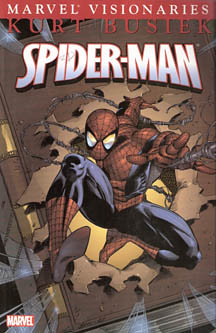
Spider-Man Visionaries: Kurt Busiek, v. 1 coverSpider-Man Visionaries: Kurt Busiek, v. 1 comes near the beginning of Busiek’s career. The stories in Visionaries are from Untold Tales of Spider-Man, a title that filled in the gaps between Spider-Man’s early adventures in the ‘60s. Usually, I dislike retcon series and stories, because they can’t tell any stories that change the status quo. But early Spider-Man — and probably all of Marvel’s Silver Age, for that matter — is a better fit. Stan Lee and Steve Ditko told the original stories with relatively broad strokes, allowing Busiek the opportunity to fill in some detail work. And if you can write a good Spider-Man story, it doesn’t have to be of earthshattering import; it just has to be entertaining.

There’s no worries there. Busiek has a firm grasp on both Spider-Man and the era. His Peter Parker is neurotic, simultaneously shunning and desiring acceptance from his classmates, learning to date for the first time with the confidence his new powers have given him, and fretting over money and Aunt May. The stories are fun, although his new villains aren’t all that interesting. (Which isn’t a problem; if they were supposed to appear for the first time at the beginning of Spider-Man’s career and haven’t been since, they have to lack something.) Two stories stick out for me: Spider-Man and the Human Torch teaming up to unravel the Wizard’s riddles and capturing him (#6) and Harry Osborne dealing with Spider-Man, the Enforcers, and his father’s deteriorating mental state (#8).

As I mentioned in the review for Last Hero Standing, I like Pat Olliffe’s work. It’s easy to see why someone could see his work on Untold Tales and think of him for the retro-styled tales of Spider-Girl and other retro-feeling tales. His Spider-Man and Peter Parker aren’t swipes of Ditko, but they do echo the first Spider-Man artist’s work, especially with the underarm webs on Spider-Man’s costume and giant glasses on Peter. The storytelling is simple and at times elegant, with little flash but with plenty of style. Shifting inkers don’t help his cause but aren’t a major source of concern.

If I were a quibbler, I’d note most of Busiek’s contributions to the Spider-Man canon have disappeared without a trace, and I don’t care about Sally Avril and Jason Ionello, his additions to Peter’s high school. But that’s not fair; it would have been extremely difficult for anything in this short-lived, set-in-the-past series to stick. It’s more useful to concentrate on Busiek and Olliffe’s work in bringing out a series of simple, worthwhile stories with a supporting cast at a time when such stories were in short supply.

Rating: Spider-Man symbol Spider-Man symbol Spider-Man symbol Spider-Man symbol (3.5 of 5)

Labels: , , , , , , ,

13 April 2006

Avengers / Thunderbolts, v. 1: The Nefaria Protocols

Collects: Avengers (v. 3) #31-4, Thunderbolts #42-44 (2000)

Released: March 2004 (Marvel)

When Count Luchino Nefaria begins a plot to change the world, who’re you gonna call?

The Avengers! And the Thunderbolts!

The 2000 crossover between the two titles was tied to ionic powers, which are … well, you see, their bodies … it alters the … Hmm. Ionic energy makes people glow odd colors, seem to have a corona and leak energy from the eyes, and allows them to be superstrong and fly (eventually) and come back from the dead (also eventually). Possibly there are other powers in there as well.

Now in the X-Books, that alone would be enough for a 12-part crossover. But that’s not enough for Avengers writer Kurt Busiek and Thunderbolts writer Fabian Nicieza. So not only does Avenger Wonder Man and Thunderbolt Atlas have ionic powers like Nefaria, Nefaria’s daughter, Madame Masque, was a former lover of Iron Man, one of the Avengers. Add in Nefaria and Masque’s ties to the Maggia, an organized crime syndicate, plus the Grim Reaper, brother of Wonder Man and the Vision (kinda), who’s working for the Maggia … well, you’ve got seven issues jammed full of plot.

That’s not to say there aren’t fun moments or characterization. Seven issues is more than enough time to allow the characters to act like themselves, have fun little moments (like Vision asking teammate Warbird out to dinner, while his ex-wife the Scarlet Witch watches), and otherwise act as if this another chapter in the characters’ lives, rather than “event.”

For the most part, The Nefaria Protocols is a fun ride, although it is occasionally extremely dense to the point of requiring decryption. The difficult part to read is the Thunderbolts issues. While the Avengers issues are wonderfully self-contained — except for following Dr. Pym’s swashbuckling alter ego as he runs around, starting bar fights with science nerds — the Thunderbolts issues are knee-deep in their own subplots. On one level, this is admirable, both from Nicieza and Marvel; Nicieza rewards readers of Thunderbolts and does a wonderful job of avoiding forcing his readers into buying the entire crossover, and it wasn’t long ago Marvel would quash subplots during crossovers (Peter David quit X-Factor for just that reason). However, I’m on a different level: that of someone reading the trade out of sequence of the rest of the series.

It’s easy to see the contrast in styles between Busiek and Nicieza in The Nefaria Protocols. Both will mine deep in past continuity and refine it for storylines. Busiek will occasionally sacrifice pacing for comprehension, although I don’t think he does in The Nefaria Protocols. Sometimes, however, Busiek’s stories read as if their primary purpose was to wrap up loose ends (Avengers Forever, for example). I’m not sure whether it’s laudable or condemnable in artistic sense. I enjoy those types of stories, especially when they seem well researched and heavily footnoted, but it does make the stories difficult to read sometimes. In this TPB, Avengers #33 seems the strongest example of this: assembling all the threads of Madame Masque’s life and tying off the loose ones.

Nicieza will skip the detailed explanations and draw out the suspense, so we see several plotlines running in the background: the Scourge, who Techno has in the tubes, what Andrea Sterman is going on about, what’s eating Moonstone, etc. I don’t know if Nicieza planned these as trailers for Avengers readers who were crossing over, but they read like spare cogs and wheels bouncing around inside the engine block in the trade. (Not that I want them taken out; when I buy a reprint, I want all the story reprinted.) Nicieza seems occasionally use obscure characters and plot points because he enjoys obscure characters and plot points. I mean, he resurrected a Humus Sapien, a character that won a Marvel contest but never even saw print, in Thunderbolts #55.

Art is provided by George Perez on the Avengers issues and Mark Bagley on the Thunderbolts. Both are accomplished superhero artists, able to tell a story with a great deal of action, and Perez, the veteran, shines in his Avengers finale. Normally, I enjoy Bagley’s work, but he clearly comes off in second place here. Thunderbolts #43, for example, has the characters standing around a great deal, which doesn’t exactly play to his strengths. All his females have the same exaggerated curvaceousness — a staple of the superhero genre, to be sure, but with so many women in spandex, it becomes monotonous and distracting, especially when you see how Perez draws them. Some might say there’s a bit of sameness in his faces as well. Still, it’s much more than competent, so there’s little real room to complain.

Unfortunately, this book appears to be out of print or on the shadowy edges of OOP that Marvel’s printing policies creates. Still, copies are available on E-Bay, and it’s well worth your time hunting it down.

Grade: A-

Labels: , , , , , , , ,