


Spider-Girl, v. 1: Family Values
Collects: Spider-Girl v. 2 #1-8, back-up from Amazing Spider-Man #648 (2011)
Released: August 2011 (Marvel)
Format: 208 pages / color / $19.99 / ISBN: 9780785146940
What is this?: Anya Corazon embraces the name Spider-Girl and begins her own adventures.
The culprits: Writer Paul Tobin and artists Clayton Henry and Matthew Southworth
I’ve complained at length about the difficulty of establishing and selling new characters in mainstream comics. But as hard as it is, the task should be a high priority for Marvel and DC, given that both are owned by huge entertainment corporations that need new concepts constantly. Warner Brothers and Disney want new characters — ones created some time after the Vietnam War, preferably — that can be sold to a new generation of consumers, and a lot of ideas can still be generated and tested in a short time in comics.
Although commercial appeal should not be artists’ main concern, it is the main concern of the companies that employ those artists. I’m not sure why Warner Brothers and Disney don’t encourage, by threat or incentive, their subsidiaries to devote more resources and patience to new characters; the Marvel movie universe should show how lucrative one sustained burst of creativity, lasting just a few years, can be.
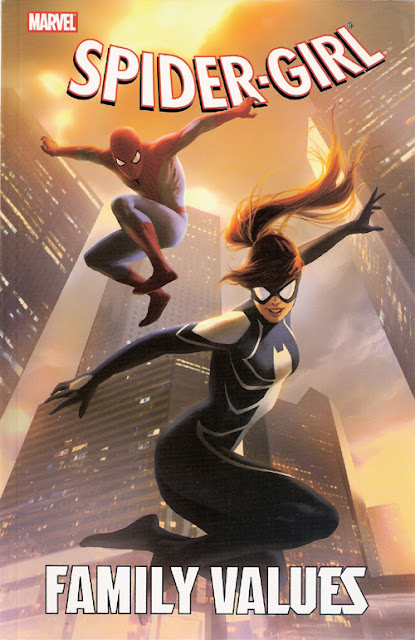 Until then, we get newer characters in dribs and drabs. Take Spider-Girl, for instance. Originally, Anya Corazon was Araña, a character whose most prominent selling point was her ethnicity. Predictably, that went over badly. When her original series was cancelled, she was separated from her mystic origin and put into the Young Allies. That series lasted as long as you would expect a team book with Firestar as its most recognizable character to last.
But Marvel didn’t give up on Anya, and good for them. The concept has the seeds of a good, marketable idea: spunky, young female protagonist who adds a little ethnic diversity to the Marvel Universe and who can be linked to Spider-Man. The “Grim Hunt” storyline in Amazing Spider-Man strengthened Anya’s ties to Spider-Man; change her code name, and viola! The result is Spider-Girl, v. 1: Family Values. Volume 1 is the totality of the series, though — the series was cancelled after eight issues. But is there anything here to salvage going forward? Maybe.
Writer Paul Tobin has decided that since Anya is a teenager in the ‘10s, she should be on Twitter … as Spider-Girl. I applaud Tobin for trying to find something new and unique for the character, something that fits her character. Spider-Girl’s tweets aren’t as intrusive as you might suspect, since they fill the same niche as text boxes with characters’ thoughts (which themselves replaced thought bubbles). This approach works as long as the reader doesn’t think too much about it; however, there’s no place for a phone on her skin-tight costume, and as another character reveals, her tweets reveal too much about Spider-Girl’s real name. We’re probably supposed to believe Anya is tweeting after she returns to her civilian ID, but given the detail and number of her tweets, I’d think another form of social networking — Reddit? a blog? — would be a better choice. Harder to make work on the comics page, though.
Tobin also tries to integrate Spider-Girl into the wider Marvel Universe. This is also a great idea, but the execution is lacking. Spider-Man is a natural fit for Spider-Girl, especially after Grim Hunt. The first story in Family Values, the back-up from Amazing Spider-Man #648, shows that working relationship: Spider-Girl intimidated but competent, with Spider-Girl not at the level of an Avenger but still an effective street-level hero. And that’s who Spider-Girl should be meeting: street-level heroes such as Daredevil, Heroes for Hire, Moon Knight, etc. Chuck a brick out the window in Marvel New York, and you hit a street-level hero.
But in #1, Anya is palling around with the Invisible Woman and the rest of the Fantastic Four, which feels wrong. I’m not sure if Tobin created the connection between Gil Corazon and the Fantastic Four, but the Fantastic Four is the first family of Marvel, and the connection draws Anya toward the middle of the Marvel Universe; writing Spider-Girl as important to the Fantastic Four and the Spider-Man makes Tobin seem like he’s trying too hard to push Spider-Girl, although the attempt is not as egregious Tamora Pierce and Timothy Liebe’s effort in White Tiger. By the end of the story, Spider-Girl is showing up Spider-Man and taunting the Red Hulk when she should be teaming up with young heroes like Bucky, her friend and classmate from Young Allies, or complementing more experienced heroes.
Anya could be a simple character with a simple, if well-worn, hook: a high-school girl with a connection to Spider-Man, balancing fighting street-level crime and a personal life centered around school and friends. But Anya was already a convoluted character before this series. Her original series made her the super-powered operative of the Spider Society, which fought the Sisterhood of the Wasp in a mystical war. During Civil War, she hobnobbed with famous heroes, such as Ms. Marvel and Wonder Man. There’s a cryptic mention in Family Values of her learning advanced computer skills from SHIELD, but I have no idea where that comes from. None of this backstory is mentioned in Family Values — the extremely brief recap page from Spider-Girl #1 is entirely insufficient. But whether Tobin is hiding these complications, trying to push across a slightly rolled-back version of Anya before pushing her back into the MU, or deprecating her complications because they aren’t relevant, it’s for the best: none of those stories make her more interesting.
Tobin nicely balances Spider-Girl’s heroism with Anya’s personal life. Anya and her father move, giving Tobin a chance to introduce a new supporting cast. In theory, that’s good, allowing the book to distance itself from Araña. However, Tobin goes too far. Her friendship with Bucky, both in and out of costume, was one of the strengths of Young Allies, but Bucky is barely in Family Values, and she’s never in costume. Worse, Tobin kills Anya’s father in the first issue. (That’s hardly a spoiler; it’s on the back cover.) Beyond the complicated questions of grief that should grip the book, it leaves the question of how a high-school student would be allowed to live without a guardian. (She could be 18, but I never had that impression.) It also removes a character who should have had a strong supporting role in favor of cheap pathos; Gil Corazon had much more potential as a father than as a corpse. Rocky, who becomes Anya’s best friend and roommate, never quite becomes interesting enough to fill in the gap. I’m sure the Fantastic Four, Marvel’s First Family, is supposed to serve as a surrogate family, but that feels forced.
Tobin does an excellent job of choosing adversaries for Spider-Girl. Screwball (a parkour-using publicity hound) and Ana Kravinoff (Kraven the Hunter’s daughter) are thematically excellent choices, although since Spider-Man has had some trouble with both of them, Spider-Girl’s victories over both does make Spider-Man look weak next to a unpowered teenager. Hobgoblin is a bit out of her league, but Spider-Man gets involved with their fight, making the heroes’ victory more believable. The Red Hulk is a mistake — not just in this book, but as a character. But the assorted muggers and thus, of course, are exactly what is needed.
Family Values also introduces Raven, a secret organization with scientists and augmented operatives in the same vein as the Secret Empire, the Corporation, AIM, etc. Raven plans to blackmail or suborn Spider-Girl into becoming its agent; it’s cute that one of its operatives thinks having Spider-Girl on Raven’s side is going to make a big difference — cute, and totally believable in the tunnel-vision way of mad planners. I’m assuming Tobin had plans to make this slow-burning plot last longer; the resolution, which takes up all of #7 and 8, feels rushed and has all the hurried hallmarks of a plot that has to be wrapped up before cancellation. There’s nothing unique about Raven that required it to be a new group — there are dozens of similar groups in Marvel history waiting for resurrection — but perhaps Tobin had something specific in mind that didn’t fit other groups.
Family Values has two pencilers on its main stories: Matthew Southworth, who drew #4 and 5 (the fight vs. Ana Kravinoff), and Clayton Henry, who drew the rest. Henry provides most of the pencils. His work is clear and pleasant, although occasionally the characters come across as a little plastic. Southworth has the more unusual style, reminiscent of Michael Lark — a good comparison when you’re dealing with two people of normal power levels kicking and punching each other. Dean Haspiel’s cartoony art is an excellent complement to Tobin’s amusing backup in #1, in which a young Anya meets the Fantastic Four for the first time. Chris Sotomayor, the colorist, has trouble finding a consistent skin tone for Anya. Her skin runs the gamut from light to dark, and she switches between being a brunette and a redhead.
So is there much to salvage from Family Values? The character of Anya, perhaps, but she was in better shape at the end of Young Allies. The stories and art are solid but not spectacular, so reading Family Values is not time wasted. But by trying to add too many new connections to the hero, Tobin’s restart doesn’t add much to the character; it serves as a detriment, actually, making the character less relatable and taking away Anya’s father. The story with Raven and the Red Hulk is wrapped up with a neat bow at the end, so the story’s main plot has few-to-no loose ends. (The exception is that another civilian knows her secret identity.) Family Values gives writers the opportunity to team Anya with the Fantastic Four. I’m not sure that’s a positive, though.
Rating:

 (2.5 of 5)
Labels: 2.5, 2011 August, Anya Corazon, Chris Sotomayor, Clayton Henry, Marvel, Matthew Southworth, Paul Tobin, Spider-Girl
posted by Raoul | 3:44 PM
|
0 comments

 Finally, May makes a decision about her love life, instead of endlessly vacillating. Mary Jane’s pregnancy finally — finally — ends. May comes closer to making her peace with Kaine, Alison Mongrain, and Felicity Hardy. We finally see Blackie Drago again. In short, the background plots seem like they are moving for once, and that injects some interest into the story. It felt as if writer Tom DeFalco was going to let some of them simmer forever.
 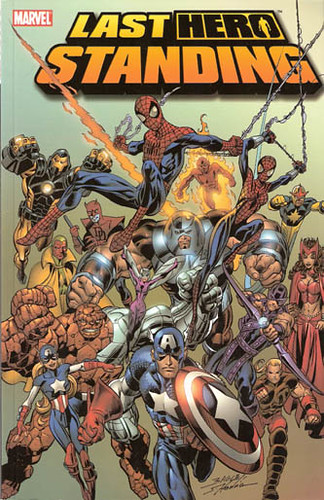 In Hero, superheroes begin disappearing — Wolverine, Spider-Man, the Thing, one of the Ladyhawks — and the other heroes blindly investigate. As more are abducted and the remaining heroes come closer to finding the truth, the missing heroes return as ‘90s version of themselves, albeit without pouches, spikes, or shoulder pads. No, they’re grittier and grimmer, and they are out for the blood of those they loosely define as villains. Meanwhile, the aged Captain America wrestles with failing abilities in an environment in which small failures could lead to death — his or another’s.
 And DeFalco’s setting up even more plotlines, with Flash and the Black Cat’s daughter Felicity in Midtown High and their difficulties with their son, Gene. A former Spider-Woman and surprise reveal comes to see Peter about the new Spider-Man. The soap operas at May’s high school are a little tiresome; other than May’s relationships (none at the moment) and the amusing Moose / Courtney pairing (dimwit Moose thinks dumpy Courtney is Spider-Girl), I just don’t care.
 (2.5 of 5)
 Spider-Girl is Marvel’s little title that could. Based on an issue of What If? (v. 2), Spider-Girl is the last survivor of a doomed comic line (M2) that focused on characters about a generation later than the current Marvel Universe. This continuity is dominated by the offspring of current heroes, and Spider-Girl is May Parker, daughter of Spider-Man.