Reviews of trade paperbacks of comic books (mostly Marvel), along with a few other semi-relevant comments / reviews.

30 August 2013

Green Goblin: A Lighter Shade of Green

Collects: Green Goblin #1-13, Web of Spider-Man #125, Spectacular Spider-Man #225, and Amazing Scarlet Spider #2 (1995-6)

Released: August 2011 (Marvel)

Format: pages / color / $39.99 / ISBN: 9780785157571

What is this?: Daily Bugle intern Phil Urich runs across some Green Goblin equipment and tries to decide whether to help himself or others.

The culprits: Writer Tom DeFalco and Terry Kavanagh and artists Scott McDaniel, Joshua Hood, and others


Marvel’s decision to reprint the 1995-6 Green Goblin series in Green Goblin: A Lighter Shade of Green was a curious one. Theoretically, with the Green Goblin being Spider-Man’s archnemesis, a Green Goblin series should have been important. It wasn’t, though; it was a mid-‘90s series about a newspaper intern, Phil Urich, who stumbles across the Osborn Goblin gear. Green Goblin wrapped up just before Onslaught gave Marvel the freedom to do some excellent work with new or lesser-known concepts (Thunderbolts, Deadpool). Neither the writer, Tom DeFalco, nor the main artist, Scott McDaniel, are “hot” or “new” or “critic’s darlings.” As a final nail in the commercial coffin, the character crossed over with the ‘90s Clone Saga.

I suppose Phil becoming the latest Hobgoblin, a recurring villain in Amazing Spider-Man, at the end of 2010 was the impetus for the reprint. Still, that’s a slender thread on which to hang a $40 reprint of a little-remembered, unlamented series like Green Goblin.
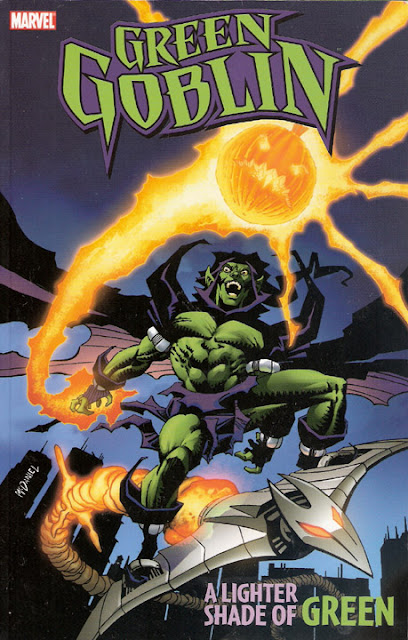
Green Goblin: A Lighter Shade of Green coverGreen Goblin is a series that relies heavily its protagonist narrating his thoughts, which is a problem: Phil is a teenager, and when middle-aged white guys write “hip” teenagers, the results always lack verisimilitude. DeFalco seems to have picked up all his teenager dialogue from bad TV shows that were also written by middle-aged white guys. Although Phil does have a distinctive voice, I don’t believe anyone has ever spoken like him in the history of mankind — unless, by chance, some grunting caveman or cavewoman accidentally strung together the same syllables Phil used. I was a teenager in the ‘90s, and I can guarantee none of my friends ever used phrases like “Scarlet really ups the gear” or “she’s mint, sexy, and all that!” I didn’t either — or at least I don’t remember sounding like that. Might explain my social life if I did say those sorts of things. Slammin’!

A second problem with Phil’s narration is that Phil is not an intrinsically likeable person. Phil is one of those slackers DeFalco had heard so much about, a college dropout working as an intern for his uncle, Ben Urich, at the Daily Bugle. Having dropped out of college, Phil doesn’t know what he’s going to do with his life, and when he gets the Green Goblin equipment, he’s not sure how he wants to use it. He doesn’t instinctually aid others, but he usually ends up being helpful. He has vague ideas of gaining fame, acclaim, money, and women, but his plots are badly thought out, and they lack ambition. Also, Phil’s a bit skeevy about the women; he notes when Lynn, the girl he has a crush on, “jiggles into view” and thinks about “all the butter [he] wanted to spread on Lynn.” It’s no surprise that when he gets some money, he spends it on a suit and flowers and expects Lynn to fall into his arms, despite his lack of charm and her general lack of interest in him as anything but a co-worker and source of info.92

DeFalco does a good job choosing sparring partners for Phil to fight, mixing established villains with new ones. Hobgoblin is a no-brainer, considering he was, at the time, the only other living link to the Goblin legacy. Arcade is always a good choice for a beginning hero. Yes, it stretches credibility that Phil would be able to defeat the Rhino early in his career, but in issue #2, the hero needs a victory, and in a battle between two lunkheads, I can buy that the first person with a good idea would win. The new villains are a mixed bag; Angel Face is the most competent and has a real reason to keep after the Green Goblin, and the Steel Slammer has a nice design. Purge, a generic assassin, and Jonathan Gatesworth, a “virtual reality” creator, are forgettable.93

Even beyond DeFalco’s failed attempts to emulate the youth slang of the day, Green Goblin is marked pretty solidly as a ‘90s comic by DeFalco working current events of the comic-book industry into the background. At one point, recurring villain Angel Face robs a tycoon named “Berinutter,” which sounds like DeFalco’s way tweaking the nose of or taking his frustrations out on Isaac Perlmutter, who was chairman at the board at Marvel at the time. DeFalco also makes “Larson Toddsmith” and “Marc Portaccio” the unscrupulous heads of Compuboot, a game company; the names are obvious references to Image Comics founders Erik Larsen, Todd McFarlane, Marc Silvestri, and Whilce Portacio.

Marvel’s financial situation was worsening at the time, and DeFalco has some opinions on how business and creative pursuits should intersect; in #9, he puts these words into a villain’s mouth: “[We] would be in Chapter 11 if not for [our] financial wizardry and … marketing magic! Creativity is fine … in its place … but the business people transform vague ideas into profits!” Later in the issue, he puts the opposite view into Phil’s mousy potential love interest, Meredith Campbell: “Corporations don’t think like us regular folks! No matter how much profit they generate … it’s never enough!” The joke was on DeFalco, though, as Marvel filed for Chapter 11 in December 1996, a few months after Green Goblin was cancelled.

The book includes three Spider-issues. The best is a crossover between Amazing Scarlet Spider #2 and Green Goblin #3, which is part of the Great Game storyline. Phil gets a crush on the amoral Joystick, who fights in the Great Game, an international gladiatorial contest. Joystick is in town to fight the Scarlet Spider, but her plans are loused up by one of her previous victims, El Toro Negro. DeFalco had an excellent chance to contrast the attitudes of the thrill-seeking Joystick and responsible Scarlet Spider, especially since the Scarlet Spider doesn’t have Spider-Man’s cachet as a moral center of the superhuman community. Instead, DeFalco treads too lightly on the question, having Phil reject Spider-Man’s ethos without seeing his own similarities to Joystick.

Web of Spider-Man #125 and Spectacular Spider-Man #225, which immediately follow Green Goblin #1 in this volume, seem like the traditional attempts to boost a new character’s profile with an appearance in a Spider-book. Unfortunately, the two issues serve as poor attempts at promotion, since the Green Goblin in those books little resembled the one who starred in his own book. Web #125, written by Terry Kavanagh, is the worst offender, as Phil’s motivations for being in the Clone-Saga story are weak at best and nonsensical at worst. Spectacular #225 is written by DeFalco, but Phil’s reasons for being out in costume are not in line with his development in his own series; Phil sees himself on a “grim mission” when he hunts down a man setting fire to homeless people, which is quite heroic for someone who hasn’t decided what to do with his new powers. His inexperience does show in his battles with the villain and Spider-Man, though.

DeFalco keeps bringing up Phil’s struggles with his identity: is he a hero or someone who merely exploits his abilities for personal gain? An ambitious man or slacker? Ladies man or creep? Although Phil arrives at the place you expect him to by the series’ end, it is sometimes hard to follow his developmental path. He eventually overcomes his fear of the neighborhood thug, Ricko the Sicko, but he still fears the Hobgoblin’s wrath. He rejects Lynn not because he finds a woman whom he is more compatible with but because he realizes Lynn isn’t that interested in him. His heroism is motivated as much by a desire to impress Lynn as his nascent conscience, despite advice from Daredevil and Scarlet Spider. Only the Onslaught crisis forces him to answer the questions, and then the series ends.

The primary artist for Green Goblin, Scott McDaniel, has a blocky, exaggerated style that works best in the ‘90s. The Green Goblin costume and mask lends itself to exaggerated touches, and I like the Steel Slammer design, but he has a little trouble with Phil’s quieter moments. (McDaniel’s Pittsburgh youth shows up when he has Phil wear a Steelers jacket, even though Phil’s a fan of the New York Smashers.) McDaniel penciled #1-4, 6-7, and 9-10, leaving a lot of space for fill-in artists. Most of these are unremarkable, with the occasional glitch; for example, Keven Kobasic draws Judge Tomb as a tall, powerful young man with single tufts of blond hair on his head and chin in #5, while McDaniel goes the more clichéd route, depicting Tomb as a small, old man with a fringe of white hair on his head in #6.

Hood Green Goblin imageJoshua Hood drew the last three issues. Hood’s distorted, elongated faces are off-putting, making the characters look almost deformed. He draws Angel Face’s scars as far more disgusting than McDaniel did, robbing her of some of her humanity (which DeFalco’s writing doesn’t compensate for). In #12, though, his Sentinels aren’t bad, and the final image from that issue is impressive.

Green Goblin grades out as mediocre — not groundbreaking or very memorable, but it’s not offensive either. Poking around these forgotten corners of the Marvel Universe is always its own reward, but on the other hand, it’s not a reward worth paying $40 for (or $30 new at Amazon). If you are an archaeologist of Marvel or ‘90s pop culture, Green Goblin might be worth it if you can find it at a reasonable price. Otherwise, let it go.

Rating: Spider-Man symbol Spider-Man symbol (2 of 5)

Labels: , , , , , , , ,

14 December 2012

Spider-Girl, v. 1: Family Values

Collects: Spider-Girl v. 2 #1-8, back-up from Amazing Spider-Man #648 (2011)

Released: August 2011 (Marvel)

Format: 208 pages / color / $19.99 / ISBN: 9780785146940

What is this?: Anya Corazon embraces the name Spider-Girl and begins her own adventures.

The culprits: Writer Paul Tobin and artists Clayton Henry and Matthew Southworth


I’ve complained at length about the difficulty of establishing and selling new characters in mainstream comics. But as hard as it is, the task should be a high priority for Marvel and DC, given that both are owned by huge entertainment corporations that need new concepts constantly. Warner Brothers and Disney want new characters — ones created some time after the Vietnam War, preferably — that can be sold to a new generation of consumers, and a lot of ideas can still be generated and tested in a short time in comics.

Although commercial appeal should not be artists’ main concern, it is the main concern of the companies that employ those artists. I’m not sure why Warner Brothers and Disney don’t encourage, by threat or incentive, their subsidiaries to devote more resources and patience to new characters; the Marvel movie universe should show how lucrative one sustained burst of creativity, lasting just a few years, can be.

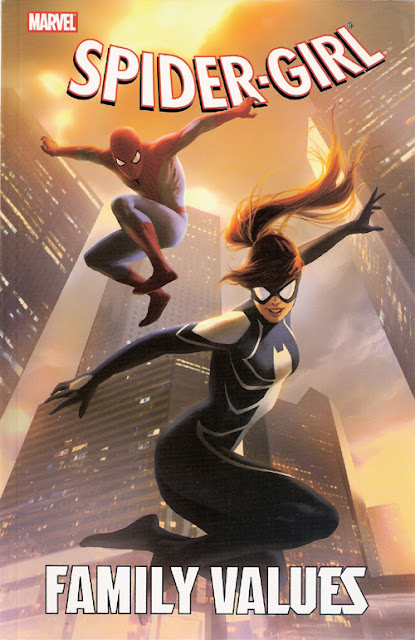
Spider-Girl: Family Values coverUntil then, we get newer characters in dribs and drabs. Take Spider-Girl, for instance. Originally, Anya Corazon was Araña, a character whose most prominent selling point was her ethnicity. Predictably, that went over badly. When her original series was cancelled, she was separated from her mystic origin and put into the Young Allies. That series lasted as long as you would expect a team book with Firestar as its most recognizable character to last.

But Marvel didn’t give up on Anya, and good for them. The concept has the seeds of a good, marketable idea: spunky, young female protagonist who adds a little ethnic diversity to the Marvel Universe and who can be linked to Spider-Man. The “Grim Hunt” storyline in Amazing Spider-Man strengthened Anya’s ties to Spider-Man; change her code name, and viola! The result is Spider-Girl, v. 1: Family Values. Volume 1 is the totality of the series, though — the series was cancelled after eight issues. But is there anything here to salvage going forward? Maybe.

Writer Paul Tobin has decided that since Anya is a teenager in the ‘10s, she should be on Twitter … as Spider-Girl. I applaud Tobin for trying to find something new and unique for the character, something that fits her character. Spider-Girl’s tweets aren’t as intrusive as you might suspect, since they fill the same niche as text boxes with characters’ thoughts (which themselves replaced thought bubbles). This approach works as long as the reader doesn’t think too much about it; however, there’s no place for a phone on her skin-tight costume, and as another character reveals, her tweets reveal too much about Spider-Girl’s real name. We’re probably supposed to believe Anya is tweeting after she returns to her civilian ID, but given the detail and number of her tweets, I’d think another form of social networking — Reddit? a blog? — would be a better choice. Harder to make work on the comics page, though.

Tobin also tries to integrate Spider-Girl into the wider Marvel Universe. This is also a great idea, but the execution is lacking. Spider-Man is a natural fit for Spider-Girl, especially after Grim Hunt. The first story in Family Values, the back-up from Amazing Spider-Man #648, shows that working relationship: Spider-Girl intimidated but competent, with Spider-Girl not at the level of an Avenger but still an effective street-level hero. And that’s who Spider-Girl should be meeting: street-level heroes such as Daredevil, Heroes for Hire, Moon Knight, etc. Chuck a brick out the window in Marvel New York, and you hit a street-level hero.

But in #1, Anya is palling around with the Invisible Woman and the rest of the Fantastic Four, which feels wrong. I’m not sure if Tobin created the connection between Gil Corazon and the Fantastic Four, but the Fantastic Four is the first family of Marvel, and the connection draws Anya toward the middle of the Marvel Universe; writing Spider-Girl as important to the Fantastic Four and the Spider-Man makes Tobin seem like he’s trying too hard to push Spider-Girl, although the attempt is not as egregious Tamora Pierce and Timothy Liebe’s effort in White Tiger. By the end of the story, Spider-Girl is showing up Spider-Man and taunting the Red Hulk when she should be teaming up with young heroes like Bucky, her friend and classmate from Young Allies, or complementing more experienced heroes.

Anya could be a simple character with a simple, if well-worn, hook: a high-school girl with a connection to Spider-Man, balancing fighting street-level crime and a personal life centered around school and friends. But Anya was already a convoluted character before this series. Her original series made her the super-powered operative of the Spider Society, which fought the Sisterhood of the Wasp in a mystical war. During Civil War, she hobnobbed with famous heroes, such as Ms. Marvel and Wonder Man. There’s a cryptic mention in Family Values of her learning advanced computer skills from SHIELD, but I have no idea where that comes from. None of this backstory is mentioned in Family Values — the extremely brief recap page from Spider-Girl #1 is entirely insufficient. But whether Tobin is hiding these complications, trying to push across a slightly rolled-back version of Anya before pushing her back into the MU, or deprecating her complications because they aren’t relevant, it’s for the best: none of those stories make her more interesting.

Tobin nicely balances Spider-Girl’s heroism with Anya’s personal life. Anya and her father move, giving Tobin a chance to introduce a new supporting cast. In theory, that’s good, allowing the book to distance itself from Araña. However, Tobin goes too far. Her friendship with Bucky, both in and out of costume, was one of the strengths of Young Allies, but Bucky is barely in Family Values, and she’s never in costume. Worse, Tobin kills Anya’s father in the first issue. (That’s hardly a spoiler; it’s on the back cover.) Beyond the complicated questions of grief that should grip the book, it leaves the question of how a high-school student would be allowed to live without a guardian. (She could be 18, but I never had that impression.) It also removes a character who should have had a strong supporting role in favor of cheap pathos; Gil Corazon had much more potential as a father than as a corpse. Rocky, who becomes Anya’s best friend and roommate, never quite becomes interesting enough to fill in the gap. I’m sure the Fantastic Four, Marvel’s First Family, is supposed to serve as a surrogate family, but that feels forced.

Tobin does an excellent job of choosing adversaries for Spider-Girl. Screwball (a parkour-using publicity hound) and Ana Kravinoff (Kraven the Hunter’s daughter) are thematically excellent choices, although since Spider-Man has had some trouble with both of them, Spider-Girl’s victories over both does make Spider-Man look weak next to a unpowered teenager. Hobgoblin is a bit out of her league, but Spider-Man gets involved with their fight, making the heroes’ victory more believable. The Red Hulk is a mistake — not just in this book, but as a character. But the assorted muggers and thus, of course, are exactly what is needed.

Family Values also introduces Raven, a secret organization with scientists and augmented operatives in the same vein as the Secret Empire, the Corporation, AIM, etc. Raven plans to blackmail or suborn Spider-Girl into becoming its agent; it’s cute that one of its operatives thinks having Spider-Girl on Raven’s side is going to make a big difference — cute, and totally believable in the tunnel-vision way of mad planners. I’m assuming Tobin had plans to make this slow-burning plot last longer; the resolution, which takes up all of #7 and 8, feels rushed and has all the hurried hallmarks of a plot that has to be wrapped up before cancellation. There’s nothing unique about Raven that required it to be a new group — there are dozens of similar groups in Marvel history waiting for resurrection — but perhaps Tobin had something specific in mind that didn’t fit other groups.

Family Values has two pencilers on its main stories: Matthew Southworth, who drew #4 and 5 (the fight vs. Ana Kravinoff), and Clayton Henry, who drew the rest. Henry provides most of the pencils. His work is clear and pleasant, although occasionally the characters come across as a little plastic. Southworth has the more unusual style, reminiscent of Michael Lark — a good comparison when you’re dealing with two people of normal power levels kicking and punching each other. Dean Haspiel’s cartoony art is an excellent complement to Tobin’s amusing backup in #1, in which a young Anya meets the Fantastic Four for the first time. Chris Sotomayor, the colorist, has trouble finding a consistent skin tone for Anya. Her skin runs the gamut from light to dark, and she switches between being a brunette and a redhead.

So is there much to salvage from Family Values? The character of Anya, perhaps, but she was in better shape at the end of Young Allies. The stories and art are solid but not spectacular, so reading Family Values is not time wasted. But by trying to add too many new connections to the hero, Tobin’s restart doesn’t add much to the character; it serves as a detriment, actually, making the character less relatable and taking away Anya’s father. The story with Raven and the Red Hulk is wrapped up with a neat bow at the end, so the story’s main plot has few-to-no loose ends. (The exception is that another civilian knows her secret identity.) Family Values gives writers the opportunity to team Anya with the Fantastic Four. I’m not sure that’s a positive, though.

Rating: Spider-Man symbol Spider-Man symbol Half Spider-Man symbol (2.5 of 5)

Labels: , , , , , , , ,

15 June 2012

Chronicles of Conan, v. 21: Blood of the Titan and Other Stories

Collects: Conan the Barbarian #160-7, Conan the Barbarian Annual #7 (1982, 1984-5)

Released: August 2011 (Dark Horse)

Format: 200 pages / color / $18.99 / ISBN: 9781595827043

What is this?: More Conan, although this time he starts adventuring with an old comrade long thought dead.

The culprits: Writers Michael Fleisher, Roy Thomas, and Larry Yakata and artists John Buscema


Chronicles of Conan, v. 21: Blood of the Titan and Other Stories coverI’m heading out on vacation, so I’m a little short on time this week. That’s fortunate, because there’s no reason to give a full-length review of Chronicles of Conan, v. 21: Blood of the Titan and Other Stories; most of what I said about v. 20: Night of the Wolf and Other Stories, holds true again. That being said:

John Buscema is still awesome, even if he still dresses Conan in a blue sleeveless T-shirt and a fur bikini.

— Giving Conan a sidekick — or partner — is a great idea by writer Michael Fleisher. Fafnir, left for dead in Conan the Barbarian #20, reappears in #161 without his left arm. His impetuousness frequently gives the stories an impetus they wouldn’t otherwise have, and he has a character arc — an obvious one, but at least it’s an arc, and it helps get rid of the aimless feeling Conan has had for quite a while.

— A character named “Gurneg” appears in three issues: Conan #160, 161, and 163. It’s a different character each time, and Gurneg always dies. What does Fleisher have against Gurneg? And why, after killing him three times, does he stop killing him?

— A fill-in issue (#164) is dropped into the middle of the Fafnir arc without explanation, which goes about as well as would be expected. Larry Yakata writes a surprisingly hard-hearted, battle-weary Conan that is more in line with creator Robert E. Howard’s barbarian than Marvel writer Roy Thomas’s Code-approved interpretation. Yakata’s Conan is just as stupid as Thomas’s, though.

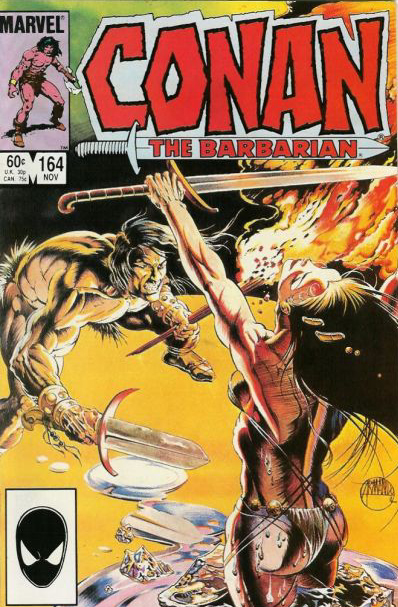
Conan the Barbarian #164 cover— The most interesting part of the fill-in issue is trying to figure out the engineering of the woman on the cover’s top. It’s an exotic design I’ve never seen in the real world, and I’m at a loss for how it could work. At first, I was confused about where the two straps on each side went after crossing her bottom, but I see one strap on each side goes down a leg and presumably is tied around her foot or calf. But then I realized there should be something pulling her top up — looping behind her neck, perhaps? — but there’s no evidence of that. How does it work?

— Ending the book on a cliffhanger — two, actually — is an intriguing idea. It gives readers a reason to return for The Chronicles of Conan, v. 22: Reavers in the Borderland and Other Stories, and it helps distinguish v. 21 from all the other Chronicles of Conan volumes. I think I will know what will happen between Conan, Fafnir, and Noirelle in Conan #168, but I’m not sure.

— Well, I think there are two cliffhangers; Conan the Barbarian Annual #7 ends abruptly, without resolving the plot. There’s no indication of where Thomas’s adaption of L. Sprague de Camp and Lin Carter’s novel Conan of the Isles will be continued. Based on Annual #7, the story probably shouldn’t be continued; the story has 33 pages, but it has only one moment of excitement and is notable only for Buscema’s best artwork in the book.

Rating: Conan symbol Conan symbol Half Conan symbol (2.5 of 5)

Labels: , , , , , , , , , ,

01 June 2011

DC August 2011 solicitations (collected editions)

Just as DC announces none of this matters and everything will start all over again in September, here are DC’s books for August 2011:

Will buy:

Nothing again. Sorry, DC!

Might buy eventually:

    Birds of Prey: The Death of Oracle (hardcover): I keep forgetting that I’m caught up with the Gail Simone Birds of Prey issues, and I could probably read this if I wanted to without being confused. But I haven’t read v. 1, and I’m going to wait for the trade for v. 2, and everything gets reset in September, and … you know, I think DC is trying to discourage me from reading Gail Simone. Weird. ($24.99)
  • Fables: Werewolves of the Heartland (hardcover): I’ve picked up the first … 15? volumes in trade paperback. I can wait for the trade again. I’m a patient person. ($22.99)
Might buy if the price is right:

    Legends of the Dark Knight: Marshall Rogers (hardcover): Marshall Rogers is a great Batman artist — one of the best ever. This collection includes 24 issues ranging from his ‘70s work on Detective Comics, a ‘90s run on Legends of the Dark Knight, and the 21st century mini Batman: Dark Detective. I don’t want it badly enough to spend $50 for it, but if you’re a big Bat-fan, then maybe you should. ($49.99)
Already have or read:

    100 Bullets, Book One (hardcover): An excellent start to a series that lost some of its momentum over time. Reading 100 Bullets in huge chunks, however, can only help the story. ($49.99)
  • The League of Extraordinary Gentlemen Omnibus (hardcover): $50 for the first to League minis? No, thank you. Unless you have a hardcover fetish, you’d be much better off with the two trades, especially since the trade doesn’t mention any special features. A couple of Jess Nevins essays might help make this more worthwhile. ($49.99)
The Rest:

    Batman: Arkham City (hardcover): It’s a video game tie-in, which is bad. It’s written by Paul Dini, which is good. It bridges the time between the two Batman: Arkham video games, which is … soul sapping, is the phrase I’m looking for. Yes, that’s it. ($22.99)
  • Batman: Eye of the Beholder (hardcover; $22.99)
  • Batman: The Widening Gyre: Diehard Kevin Smith fans only. Sorry. ($17.99)
  • Cuba: My Revolution: That’s a weird way to look at a Communist revolution. I mean, surely one’s personal development, like the tractor and the land, belongs to everyone in a Communist society? ($17.99)
  • A God Somewhere: This doesn’t appear to be a Vertigo title, despite a premise (man who gets powers in a normal, non-powered world) that would seem to fit under that imprint. ($17.99) Greek Street, v. 3: Medea’s Luck: If it weren’t for Medea’s luck, I’d have no luck at all: gloom, despair, and agony on me. ($14.99)
  • Green Lantern: The Sinestro Corps War ($29.99)
  • How to Understand Israel in 60 Days or Less ($19.99)
  • iZombie, v. 2: uVampire: OK, enough with this Apple knockoff naming. It has ceased to be funny. ($14.99)
  • JLA, v. 1: What do you mean Grant Morrison’s JLA isn’t already out in trade paperback? I thought everything the man had done at DC had been reprinted. That being said, I’m not quite a big enough fan of JLA or Morrison to pick this one up. ($19.99)
  • Justice League of America: Team History: This reprints issues from Blackest Night? How long ago was that? More than a year, almost a year and a half. Anyone who waits that long for a James Robinson JLA story either has some weird priorities or really likes Mark Bagley art. ($17.99)
  • Justice League: Generation Lost, v. 2 (hardcover; $39.99)
  • Justice Society of America: Super Town ($14.99)
  • The New York Five: “Collecting the four-issue miniseries the [sic] exposes the underbelly of college life in the Big Apple!” Nice advertising — if you wanted it to sound like a pulp sex novel from the ‘50s and ‘60s. ($14.99)
  • Night Force (hardcover): An intriguing idea — a collection of an obscure early 1980s horror comic by the creators behind Tomb of Dracula — but it’s so obscure I can’t imagine wanting it, and the price is certainly more than enough to put me off. (Even for 14 issues in hardcover.) I’ll probably give it another thought when the trade comes around, if it comes around. ($39.99) Saga of the Swamp Thing, Book 6 (hardcover; $24.99)
  • Showcase Presents: All-Star Comics, v. 1: This is the JSA, for those of you who can’t immediately twig to the significance of “All-Star Comics.” (That category includes me.) Always nice to see DC reprint different stuff, but the JSA has never been that interesting to me. ($19.99)
  • Superman / Batman: Sorcerer Kings (hardcover): Because, sooner or later, there has to be a story about Batman using magic in Superman / Batman. ($22.99)
  • The Flash: The Road To Flashpoint (hardcover): “This hardcover collection of THE FLASH #8-12 leads up to FLASHPOINT, the biggest comic-book event for summer 2011!” In other words: By the time this comes out, Flashpoint will be over. ($22.99)
  • Titans: Family Reunion ($14.99)
  • Tom Strong’s Terrific Tales, v. 2: Of all the ABC titles, I think Tom Strong was the one I had the least interest in. ($17.99)

Labels: , , ,

26 May 2011

Marvel August 2011 solicitations (collected editions)

Sorry this is up a little late — I was serving my time in Canada earlier this month, and I’m just now getting caught up. Here are Marvel’s books for August 2011:

Will buy:

Shock of shocks — I’m not definitely going to buy any Marvel books in August. Is this my failing, or is something wrong with the House of Ideas? You decide!

Might buy eventually:

  • Avengers Academy: Arcade: Death Game: The first TPB isn’t out yet; that will determine whether I pick up this second book. On the other hand, this is an odd collection: an issue of Marvel Team-Up from the late ‘70s, a Spider-Man from the early ‘90s, and Avengers Academy Giant-Size #1. Actually, this looks more like an Arcade collection than Avengers Academy. ($14.99; ISBN: 9780785156307)
  • Spider-Girl: Family Values: On one hand, the early issues got good reviews. On the other hand, this is Anya Corazon, who starred in the badly received Arana. Ah, well, at least it’s complete in one volume. ($19.99; ISBN: 9780785146940)
Might buy if the price is right:

  • FF by Jonathan Hickman, v. 1 (hardcover): This isn’t the first time the team has lost one of the founding members to death, but it is the first time they’ve changed the team name and costumes because of it. So that’s something, I guess. ($19.99; ISBN: 9780785151449)
  • Green Goblin: A Lighter Shade of Green: I am interested in this title; I heard good things about Green Goblin back in the ‘90s when it originally came out. Am I $40 interested? Hell, no, I am not. I can get the original issues for less than half that and then have them bound together in hardcover. ($39.99; ISBN: 9780785157571)
Masterworks:

  • Marvel Masterworks: Golden Age All-Winners, v. 4 (hardcover): They were golden, and they were all winners. Even the Silver Loser. ($64.99; ISBN: 9780785133599)
  • Marvel Masterworks: The Fantastic Four, v. 13 (hardcover): I had no idea the Masterworks were so far into the post-Lee / Kirby era of Fantastic Four; this reprints #129141, which I don’t remember as very good despite John Buscema’s work. ($59.99; ISBN: 9780785150404)
  • Marvel Masterworks: The Sub-Mariner, v. 1: I just read the Essential, and I don’t think color’s going to help this one. ($24.99; ISBN: 9780785150688)
Already have or read:

  • Essential Web of Spider-Man, v. 1: An interesting choice for an Essential — the third-tier Spider-title — but we all knew we’d get here sooner or later. It is curious Web begins before the title it replaced, Marvel Team-Up, is finished. It would be like the Essential Thing coming out before Essential Marvel Two-in-One finished. Ha, I kid! Marvel Two-in-One is never going to finish. ($19.99; ISBN: 9780785157564)
  • Fantastic Four by John Byrne Omnibus, v. 1 (hardcover): Always worth reading. ($125; ISBN: 9780785158240)
  • Fantastic Four by Mark Waid & Mike Wieringo Ultimate Collection, Book 2: Have it on the GIT Corp. DVD-Rom, which I heartily recommend. ($24.99; ISBN: 9780785156581)
  • Hulk Visionaries: Peter David, v. 8: Volume 8 gets us about halfway through David’s run. I don’t know what is more astonishing: that it will take at least 16 volumes to get through the entirety of Hulk Visionaries: Peter David or that we might actually get all those volumes. ($29.99; ISBN: 9780785156031)
  • New X-Men by Grant Morrison, Book 4 ($14.99; ISBN: 9780785155324)
  • X-Force: Assault on Graymalkin (hardcover): Not really a run of X-Force I would choose to collect, but, you know, whatever. It does have the benefit of coming during X-Force’s first non-Cable period. As a side note, this contains the first non-crossover X-Force issues that I ever read. ($29.99; ISBN: 9780785158998)
  • X-Statix Omnibus (hardcover): Peter Milligan and Mike Allred’s classic work, in one gigantic volume. The same price as the John Byrne Omnibus, but it has 116 more pages. (Total: 1,200 pages.) Bonus! ($125; ISBN: 9780785158448)
Licensed books:

  • Formic Wars: Burning Earth (hardcover): Burn, Earth, burn! ($24.99; ISBN: 9780785136095)
  • Marvelman Classic, v. 3 (hardcover): No, this isn’t the Moore / Davis / Gaiman stuff. Quit asking. ($34.99; ISBN: 9780785157236)
  • Oz: Ozma of Oz (hardcover): Eric Shanower’s Oz is well regarded, but I personally have no interest Oz. ($29.99; ISBN: 9780785142478)
  • The Stand, v. 1: Captain Trips: Horrible line from the solicitation: “For when Captain Trips works its way across the land, it is time to make a stand.” First, “Captain Trips” is the superflu, and making a stand against a virus is likely to be a futile effort. Second, way to awkwardly shoehorn the name of the series and volume into the book while making it sound like you haven’t read the source material or the book solicited. ($14.99; ISBN: 9780785135210)
The Rest:

  • Annihilators (hardcover): Although I have all of Guardians of the Galaxy and have read Annihilation, I don’t have any interest in this. Weird. ($24.99; ISBN: 9780785160403)
  • Black Widow: The Itsy-Bitsy Spider (hardcover): I don’t think I’ve seen any artist draw the Black Widow in a way that could be described as “itsy-bitsy.” ($24.99; ISBN: 9780785158271)
  • Captain America: Prisoner of War (hardcover): The solicit doesn’t say what war Cap is a prisoner of, so I’m going to choose my favorite: The War of Spanish Succession. ($24.99; ISBN: 9780785151210)
  • Carnage: Family Feud (hardcover): In which Carnage kills Richard Dawson, Ray Combs (again), Louie Anderson, Richard Karn, John O’Hurley, and Steve Harvey. That’s why it’s five issues long! ($24.99; ISBN: 9780785151128)
  • Daken: Dark Wolverine: Empire ($19.99; ISBN: 9780785147060)
  • Deadpool / Amazing Spider-Man / Hulk: Identity Wars (hardcover): I’ll take random team-ups for $800, Alex. Although I suppose it’s not as random as it could be, given that both Spider-Man and Deadpool have been featured in team-up books. ($19.99; ISBN: 9780785155683)
  • Incredible Hulks: Dark Son: So, in this book, the Hulk has three kids, and his cousin, wife (?), and best pal are all Hulk critters as well. There has to be a reset button in there somewhere. ($19.99; ISBN: 9780785150015)
  • Invincible Iron Man, v. 6: Stark Resilient, Book 2 ($15.99; ISBN: 9780785148357)
  • Invincible Iron Man, v. 8: The Unfixable (hardcover): Hmm, the hardcover and TPBs are two apart now. That’s probably not good, although I’m too lazy to look up whether ($19.99; ISBN: 9780785153221)
  • Marvel Adventures Spider-Man: Friendly Neighborhood (digest): I remember when digests cost $7. (I’m not old; I’m just surly.) ($9.99; ISBN: 9780785152576)
  • The Marvel Art of John Romita Jr. (hardcover) ($49.99; ISBN: 9780785155355)
  • Marvel Zombies: Christmas Carol (hardcover): Nothing says “Christmas” like a zombie collection released in August. Ho ho ho! ($24.99; ISBN: 9780785157724)
  • Namor: The First Mutant, v. 2: Namor Goes to Hell: It’s rare for any publisher to put such a bald statement of quality on the cover. Bravo, Marvel! ($16.99; ISBN: 9780785151760)
  • New Avengers by Brian Michael Bendis, v. 2 (hardcover) ($24.99; ISBN: 9780785148746)
  • Shadowland: Lots of Shadowland this month! Are you excited? (No, you’re probably not, and that’s not uncommon.) ($19.99; ISBN: 9780785147633)
  • Shadowland: Daredevil: Wait — shouldn’t this be Daredevil: Shadowland? Does the crossover really deserve top billing over Daredevil? ($14.99; ISBN: 9780785145226)
  • Shadowland: Street Heroes: When you can’t bother to come up with a better name than “Street Heroes” for a crossover that was almost entirely about street-level crimefighting, then you may have a problem. Also: Bullseye (featured in the Shadowland: Bullseye one shot) is not a hero. ($19.99; ISBN: 9780785148883)
  • Shadowland: Thunderbolts ($15.99; ISBN: 9780785152194)
  • Silver Surfer: Devolution ($14.99; ISBN: 9780785156659)
  • Spider-Man: The Fantastic Spider-Man (hardcover): Might pick this up in paperback, but I have no real desire to even look at it in hardcover. Especially if it’s shrinkwrapped. ($24.99; ISBN: 9780785151067)
  • Spider-Man: The Next Chapter, v. 1: Do you want to see Howard Mackie and John Byrne screw up a Spider-Man relaunch? And by “screw up,” I mean spectacularly. (Tired of the stupid plot twists and characters from the previous titles? Then you’ll love this relaunch, which immediately brings back those same tired characters and plots!) It’s fourteen issues of Spider-mediocrity for $40! ($39.99; ISBN: 9780785157595)
  • Thunderbolts by Warren Ellis & Mike Deodato Ultimate Collection: Really: “ultimate.” The only thing ultimate about this collection is that it’s the final one. Of course, if you really like Mike Deodato or Warren Ellis, your opinion might vary, but I don’t think anyone is going to say this is their best work. ($29.99; ISBN: 9780785158493)
  • Vampire Tales, v. 3: The solicit for this is all messed up. The information has nothing to do with vampires; instead, it’s the description for New Mutants Classic. Since I have a soft spot for Marvel’s older horror properties, I might reconsider once I have better details. ($19.99; ISBN: 9780785156048)
  • Wolverine / Hercules: Myths, Monsters & Mutants ($14.99; ISBN: 9780785141105)
  • Wolverine: Wolverine Goes to Hell: See Namor: The First Mutant. ($19.99; ISBN: 9780785147855)
  • X-Men Legacy: Collision ($14.99; ISBN: 9780785146698)
  • X-Men: Curse of the Mutants: Of course the X-Men fight vampires. Because once you lose your central metaphor for half a decade, it’s natural to flounder for a new direction. ($19.99; ISBN: 9780785148470)
  • X-Men: Curse of the Mutants: Mutants vs. Vampires: I’d only read this if Wolverine gutted Edward Cullen. Or vampire married him, either one. ($19.99; ISBN: 9780785152293)
  • X-Men: Prelude to Schism (hardcover): Watch as Wolverine travels to Avignon and declares himself the antipope. ($19.99; ISBN: 9780785156895)

Labels: , , ,