Reviews of trade paperbacks of comic books (mostly Marvel), along with a few other semi-relevant comments / reviews.

06 February 2015

Chronicles of Conan, v. 28: Blood and Ice and Other Stories

Collects: Conan the Barbarian #215-23 (1989)

Released: November 2014 (Dark Horse)

Format: 220 pages / color / $19.99 / ISBN: 9781616553746

What is this?: Conan becomes a implacable, unbeatable killing machine as he works his way toward Turan.

The culprits: Charles Santino (writer) and Val Semeiks (co-plotter / artist), with help from Larry Hama, Don Perlin, Michael Fleisher, and Gary Kwapisz


So far this year, I’ve read the first volume of Batman ‘66, Astro City: Life in the Big City, most of Mark Waid’s Daredevil run, the first book of Waid’s Indestructible Hulk, Umbrella Academy, v. 1: Apocalypse Suite, and Fantastic Four, v. 2: Road Trip. So of course the book that I’m going to write about is Chronicles of Conan, v. 28: Blood and Ice and Other Stories.

Chronicles of Conan, v. 28: Blood and Ice and Other Stories coverWhat interests me about Blood and Ice is writer Charles Santino’s run, which stretches from #215 to 220. Santino took over for James Owsley (today known as Christopher Priest), who improved the title immeasurably by giving Conan a supporting cast; if Conan was a static character in the Marvel Comics — and he was — Owsley’s supporting cast was allow to grow, to act in surprising ways, and to die.

It was a welcome change. Before that, Conan had been stuck in endless retreads of one- and two-issue stories where Conan had battled some uncanny threat, been involved in some way with a comely lass, and then moved on to the next uncanny threat / comely lass. It was boring and short sighted.

With Conan having jettisoned the last of his supporting cast at the end of the Owsley run, Santino and co-plotter / artist Val Semeiks embarked on a series of stories unique in the Conan canon: a series of brutal one-issue fights as Conan makes his way to the eastern nation of Turan. Never in the original Robert E. Howard stories, the movies, or Conan the Barbarian has Conan seemed so much of a ‘90s superhero.

The break beginning of this volume is well chosen, although my guess is that it was a fortunate accident. In #214, which is in the previous volume (Chronicles of Conan, v. 27: Sands upon the Earth and Other Stories), Conan is trapped in a mirage city. It’s a story indistinguishable from dozens of others in the Marvel series; a seemingly inescapable trap, a few monsters to bash, a scantily clad maiden hanging around the periphery of the story.

But in #215, the start of Blood and Ice, the story direction changes. Gone are the pretty girls; magic is violently shoved from the plots. In the first story, Conan is captured by Turanians at a desert outpost. Well, “captured” — the soldiers are able to move him along but not subdue him in an attempt to enslave him to work the giant water wheel beneath the outpost. Conan, unbowed, not only kills Turanian soldiers but destroys the water wheel and breaks the Turanian’s slavery. It seems as if most of the slaves die in the carnage as well, but that’s a small matter.

In “Death Pit” — the simple title is a taste of things to come — Conan can’t be beaten, can’t be stopped. He is a force of nature, destroying the works of true villains. The Turanian soldiers — agents of an encroaching imperialistic nation turned slavers to make the machinery of daily life turn fluidly — are more effective as villains than any number of black wizards or monsters; they represent a commonplace sort of injustice, and Conan will not let himself submit to that injustice. In the end, he smashes not only the soldiers but everything they have brought to the outpost.

The following issues show Conan against armies of men who not only cannot defeat him but also cannot bloody him. He destroys a large army of cultists in #216, invading their temple and bulling through their attempts to subdue him; the only beautiful woman is sacrificed by the cult early in the story, and Conan can’t save her. In #217, he’s back to battling a magical guardian in a deserted city, but he’s trapped on a small island in #218 and has to kill a homicidal band of tribesmen to gain their boat and escape. He fights through a Turanian army in #219, escaping by stealing superior horseflesh. Santino finishes his run by showing Conan pursuing a band of gold thieves; they stole what he had his eye on, and so he relentlessly follows them through the snow until they are all finished.

Santino’s Conan shows no cunning and very little guile, which is far from the character that Robert E. Howard created. Santino’s Conan is the greatest swordsman ever, it seems, indomitable and undefeatable — the very epitome of a superhero, except for his massive body count. Santino’s issues are bloody little fables about an unstoppable force, with Conan destroying all who tries to slow him. I’m not sure if these stories are good, but they are fascinating; why had no one done this with Conan before? Was it because this level of violence wasn’t permitted before the late ‘80s? Or was it because even the most mediocre of writers who had written Conan the Barbarian before this understood that that was not truly who Conan was?

Although I’m attributing most of this interpretation of Conan to Santino, Semeiks is listed as co-plotter as well as artist. Semeiks had graduated to co-plotter with Owsley, whose issues were greatly different in tone; unless Semeiks was able to exert considerably more influence on Santino than he was on Owsley, it’s unlikely the new direction was his. Semeiks continued to supply very good art during this time, fluid and action-filled, but it lacks the visceral brutality and blood to back up this version of Conan. It’s probable that editorial prevented Semeiks from drawing that level of brutality, though.

After Santino and Semeiks depart the title, the rest of the volume becomes much more like Conans past. Larry Hama’s #221 is an eerie little story that would not have been out of place in a ‘50s horror comic. Hama writes the story in verse, and his versification detracts from the story’s impact; a story with minimal dialogue / narration would’ve made the story truly memorable instead of an intriguing curio. Don Perlin shows Conan pursued by and confronting his own revenge squad; unsurprisingly, with all the men Conan has hacked to pieces over the years, Conan remembers none of them. The poignant revelation of their pointless attempt at revenge against a man who never hated them and didn’t even recall maiming them is balanced by Conan’s incompetence against a bunch of crippled buffoons. The volume ends with a story by Michael Fleisher, whose Conan is as different from Santino’s as possible: Fleisher’s Conan displays almost preternatural foresight while helping a comely lass recover a religious icon.

I don’t think I can recommend Blood and Ice for Conan fans. Santino’s interpretation of the character is too far off model to be convincing. On the other hand, his protagonist is a force of nature, compelling and readable because of his direct, brutal nature. I think even for a fan of sword-and-sorcery fiction, it is too simplistic, and six issues of it is altogether too much. However, if you can read #215 by itself, give it a try; I found myself reacting more emotionally to Conan’s struggles in that story than I had in total to the 100 issues before it.

Rating: Conan symbol Conan symbol (2 of 5)

Labels: , , , , , , , , ,

18 January 2013

Chronicles of Conan, v. 22: Reavers in the Borderland and Other Stories

Collects: Conan the Barbarian Annual #8-9 and Conan the Barbarian #168-73 (1983-4, 1985)

Released: June 2012 (Dark Horse)

Format: 224 pages / color / $18.99 / ISBN: 9781595828125

What is this?: Conan joylessly wenches and kills his way through more of the Hyborian Age.

The culprits: Writers Michael Fleisher and Jim Owsley and artists John Buscema, Ernie Chan, and Val Mayerik


Writer Michael Fleisher’s work in Chronicles of Conan, v. 21: Blood of the Titan and Other Stories left me optimistic the quality of the Chronicles of Conan would improve from its consistently forgettable levels. And then The Chronicles of Conan, v. 22: Reavers in the Borderland and Other Stories jammed a broadsword through that optimism.

I wasn’t expecting a return to Roy Thomas levels of quality but something memorable about the stories in Reavers in the Borderland — about any story in Reavers, actually. Introducing Fafnir, a sidekick / partner for the title barbarian, distinguished Blood of the Titan from other books in the series. The rivalry and friendship of the two added a new dimension to Conan’s character, and for once, there was a character in Conan (other than Conan) I gave a damn about.

 cover But Fafnir is dropped from the stories in Reavers, and the series returns to random hack-and-slash action, full of gaudily colored thugs, wizards, and bravos trying to cut Conan down. Fleisher, who wrapped up his two-year run with #171, writes largely forgettable pieces, studded with violence and lady flesh. Fleisher’s stories show little wit and feature no memorable characters. The images parade in front of the eyes and then vanish, leaving as much of an impression upon Conan as they do the reader — that is, none.

In Reavers, Conan saves an old ally from a carnival (?!) sideshow. Conan protects a wench from some of his old enemies, only to find she is more than she seems. A wizard needs help with a demon and a cursed sword; that takes two issues to resolve. Conan appears to die; the reader yawns, not particularly caring how he survives. (Poison coma, if you’re interested. You shouldn’t be, though.)

I almost called Fleisher’s stories continuity-free, but that’s not true; he reuses characters from his run in two of his stories. In #168, Conan chances across Alhambra, the winged woman from #153-4 (The Chronicles of Conan, v. 20: Night of the Wolf and Other Stories), and saves her from the sideshow and her old enemies, the Batmen of Ur-Xanarrh. (He almost burns her and everyone in the carnival to death first, though.) In #171, he fails to protect a girl from the Brotherhood of the Falcon, which he fought in #162 (Blood of the Titan). But Alhambra is just a pretty face (and pair of wings) who doesn’t stick around, and despite “killing” Conan, the Brotherhood of the Falcon is just another group of faceless goons, with little to distinguish them from a random wizard’s henchmen or a corrupt duke’s soldiers. Fafnir, the saving grace of the last volume, does come back briefly in #170, although it’s only to say goodbye.

What Conan needs is a supporting cast, people who stay with him. They don’t have to stay forever; three or four issues would be fine. But Conan needs a contrast in the story, someone to express himself to (even if it’s by not saying anything), or else the book becomes the story of a guy with a sword killing random stuff, with as much character as a video game avatar. Not becomes, I guess — became, and that happened a long time ago.

Jim Owsley (known today as Christopher Priest) starts with #172, and things change for the better. The remaining two stories are to parts of a larger storyline set in the Pictish wilderness. Conan gains a sidekick, a pretty girl — giving artist John Buscema just what he needs: even more opportunities to draw pretty girls — and still has a hapless victim to protect. Owsley writes a more brutish Conan than Fleisher, who has Conan give his horse to a woman who just tried to steal his sword. Owsley’s Conan is plainspeaking and rude, saying hurtful things to people who might not deserve it. It’s a refreshing change; Conan should have some teeth. Issues #182-3 augur well for the future, and many people really like Owsley’s work on Conan.

But I’ve been burned before. The potentially explosive cliffhangers in Blood resolve as damp squibs in Reavers. I thought I had a handle on how the story in #167 would be resolved. I was wrong; I didn’t expect Fleisher to make the bold choice of ignoring the dangling plot altogether. The cliffhanger in Annual #7 seems similarly forgotten, although it was resolved eventually. Not in Conan the Barbarian or a Conan Annual or even Savage Sword of Conan, but in the Conan of the Isles graphic novel, which came out six years after Annual #7. I’m not going to change my rating of Blood, but the lack of payoff in Reavers does devalue the story in Blood.

There are many roles I rarely discuss in my reviews: colorists, editors, letterers … Reavers made me consider the reprint editor, which in this case is Chris Warner. Unfortunately, my attention is not to his benefit. Warner leads off the book with two Conan the Barbarian Annuals (#8 and 9). They were published before the Conan the Barbarian issues in this collection, but since I was looking forward to the continuation of Fafnir’s story, the beginning of this book seemed a poor place to put the annuals. (The wait also made the weak payoff even more disappointing.) Between Fleisher’s and Owsley’s runs would have been a better place, and it’s not like anyone was paying attention to Conan’s chronology at this point.

As for art: Buscema’s in fine form. His work looks better with inks from Bob Camp (#169-70, 172-3) than from Armando Gil (#171) or Buscema himself (#168), though. The final two issues are especially superb and sharp, even if I wish Bucema would get rid of Conan’s blue-sleeveless-tee-and-fur-underwear combo. Ernie Chan draws an action-packed Annual #9, although he can’t quite measure up to Buscema. Val Mayerik supplies the art for Annual #8, and I was too distracted by his tentative inking to say anything about his pencils. (This book is a warning against self-inking, really.)

Maybe my optimism isn’t dead; maybe it will survive the bloody attack that is Reavers in the Borderland. But even if it can survive this crummy book, you should skip Reavers. Reavers has little to recommend it, other than Buscema’s art, and Buscema’s work is in so many better Chronicles. Oh, there might be something to the Owsley run, and if there is, it’s going to annoying to miss the first two issues. Still: do not be tempted to buy this waste of time. It’s not worth it.

Rating: Half Conan symbol (0.5 of 5)

Labels: , , , , , , , , , , ,

15 June 2012

Chronicles of Conan, v. 21: Blood of the Titan and Other Stories

Collects: Conan the Barbarian #160-7, Conan the Barbarian Annual #7 (1982, 1984-5)

Released: August 2011 (Dark Horse)

Format: 200 pages / color / $18.99 / ISBN: 9781595827043

What is this?: More Conan, although this time he starts adventuring with an old comrade long thought dead.

The culprits: Writers Michael Fleisher, Roy Thomas, and Larry Yakata and artists John Buscema


Chronicles of Conan, v. 21: Blood of the Titan and Other Stories coverI’m heading out on vacation, so I’m a little short on time this week. That’s fortunate, because there’s no reason to give a full-length review of Chronicles of Conan, v. 21: Blood of the Titan and Other Stories; most of what I said about v. 20: Night of the Wolf and Other Stories, holds true again. That being said:

John Buscema is still awesome, even if he still dresses Conan in a blue sleeveless T-shirt and a fur bikini.

— Giving Conan a sidekick — or partner — is a great idea by writer Michael Fleisher. Fafnir, left for dead in Conan the Barbarian #20, reappears in #161 without his left arm. His impetuousness frequently gives the stories an impetus they wouldn’t otherwise have, and he has a character arc — an obvious one, but at least it’s an arc, and it helps get rid of the aimless feeling Conan has had for quite a while.

— A character named “Gurneg” appears in three issues: Conan #160, 161, and 163. It’s a different character each time, and Gurneg always dies. What does Fleisher have against Gurneg? And why, after killing him three times, does he stop killing him?

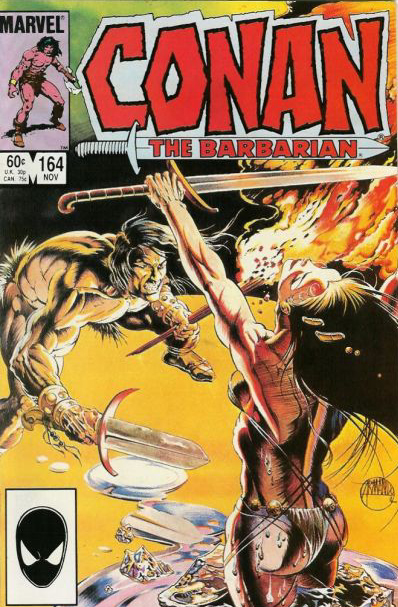
— A fill-in issue (#164) is dropped into the middle of the Fafnir arc without explanation, which goes about as well as would be expected. Larry Yakata writes a surprisingly hard-hearted, battle-weary Conan that is more in line with creator Robert E. Howard’s barbarian than Marvel writer Roy Thomas’s Code-approved interpretation. Yakata’s Conan is just as stupid as Thomas’s, though.

Conan the Barbarian #164 cover— The most interesting part of the fill-in issue is trying to figure out the engineering of the woman on the cover’s top. It’s an exotic design I’ve never seen in the real world, and I’m at a loss for how it could work. At first, I was confused about where the two straps on each side went after crossing her bottom, but I see one strap on each side goes down a leg and presumably is tied around her foot or calf. But then I realized there should be something pulling her top up — looping behind her neck, perhaps? — but there’s no evidence of that. How does it work?

— Ending the book on a cliffhanger — two, actually — is an intriguing idea. It gives readers a reason to return for The Chronicles of Conan, v. 22: Reavers in the Borderland and Other Stories, and it helps distinguish v. 21 from all the other Chronicles of Conan volumes. I think I will know what will happen between Conan, Fafnir, and Noirelle in Conan #168, but I’m not sure.

— Well, I think there are two cliffhangers; Conan the Barbarian Annual #7 ends abruptly, without resolving the plot. There’s no indication of where Thomas’s adaption of L. Sprague de Camp and Lin Carter’s novel Conan of the Isles will be continued. Based on Annual #7, the story probably shouldn’t be continued; the story has 33 pages, but it has only one moment of excitement and is notable only for Buscema’s best artwork in the book.

Rating: Conan symbol Conan symbol Half Conan symbol (2.5 of 5)

Labels: , , , , , , , , , ,

13 February 2012

Chronicles of Conan, v. 20: Night of the Wolf and Other Stories

Collects: Conan the Barbarian #151-9 (1983-4)

Released: December 2010 (Dark Horse)

Format: 200 pages / color / $18.99 / ISBN: 9781595825841

What is this?: Conan stabs his way through another nine issues of his eponymous series.

The culprits: Writer / artist John Buscema and writer Michael Fleischer, with fill-in art from Gary Kwapisz


There’s no doubt the comic book direct market is in trouble. Sales have been declining for years, and unlike at the direct market’s dawn, few titles are guaranteed a continued existence. This is discouraging for those of us who would enjoy long runs for new characters and titles or hope titles that have always been at the fringe of economic viability (Power Man & Iron Fist, Defenders, Alpha Flight, etc.) will get a new ongoing series. The only good news is that almost every current title should have a purpose or a hook.

You don’t see too many zombie titles any more. If you’ve read comics in the late 20th century, you’ve probably come across a zombie title or three. They’re the ones that lurched along, all semblance of life drained away, still repetitively doing all those things it did when it was new and vital. There’s no creative reason to publish these comics: no overarching plots, no exciting young creators looking to work with the character, no groundbreaking creativity. There’s just a semi-loyal audience hanging around, large enough to make money off of. For a Marvel comic, there’s something humorous about this: Marvel zombies helping zombie comics titles survive. A zombie support network, if you will.

Chronicles of Conan, v. 20: Night of the Wolf and Other Stories coverConan the Barbarian was a prime example of a zombie title. After original writer Roy Thomas left, there was a drop-off in the writing quality; few of his successors had a handle on Conan and his world like he did. Truth to tell, even Thomas was having trouble by the end of his long run. The title floundered. So by issue #151 — where Chronicles of Conan v. 20: Night of the Wolf and Other Stories begins — what was the purpose of this title?

The easy answer is that Conan stuck around to give artist John Buscema, often inked by his frequent Conan collaborator Ernie Chan, a place to play. Conan is the title the elder Buscema brother was most associated with, and if he wanted to do the title, why not let him? The art still looks great; there’s no doubt about that. Conan and his enemies are dynamic, active enough to still occasionally surprise the long-term reader with their vividness. Conan himself hasn’t devolved into a copy or parody artistically, although I have my doubts about his blue-sleeveless-tee-tucked-into-furry-bikini ensemble. Still, the monsters are monstrous, and the girls are as gorgeous as ever. And Buscema even started plotting the stories. Giving Buscema a forum for his work and keeping him happy seems a worthy goal, right?

But it’s hard to shake the idea that even the art has lost its freshness. I’ve seen the Conan / pretty girl / evil-wizard / monster set piece before, and if Buscema moves the elements of this stock tale around artfully, he can’t disguise that they are the same elements. I find myself wishing Marvel would have given Buscema a new challenge, something for him to flex his character design and artistic muscles on.

On the other hand, Conan must have sold. So the zombie stays in the publishing schedule.

The writing is a larger problem. Certainly there’s nothing new there. The stories aren’t the worst in the Chronicles of Conan series, but Buscema and Michael Fleischer (writer #151-4, dialogue #155-9) aren’t breaking new ground. There are no overarching plots, no development of Conan’s character (although 21st century readers should know that’s not a priority), and few characters — good or evil — are worth seeing again. Conan’s violent edge has dulled into a paternalistic affability; he’s a nice guy by this collection. A nice guy who guts a few people every issue, but he’s not out to destroy, and he’s not always on the make.

The same elements are used again and again — abducted maiden, lost city under attack (that one’s used twice), evil woman trying to control Conan (again, twice), the perilous inn. Issue #155, in which Conan rescues a grateful toady from a semi-competent wizard, is the best of the lot, and although there are a few attempts at twists (the wolf in #158, the wizard’s identity in #157), the execution produces limp results. (The twist in #158 is spoiled on cover, for instance.) This is partially down to Buscema, who is presumably learning the ropes as a writer; in #156, for instance, the final third of the story is a flashback in which Conan doesn’t appear.

I have to admit I didn’t initially catch that the title of #154 — “The Man-Bats of Ur-Zanarrh!” — was a play on a 1958 Batman story, “Batman — The Superman of Planet-X,” in which Batman encounters the Batman of Zur-En-Arrh, an alien planet. (Not many other people would have caught it had Grant Morrison not resurrected the idea for his recent Batman run.) Clever — but not clever enough to save the story or the book. In any event, when a war between winged humans and bat men on a floating city — a war in which Conan rides a giant dragonfly — seems a little ho-hum, it’s probably time to strike the curtain and call it a day.

There are reasons for zombie titles to exist — or there were, at least. They served as a safe place to launch new creators, such as Frank Miller on Daredevil, and new ideas. They provided a feeling of a shared universe, which was more important then than it is today. These zombie titles also give readers a nice feeling of continuity: there’s Conan on the newsstand; it’s been there for a decade, and it will still be there in another decade.

That last is a luxury the direct market will no longer allow, though, and the other two aren’t relevant to Night of the Wolf. The only reason for Conan to continue throughout the ‘80s was economic. But that’s not really a reason for anyone but Conan diehards to read Night of the Wolf in 2012.

Rating: Conan symbol Conan symbol (2 of 5)

Labels: , , , , , , , ,