Reviews of trade paperbacks of comic books (mostly Marvel), along with a few other semi-relevant comments / reviews.

12 February 2016

Skull the Slayer

Collects: Skull the Slayer #1-8 and Marvel Two-in-One #35-6 (1975-6, 1978)

Released: April 2015 (Marvel)

Format: pages / color / $24.99 / ISBN: 9780785193975

What is this?: After surviving a plane crash in the Bermuda triangle, a Vietnam vet, a physicist, his assistant, and a wealthy white teenager encounter a weird world with dinosaurs and aliens.

The culprits: Writers Marv Wolfman, Steve Engelhart, and Bill Mantlo and artists Steve Gan, Sal Buscema, and Ernie Chan


In 1975, Marv Wolfman finally persuaded Marvel to publish a series that he’d had simmering in his mind for years, a series with a bold premise: readers would hate every character, but to distract them, the artist would include dinosaurs.

That wasn’t really the premise. Wolfman’s idea has a former soldier leading a group of plane-crash survivors around a mysterious island in the Bermuda Triangle, where they have to deal with dinosaurs, aliens, and all manner of strange mysteries. But the characters’ unlikeability will remain my lasting memory of Skull the Slayer, a mid-’70s Marvel series with more ambition than continuity or ability, long after I forget everything else but the dinosaurs.

Skull the Slayer coverThe unlikeable roll call starts with Vietnam vet Jim “Skull” Scully. He’s had a hard time of it: years spent in a POW camp, where his jailors tortured him for information he didn’t have, followed by a sour homecoming where he found his wife shacked up with another man, his parents dead from their worry about him, and his brother strung out. Almost immediately, his brother attacks Scull with a knife, and in the scuffle, his brother is killed. Scully goes on the run, and his arrest in Bermuda leads to him being on the plane that crashes in the Bermuda Triangle.

All that should build a lot of sympathy for Scully, but as soon as he meets the other survivors of the crash, his arrogance comes to the fore. He’s always scuffling with Dr. Raymond Corey, the physicist, over dominance in the group. He scorns the peacemaking of Ann Reynolds, Corey’s assistant, and Jeff Turner, the son of a wealthy Ohio senator. He won’t compromise; all his dialogue is bluster, convinced the entire world, down its smallest molecule, is against him. This is the Marvel template: a hero with ability (Scully kills a dinosaur in #1) but brashness that drives everyone away. In the Marvel style, the hero eventually comes to an understanding with (most of) his supporting cast, toning down his rough edges, but before that happens, he abandons Corey, Reynolds, and Turner to their deaths in #4.

Since Scully is the protagonist, the other characters are supposed to irritate Scully and the readers, by extension. The supporting cast mainly gets broad-stroke characterization, and the writers aren’t afraid to lean on stereotypes when they have to. Corey is highly educated and scorns Scully as a murderer; he’s also African-American, and he admits his frustration with racism that has held him back. Corey’s bitterness drips from every word of dialogue, but he lacks any empathy or vulnerability. Sexism has held back Ann Reynolds, but she often assumes female stereotypes — an obsession for clothes, an injury while running that prevents the others from escaping, etc. Turner is a load with a bad haircut.

Wolfman left the series after #3, so it’s possible he could have planned to soften the characters some. Steve Engelhart, however, took over for #4, and he torpedoed any chance Scully had for likeability by having him abandon his comrades during an escape attempt. This was part of a plan to dump Scully’s supporting cast for a more in-depth investigation of the world Scully found himself in, but #4 was Engelhart’s only issue. Bill Mantlo, who guided the series to its limping end, wrenched the series back in the direction Wolfman had aimed it in by resurrecting and reinstating the supporting cast the next issue. Oops!

Knowing someone abandoned you in the hour of your direst need, and that you actually died because of what they did, would put a crimp in any relationship. Reynolds, Corey, and Turner forgive Scully unimaginably quickly, although they do spend #5 trying to kill him.

Given the characters’ lack of charisma, Skull needed intriguing plots and / or great art to succeed. Skull had a very strong similarity to the TV series Lost: in each, the survivors of a mysterious plane crash find themselves on a weird island with little chance of rescue. (I would pay cash money for a sequel to Skull, with Scully tearfully crying, “We have to go back to the island!”) After the plane crash, the mysteries Skull and his crew uncover on the island include:
  • Dinosaurs (#1)?
  • Why are there prehistoric men (#2)? They didn’t exist at the same time as dinosaurs.
  • Where did that dead alien come from (#2)?
  • And why did he have a magic power belt (#2)?
  • Why were all those human and alien pilots (now skeletons) tied to stakes in one place (#3)?
  • What’s the deal with the tower that has different time periods on each level (#3), all populated with robots?

Those are Wolfman’s plots, with Marv piling weird stuff into the pages without seeming to have an idea of how to resolve them or what the survivors should be doing, other than not being eaten by dinosaurs. Perhaps three issues is too little time to be seeing movement in those areas, although the lack of a plan shows why Scully should not have been the group’s leader.

Engelhart wraps up the last plot in that list — aliens built the tower as part of a plot to conquer Earth at all time periods simultaneously — but then Mantlo ends that plot in #6 with the destruction of the tower. It’s unclear whether the aliens are responsible for the non-tower weirdness on the island — why do aliens care about dinosaurs? — but Mantlo moves on to a faux-Aztec society, another pilot from our world, and societal civil war. Wolfman returns to wrap up everything in two issues of Marvel Two-in-One, but it’s clear he’s sweeping up the pieces in case another writer sees something he likes. Most of those pieces ended up in the trash, though. Wolfman didn’t even bother to salvage (or mention) the pilot from our world that Mantlo introduced.

For readers who like drawings of dinosaurs, though, Skull might be something to investigate. (Evidently not enough of those existed in the mid-’70s.) Steve Gan gets the bulk of the dinosaur duty, drawing #1-3 and #6. His dinosaurs are massive, powerful creatures. Sal Buscema’s arc (#4-8) concentrates on different eras of human history; his work is harmed by the bright colors, but his design for the alien Slitherogue is satisfyingly sinister. (Sure, Slitherogue looks like he’s a Yellow Peril villain, but he’s purple, and from outer space, so it’s OK, right?) Buscema’s less-detailed style suffers compared to Gan’s work; Gan’s linework, especially with its emphasis on the hair and sinew of the figures he draws, is more in keeping with the dirty, more animalistic world the book inhabits. Gan’s Scully is a more vicious, feral man than Buscema’s version, giving the impression that Scully might be a man who fits the island better than he does modern society. Ernie Chan draws the MTiO issues like they are, well, MTiO issues, and the more superheroic look is jarring. The rushed plot does Chan no favors, though.

The series is a brief flash of muddled creativity that never clicks. Readers can probably find bits and pieces that entertain them or that they’d love to see repurposed in something more coherent, and the series’ failure shows how difficult it must have been to keep the mélange of character and mystery plotlines going for so long on Lost. Skull the Slayer is an artifact of the fecund ‘70s, but like a lot of the high-concept ideas that came out of that time, its execution means it isn’t worth reading.

Rating: Marvel symbol Half Marvel symbol (1.5 of 5)

Labels: , , , , , , , , , ,

10 August 2013

Chronicles of Conan, v. 23: Well of Souls and Other Stories

Collects: Conan the Barbarian #174-81 and Conan the Barbarian Annual #10 (1985-6)

Released: March 2013 (Dark Horse)

Format: 232 pages / color / $18.99 / ISBN: 9781616550523

What is this?: Conan, along with a Zingaran captain and a teenage girl, continues looking for a fabulous treasure, but he finds more than he’s looking for.

The culprits: Writer Jim Owsley and artists John Buscema and Ernie Chan


In previous reviews of the Chronicles of Conan series, I have complained about a great many things. The most important, to me, was the series’ lack of supporting characters and ongoing narrative. Every issue was the same: Conan steps into a new situation, starts stabbing people, and walks out the end, often as the only survivor. That narrative doesn’t provide much tension: He has to survive, since he’s the main character.

With Chronicles of Conan, v. 23: Well of Souls and Other Stories, writer Jim Owsley (the future Christopher Priest) has changed that. Conan has a partner, Zingaran captain Delmurio, and a sidekick, Tetra, a lovestruck teenage girl who Conan has taught to be a fearsome warrior. They are on a quest to find treasure — simple enough, but one rarely used for long-form Conan stories.

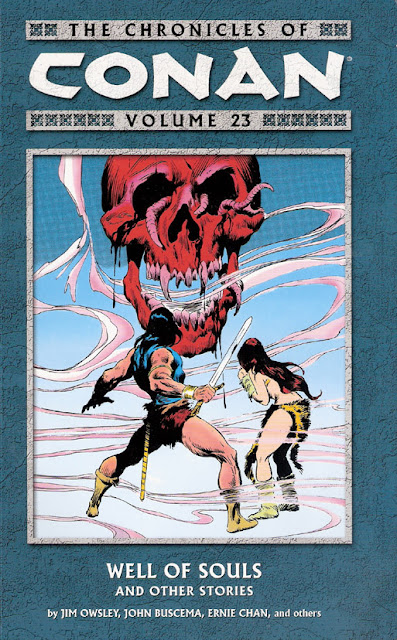
Chronicles of Conan, v. 23: Well of Souls and Other Stories coverWell of Souls isn’t going to convince a reader with no interest in Conan to start reading the series. However, it might lure readers who are interested in the character or concept back to the series by giving them reasons to invest in the title rather than an individual story. The supporting cast is vivid enough to make readers care about them. Delmurio and Tetra have personalities, and readers will most likely have an opinion about them; when they leave Conan’s side, the barbarian picks up a new companion, who will presumably also make readers like or hate him. The extended plot pays off in a not completely unexpected fashion after seven issues (two in the previous volume, Reavers in the Borderland), and a new plotline begins.

It’s a solid foundation for a series. It’s only a baseline, but it saddens me how badly previous volumes miss that mark.

The individual issues are on the whole mildly interesting, elevated by the structure but showing only flashes of excellence. Issue #175, with its war-haunted river town and mysterious boatman, is the most atmospheric and probably the best issue in the collection. Even the less interesting issues have elements that momentarily pique interest; the opening story, which largely revolves around a mob of uninteresting war orphans, has some surprisingly vicious moments and ruminations about the ethics of keeping occupied populations in line that redeems the fleeting romances and undifferentiated crowds.

Despite my faint praise for the individual issues, Owsley has a better handle on Conan’s world than the writers who preceded him. The settings are filled with casual violence and superstitious people who cannot recognize false prophets or true prophecy when it is shouted at them. People die soon after they appear, and they die when it seems like they are going to join the ongoing cast. Owsley gives the protagonist more dimensions than he usually possesses in Marvel comics; the Conan in Well is as brooding, angry, and violent as usual, but the presence of Tetra restrains his lustful side. The narration says he is affected by her resemblance to lost lovers Red Sonja and Bêlit, but it’s clear Conan sees her adoration and reacts to it. Given her youth, he can’t return her affection, and he doesn’t want to reject her outright, so he doesn’t flaunt his sexual preference of other women to her. When her eyes are no longer on the barbarian, Conan goes back to his lecherous ways almost immediately.

Well of Souls has plenty of areas where it could be improved; better choices by editor Larry Hama might have prevented colorist George Roussos from assaulting readers’ eyes with a technicolor Hyborian Age or convinced artist John Buscema to cast aside the teenage Tetra’s furry bikini and loincloth ensemble, even if it is accessorized with green furry boots. (What animal could those boots have come from?) Making the spelling of man-monster Keiv (not “Kiev”) consistent would have helped. Having Owsley restate the overarching plot — on a quest to find treasure, based on a map Conan and Delmurio each have half of — would have been useful as well, since the reader often knows only that the trio are going to some destination. Hama also makes a mistake in issue #176, referring to Conan’s adventure with ex-mercenary Redondo as being in Annual #9 instead of #10. Since Annual #10 is included in Well, that’s not a big problem, but collection editor Chris Warner might have given the story in #176 greater impact by putting Annual #10 before #176. On the other hand, the continuing narrative doesn’t give much room for the annual, so it might not have been feasible.

The ever-reliable John Buscema drew all the issues of the regular series. Buscema was getting near 60 when these issues came out, but his art is as strong and vivid as ever. Owsley’s intense Conan would not work half so well with another artist, as Buscema’s work on the barbarian hero conveys a hardness that has nothing to do with his musculature. Buscema’s penchant for cheesecake — de rigueur for fantasy, I know — gets a little out of hand, as no woman in Well conceals her navel, and Tetra’s outfit is, as described, gratuitous. Frequent Conan inker Ernie Chan penciled the annual and does a good job of it.

The immediate future looks good for the title. The overarcing plot is controlled by a new adversary, not Conan, but the villain looks like he has a plan and is putting it into place. With Owsley remaining on Conan until #213 (another four volumes or so), the stories should retain their barbarousness, and Conan should remain well rounded.

Rating: Conan symbol Conan symbol Conan symbol Half Conan symbol (3.5 of 5)

Labels: , , , , , , , ,

18 January 2013

Chronicles of Conan, v. 22: Reavers in the Borderland and Other Stories

Collects: Conan the Barbarian Annual #8-9 and Conan the Barbarian #168-73 (1983-4, 1985)

Released: June 2012 (Dark Horse)

Format: 224 pages / color / $18.99 / ISBN: 9781595828125

What is this?: Conan joylessly wenches and kills his way through more of the Hyborian Age.

The culprits: Writers Michael Fleisher and Jim Owsley and artists John Buscema, Ernie Chan, and Val Mayerik


Writer Michael Fleisher’s work in Chronicles of Conan, v. 21: Blood of the Titan and Other Stories left me optimistic the quality of the Chronicles of Conan would improve from its consistently forgettable levels. And then The Chronicles of Conan, v. 22: Reavers in the Borderland and Other Stories jammed a broadsword through that optimism.

I wasn’t expecting a return to Roy Thomas levels of quality but something memorable about the stories in Reavers in the Borderland — about any story in Reavers, actually. Introducing Fafnir, a sidekick / partner for the title barbarian, distinguished Blood of the Titan from other books in the series. The rivalry and friendship of the two added a new dimension to Conan’s character, and for once, there was a character in Conan (other than Conan) I gave a damn about.

 cover But Fafnir is dropped from the stories in Reavers, and the series returns to random hack-and-slash action, full of gaudily colored thugs, wizards, and bravos trying to cut Conan down. Fleisher, who wrapped up his two-year run with #171, writes largely forgettable pieces, studded with violence and lady flesh. Fleisher’s stories show little wit and feature no memorable characters. The images parade in front of the eyes and then vanish, leaving as much of an impression upon Conan as they do the reader — that is, none.

In Reavers, Conan saves an old ally from a carnival (?!) sideshow. Conan protects a wench from some of his old enemies, only to find she is more than she seems. A wizard needs help with a demon and a cursed sword; that takes two issues to resolve. Conan appears to die; the reader yawns, not particularly caring how he survives. (Poison coma, if you’re interested. You shouldn’t be, though.)

I almost called Fleisher’s stories continuity-free, but that’s not true; he reuses characters from his run in two of his stories. In #168, Conan chances across Alhambra, the winged woman from #153-4 (The Chronicles of Conan, v. 20: Night of the Wolf and Other Stories), and saves her from the sideshow and her old enemies, the Batmen of Ur-Xanarrh. (He almost burns her and everyone in the carnival to death first, though.) In #171, he fails to protect a girl from the Brotherhood of the Falcon, which he fought in #162 (Blood of the Titan). But Alhambra is just a pretty face (and pair of wings) who doesn’t stick around, and despite “killing” Conan, the Brotherhood of the Falcon is just another group of faceless goons, with little to distinguish them from a random wizard’s henchmen or a corrupt duke’s soldiers. Fafnir, the saving grace of the last volume, does come back briefly in #170, although it’s only to say goodbye.

What Conan needs is a supporting cast, people who stay with him. They don’t have to stay forever; three or four issues would be fine. But Conan needs a contrast in the story, someone to express himself to (even if it’s by not saying anything), or else the book becomes the story of a guy with a sword killing random stuff, with as much character as a video game avatar. Not becomes, I guess — became, and that happened a long time ago.

Jim Owsley (known today as Christopher Priest) starts with #172, and things change for the better. The remaining two stories are to parts of a larger storyline set in the Pictish wilderness. Conan gains a sidekick, a pretty girl — giving artist John Buscema just what he needs: even more opportunities to draw pretty girls — and still has a hapless victim to protect. Owsley writes a more brutish Conan than Fleisher, who has Conan give his horse to a woman who just tried to steal his sword. Owsley’s Conan is plainspeaking and rude, saying hurtful things to people who might not deserve it. It’s a refreshing change; Conan should have some teeth. Issues #182-3 augur well for the future, and many people really like Owsley’s work on Conan.

But I’ve been burned before. The potentially explosive cliffhangers in Blood resolve as damp squibs in Reavers. I thought I had a handle on how the story in #167 would be resolved. I was wrong; I didn’t expect Fleisher to make the bold choice of ignoring the dangling plot altogether. The cliffhanger in Annual #7 seems similarly forgotten, although it was resolved eventually. Not in Conan the Barbarian or a Conan Annual or even Savage Sword of Conan, but in the Conan of the Isles graphic novel, which came out six years after Annual #7. I’m not going to change my rating of Blood, but the lack of payoff in Reavers does devalue the story in Blood.

There are many roles I rarely discuss in my reviews: colorists, editors, letterers … Reavers made me consider the reprint editor, which in this case is Chris Warner. Unfortunately, my attention is not to his benefit. Warner leads off the book with two Conan the Barbarian Annuals (#8 and 9). They were published before the Conan the Barbarian issues in this collection, but since I was looking forward to the continuation of Fafnir’s story, the beginning of this book seemed a poor place to put the annuals. (The wait also made the weak payoff even more disappointing.) Between Fleisher’s and Owsley’s runs would have been a better place, and it’s not like anyone was paying attention to Conan’s chronology at this point.

As for art: Buscema’s in fine form. His work looks better with inks from Bob Camp (#169-70, 172-3) than from Armando Gil (#171) or Buscema himself (#168), though. The final two issues are especially superb and sharp, even if I wish Bucema would get rid of Conan’s blue-sleeveless-tee-and-fur-underwear combo. Ernie Chan draws an action-packed Annual #9, although he can’t quite measure up to Buscema. Val Mayerik supplies the art for Annual #8, and I was too distracted by his tentative inking to say anything about his pencils. (This book is a warning against self-inking, really.)

Maybe my optimism isn’t dead; maybe it will survive the bloody attack that is Reavers in the Borderland. But even if it can survive this crummy book, you should skip Reavers. Reavers has little to recommend it, other than Buscema’s art, and Buscema’s work is in so many better Chronicles. Oh, there might be something to the Owsley run, and if there is, it’s going to annoying to miss the first two issues. Still: do not be tempted to buy this waste of time. It’s not worth it.

Rating: Half Conan symbol (0.5 of 5)

Labels: , , , , , , , , , , ,

13 February 2012

Chronicles of Conan, v. 20: Night of the Wolf and Other Stories

Collects: Conan the Barbarian #151-9 (1983-4)

Released: December 2010 (Dark Horse)

Format: 200 pages / color / $18.99 / ISBN: 9781595825841

What is this?: Conan stabs his way through another nine issues of his eponymous series.

The culprits: Writer / artist John Buscema and writer Michael Fleischer, with fill-in art from Gary Kwapisz


There’s no doubt the comic book direct market is in trouble. Sales have been declining for years, and unlike at the direct market’s dawn, few titles are guaranteed a continued existence. This is discouraging for those of us who would enjoy long runs for new characters and titles or hope titles that have always been at the fringe of economic viability (Power Man & Iron Fist, Defenders, Alpha Flight, etc.) will get a new ongoing series. The only good news is that almost every current title should have a purpose or a hook.

You don’t see too many zombie titles any more. If you’ve read comics in the late 20th century, you’ve probably come across a zombie title or three. They’re the ones that lurched along, all semblance of life drained away, still repetitively doing all those things it did when it was new and vital. There’s no creative reason to publish these comics: no overarching plots, no exciting young creators looking to work with the character, no groundbreaking creativity. There’s just a semi-loyal audience hanging around, large enough to make money off of. For a Marvel comic, there’s something humorous about this: Marvel zombies helping zombie comics titles survive. A zombie support network, if you will.

Chronicles of Conan, v. 20: Night of the Wolf and Other Stories coverConan the Barbarian was a prime example of a zombie title. After original writer Roy Thomas left, there was a drop-off in the writing quality; few of his successors had a handle on Conan and his world like he did. Truth to tell, even Thomas was having trouble by the end of his long run. The title floundered. So by issue #151 — where Chronicles of Conan v. 20: Night of the Wolf and Other Stories begins — what was the purpose of this title?

The easy answer is that Conan stuck around to give artist John Buscema, often inked by his frequent Conan collaborator Ernie Chan, a place to play. Conan is the title the elder Buscema brother was most associated with, and if he wanted to do the title, why not let him? The art still looks great; there’s no doubt about that. Conan and his enemies are dynamic, active enough to still occasionally surprise the long-term reader with their vividness. Conan himself hasn’t devolved into a copy or parody artistically, although I have my doubts about his blue-sleeveless-tee-tucked-into-furry-bikini ensemble. Still, the monsters are monstrous, and the girls are as gorgeous as ever. And Buscema even started plotting the stories. Giving Buscema a forum for his work and keeping him happy seems a worthy goal, right?

But it’s hard to shake the idea that even the art has lost its freshness. I’ve seen the Conan / pretty girl / evil-wizard / monster set piece before, and if Buscema moves the elements of this stock tale around artfully, he can’t disguise that they are the same elements. I find myself wishing Marvel would have given Buscema a new challenge, something for him to flex his character design and artistic muscles on.

On the other hand, Conan must have sold. So the zombie stays in the publishing schedule.

The writing is a larger problem. Certainly there’s nothing new there. The stories aren’t the worst in the Chronicles of Conan series, but Buscema and Michael Fleischer (writer #151-4, dialogue #155-9) aren’t breaking new ground. There are no overarching plots, no development of Conan’s character (although 21st century readers should know that’s not a priority), and few characters — good or evil — are worth seeing again. Conan’s violent edge has dulled into a paternalistic affability; he’s a nice guy by this collection. A nice guy who guts a few people every issue, but he’s not out to destroy, and he’s not always on the make.

The same elements are used again and again — abducted maiden, lost city under attack (that one’s used twice), evil woman trying to control Conan (again, twice), the perilous inn. Issue #155, in which Conan rescues a grateful toady from a semi-competent wizard, is the best of the lot, and although there are a few attempts at twists (the wolf in #158, the wizard’s identity in #157), the execution produces limp results. (The twist in #158 is spoiled on cover, for instance.) This is partially down to Buscema, who is presumably learning the ropes as a writer; in #156, for instance, the final third of the story is a flashback in which Conan doesn’t appear.

I have to admit I didn’t initially catch that the title of #154 — “The Man-Bats of Ur-Zanarrh!” — was a play on a 1958 Batman story, “Batman — The Superman of Planet-X,” in which Batman encounters the Batman of Zur-En-Arrh, an alien planet. (Not many other people would have caught it had Grant Morrison not resurrected the idea for his recent Batman run.) Clever — but not clever enough to save the story or the book. In any event, when a war between winged humans and bat men on a floating city — a war in which Conan rides a giant dragonfly — seems a little ho-hum, it’s probably time to strike the curtain and call it a day.

There are reasons for zombie titles to exist — or there were, at least. They served as a safe place to launch new creators, such as Frank Miller on Daredevil, and new ideas. They provided a feeling of a shared universe, which was more important then than it is today. These zombie titles also give readers a nice feeling of continuity: there’s Conan on the newsstand; it’s been there for a decade, and it will still be there in another decade.

That last is a luxury the direct market will no longer allow, though, and the other two aren’t relevant to Night of the Wolf. The only reason for Conan to continue throughout the ‘80s was economic. But that’s not really a reason for anyone but Conan diehards to read Night of the Wolf in 2012.

Rating: Conan symbol Conan symbol (2 of 5)

Labels: , , , , , , , ,

24 April 2009

Essential Power Man and Iron Fist, v. 2

Collects: Power Man & Iron Fist #76-100 and Daredevil #178 (1981-3)

Released: March 2009 (Marvel)

Format: 624 pages / black and white / $19.99 / ISBN: 9780785130727

What is this?: A two-year slice of early ‘80s street-level Marvel superheroing, featuring the Heroes for Hire: Power Man and Iron Fist.

The culprits: Writers Mary Jo Duffy, Denny O’Neil, and Kurt Busiek and pencilers Denys Cowan, Ernie Chan, and Kerry Gammill, with many other writers and artists

When people get nostalgic for the early ‘80s, Jim Shooter-era Marvel, they don’t often wax nostalgic about Power Man & Iron Fist. (Not in my experience, anyway. I’m sure there are corners of the Internet where that is exactly what happens.) But in many ways, Essential Power Man & Iron Fist, v. 2, is part of the bedrock of that time.

Power Man & Iron Fist has its flaws, but it was a second-tier book that kept chugging along, month after month. Once past Cage’s “Sweet Christmas!” (not much in evidence here) and jive, there’s not much laughable about the title, unlike Dazzler or U.S. 1. Every month is a solid story — well short of unforgettable, usually, but rarely disappointing. There was a consistent supporting cast, well used. The villains … OK, these were mostly second-tier, and even with Sabretooth, you know no one had figured out quite what to do with him yet, other than use him as an Iron Fist villain. But these villains were appropriate to the heroes, they had a score to settle, and they frequently had an interesting hook or visual.

Essential Power Man & Iron Fist, v. 2 cover The writers all have solid credentials in similar low-powered superheroes, although Kurt Busiek found his success a little later than Denny O’Neil and Mary Jo Duffy’s best-known writing is probably Power Man & Iron Fist. The artists are nothing to sneer at either, although Ernie Chan is better known as the inker for Conan than a penciler and neither Kerry Gammill nor Denys Cowan are current superstars or objects of nostalgic veneration.

There is no overarching plot for the volume, of course; there never is in an Essential. So let’s talk about the writers. Duffy uses humor well, rarely letting it get in the way of the plot (except for #79, which is essentially a Doctor Who story, with a cut-rate non-licensed Doctor Who). Unsurprisingly, she’s also the most deft with the largely female supporting cast. O’Neil, who takes over with #85, does away with Duffy’s last shocking change — the scarring of Harmony, a fashion model and Cage’s girlfriend, as soon as it is safe — and … well, I’m not sure what to say about his run, which lasted until #89, except that it’s mainly forgettable: a couple of adventures outside New York, a rescue of Moon Knight, an anti-drugs story. Very ‘80s, in its way, I suppose.

Busiek takes it the rest of the way (except for #91, written by Steven Grant), but this isn’t the Busiek we know from Marvels or Astro City. He’s unpolished here, indulging in legacy characters by bringing back the ID and gimmick of Chemistro and picking up on hints from the O’Neil run that Luke might not be looked upon kindly by his Times Square neighbors. That’s an interesting idea, but he conflates the scum of Times Square, who might want to kick a hero out of their midst, with the African-Americans who think Cage is too white. (The word “Oreo” is used a lot.) Both those groups are wrapped up in the newest Chemistro, who is black and promises to keep the area safe for criminals — not like that Cage, who works with the po-lice. There’s a good story about the heroes escorting Hammerhead to a different prison (although why do they have to ride on the top of a truck to do it?), and Busiek does manage to keep a group of subplots moving forward quite ably, wrapping them up in the double-sized #100.

Gammill supplies the best art in the volume. His pencils are sharp, vivid, and kinetic, and for readers, it’s a shame he only stays on for only for only three issues, #77-9. In many ways, this style of art is underappreciated: without enough tics or exaggerations to be memorable, it has to settle for an understated excellence. Cowan’s style suffers from the black-and-white reproduction and a series of inkers; I remember his work being much better in color in the original issues. The inking of Carl Potts, who finished almost half Cowan’s work on the title (#80-4, 86-90, and 92-3), does him no favors, and that and the lack of color sometimes makes it difficult to make out details with his scratchy style. Chan works #94-100; his art starts off stiff, but it improves greatly when he stops inking his own pencils.

Some call it mediocrity, others consistency. But most of us who enjoy comics from that era can’t quite put our fingers on what to call it; we only recognize it has a familiar feel, comforting without being exciting. This isn’t probably the best way to spend your $20 — and don’t think I haven’t noticed that price increase, Marvel; you’re on notice — but most readers won’t regret the time or money spent with this volume.

Rating: Marvel symbol Marvel symbol Marvel symbol (3 of 5)

Labels: , , , , , , , , , ,