Reviews of trade paperbacks of comic books (mostly Marvel), along with a few other semi-relevant comments / reviews.

12 February 2016

Skull the Slayer

Collects: Skull the Slayer #1-8 and Marvel Two-in-One #35-6 (1975-6, 1978)

Released: April 2015 (Marvel)

Format: pages / color / $24.99 / ISBN: 9780785193975

What is this?: After surviving a plane crash in the Bermuda triangle, a Vietnam vet, a physicist, his assistant, and a wealthy white teenager encounter a weird world with dinosaurs and aliens.

The culprits: Writers Marv Wolfman, Steve Engelhart, and Bill Mantlo and artists Steve Gan, Sal Buscema, and Ernie Chan


In 1975, Marv Wolfman finally persuaded Marvel to publish a series that he’d had simmering in his mind for years, a series with a bold premise: readers would hate every character, but to distract them, the artist would include dinosaurs.

That wasn’t really the premise. Wolfman’s idea has a former soldier leading a group of plane-crash survivors around a mysterious island in the Bermuda Triangle, where they have to deal with dinosaurs, aliens, and all manner of strange mysteries. But the characters’ unlikeability will remain my lasting memory of Skull the Slayer, a mid-’70s Marvel series with more ambition than continuity or ability, long after I forget everything else but the dinosaurs.

Skull the Slayer coverThe unlikeable roll call starts with Vietnam vet Jim “Skull” Scully. He’s had a hard time of it: years spent in a POW camp, where his jailors tortured him for information he didn’t have, followed by a sour homecoming where he found his wife shacked up with another man, his parents dead from their worry about him, and his brother strung out. Almost immediately, his brother attacks Scull with a knife, and in the scuffle, his brother is killed. Scully goes on the run, and his arrest in Bermuda leads to him being on the plane that crashes in the Bermuda Triangle.

All that should build a lot of sympathy for Scully, but as soon as he meets the other survivors of the crash, his arrogance comes to the fore. He’s always scuffling with Dr. Raymond Corey, the physicist, over dominance in the group. He scorns the peacemaking of Ann Reynolds, Corey’s assistant, and Jeff Turner, the son of a wealthy Ohio senator. He won’t compromise; all his dialogue is bluster, convinced the entire world, down its smallest molecule, is against him. This is the Marvel template: a hero with ability (Scully kills a dinosaur in #1) but brashness that drives everyone away. In the Marvel style, the hero eventually comes to an understanding with (most of) his supporting cast, toning down his rough edges, but before that happens, he abandons Corey, Reynolds, and Turner to their deaths in #4.

Since Scully is the protagonist, the other characters are supposed to irritate Scully and the readers, by extension. The supporting cast mainly gets broad-stroke characterization, and the writers aren’t afraid to lean on stereotypes when they have to. Corey is highly educated and scorns Scully as a murderer; he’s also African-American, and he admits his frustration with racism that has held him back. Corey’s bitterness drips from every word of dialogue, but he lacks any empathy or vulnerability. Sexism has held back Ann Reynolds, but she often assumes female stereotypes — an obsession for clothes, an injury while running that prevents the others from escaping, etc. Turner is a load with a bad haircut.

Wolfman left the series after #3, so it’s possible he could have planned to soften the characters some. Steve Engelhart, however, took over for #4, and he torpedoed any chance Scully had for likeability by having him abandon his comrades during an escape attempt. This was part of a plan to dump Scully’s supporting cast for a more in-depth investigation of the world Scully found himself in, but #4 was Engelhart’s only issue. Bill Mantlo, who guided the series to its limping end, wrenched the series back in the direction Wolfman had aimed it in by resurrecting and reinstating the supporting cast the next issue. Oops!

Knowing someone abandoned you in the hour of your direst need, and that you actually died because of what they did, would put a crimp in any relationship. Reynolds, Corey, and Turner forgive Scully unimaginably quickly, although they do spend #5 trying to kill him.

Given the characters’ lack of charisma, Skull needed intriguing plots and / or great art to succeed. Skull had a very strong similarity to the TV series Lost: in each, the survivors of a mysterious plane crash find themselves on a weird island with little chance of rescue. (I would pay cash money for a sequel to Skull, with Scully tearfully crying, “We have to go back to the island!”) After the plane crash, the mysteries Skull and his crew uncover on the island include:
  • Dinosaurs (#1)?
  • Why are there prehistoric men (#2)? They didn’t exist at the same time as dinosaurs.
  • Where did that dead alien come from (#2)?
  • And why did he have a magic power belt (#2)?
  • Why were all those human and alien pilots (now skeletons) tied to stakes in one place (#3)?
  • What’s the deal with the tower that has different time periods on each level (#3), all populated with robots?

Those are Wolfman’s plots, with Marv piling weird stuff into the pages without seeming to have an idea of how to resolve them or what the survivors should be doing, other than not being eaten by dinosaurs. Perhaps three issues is too little time to be seeing movement in those areas, although the lack of a plan shows why Scully should not have been the group’s leader.

Engelhart wraps up the last plot in that list — aliens built the tower as part of a plot to conquer Earth at all time periods simultaneously — but then Mantlo ends that plot in #6 with the destruction of the tower. It’s unclear whether the aliens are responsible for the non-tower weirdness on the island — why do aliens care about dinosaurs? — but Mantlo moves on to a faux-Aztec society, another pilot from our world, and societal civil war. Wolfman returns to wrap up everything in two issues of Marvel Two-in-One, but it’s clear he’s sweeping up the pieces in case another writer sees something he likes. Most of those pieces ended up in the trash, though. Wolfman didn’t even bother to salvage (or mention) the pilot from our world that Mantlo introduced.

For readers who like drawings of dinosaurs, though, Skull might be something to investigate. (Evidently not enough of those existed in the mid-’70s.) Steve Gan gets the bulk of the dinosaur duty, drawing #1-3 and #6. His dinosaurs are massive, powerful creatures. Sal Buscema’s arc (#4-8) concentrates on different eras of human history; his work is harmed by the bright colors, but his design for the alien Slitherogue is satisfyingly sinister. (Sure, Slitherogue looks like he’s a Yellow Peril villain, but he’s purple, and from outer space, so it’s OK, right?) Buscema’s less-detailed style suffers compared to Gan’s work; Gan’s linework, especially with its emphasis on the hair and sinew of the figures he draws, is more in keeping with the dirty, more animalistic world the book inhabits. Gan’s Scully is a more vicious, feral man than Buscema’s version, giving the impression that Scully might be a man who fits the island better than he does modern society. Ernie Chan draws the MTiO issues like they are, well, MTiO issues, and the more superheroic look is jarring. The rushed plot does Chan no favors, though.

The series is a brief flash of muddled creativity that never clicks. Readers can probably find bits and pieces that entertain them or that they’d love to see repurposed in something more coherent, and the series’ failure shows how difficult it must have been to keep the mélange of character and mystery plotlines going for so long on Lost. Skull the Slayer is an artifact of the fecund ‘70s, but like a lot of the high-concept ideas that came out of that time, its execution means it isn’t worth reading.

Rating: Marvel symbol Half Marvel symbol (1.5 of 5)

Labels: , , , , , , , , , ,

13 November 2015

Nova Classic, v. 3

Collects: Nova #20-25 and Fantastic Four #204-6 and 208-14 (1978-80)

Released: June 2014 (Marvel)

Format: 304 pages / color / $34.99 / ISBN: 9780785185529

What is this?: The last storyline of Nova’s solo title is diverted into a Fantastic Four plot, then forgotten in favor of something more interesting.

The culprits: Writer Marv Wolfman and artists Carmine Infantino, Keith Pollard, and John Byrne


One of the first superhero comic books I can remember reading is Fantastic Four #208. It was the early ‘80s, and a relative on my mother’s side gave me a stripped copy, without the cover.

The issue didn’t make me a Fantastic Four fan, although years later I was surprised to find the issue was penciled by Sal Buscema, which might account for my affection for his art. What the comic really introduced me to was the Marvel style of story: if you pick up a random issue, you’re likely to be dropped into the middle of an ongoing story that picks up threads from the previous issue and leaves others to be wrapped up by later issues.

Nova Classic, v. 3 coverFantastic Four #208 left me with so many questions. First, who the hell were these people who weren’t the Fantastic Four? Will they save Xandar from the Skrulls? Will the Fantastic Four survive their execution by old age? Can they stop the Sphinx? Is Dr. Sun as awesome as he appears?

So I bought Nova Classic, v. 3, to find the answer to those questions. (I would say that last one deserves a definite “yes,” although I needed to consult Tomb of Dracula to answer it.) Despite the name, Nova Classic, v. 3, is not a Nova book, not really; the last five issues of Nova introduce this trade, but Nova (and his supporting cast) appear in only one of the ten issues of Fantastic Four that close out the book.

To back up a bit: Nova is Richard Rider, a character introduced in his own short-lived ‘70s series (collected in the Essential Nova, one of my earliest reviews). He was created by Marv Wolfman and John Buscema (Sal’s brother) as a Spider-Man / Green Lantern hybrid: a teenager, with real teenage problems, who becomes a superhero by getting the powers of a dying space cop. The series lasted 25 issues and was cancelled mid-storyline in 1979. Fortunately, Wolfman, who was still the writer and editor of Nova, was also the writer and editor of Fantastic Four, so he inserted Nova and his cast in the middle of the then-current Fantastic Four storyline — #208, to bring this review back to the beginning.

In #204 through #206, the Fantastic Four had gone to Xandar to help defend it from the Fantastic Four’s old enemies, the shape-shifting Skrulls. The Sphinx, the villain who gathered Nova and his allies and enemies together for a space trip, wanted to use the computers of Xandar to help him end his immortality. Unfortunately, the Xandarian computers showed him how to gain immense power instead, so he headed to Earth to gain vengeance on his home planet. The Fantastic Four switched adversaries with Nova and his allies.

So Nova Classic, v. 3, is split into two halves, which touch in #208. The Nova plotline sputters out after that. Nova disappears from the book, and the story of the Champions of Xandar, as Nova and his allies are called, defending Xandar is taken over in Rom the Spaceknight (#24). Since Rom is a licensed character, that story has never been reprinted, although IDW recently acquired the comics rights to the character and probably nothing will happen in the reprint realm but we can hope?

Nova itself was not a very good series, and #20-25 are representative in that regard. The issues included have Nova outing himself to his family, which is a nice touch — Richard can’t hide it any more, and we see a brief scene of him dealing with his family’s reactions. But after that, he’s quickly roped into the Sphinx’s shenanigans, and then he’s back to fighting forgettable villains, just like the issues preceding this book. (You don’t see Nova villains other than Sphinx very often, and there’s a reason for that. Marvel also killed the rest of the Champions of Xandar — and Xandar — off panel in Avengers #260.) The only interesting bits in Nova other than Richard and his family dealing with his costumed identity are Dr. Sun facing off against the Sphinx, but that’s a brief scene without a real resolution.

The other half of Nova Classic, v. 3, on the other hand, is a decent-to-good Fantastic Four story. The Fantastic Four are called to aid the Xandarians against the Skrulls. This time, the Skrulls gain the upper hand, and three members of the Fantastic Four are captured and executed — in a sense. The Skrulls subject them to an aging ray, which will kill them in three days. It’s a needlessly cruel way to kill, but it fits the Skrulls and their hatred of the Fantastic Four. The executed heroes then escape and meet up with the Champions of Xandar on Xandar.

Once the Fantastic Four starts pursuing the Sphinx, the storyline gets a little flabby; #209 reads like a well-chosen, well-written fill-in, with the team rounding up escaped space convicts in a spaceship graveyard. It has little to do with the ongoing plot, and it introduces Reed’s idiotic robot HERBIE into the comics. After the Fantastic Four reaches Galactus and tries to convince him to fight the Sphinx, Galactus makes them spend an issue fetching him a herald, which should give the Sphinx time to destroy the Earth a few times over. Still, the individual issues are exciting, and they ramp up the tension nicely. (Except for #209.)

The ending of the storyline is a little weak. Galactus uses an ability I’ve never heard of him using to battle the Sphinx, and the solution to solving Reed, Sue, and Ben’s aging problem is to have Reed solve it after Reed has been declared too weak to do anything. The story does introduce Terrax, though, and it also has a nice Terrax-vs.-the-old-FF fight.

The art improves markedly throughout, going from Carmine Infantino’s scratchy, static drawing to the smooth lines of Keith Pollard (#204-6) and the first Fantastic Four issues drawn by John Byrne (#209-14). (Byrne and Pollard match up pretty well, in fact.) Pollard’s a little weak on the chaotic, hand-to-hand battle royales between the Fantastic Four and the Skrulls, but Byrne shows why he would be associated with Fantastic Four for years; his old versions of the team actually look like they are elderly (albeit elderly people with superpowers), and the Sphinx looks like a credible threat to Galactus. Their fight lacks any cosmic touches, but that’s OK, I suppose.

I think the best way to look at Nova Classic, v. 3, is as a Fantastic Four trade paperback with six issues of Nova bolted on. Unfortunately, $35 for a reprint of a bunch of ‘70s Fantastic Four issues is a bit steep, even if those issues do reprint the first appearance of Terrax and some nice Byrne work.

(And the book is even missing a Fantastic Four issue! In #207, Johnny Storm enrolls in New York’s dumbest college — appropriate, given that Johnny’s pretty dumb himself — and is used by the Monocle, the college’s dean who has used his advanced degree to come up with an imbecilic name, to steal Mr. Fantastic’s inventions. With all that stupidity in evidence, it’s Spider-Man who handily saves the day.)

Despite my affection for Nova Classic, v. 3, I really can’t recommend it unless you’re hunting for a Fantastic Four story that you haven’t read. In that case, it’s going to be a pleasant surprise.

Rating: Fantastic Four symbol Fantastic Four symbol Half Fantastic Four symbol (2.5 of 5)

Labels: , , , , , , , , , , ,

05 April 2013

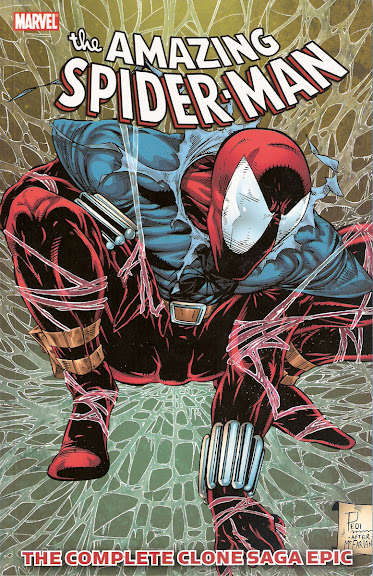
Spider-Man: The Complete Clone Saga Epic, v. 5

Collects: Amazing Spider-Man #405-6, Spectacular Spider-Man #228-9, Web of Spider-Man #128-9, Spider-Man #62-3, Spider-Man Unlimited #10, New Warriors #62-4, Spider-Man Team-Up #1, and backups from Amazing Spider-Man, Spectacular Spider-Man, Spider-Man, Venom, and Web of Spider-Man Super Specials (1995)

Released: January 2011 (Marvel)

Format: 472 pages / color / $39.99 / ISBN: 9780785150091

What is this?: The Clone Saga is wrapped up — ha! — Ben and Peter figure out what to do with their lives.

The culprits: Writers Tom DeFalco, Terry Kavanagh, J.M. DeMatteis, Todd DeZago, Howard Mackie, and Evan Skolnick and artists Patrick Zircher, Sal Buscema, Steven Butler, Gil Kane, and others


Spider-Man: The Complete Clone Saga Epic, Book 5 isn’t great, but I can praise some elements of the book without reservation. More importantly, little in Book 5 inspires the deep loathing the abysmal Book 4 did.

The high point of Book 5 is the five-part story that ran alongside “Planet of the Symbiotes” (reprinted in Book 3) in the Super Specials. Written by Terry Kavanagh, the tale introduces a new hero, Strongarm, who is created by a scientist’s reworking of Dr. Curtis Connors’s research. Strongarm’s story, which — of course — culminates in a battle with the Lizard, Connors’s alter ego, is forgettable, but Strongarm himself has a certain uncomplicated, Boy Scout charm about him. More interesting, though, is the attempt of Spider-clone Ben Reilly to assemble a life: a job, a love interest, a supporting cast. Heck, he even shows a hint of jealousy, and even though jealousy is a negative emotion, any emotion not connected to Peter Parker or clones is welcome. Chronologically, this story should probably have been included before Amazing Spider-Man #400 — it’s hard to believe Ben could get hired for a job without anyone remarking upon his resemblance to a front-page murder suspect — but it’s good to see the Spider-office spend some time on the man who will be Spider-Man for the next year.

Spider-Man: The Complete Clone Saga Epic, Book 5 cover I also like the New Warriors issues in Book 5. The three issues have nothing to do with Spider-Man, and most have little to do with the Scarlet Spider (Ben’s alter ego), but they are a nice, clone-free palate cleanser. Writer Evan Skolnick shows a different side to Ben, who relates to a team — something Spider-Man had not done up to this point — and even takes charge when necessary. The issues also have some intriguing subplots, which — again — have nothing to do with Spiders or clones … unfortunately, this makes it sound as if I’m tired of reading about Spider-Man or the Clone Saga.

Perhaps I am; the other three storylines in Book 5 don’t generate any interest in the clones. In quality, they range from dull (“Exiled” and most of “Greatest Responsibility”) to awful (“Time Bomb”).

The four-part “Exiled” crossover is mystifying, as the four issues have three unrelated stories in them. They are tied together by a subplot: Ben’s decision to leave New York, which he reverses almost immediately. The main stories are random. Web of Spider-Man #128 is a D’Spayre story — a D’Spayre story, for Odin’s sake! D’Spayre feeds on people’s, well, despair, and he’s always beaten when one of his victims overcomes that emotion. Web #128 is no exception. Amazing Spider-Man #405 and Spider-Man #62 shows Ben fighting a new adversary to protect his friend, Dr. Seward Trainer, and Trainer’s data; the B-plot shows some of Ben and Seward’s back story, which might be interesting except for the Clone Saga taint lingering over Seward. And Spider-Man Unlimited #10, the last part of “Exiled,” is a forgettable Vulture story that also has Ben helping Uncle Ben’s friend put his kid into college. Sure, why not?

The first two parts of the three-issue “Greatest Responsibility” are similarly forgettable. The new Dr. Octopus, who is also Trainer’s daughter, is revealed as the mystery villain from the middle of “Exiled,” to the collective yawn of the audience. Her conflict with her father and the Spider-Men features ‘90s conceptions of virtual reality, Trainer in an X-Men-style uniform, and one of the odder father-daughter relationships in comics. These issues aren’t awful, but the plot developments feel forced, and the plot and art are dated.

The final issue of “Greatest Responsibility,” Spectacular Spider-Man #229, is cut above the rest of the crossover, as creator Tom DeFalco, Sal Buscema, and Bill Sienkiewicz step up on what is ostensibly Peter’s last issue as Spider-Man before he is replaced forever. The plot is reminiscent of Amazing Spider-Man #33; since Amazing #33 is one of Spider-Man’s greatest moments, and echoing it to give Peter a sendoff is an excellent idea. Both issues have a battle vs. Dr. Octopus in an underwater base, Spider-Man trapped under broken machinery, and a loved one waiting for Spider-Man to return with medicine. Spider-Man’s escape is appropriately different from Amazing #33, and Spider-Man needing Ben’s assistance can be interpreted many ways. The execution on Spectacular #229 doesn’t do justice to the earlier issue, but the idea is so far ahead of the rest of the book I don’t mind.

Curiously, reprint editor Mike O’Sullivan inserted Spider-Man Team-Up #1 between the second and third chapters of “Greatest Responsibility.” In SMTU #1, Scarlet Spider and the X-Men ally to battle Shinobi Shaw’s Hellfire Club, and like Shinobi Shaw, the issue slips from the memory as soon as it’s out of sight. I don't see the logic of inserting the issue into the middle of a storyline, but I’m of two minds about including the issue at all; I like getting more stories, but SMTU #1 is of such negligible importance to Scarlet Spider and the Clone Saga that it feels like filler.

“Time Bomb” is a two-part story that, like Book 4, seems published solely to tear down Peter Parker. Premonitions in previous books showed Mary Jane, Peter’s wife, being killed by a mysterious assailant; writers DeFalco and Todd DeZago resolve the plot by making Peter, under the Jackal’s post-hypnotic, post-mortem control, the assassin. Scarlet Spider and the New Warriors attempt to stop him, but Mary Jane helps Peter break the Jackal’s control with the power of love — a clichéd ending that makes everyone other than Mary Jane look stupid.

The art suffers this time from a complete lack of the excellent Mark Bagley, although the inclusion of Patrick Zircher’s clean, clear, and exciting art on New Warriors helps make up the deficiency. Buscema and Sienkiewicz continue to contribute their not-so-excellent work on Spectacular Spider-Man, although through Stockholm Syndrome, I’m growing accustomed to them. (Buscema’s finishes of Tod Smith’s work on the Spider-Man Super Special are quite pleasing, reminiscent of Buscema’s earlier work.) Steven Butler’s work is sharp but entirely too over-the-top for me; the first image in Web of Spider-Man #128 is the Black Cat in a pin-up pose, her considerable chest thrust out, in the middle of swinging between buildings, which automatically discredits the artist in my eyes. The remaining pencilers range from good to serviceable in a ‘90s way, with no one so good you wonder what happened to them.

Book 5 is a significant improvement on Book 4, but that’s a backhanded compliment. If Marvel had drawn a line under the Clone Saga after this book and moved on, there would be something good to take away from Book 5 and some optimism for the future. But the Clone Saga will be back, as will Peter Parker, so everything will get churned up again. I can’t rate the mediocre Book 5 lower because of my dread of the future … but I want to.

Rating: Spider-Man symbol Spider-Man symbol
(2 of 5)

Labels: , , , , , , , , , , , , , , ,

29 March 2013

Spider-Man: The Complete Clone Saga Epic, Book 4

Collects: Amazing Spider-Man #402-4, Spectacular Spider-Man #225-7, Spider-Man #59-61, Web of Spider-Man #125-7, New Warriors #61, Spider-Man: The Jackal Files, and Spider-Man: Maximum Clonage Alpha and Omega (1995)

Released: November 2010 (Marvel)

Format: 480 pages / color / $39.99 / ISBN: 9780785149552

What is this?: The Clone Saga rushes toward its nadir.

The culprits: So much blame to hand out, so little time.


The Clone Saga, in which Spider-Man’s “clone” returns to his life, has a horrible reputation. Most comic book readers take this as an article of faith. I have read the first three volumes of the Clone Saga, and each were passable, if not always enjoyable. I was pleasantly surprised by this competence, but each competent volume only delayed the pain the Clone Saga’s reputation promised.

Now my waiting is over: Spider-Man: The Complete Clone Saga Epic, Book 4 is the awful sludge at the bottom of the cloning vat.

Spider-Man: The Complete Clone Saga Epic, Book 4 coverThe Clone Saga could go wrong in so many ways, and Book 4 finds a surprising number of them. The most important mistake is undermining Peter Parker, and Book 4 does that as often as possible. Peter is revealed to be the clone, not Ben Reilly, as was assumed. Peter does little to clear his name while Ben sits in prison for him. He hits his wife.81 He runs out on his responsibilities and joins up with the Jackal, a mass murderer and the man responsible for the chaos of the Clone Saga. And he doesn’t join the Jackal while in a fugue or amnesiac state: he buys the Jackal’s idiotic lies and watches, without intervening, as the Jackal does evil things.

I think the most disappointing part is that when the Jackal claims the role of Peter’s father, Peter doesn’t tell the Jackal he had a father, and his name was Ben Parker. But that’s because Peter sees “clone” as meaning “outsider” and “other” and “worthless”; he doesn’t see the past he shares with Ben Reilly as his, he sees no future for himself, and he sees his present as valueless, despite the love of his pregnant wife. And so he becomes a supervillain’s henchman.

Our hero, everyone! It makes you want to shake him and scream, “GREAT POWER / GREAT RESPONSIBILITY, YOU @#*($ING TWIT.”

Since the Jackal was the villain of the original story featuring Peter’s clone, he is appropriately the Clone Saga’s main villain. Unfortunately, this means the Spider-writers have made “clones” a theme of the mega-crossover, and nothing devalues the uniqueness of a character like a clone. Four major versions of Peter Parker wander through Book 4: Peter, Ben, the original clone, Kaine, and a third clone. The third clone was introduced in Book 3 as an amnesiac Peter; the writers tried to fake out the readers and convince them this clone might be the original, but he turned out to be the Jackal’s super-secret mind-controlled agent who had complete control over every atom of his body. Ben called him “Freak Face,” but in Book 4 Jackal renames him “Spidercide,” a name so awful even the Jackal later disavows it. The Jackal also releases a hundred half-baked clones to stop Ben, which he and Kaine defeat easily, and the Jackal keeps mini-servitors, dressed in Jackal costumes, that he claims are clones of Peter.

By the end of Book 4, you wonder who isn’t a clone of Peter Parker. Perhaps it’s Spider-Man who is the superhero who could be you, literally — because one of you is the clone of the other.

The Jackal gets his biggest moments in Book 4. The problem with the Jackal — other than his incessant cloning — is a failing consistent with many villains with mysterious, overreaching goals: he keeps his goals secret whenever he can, and when he can’t, he lies. But most of his peers have some core value they cling to; Mr. Sinister has his obsession with Summers DNA, for instance. But the Jackal doesn’t have an honest bone in his body.82 He says he wants to replace everyone in the world with genetically perfected clones, but he’s going to get distracted the first time he gets thwarted by Ben or Peter or distracted by a shiny object. Then his long-term plot will be something else, and the previous plot will be revealed as a lie, along with anything else he said.

The only positive is the Jackal makes other villains in the Clone Saga look better by comparison. The usually cryptic Judas Traveller seems forthright, and his assistant, Scrier, is merely annoyingly enigmatic.83 Helix, a mindless, rampaging superpowered man created by the Jackal’s Carrion Virus, is pointless but harmless. The identity of the newest Green Goblin is a happy diversion, rather than a frustrating non sequitur, when reader realizes the pages given to him could have been given to the Jackal instead. The Punisher, in a gratuitous cameo, becomes the greatest hero ever: he shoots the Jackal in the chest.84

The art helps the story a little. To say it is inconsistent is an understatement, though. Mark Bagley’s kinetic, graceful work is a beautiful oasis, but Sal Buscema, inked by Bill Sienkiewicz, pencils as many ugly, scratchy pages as Bagley does pretty ones. Ron Lim’s work on Spider-Man Unlimited is a nice change from the rest of the artists in the book, whose work is, on average, good but a bit too Todd McFarlane / Image influenced for me.

Not everything is awful, but typing that makes me grit my teeth. The idea of putting Spider-Man on trial, with Kaine as his defense attorney and the inmates of Ravenscroft Institution as the jury, has some possibilities, but it’s ended quickly in favor of the asinine criminal trial of Peter Parker.85 In a backup story, Ben Urich interviews Peter’s friends and family for a human-interest story on the man accused of a shocking murder; that’s a better idea for a full-length story than anything actually used for a full issue in Book 4. Readers finally get some closure when Kaine is revealed as Peter’s first clone. The best part, though? The relief of finishing the book.

Book 4 is everything fans objected to (except for the aimlessness and length) in the Clone Saga. There’s more to complain about than what I have listed; I didn't even get into how cavalierly the Spider-Men treat the presence of a Gwen Stacy clone or how little Det. Raven does to see justice is done or … or any number of things. The Complete Clone Saga, Book 4, is a black spot on Spider-Man’s half-century history.

Rating: Half Spider-Man symbol (0.5 of 5)

Labels: , , , , , , , , , , ,

15 February 2013

Spider-Man: The Complete Clone Saga Epic, Book 3

Collects: Amazing Spider-Man #400-1, Web of Spider-Man #123-4, Spider-Man #57-8, Spectacular Spider-Man #222-4, Spider-Man Unlimited #9, Amazing Spider-Man Super Special, Web of Spider-Man Super Special, Spider-Man Super Special, Spectacular Spider-Man Super Special, Venom Super Special, and Spider-Man: The Clone Journal (1995)

Released: September 2010 (Marvel)

Format: 464 pages / color / $34.99 / ISBN: 9780785149545

What is this?: Peter Parker deals with a trio of his clones, the police, and a death in the family.

The culprits: Writers Howard Mackie, Tom DeFalco, Terry Kavanagh, J.M. DeMatteis, and David Michelinie and artists Mark Bagley, John Romita Jr., Sal Buscema, Tom Lyle, and Steven Butler


I expected Spider-Man: The Complete Clone Saga Epic, Book 3, to be noticeably worse than Book 2. I was right; it isn’t very good, but fortunately, it’s not an irredeemable pile of crap or evidence the entire Clone Saga is unsalvageable.

Let me start with a positive, a strong positive: After reading Spider-Man: Identity Crisis, I’m struck by how much better the story-level editing is in Book 3; Danny Fingeroth keeps the stories from overlapping or contradicting themselves, even if I don’t care for the story being told. The stable of Spider-writers — Tom DeFalco on Spectacular Spider-Man, Terry Kavanagh on Web of Spider-Man, J.M. DeMatteis on Amazing Spider-Man, and Howard Mackie on Spider-Man — keep their characterizations consistent even as they struggle to move the plot along without revealing anything, because the Clone Saga has months to go yet. I mean, there’s a story here, but it doesn’t address the crossover’s big question: Is Ben or Peter the clone?

Spider-Man: The Complete Clone Saga Epic, Book 3 coverAll that lack of storytelling creates a lot of slow spots. “Players and Pawns,” which starts the collection, is stalling until Amazing Spider-Man #400, which falls in the middle of Book 3. In “Players and Pawns,” a third clone of Peter Parker is released into the wild, and he wanders around a bit, amnesiac; both Peter and Ben reject claims that he is the original Peter Parker. All this sounds important, but of course rejecting proof that could answer the Clone Saga’s central question doesn’t advance the story, and the third clone doesn’t become important until “Mark of Kaine,” which ends Book 3.

The five-part “Planet of the Symbiotes,” which follows “Players and Pawns,” is told in the year’s substitutes for annuals (“Super Specials” for each of the regular Spider-Man titles and Venom). The story, written by David Michelinie, is filler, divorced from continuity, that shouldn’t need five double-sized issues to complete. The story also is an ill fit in this book, part of the era of disposable summer crossovers in annuals. By themselves, the Super Specials might feel like a big event — although I doubt it — but contrasted with other stories in Book 3, which have a relatively grounded attempt at continuity, the story of a race of symbiotes taking over Earth is ridiculous, especially when it’s never mentioned again.

The only issue in Book 3 that’s not a part of a crossover is Amazing Spider-Man #400, and it’s no surprise it’s the highlight of the book; it’s also the only issue in Book 3 I’ll remember. In ASM #400, DeMatteis writes a surprisingly moving story about a death in Peter’s family, giving the characters a sense of closure, while ending the story with a development that opened new story possibilities. (It wasn’t a shock, as it had been teased for quite a while, but I was surprised how much it caught me off guard.) More amazingly, DeMatteis manages five pages without dialogue or narrative captions, which must be a record for him.

It’s a shame he’s teamed on the issue with Mark Bagley, who is miscast at this point in his career on an emotional, conversational issue. But that’s in keeping with the book overall, as the art in Book 3 is undistinguished, at best. The John Buscema (pencils) / Bill Sienkiewicz (inks) combo on Spectacular Spider-Man hurts the eyes; it pains me to say this, given how much I enjoy the work of both. Steven Butler draws pretty but plastic people in Web of Spider-Man; Tom Lyle and John Romita Jr. do unremarkable work on a Spider-Man issue each. The art on the Super Specials are vaguely Image-influenced, except for Darick Robertson’s strong work on the Spectacular Spider-Man Super Special.

The two-part “Aftershocks,” like “Players and Pawns,” plays a waiting game, but it’s a much more tolerable one; it gives everyone a chance to react to the genuinely important changes to the status quo from Amazing Spider-Man #400. Two issues seems about the right amount of time for that — even if it does waste too much time on cosmic-level busybody Judas Traveller and the Jackal chewing the scenery in the Ravencroft Institute.

Then the third clone steps front and center, making the five-part final crossover (“Mark of Kaine”) a chore to read. After the clone remembers who he is, he tries to claim Peter’s life and wife and gets all grabby with Mary Jane. Kaine, having had precognitive flashes of Mary Jane’s death, kidnaps her and plans to keep her stashed in the sewers until … until everything blows over, I guess, which should be when all the clones degenerate. Obviously not the greatest scheme, but no one has accused Kaine of being a great thinker. The hiding doesn’t work, there’s a big, confused brawl, and the newest clone turns out to be a super-secret agent of the Jackal (so secret even the clone didn’t know it) who hideously mutates into someone drawn by Buscema and inked by Sienkiewicz. (He’s supposed be transformed into a monstrosity, and he certainly looks it, but the collaboration between Buscema and Sienkiewicz uglifies everything, so it’s hard to tell how ugly he’s supposed to be.) The story has too many Peters and too little reason to exist; the third clone goes from amnesiac wanderer to paranoid loon to genetic weapon in less time than it takes to whip up a batch of web fluid, but he never finds a moment to be interesting. Peter comes across as short sighted and irritable; only Ben seems reasonable, which wouldn’t have been a good idea if the writers were planning for Peter to remain Spider-Man.

Lyle tries to salvage something in Part 5 of the crossover (Spider-Man Unlimited #9) by writing a story that has nothing to do with the rest of “Mark of Kaine”: the Sinister Six / Seven teams up to deal with Kaine, who has already killed Dr. Octopus and the most recent Kraven. It’s a good idea for a story, one that had to be addressed if the villains were going to keep their credibility. The villains bicker, and the plan isn’t very good — the Hobgoblin has neither the leadership or strategic abilities of Dr. Octopus, which is demonstrated by his giving Mysterio and Shocker (!) handguns — and the trap predictably goes awry. But I enjoyed Lyle’s turn as a writer.

Volume 3 isn’t a disaster; many parts are perfectly cromulent. ASM #400 is excellent, as befits an anniversary issue. But the book is weighed down by “Mark of Kaine” and “Planet of the Symbiotes,” neither of which has a reason to exist, story wise. There’s no reason Book 4 and 5 can’t be worth reading, but you should borrow someone else’s copy of ASM #400 instead of spending time on this.

Rating: Spider-Man symbol Spider-Man symbol (2 of 5)

Labels: , , , , , , , , , , ,

01 February 2013

Incredible Hulk: Pardoned

Collects: Incredible Hulk #269-85 (1982-3)

Released: April 2012 (Marvel)

Format: 400 pages / color / $39.99 / ISBN: 9780785162087

What is this?: The mind of scientist Bruce Banner gains control of the Hulk’s monstrous body.

The culprits: Writer Bill Mantlo and artist Sal Buscema


Even though I had all the issues collected, I was looking forward to Incredible Hulk: Pardoned. The book collects one of the best writer / artist teams in Hulk’s history: writer Bill Mantlo and artist Sal Buscema.

Mantlo isn’t the greatest Hulk writer; that honor belongs to Peter David, whose almost universally praised run on Incredible Hulk lasted for more than a decade. But some of Mantlo’s nearly seventy-issue run presaged and inspired David’s, and David never worked with an artist like Buscema. To me, Buscema will always be the Hulk artist, with his knack for imbuing brutes with human expression and humans with almost monstrous expressions.

Incredible Hulk: Pardoned coverIn Pardoned, Bruce Banner finally gets control of his Hulk persona after massive doses of gamma rays. (One might think Banner had futzed around with gamma rays so often that they wouldn’t have much effect, but that’s what Mantlo has chosen, so roll with it.) After that, Banner / the Hulk seeks a pardon and acceptance; with the help of the Avengers, he fights his old enemy, the Leader. The Hulk having the mind of Banner is interesting — and it’s hard to believe it two decades for Marvel to publish such a storyline — but it’s the implications, studded among the slugathons, that are the reward in this story.

You might think, as Banner does, that the fusion of brawn and brilliance will make life easy, especially after the pardon and support of the superhero community. But the change presents a new set of challenges. When longtime girlfriend Betty learns Banner wants to remain the Hulk, whom she hates, she rejects Banner. Former sidekick Rick Jones, who helped the scientist and his alter ego interface with humanity, feels useless now that the Hulk can function within society. Banner realizes the Hulk’s savage mind had an advantage to his more reasoning one: the Hulk was too stupid to fear danger, which made him furious and stronger. Banner also fares poorly under the media’s fawning attention. Fortunately, there is some compensation: the Avengers accept the new Hulk without reservation, and She-Hulk is happy her cousin is now, like her, in control of his gamma form.

So overall, it’s an action story with some exploration of how personal growth changes life. But this is also an early ‘80s comic story, and that means certain tropes that seem outdated appear. A couple of unnecessary fights break out because of miscommunication. Three alien Hulk foes appear, calling themselves “Hulk Hunters,” and wonder why the Hulk won’t go with them; alien insects devour a Canadian town’s wheat crop without a word of explanation, then blame the Hulk when he strikes back at them and ruins the boon they were going to give humanity. Of course, some hoary old story holes are eternal: the Leader refuses to kill the Hulk after defeating him, and the herald for the cosmic threat the Hulk Hunters want to Hulk to deal with is, of course, Hulk’s old foe, the Abomination.

(That last story ends with the Hulk punching a giant space mouth, though, so that makes it OK.)

Although Pardoned is a recognizable character arc, it obviously wasn’t written for the trade paperback form. Bereet, an alien filmmaker, plays an important role early on, but after a liaison70 with the Hulk about two-thirds the way through, she almost entirely disappears. 71 The pun-filled issue with funny animal Rocket Raccoon sticks out like a stalk of broccoli in a jelly bean jar. Rick Jones’s radiation poisoning is mostly pointless, and the fight vs. Galaxy Master and Abomination serves only to deliver an extra dose of gamma radiation to the Hulk — not much of a payoff for two issues. The Hulk fights a great deal of villains without much purpose, but as the stories in Pardoned were written around the Hulk’s 20th anniversary, that’s no bad thing. Besides, most of the villains are a threat — the Leader is the most important, but Pardoned also has Abomination, Wendigo, Zzzax, the U-Foes, and a cameo from the U.S. Army.

As I mentioned, I think Buscema is the greatest Hulk artist, based both on the quality of his work and his longevity (he came onto the title well before Mantlo and left a few issues before, with #309). Pardoned gives him a chance to do something few artists get to do: humanize Hulk. Buscema succeeds admirably, and he also keeps the savage Hulk in his back pocket for when he needs him. Writer and editor Mark Gruenwald is credited with the art on #279, and he does a fine job on an issue without action and full of crowd shots — an excellent job, really, for someone with no reputation as an artist.

Pardoned, at times, reads like Mantlo was plotting by the seat of his pants; the first three issues have little to do with the rest of the story, and they feel as if Mantlo was trying to figure out how to start the story. But Mantlo and Buscema combine for a story that is surprisingly nuanced and innovative. My enthusiasm for Pardoned was not misplaced … although it was dampened by those first three issues.

Rating: Hulk head Hulk head Hulk head Hulk head (4 of 5)

Labels: , , , , ,

19 August 2011

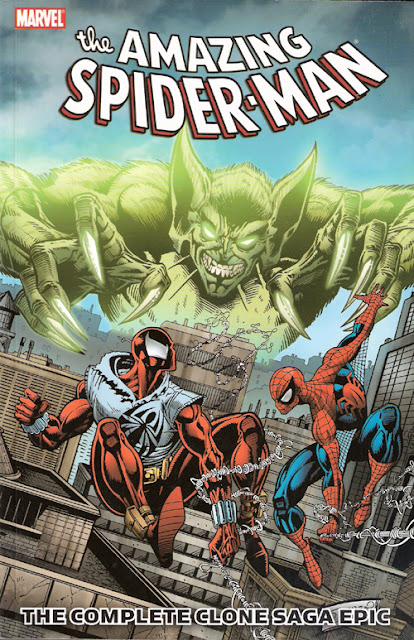
Spider-Man: The Clone Saga Epic, Book 2

Collects: Amazing Spider-Man #395-9, Spectacular Spider-Man #218-21, Spider-Man #54-6, Web of Spider-Man #120-2, Spider-Man: Funeral for an Octopus #1-3, Spider-Man Unlimited #8 (1994-5)

Released: May 2010 (Marvel)

Format: 480 pages / color / $34.99 / ISBN: 9780785143512

What is this?: The Clone Saga’s second installment, in which the story of a Spider-Boy and his clone begins to ramp up.

The culprits: Writers J.M. DeMatteis, Tom DeFalco, Howard Mackie, Tom Brevoort, Todd DeZago, and others and artists Mark Bagley, Sal Buscema, Tom Lyle, Steven Butler, Stewart Johnson, and others

When I reviewed Spider-Man: The Complete Clone Saga Epic, Book 1, I found it occasionally dull but not as dire as the Clone Saga’s reputation would have me believe. Evidently, this is the kind of evaluation that gets me to pick up subsequent volumes of a series.

So … Spider-Man: The Complete Clone Saga Epic, Book 2. We all know the Clone Saga gets bad, eventually … but when? It’s not in Book 2, which is a surprisingly fun read.

Spider-Man: The Complete Clone Saga Epic, v. 2 coverYes, I said “fun.” It’s not a classic, and if you were looking for a Spider-Man story, there are a couple dozen others I would recommend first. But I can’t deny I found the book interesting and sometimes exciting, despite the plot being spoiled long ago.
In Book 2, you can almost see the writers ticking off the boxes as they complete the tasks editors set for them. Wrap up unresolved plots, with Mary Jane and her family and Peter finally defeating his stubborn case of asshattery. Establish Kaine as a bad mamajamma, even if they have to kill some established villains to do so. Show that Peter and Ben Reilly, his clone, can exist in the same storytelling universe with unique roles. Prepare readers that this time, yes, May might actually die. Most importantly, start to lay groundwork for new plots, such as the proliferation and identity of clones and Mary Jane’s medical condition. And yeah, if you can get across a new, non-clone villain like Stunner, good on you.

And the writers — J.M. DeMatteis for Amazing, Tom DeFalco (with some help from Todd DeZago) on Spectacular, Howard Mackie for Spider-Man, and Terry Kavanagh, DeMatteis, and DeZago on Web — do just that. The stories aren’t perfect, but they hit the important points of the overall plot without boring readers too much. And even if some plots drag on too long — Peter trying to beat the Vulture’s poison, DeMatteis trying to end Peter’s idiotic “The Spider” personality by drowning the page in captions — it’s important to remember how collaborative the issues in this book are. Book 2 has 19 issues, and all but four — Spider-Man Unlimited and Funeral for an Octopus #1-3 — are linked in four crossovers (“Web of Death,” “Web of Life,” “Smoke and Mirrors,” and “Back from the Edge”). Think about it: this represents about a quarter of a year’s issues for some titles, and none of their writers get to complete a story without sending it through another writer first. It’s a miracle anyone was able to complete a decent story at all. Spider-title editor Danny Fingeroth deserves a lot of credit for keeping things under control.

The stories get better as the farther the book gets from “The Spider” and DeMatteis’s deconstruction of Peter’s mind at the time (it’s a plot that seems tailor-made for DeMatteis, except that it’s not very good). Peter gets poisoned, which touches off all sorts of wacky hijinks: teaming up with the “new” Daredevil, going to Heaven, having Dr. Octopus aid him. I’m not sure the latter was a good development — Otto’s reasoning is a little clichéd — but at least it’s a different take on the character, one that couldn’t be done now.

My favorite story was Funeral for an Octopus, a miniseries that hearkens back to the Fingeroth-written Deadly Foes of Spider-Man and Lethal Foes of Spider-Man minis from the early ‘90s. Those comics concentrated on Spidey vs. a large number of foes, each of whom had his own motivations for taking part; Funeral, written by Tom Brevoort, has a similar plot. Yes, it’s used to get across how tough the mysterious (and horribly costumed) Kaine is, but on the other hand, one of the Sinister Six does outwit the thug, so that’s something. Plus, at this stage, I don’t mind Kaine getting a push as long as the body count doesn’t get too ridiculous; in Book 2, the death toll is confined to a throwaway villain who really never got started and a major villain (no extra points for guessing who).

The final crossover, though, shows some of the cracks that would eventually cause the whole “epic saga” to crumble. In “Smoke and Mirrors,” Spider-Man and the Scarlet Spider fight the Jackal, who has been resurrected via cloning. The Jackal is served by two of Peter’s altered clones, who strangely look nothing like Peter. For the second and third issues of the three-part crossover, all the Jackal does is hint and lie and tell the two Spiders that each is a clone — or maybe the other is a clone? neither? — while Scrier and Kaine watch. (Somehow, I don’t think Spider-baiting is a spectator sport that will ever catch on, regardless of the crowd it drew this time.) The Jackal does show them what happens to clones in the end (they degenerate into dust quickly), and he puts on a Goth leather trench coat with enough chains to satisfy Ghost Rider, but three issues is a little too much for this. Given that the Clone Saga’s mind-numbing number of clones and the claim that Peter was the clone were major reasons fans soured on this storyline, the Jackal’s wild claims and the hint that there is another clone in the offing (and the presence of Scrier) have to be considered major missteps.

Since Book 2 collects five different Spider-titles, you can take your pick on what flavor of artist you like. Mark Bagley, who drew Amazing at the time, is probably the best-known today; his lithe, athletic Spider-Man is outstanding, although his women tend to be overendowed (staying just short of cheesecake) and his facial expressions uniform. Sal Buscema, the regular artist for Spectacular, is my favorite, but this isn’t his best work; it’s near the end of his career, and his art lacks the tightness it once had (especially when inked by Bill Sienkiewicz). His Kaine looks especially stupid as well, although that’s partially because Kaine’s costume is stupid to begin with. Tom Lyle, the regular Spider-Man artist, is excellent: he’s the best in Book 2 at conveying emotion (and faces in general), although his action shots aren’t as lively as Bagley’s. Stephen Butler (Web) and Stewart Johnson (Funeral) do similarly good work without much of the ‘90s excesses.

I enjoyed Book 2 quite a bit. I mean that statement without qualifications or temporization. That being said, I think this book is probably the high point for the “epic saga.”

Rating: Spider-Man symbol Spider-Man symbol Spider-Man symbol Half Spider-Man symbol (3.5 of 5)

Labels: , , , , , , , , , ,

18 March 2011

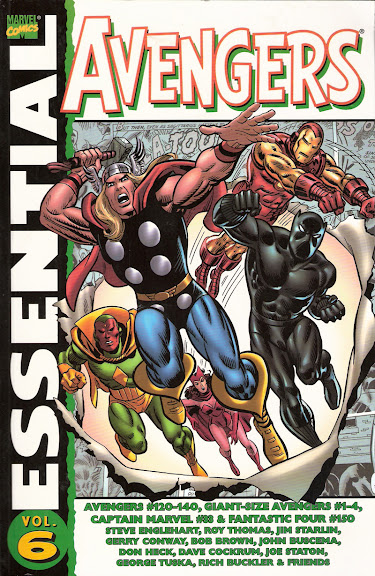
Essential Avengers, v. 6

Collects: Avengers #120-40, Giant-Size Avengers #1-4, Captain Marvel #33, and Fantastic Four #150 (1974-5)

Released: February 2008 (Marvel)

Format: 576 pages / black and white / $19.99 / ISBN: 9780785130581

What is this?: Kang tries to decide who the Celestial Madonna is; Mantis, the Vision, and the Scarlet Witch learn their origins; Zodiac and Thanos attack.

The culprits: Writer Steve Engelhart (with help from Roy Thomas and Gerry Conway) and art by Sal and John Buscema, Bob Brown, George Tuska, Rich Buckler, Don Heck, Dave Cockrum, and Tom Sutton

Having bought GIT Corp’s DVD-Roms of several Marvel series — Fantastic Four, Uncanny X-Men, Captain America, Amazing Spider-Man — I don’t have much use for Essentials featuring these characters. Which is fortunate, because Marvel seems like it isn’t all that interested in putting out new Essentials.

Unfortunately, these DVD collections, which have more than 40 years of comics and annuals, have one major flaw: they don’t include the Giant-Size series Marvel put out in the ‘70s. Now, I’ve read most of the Giant-Size Spider-Man, and there’s nothing that essential in them (although they can be enjoyable). And all you really miss in the Giant-Size Fantastic Four is Madrox the Multiple Man’s origin in #4. Fortunately, Giant-Size X-Men #1, which has the debut of the All-New, All-Different X-Men and is probably the most important Giant-Size issue, is included with the X-Men DVD-Rom. But the Giant-Size Avengers are important too, and they are left out of 40 Years of the Avengers.

Essential Avengers, v. 6 coverSo I purchased Essential Avengers, v. 6, which included all four issues of Giant-Size Avengers. Avengers, v. 6, also has another distinction among Essentials that makes it, if not unique, then very unusual: the issues collected in this book make up one storyline. That is, Essential Avengers, v. 6, makes an acceptable alternative to the Celestial Madonna Saga trade paperback, and it gives almost a year’s worth of issues that precede Celestial Madonna and a half year’s worth that follow the storyline. For these extra issues, you sacrifice color, but that’s a small price to pay.

One would expect a story that features the “Celestial Madonna” to have a long-lasting effect on the Marvel Universe — or at least the Avengers. But the most important event is the marriage of the Scarlet Witch and Vision; admittedly, that’s a pretty important moment, but neither of them are the Celestial Madonna. That honor goes to Mantis, a Vietnamese orphan who is trained by pacifist Kree monks after her uncle kills her mother and blinds her father. As with most storylines that revolve around the birth of a child unconceived, there has been little to no payoff from Mantis’s role. Mostly, the Celestial Madonna story is a time war vs. Kang, who returns again and again to kidnap Mantis and mate with her.

Oh, Kang. It doesn’t take much to get bored with Kang in this volume, despite writer Steve Englehart’s efforts. Why? Because Kang is the master of time, and his answer on how to use this temporal advantage is to steal dead heroes and villains out of the time stream and bring them to Limbo. Why use dead people? Who knows? Since he gains mental control of his new warriors, he could choose anyone — he could even steal future or past versions of the Avengers out of the time stream, which would at least make it an even fight. But no, he decides to create his Legion of the Unliving, none of whom, strangely, had died in their personal timelines yet. Kang’s other gambit include superrobots, Avenger-powered superrobots, and invading the present from several different points of his personal timeline simultaneously. This last is, at least, a good use of his advantages, but since his other versions seemed to have invaded from his Girl Scout days, anyone can beat them.

Once you get past a baby that won’t be born until after the book ends and a Kang who literally cannot even beat himself in a fight (and how could he, since he was outnumbered by himself two to one?), what do you have? Well, Giant-Size Avengers #4 has one of the oddest endings of any Avengers story outside Avengers #200: a half-Vietnamese, half-German girl who always talks of herself in the third person marries an alien tree who’s taking the form of her dead boyfriend, which takes her into space and will later impregnate her with the universal Messiah. Meanwhile, in the background, a mutant marries an android in a double marriage ceremony officiated by the future version of the supervillain the team just defeated (who also does not seem to have any real credentials that would allow him to perform marriages).

I wish I could say there were other parts of the story that rose to those heights, but that’s it — it’s hard to get that strange consistently, but other than the Legion of the Unliving, Essential Avengers doesn’t consistently rise to any notable level of insanity, nor does it get that exciting. “Celestial Madonna” is not exactly a disappointment, but it’s not a seminal Avengers story, despite its memorable name. The romantic tangle between Vision, Scarlet Witch, Swordsman, and Mantis is predictably resolved. This volume is also notable for the beginning of Vision’s confusing backstory; his body is that of the World War II android the Human Torch, a revelation that utterly fails to be interesting. The Scarlet Witch has an odd subplot with developing her “magical powers.” The Avengers have no problem operating in South Vietnam, which is a bit disorienting, but the issue was published just before North Vietnam won the war and unified the country under Communist rule.

The material that precedes the Celestial Madonna story is interesting as a snapshot of early Bronze-Age Avengers. The stories feature Zodiac, the revelation of who the parents of the Scarlet Witch and Quicksilver are (later revealed as false), the marriage of Quicksilver and the Inhuman Crystal, and the bizarre beginning of the Scarlet Witch’s training in witchcraft by Agatha Harkess (based, apparently, solely on the Scarlet Witch’s name). A battle with Thanos is a distraction —Captain Marvel #33 includes literally three pages of dense recap on Thanos’s history, which isn’t conducive to narrative flow — that comes to nothing, especially since it doesn’t end Thanos’s story as definitively as it pretends. And what comes after the Celestial Madonna heads into space is interesting as well; the introduction of new members Beast and Moondragon gives the team exciting new dynamics, despite the return of the slappingest, insanest Avenger, Hank Pym.

The art in Essential Avengers, v. 6, is top notch. The Buscema brothers provide the plurality of the art, with Sal penciling more than his brother John. Other pencilers include George Tuska, Dave Cockrum, Bob Brown, Don Heck, Rich Buckler, and Tom Sutton — a distinguished roster that needs no praise from me, however much it deserves it.

Despite the many interesting parts of Essential Avengers, v. 6, I think the main appeal is getting all four Giant-Size Avengers issues in one volume. There are other attractions — and I have to emphasize, the book is drawn by a lot of great artists who do not clash in style — but Marvel’s Giant-Size line is sadly neglected in reprint form. Englehart fans will find much to enjoy, as will those who like comic-book weddings — three in one volume, none of whom are married today!

Oh, and those who enjoy the thought of alien plants having consensual sex with human women will also find this appealing. You know who you are.

Rating:  symbol  symbol  symbol  symbol (3.5 of 5)

Labels: , , , , , , , , , , , , , , , ,

18 June 2010

Spider-Man: The Complete Clone Saga Epic, Book 1

Collects: Amazing Spider-Man #394, Spectacular Spider-Man #217, Spider-Man #51-3, Spider-Man Unlimited #7, Web of Spider-Man #117-9, Spider-Man: The Lost Years #1-3 (1994-5)

Released: March 2010 (Marvel)

Format: 424 pages / color / $34.99 / ISBN: 9780785144625

What is this?: Oh, the Clone Saga? You know, the ‘90s? Well, a duplicate Peter Parker, calling himself Ben Reilly, shows up.

The culprits: Many, many people, including writers Tom DeFalco, Howard Mackie, and J.M. DeMatteis and artists John Romita Jr., Steven Butler, Sal Buscema (really?), and Tom Lyle

When I first saw Spider-Man: The Complete Clone Saga Epic, Book 1 in the solicitations, I thought, “Man, what a waste — who’s going to want to buy that?” Because as everyone reading comics in the ‘90s remembers, the Clone Saga was Marvel’s biggest misstep of the decade, and that’s competing against some intensely stiff competition: Onslaught, The Crossing, Marvel’s bankruptcy. … What I’m trying to say is that the ‘90s were a crappy decade for the company, and the Clone Saga was the crap cherry on top of the crap sundae — the crap de resistance, if you will. But Marvel, always trying to put a little polish on that turd, has labeled the story both a “Saga” and an “Epic.”

So of course a few months after its release, I’m reading Book 1 of the Clone Saga. In my defense, I can say it’s a hell of a bargain after an Amazon discount — that’s a lot of story for $23 and change. Of course, it’s the quality of the story that matters.

Spider-Man: The Complete Clone Saga Epic, Book 1 coverTo be fair, the beginning of the Clone Saga was never what was at issue. Marvel has decided to tell the story in the order it takes place in the life of Spider-Man’s clone (Ben Reilly). This is an odd decision but a defensible one; rather than reading the stories as they were originally issued, Marvel is trying to tell a coherent story with the reprint.

That may be trouble later on, but for now, the backup stories telling about the clone’s awakening (from about Amazing Spider-Man #149 or so) are presented at the beginning rather than interspersed among the first real crossover of the Clone Saga. So much to the good; on the other hand, that means the Spider-Man: The Lost Years miniseries is presented next, which was written when the clone thought he was the original Peter Parker. This means there are several confusing references to Ben being the real Spider-Man when the story has him still as the clone (and that’s how he’ll end the Saga). There aren’t any footnotes or explanations, so it seems Marvel will trust everyone to stay calm and carry on.

The story begins in earnest when Peter (and Ben’s) Aunt May has a spell and has to be hospitalized. Ben rushes back to New York, the identical pair clash with each other, they find other enemies to fight. Peter has, at this point in the storyline, become a deranged ass, unhinged by the Chameleon passing a pair of robotic duplicates off as Peter’s dead parents. He calls himself “the Spider,” avoids May and Mary Jane, and generally is unpleasant and violent. (Thankfully, there’s a text page that describes all this.) It’s a great way to make Ben the sympathetic one, as Peter assumes Ben is there to replace him. But at this point these are still supposed to be Peter’s books, so making him unsympathetic is a risk — some would say stupid.

The stories themselves are unremarkable. The backups that introduce the clone, written by J.M. DeMatteis, are forgettable. The “Power and Responsibility” crossover, in which Ben made his debut, features Judas Traveller as the villain — the less said about Traveller, a ‘90s kind of villain with vague mental powers, ambiguous goals, and weird, slightly multicultural minions, the better. The whole Spider-writing staff — Terry Kavanagh, DeMatteis, Howard Mackie, and Tom DeFalco — grabs an issue each; each has done better work elsewhere (well, maybe not Mackie). The story that rounds out the collection has Ben choosing Venom as his first villain to fight, taking offense with Peter’s peace treaty with the villain. The choice is logical, and Mackie and Kavanagh establish Ben as having Peter’s moral code while putting a few new trappings on the character, but the issue is muddled with a second symbiote wandering around and a Bugle reporter trying to ride superheroes to the top of his profession.

The Lost Years miniseries is a bit of a standout, though; a younger Ben finds love in Salt Lake City, managing to eschew full-blown superheroics while still trying to do right. The story is as much about Kaine, another Spider-clone who is embittered by being an earlier, imperfect attempt at cloning; he too thinks he’s found love, only to find it being as imperfect as he is. DeMatteis manages to make parallels between the two clones without bashing the reader over the head and write a decent crime story. As DeMatteis writes in the afterword, the Lost Years setup — essentially Spider-Man stories without the Spider-Man, set around the world — seems like a gold mine of stories.

Kaine by John Romita Jr. in The Lost YearsThe Lost Years is also the winner in the art department. I’m not a big John Romita, Jr. fan, but his work for the miniseries is excellent — it is, by far, my favorite work of his post-‘80s portfolio. Credit has to be given to inker Klaus Janson and colorist Christie Steele; the pair give Romita’s art a gritty, washed-out look appropriate for a crime story set in a rainy city.

The rest of the volume mostly manages to avoid the crossover syndrome, except for “Power and Responsibility.” Still, most of it is forgettable ‘90s art. Exceptions are Sal Buscema, whose work I love dearly but is clearly miscast for this story, and Tom Lyle, who manages to give Ben a lithe and powerful Mark Bagley-esque look in his issues. On the other hand, his original design for Kaine is hideous in a very ‘90s way and in no way captures the menace that Romita gives him in The Lost Years. Liam Sharpe draws an empty-eyed series of backups, but he’s drawing unformed clones, so empty-eyed is appropriate.

Kaine by Tom Lyle in Spider-Man #53Marvel has done some very good things here. The ordering of the issues is probably the best choice, as mentioned. The text page setting up the clone’s introductory crossover is much appreciated. The book also includes numerous fragments from many Spider-titles leading up to the initial crossover in which someone is rushing to New York to see May; Marvel wisely didn’t claim the book reprinted the comics the fragments came from. The afterword from J.M. DeMatteis (reprinted from the 1996 TPB of The Lost Years) is more vital than the usual nattering of a writer or artist; this is a disaster in the making, and it’s useful for readers to get a sense of how things started to fall apart.
I had a thought, while writing this review, that wanting to read this book not out of morbid curiosity or completionism — that you sincerely have a desire to read a Spider-Man story from an era that doesn’t get reprinted much — is a mark of a real Spider-Man fan. Not necessarily a better Spider-Man fan, since “real” fans can also disdain what they are pretty sure is going to be a steaming pile of Rhino scat. But someone could put that forward as part of their Spider-Fan bona fides.

Book 1 isn’t as bad as the Clone Saga is supposed to be. (Is it really that bad? Well, Book 2 is out, Book 3 has been solicited for August, and Book 4 already has a (possibly bogus) page on Amazon. (Reading the description for that last one makes me think that one’s going to be awful — and there will still be about a year of the Clone Saga to reprint. That’s one to send shivers up your spine.) But is Book 1 compelling? As a story, no. As a ‘90s artifact? Probably. As part of the anatomy of a disaster? Oh, yes — such a lackluster start to a major event doesn’t bode well.

Rating: Spider-Man symbol Spider-Man symbol (2 of 5)

Labels: , , , , , , , , , , , , , ,

24 February 2009

Essential Hulk, v. 5

Collects: Incredible Hulk #171-200, Incredible Hulk Annual #5 (1974-6)

Released: November 2008 (Marvel)

Format: 616 pages / black and white / $16.99 / ISBN: 9780785130659

What is this?: Hulk smash! as usual, all around the world, vs. supervillains, Commies, and puny Banner.

The culprits: Writer Len Wein (and others) and pencilers Herb Trimpe and Sal Buscema

The Marvel Essentials line concentrated, in its early years, on the company’s Silver Age core and a few later classic titles, such as Uncanny X-Men and Wolverine. (Yes, I know Wolverine’s not really classic, but work with me here.)

Most of those Silver Age titles have wandered into the ‘70s. Overall, the ‘70s were a fallow time for Marvel; yes, X-Men were picking up steam with Chris Claremont and Captain America had some well received stories, like the Secret Empire, but the big titles — Fantastic Four, Amazing Spider-Man, Avengers — were not at the creative peaks that preceded and followed the Me Decade.

Essential Hulk, v. 5 coverWhich brings us to Essential Hulk, v. 5. For most people, Incredible Hulk didn’t really get memorable — from a story perspective, at least — until Peter David took over the title in the ‘80s; it’s the TV show, with Bill Bixby and Lou Ferrigno, that draws the attention before that. But I admit to a fondness for the Hulk title. As I mentioned in my review for the previous volume, all that mediocrity really doesn’t matter.

The Hulk fights supervillains. He travels the world. He gains friends, loses friends. He’s always wandering, getting out of stuffy New York to see the world. The only thing casual readers have heard of from this volume is the debut of Wolverine in #180-2, but the Hulk is not just doing the same things over and over again.

Roy Thomas wrote #171-5 (and plots #176), followed by Gerry Conway for three issues. Thomas, being Thomas, couldn’t resist bringing back forgotten or stranded characters, like the Juggernaut and the Cobalt Man. Conway got to write the results of the first time a group with Black Bolt shot the Hulk into space for his good and the good of society; it didn’t work either, but it was a lot less destructive to society than Planet Hulk and World War Hulk. (The first outer space exile is a boring story set on Counter-Earth, where Adam Warlock gets to play a very obvious golden-skinned Jesus. Don’t ask. Just … don’t, OK?)

Then Len Wein settled in for a long run, running through the end of the volume. Wein introduced Wolverine, which is one of the most significant moments in Marvel history, but most of the book is uneventful. I am fond of some bits. I enjoyed the return of Glenn Talbot, which included saving a nonplussed President Ford from a bomb and a breakout from a Soviet prison that featured a talking, rhyming orange dinosaur named Droogi. The Russians aren’t paper enemies; they manage to deal the imperial running dogs a good deal of damage, even taking out the Hulkbuster base and its commander. The story with the Shaper of Worlds, in which he and his protégé create a paradise for the Hulk that is ruined by the Toad Men and the Hulk’s own demands that “if paradise is not real … then it is not paradise!”, is touching.

The less said of Hulk vs. the Loch Ness (sorry, Loch Fear) Monster, the better. The same holds true of the two-issue story featuring Man-Thing and the Collector. Yes, calm down, form a line — there are copies enough for everyone.

The art comes from iconic Hulk pencilers Herb Trimpe and Sal Buscema, with Trimpe providing the work for all the stories up to #193 and Buscema doing the rest. Personally, I prefer Buscema, who is my favorite Hulk artist and one of my favorite comic artists of all time. There’s something about his ability to get across the Hulk’s power and frustration with a world that makes no sense. Trimpe, though, has a memorable Hulk, even if he does have a fondness for oddly shaped heads. As I mentioned in the review for v. 4, you can see a big difference in Trimpe’s work depending on the inker. I prefer the inking of Jack Abel, who worked on #171-81.

My recommendation for this title is the same as the previous volume: I like this volume because I like this style of Hulk. It’s occasionally strange, not infrequently boring … but it’s rarely the same for more than two issues. It’s like the weather; if you don’t like it, wait a while. That being said, I’m deducting a half point because of the “Adam Warlock as Messiah” thing.

Rating: Hulk head Hulk head Half of a Hulk head (2.5 of 5)

Labels: , , , , , , , , , , ,

31 October 2008

Essential Marvel Horror, v. 1

Collects: Ghost Rider #1-2, Marvel Spotlight #12-24, Son of Satan #1-8, Marvel Two-in-One #14, Marvel Team-Up #32 and 80-1, Vampire Tales #2-3, Haunt of Horror #2 and 4-5, Marvel Premiere #27, Marvel Preview #7 (1973-7, 1979)

Released: November 2006 (Marvel)

Format: 608 pages / black and white / $16.99 / ISBN: 078512196x

Essential Marvel Horror, v. 1 gained its name, I was convinced when it was released, because Marvel was too squeamish to publish Essential Son of Satan (or Children of Satan).18

Marvel Horror features two protagonists: Daimon Hellstrom, Son of Satan, and his sister, Satana. Hellstrom, being a square who sides with “humanity” over “the forces of evil,” gets the bulk of the book, but his darker sister gets her share at the end. Unfortunately, the shift in tone and style between these two is likely to spin the reader’s head around like that girl’s in The Exorcist.

Essential Marvel Horror, v. 1 coverHellstrom is a rarity: an academic hero. (Ray Palmer is a professor; are there other superheroes who work for a university?) In his Marvel Spotlight series, he battles his father’s forces in St. Louis while being affiliated with Gateway University; in his Son of Satan series, he goes to work for the University of the District of Columbia. I prefer the Spotlight issues, written by Steve Gerber; they were consciously superheroic, with Hellstrom fighting a new supernatural menace each month and trying to keep the squares in St. Louis from learning about it. Why St. Louis? I don’t know, but it’s no goofier than fighting demons in New York City.

(Plus, Hellstrom transforms into his demonic alter ego by raising both hands with three fingers pointed upward, making the sign of his demonic trident. Yeah, right — laziest transformation ever.)

The eponymous title, which was mostly written by John Warner, seemed more crowded and more blatantly supernatural, treading ground already trammeled. Thematically, yes, it’s appropriate, but it’s less enjoyable, trying to tread the ground between the superheroes and Marvel horror mags.

And then there are issues of Marvel Team-Up and Marvel Two-in-One, the superheroist of the Marvel superhero comics. Hellstrom got his start in Ghost Rider, which wasn’t a straight superhero comic but was never incredibly far from it.

Gene Colan is perfect for this subject matter; unfortunately, he only does two issues. The other superhero artists … not so much. Not even one of my favorite superhero artists, Sal Buscema, really does the subject justice. On the other hand, they draw demons better than later artists, especially those involved in the Inferno crossover, who believed evil was best represented in Technicolor.

Satana, Daimon’s sister, was featured mainly in Marvel horror magazines. These stand out against the crowd; they are serious, drawn for a mature audience who doesn’t want to see superheroes. The plots are dark, and while they might not match the top of the horror market, they have a unified goal and show us the horror of a child of Satan gone wrong (or right, from Satan’s point of view). Not bound by the Comics Code or its usual kiddie audience, Marvel let the creators have free rein in subject matter and format, occasionally publishing illustrated texts that described Satana’s deeds.

I’m not entirely sure Chris Claremont, who wrote the bulk of the Satana stuff, was the right person for the job, for two reasons. One, his overwrought writing style, which was only beginning here, is more suited to the less serious and self-conscious superhero comics. And two, this is dangerous for him; Claremont loved writing powerful women, and in his later days, became obsessed with certain … well, let’s say tropes, because “fetishes” is a loaded word.

I won’t say the art in these issues are better, but I will say they are striking, while the Comics Code constrained the others so they were quite forgettable. Straying outside their usual bullpen for Satana’s stories, Marvel published contributions from international artists. Their work is moody, dark, vivid even in black and white. These issues really make the volume, and it’s a shame the rest of the book contrasts so sharply with it.

Since it’s Halloween, I’m legally required to answer this question: Is it scary? Well, the Hellstrom parts are decidedly not so. Marvel has neutered most of its dread evil Lords of the Afterlife and all of its demons so superheroes can fight them. The Satana parts? Let’s just say they feel nothing like a superhero story, with a definite sense that evil might win. That’s not enough to rescue the volume as a whole, however.

Rating: Angry pumpkin symbol Angry pumpkin symbol (2 of 5)

Labels: , , , , , , , , , , ,

24 October 2008

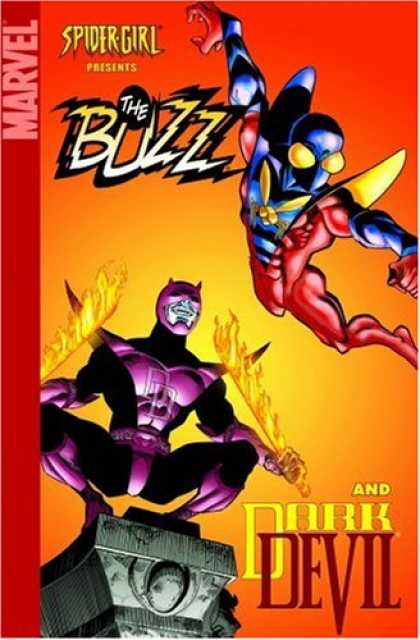
Spider-Girl Presents The Buzz & Darkdevil

Collects: The Buzz #1-3 and Darkdevil #1-3 (2000-1)

Released: August 2007 (Marvel)

Format: 112 pages / color digest / $7.99 / ISBN: 0785126015

As you might guess from the title, Spider-Girl Presents The Buzz and Darkdevil is neither flesh nor fowl nor good red Daredevil.

This is what happens when you join together two three-issue miniseries starring third-rate characters, even if the minis have the same creative team and they both appear as supporting characters in the same low-selling title. The good news is that with writer Tom DeFalco and penciller Ron Frenz (the two co-plotted both minis), you know what you’re going to get, and while I doubt DeFalco / Frenz will ever rival Alan Moore / Dave Gibbons (or Dave Lloyd or Gene Ha or …), the collaboration isn’t going to be bad either.

Spider-Girl Presents The Buzz and Darkdevil coverSo that leaves the question of whether Buzz and Darkdevil is forgettable or fun, and it’s a split decision. This digest is meant to appeal to hardcore M2-Universe fans, what few there are: the kind of people who have been curious as to what Darkdevil’s deal is. (Until I read this, I never really considered the Buzz to have much of a mysterious backstory.) The usual caveat is M2 stories appeal to those who enjoy old-school comic-book stories, but that’s not really the case here. The Buzz is that sort of story, a fun little bit of fluff full of team ups, mistaken identities, and a classic villain using his only pseudonym. It’s not going to get written up as one of the great stories of the decade, but it is an enjoyable example of the genre; it would fit into the ‘70s / ‘80s Marvel output with no problems.

Darkdevil, however, clashes with that. DeFalco uses the old Daredevil vs. Kingpin battles as a reference, but then he throws in Clone Saga characters from the ‘90s and supernatural elements grafted onto Daredevil and scientific equipment out of the origin of Spider-Woman. It’s an uneasy fit, at best. DeFalco has a habit of trying to hammer the Clone Saga into M2 continuity, and I think that’s misguided. I know DeFalco put a lot of work into the Saga when it came out in the ‘90s, but now it’s reviled, and for those who don’t remember the story, it’s needlessly complex. You get Scriers, clones, Kaine, and the sons of clones … and then you throw in Zarathos, the Spirit of Vengeance from Ghost Rider. It ends up being a bit of a mishmash, and a forgettable one at that.

The good news is that at the former digest price of $7.99, it’s still a good deal. Frenz’s clear pencils and old-school inks from Sal Buscema (Buzz) and Al Milgrom (Darkdevil), combined with bright colors (even in the supernatural / dark themes of Darkdevil), hold up well in the smaller size.

Still: this is mainly for those who follow the M2 universe. Or if you like What If? / Elseworld titles. Now, if you want to go through the Spider-Girl titles to build an appreciation for Buzz and Darkdevil, well, I can recommend that.

Rating: Marvel symbol Marvel symbol Half Marvel symbol (2.5 of 5)

Labels: , , , , , , , ,