


Spider-Man: The Complete Clone Saga Epic, Book 3
Collects: Amazing Spider-Man #400-1, Web of Spider-Man #123-4, Spider-Man #57-8, Spectacular Spider-Man #222-4, Spider-Man Unlimited #9, Amazing Spider-Man Super Special, Web of Spider-Man Super Special, Spider-Man Super Special, Spectacular Spider-Man Super Special, Venom Super Special, and Spider-Man: The Clone Journal (1995)
Released: September 2010 (Marvel)
Format: 464 pages / color / $34.99 / ISBN: 9780785149545
What is this?: Peter Parker deals with a trio of his clones, the police, and a death in the family.
The culprits: Writers Howard Mackie, Tom DeFalco, Terry Kavanagh, J.M. DeMatteis, and David Michelinie and artists Mark Bagley, John Romita Jr., Sal Buscema, Tom Lyle, and Steven Butler
I expected Spider-Man: The Complete Clone Saga Epic, Book 3, to be noticeably worse than Book 2. I was right; it isn’t very good, but fortunately, it’s not an irredeemable pile of crap or evidence the entire Clone Saga is unsalvageable.
Let me start with a positive, a strong positive: After reading Spider-Man: Identity Crisis, I’m struck by how much better the story-level editing is in Book 3; Danny Fingeroth keeps the stories from overlapping or contradicting themselves, even if I don’t care for the story being told. The stable of Spider-writers — Tom DeFalco on Spectacular Spider-Man, Terry Kavanagh on Web of Spider-Man, J.M. DeMatteis on Amazing Spider-Man, and Howard Mackie on Spider-Man — keep their characterizations consistent even as they struggle to move the plot along without revealing anything, because the Clone Saga has months to go yet. I mean, there’s a story here, but it doesn’t address the crossover’s big question: Is Ben or Peter the clone?
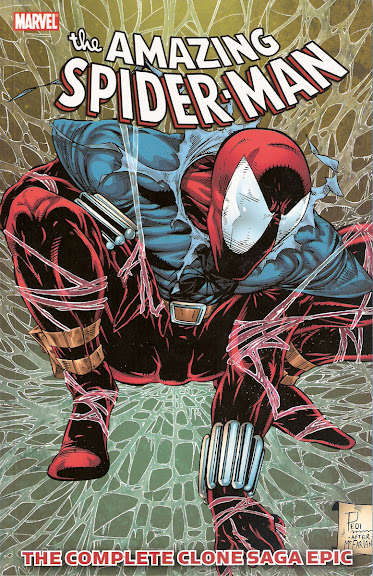 All that lack of storytelling creates a lot of slow spots. “Players and Pawns,” which starts the collection, is stalling until Amazing Spider-Man #400, which falls in the middle of Book 3. In “Players and Pawns,” a third clone of Peter Parker is released into the wild, and he wanders around a bit, amnesiac; both Peter and Ben reject claims that he is the original Peter Parker. All this sounds important, but of course rejecting proof that could answer the Clone Saga’s central question doesn’t advance the story, and the third clone doesn’t become important until “Mark of Kaine,” which ends Book 3.
 The five-part “Planet of the Symbiotes,” which follows “Players and Pawns,” is told in the year’s substitutes for annuals (“Super Specials” for each of the regular Spider-Man titles and Venom). The story, written by David Michelinie, is filler, divorced from continuity, that shouldn’t need five double-sized issues to complete. The story also is an ill fit in this book, part of the era of disposable summer crossovers in annuals. By themselves, the Super Specials might feel like a big event — although I doubt it — but contrasted with other stories in Book 3, which have a relatively grounded attempt at continuity, the story of a race of symbiotes taking over Earth is ridiculous, especially when it’s never mentioned again.
The only issue in Book 3 that’s not a part of a crossover is Amazing Spider-Man #400, and it’s no surprise it’s the highlight of the book; it’s also the only issue in Book 3 I’ll remember. In ASM #400, DeMatteis writes a surprisingly moving story about a death in Peter’s family, giving the characters a sense of closure, while ending the story with a development that opened new story possibilities. (It wasn’t a shock, as it had been teased for quite a while, but I was surprised how much it caught me off guard.) More amazingly, DeMatteis manages five pages without dialogue or narrative captions, which must be a record for him.
It’s a shame he’s teamed on the issue with Mark Bagley, who is miscast at this point in his career on an emotional, conversational issue. But that’s in keeping with the book overall, as the art in Book 3 is undistinguished, at best. The John Buscema (pencils) / Bill Sienkiewicz (inks) combo on Spectacular Spider-Man hurts the eyes; it pains me to say this, given how much I enjoy the work of both. Steven Butler draws pretty but plastic people in Web of Spider-Man; Tom Lyle and John Romita Jr. do unremarkable work on a Spider-Man issue each. The art on the Super Specials are vaguely Image-influenced, except for Darick Robertson’s strong work on the Spectacular Spider-Man Super Special.
The two-part “Aftershocks,” like “Players and Pawns,” plays a waiting game, but it’s a much more tolerable one; it gives everyone a chance to react to the genuinely important changes to the status quo from Amazing Spider-Man #400. Two issues seems about the right amount of time for that — even if it does waste too much time on cosmic-level busybody Judas Traveller and the Jackal chewing the scenery in the Ravencroft Institute.
Then the third clone steps front and center, making the five-part final crossover (“Mark of Kaine”) a chore to read. After the clone remembers who he is, he tries to claim Peter’s life and wife and gets all grabby with Mary Jane. Kaine, having had precognitive flashes of Mary Jane’s death, kidnaps her and plans to keep her stashed in the sewers until … until everything blows over, I guess, which should be when all the clones degenerate. Obviously not the greatest scheme, but no one has accused Kaine of being a great thinker. The hiding doesn’t work, there’s a big, confused brawl, and the newest clone turns out to be a super-secret agent of the Jackal (so secret even the clone didn’t know it) who hideously mutates into someone drawn by Buscema and inked by Sienkiewicz. (He’s supposed be transformed into a monstrosity, and he certainly looks it, but the collaboration between Buscema and Sienkiewicz uglifies everything, so it’s hard to tell how ugly he’s supposed to be.) The story has too many Peters and too little reason to exist; the third clone goes from amnesiac wanderer to paranoid loon to genetic weapon in less time than it takes to whip up a batch of web fluid, but he never finds a moment to be interesting. Peter comes across as short sighted and irritable; only Ben seems reasonable, which wouldn’t have been a good idea if the writers were planning for Peter to remain Spider-Man.
Lyle tries to salvage something in Part 5 of the crossover (Spider-Man Unlimited #9) by writing a story that has nothing to do with the rest of “Mark of Kaine”: the Sinister Six / Seven teams up to deal with Kaine, who has already killed Dr. Octopus and the most recent Kraven. It’s a good idea for a story, one that had to be addressed if the villains were going to keep their credibility. The villains bicker, and the plan isn’t very good — the Hobgoblin has neither the leadership or strategic abilities of Dr. Octopus, which is demonstrated by his giving Mysterio and Shocker (!) handguns — and the trap predictably goes awry. But I enjoyed Lyle’s turn as a writer.
Volume 3 isn’t a disaster; many parts are perfectly cromulent. ASM #400 is excellent, as befits an anniversary issue. But the book is weighed down by “Mark of Kaine” and “Planet of the Symbiotes,” neither of which has a reason to exist, story wise. There’s no reason Book 4 and 5 can’t be worth reading, but you should borrow someone else’s copy of ASM #400 instead of spending time on this.
Rating:
 (2 of 5)
Labels: 2, 2010 September, Ben Reilly, Bill Sienkiewicz, Clone Saga, Danny Fingeroth, J.M. DeMatteis, Mark Bagley, Marvel, Sal Buscema, Spider-Man, Tom Lyle
posted by Raoul | 11:06 AM
|
1 comments

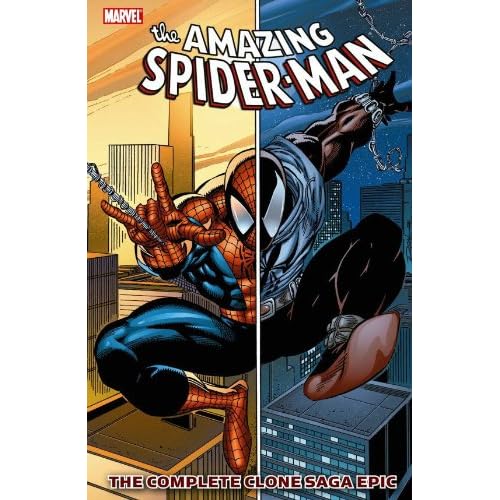 To be fair, the beginning of the Clone Saga was never what was at issue. Marvel has decided to tell the story in the order it takes place in the life of Spider-Man’s clone (Ben Reilly). This is an odd decision but a defensible one; rather than reading the stories as they were originally issued, Marvel is trying to tell a coherent story with the reprint.
  The Lost Years is also the winner in the art department. I’m not a big John Romita, Jr. fan, but his work for the miniseries is excellent — it is, by far, my favorite work of his post-‘80s portfolio. Credit has to be given to inker Klaus Janson and colorist Christie Steele; the pair give Romita’s art a gritty, washed-out look appropriate for a crime story set in a rainy city.
  Marvel has done some very good things here. The ordering of the issues is probably the best choice, as mentioned. The text page setting up the clone’s introductory crossover is much appreciated. The book also includes numerous fragments from many Spider-titles leading up to the initial crossover in which someone is rushing to New York to see May; Marvel wisely didn’t claim the book reprinted the comics the fragments came from. The afterword from J.M. DeMatteis (reprinted from the 1996 TPB of The Lost Years) is more vital than the usual nattering of a writer or artist; this is a disaster in the making, and it’s useful for readers to get a sense of how things started to fall apart.