Reviews of trade paperbacks of comic books (mostly Marvel), along with a few other semi-relevant comments / reviews.

05 April 2013

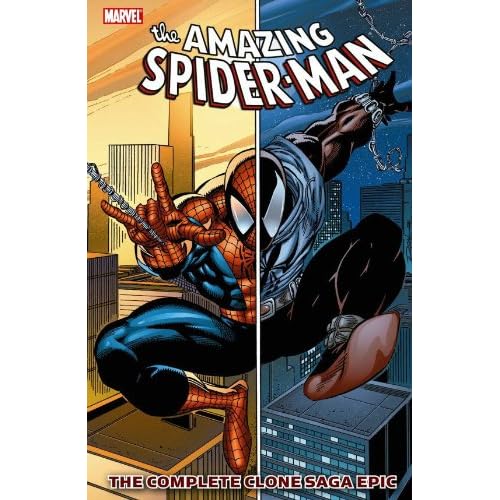
Spider-Man: The Complete Clone Saga Epic, v. 5

Collects: Amazing Spider-Man #405-6, Spectacular Spider-Man #228-9, Web of Spider-Man #128-9, Spider-Man #62-3, Spider-Man Unlimited #10, New Warriors #62-4, Spider-Man Team-Up #1, and backups from Amazing Spider-Man, Spectacular Spider-Man, Spider-Man, Venom, and Web of Spider-Man Super Specials (1995)

Released: January 2011 (Marvel)

Format: 472 pages / color / $39.99 / ISBN: 9780785150091

What is this?: The Clone Saga is wrapped up — ha! — Ben and Peter figure out what to do with their lives.

The culprits: Writers Tom DeFalco, Terry Kavanagh, J.M. DeMatteis, Todd DeZago, Howard Mackie, and Evan Skolnick and artists Patrick Zircher, Sal Buscema, Steven Butler, Gil Kane, and others


Spider-Man: The Complete Clone Saga Epic, Book 5 isn’t great, but I can praise some elements of the book without reservation. More importantly, little in Book 5 inspires the deep loathing the abysmal Book 4 did.

The high point of Book 5 is the five-part story that ran alongside “Planet of the Symbiotes” (reprinted in Book 3) in the Super Specials. Written by Terry Kavanagh, the tale introduces a new hero, Strongarm, who is created by a scientist’s reworking of Dr. Curtis Connors’s research. Strongarm’s story, which — of course — culminates in a battle with the Lizard, Connors’s alter ego, is forgettable, but Strongarm himself has a certain uncomplicated, Boy Scout charm about him. More interesting, though, is the attempt of Spider-clone Ben Reilly to assemble a life: a job, a love interest, a supporting cast. Heck, he even shows a hint of jealousy, and even though jealousy is a negative emotion, any emotion not connected to Peter Parker or clones is welcome. Chronologically, this story should probably have been included before Amazing Spider-Man #400 — it’s hard to believe Ben could get hired for a job without anyone remarking upon his resemblance to a front-page murder suspect — but it’s good to see the Spider-office spend some time on the man who will be Spider-Man for the next year.

Spider-Man: The Complete Clone Saga Epic, Book 5 cover I also like the New Warriors issues in Book 5. The three issues have nothing to do with Spider-Man, and most have little to do with the Scarlet Spider (Ben’s alter ego), but they are a nice, clone-free palate cleanser. Writer Evan Skolnick shows a different side to Ben, who relates to a team — something Spider-Man had not done up to this point — and even takes charge when necessary. The issues also have some intriguing subplots, which — again — have nothing to do with Spiders or clones … unfortunately, this makes it sound as if I’m tired of reading about Spider-Man or the Clone Saga.

Perhaps I am; the other three storylines in Book 5 don’t generate any interest in the clones. In quality, they range from dull (“Exiled” and most of “Greatest Responsibility”) to awful (“Time Bomb”).

The four-part “Exiled” crossover is mystifying, as the four issues have three unrelated stories in them. They are tied together by a subplot: Ben’s decision to leave New York, which he reverses almost immediately. The main stories are random. Web of Spider-Man #128 is a D’Spayre story — a D’Spayre story, for Odin’s sake! D’Spayre feeds on people’s, well, despair, and he’s always beaten when one of his victims overcomes that emotion. Web #128 is no exception. Amazing Spider-Man #405 and Spider-Man #62 shows Ben fighting a new adversary to protect his friend, Dr. Seward Trainer, and Trainer’s data; the B-plot shows some of Ben and Seward’s back story, which might be interesting except for the Clone Saga taint lingering over Seward. And Spider-Man Unlimited #10, the last part of “Exiled,” is a forgettable Vulture story that also has Ben helping Uncle Ben’s friend put his kid into college. Sure, why not?

The first two parts of the three-issue “Greatest Responsibility” are similarly forgettable. The new Dr. Octopus, who is also Trainer’s daughter, is revealed as the mystery villain from the middle of “Exiled,” to the collective yawn of the audience. Her conflict with her father and the Spider-Men features ‘90s conceptions of virtual reality, Trainer in an X-Men-style uniform, and one of the odder father-daughter relationships in comics. These issues aren’t awful, but the plot developments feel forced, and the plot and art are dated.

The final issue of “Greatest Responsibility,” Spectacular Spider-Man #229, is cut above the rest of the crossover, as creator Tom DeFalco, Sal Buscema, and Bill Sienkiewicz step up on what is ostensibly Peter’s last issue as Spider-Man before he is replaced forever. The plot is reminiscent of Amazing Spider-Man #33; since Amazing #33 is one of Spider-Man’s greatest moments, and echoing it to give Peter a sendoff is an excellent idea. Both issues have a battle vs. Dr. Octopus in an underwater base, Spider-Man trapped under broken machinery, and a loved one waiting for Spider-Man to return with medicine. Spider-Man’s escape is appropriately different from Amazing #33, and Spider-Man needing Ben’s assistance can be interpreted many ways. The execution on Spectacular #229 doesn’t do justice to the earlier issue, but the idea is so far ahead of the rest of the book I don’t mind.

Curiously, reprint editor Mike O’Sullivan inserted Spider-Man Team-Up #1 between the second and third chapters of “Greatest Responsibility.” In SMTU #1, Scarlet Spider and the X-Men ally to battle Shinobi Shaw’s Hellfire Club, and like Shinobi Shaw, the issue slips from the memory as soon as it’s out of sight. I don't see the logic of inserting the issue into the middle of a storyline, but I’m of two minds about including the issue at all; I like getting more stories, but SMTU #1 is of such negligible importance to Scarlet Spider and the Clone Saga that it feels like filler.

“Time Bomb” is a two-part story that, like Book 4, seems published solely to tear down Peter Parker. Premonitions in previous books showed Mary Jane, Peter’s wife, being killed by a mysterious assailant; writers DeFalco and Todd DeZago resolve the plot by making Peter, under the Jackal’s post-hypnotic, post-mortem control, the assassin. Scarlet Spider and the New Warriors attempt to stop him, but Mary Jane helps Peter break the Jackal’s control with the power of love — a clichéd ending that makes everyone other than Mary Jane look stupid.

The art suffers this time from a complete lack of the excellent Mark Bagley, although the inclusion of Patrick Zircher’s clean, clear, and exciting art on New Warriors helps make up the deficiency. Buscema and Sienkiewicz continue to contribute their not-so-excellent work on Spectacular Spider-Man, although through Stockholm Syndrome, I’m growing accustomed to them. (Buscema’s finishes of Tod Smith’s work on the Spider-Man Super Special are quite pleasing, reminiscent of Buscema’s earlier work.) Steven Butler’s work is sharp but entirely too over-the-top for me; the first image in Web of Spider-Man #128 is the Black Cat in a pin-up pose, her considerable chest thrust out, in the middle of swinging between buildings, which automatically discredits the artist in my eyes. The remaining pencilers range from good to serviceable in a ‘90s way, with no one so good you wonder what happened to them.

Book 5 is a significant improvement on Book 4, but that’s a backhanded compliment. If Marvel had drawn a line under the Clone Saga after this book and moved on, there would be something good to take away from Book 5 and some optimism for the future. But the Clone Saga will be back, as will Peter Parker, so everything will get churned up again. I can’t rate the mediocre Book 5 lower because of my dread of the future … but I want to.

Rating: Spider-Man symbol Spider-Man symbol
(2 of 5)

Labels: , , , , , , , , , , , , , , ,

09 September 2011

X-Men: Onslaught: The Complete Epic, v. 3

Collects: X-Men #55, Uncanny X-Men #336, Cable #35, X-Force #58, X-Man #19, Incredible Hulk #445, Iron Man #332, Avengers #402, Thor #502, Wolverine #105 (1996)

Released: August 2008 (Marvel)

Format: 248 pages / color / $29.99 / ISBN: 9780785128250

What is this?: The penultimate volume of the Onslaught story, a “Mutants Gone Wild” cautionary tale.

The culprits: Too many to name, not enough to blame

Completism is a hell of a drug.

It’s one nearly every comic-book fan has felt the pull of. There are steps, gradations, but they’re all rationalizations and symptoms that don’t lead to an understanding of why completism has such a firm hold on our souls. It’s common to all sorts of collecting, and when you cross collecting with serial literature … well, like I said: a hell of a drug, although not without its highs.

We live in a Golden Age for completists, a time when we can go out and buy trade paperbacks of storylines that would be too Godawful or tedious to collect issue by issue but are relatively painless to swallow in one gulp — as long as we hold our noses. For us Gen Xers, it’s truly wonderful, with Marvel releasing compilations of ‘90s stories that seemed too horrible to contemplate at the beginning of the decade; the House of Ideas has released the hell out of the Clone Saga and has kept the Onslaught “Saga” in print, so all that remains is for someone at Marvel to find the unmitigated gall (or suffer the crushing brain damage) to complete the trifecta of crap by releasing a collection of The Crossing.

X-Men: Onslaught: The Complete Epic, v. 3 cover*ahem* Anyway. X-Men: Onslaught: The Complete Epic, Book 3, is indisputably part of the Onslaught crossover, which is indisputably an X-Men story. Well, you could dispute that, since it did end v. 1 of Fantastic Four, Avengers, Thor, and Iron Man (the last issues of the latter three are collected here), but the number of ancillary X-titles is convincing. What is disputable is whether anyone should buy it.

Despite the reputation of the Onslaught crossover, I’m not saying this book is bad. No, far from it; there’s nothing of the offensive stench of, say, Ghost Rider: Danny Ketch Classic, v. 1, or Captain America & the Falcon, v. 1: Two Americas. The skill involved in the individual issues is even better than Gambit Classic, although admittedly that’s setting the bar low.

Still, I’d advise reading any of those books before Onslaught, v. 3. Why? Because they are interesting in their awfulness. Nothing happens in the 248 pages of Onslaught, v. 3. Well, nothing happens except Onslaught loses Professor X as a prisoner and gains X-Man, which is more of a rearrangement of Scrabble tiles than a plot development. Oh, and Teen Tony Iron Man makes very ‘90s headpieces out of vibranium. But that’s really it, unless you like crowd control, attacks that achieve nothing but also lose nothing, illusory telepathic landscapes, and mutant mutant angst angst. And I suppose if you like catchphrases, Onslaught screams, “Behold my mighty hand!” several times, but as a catchphrase that ranks just below “Around the survivors a perimeter create.”

The blame for this doughnut hole of a collection has to be placed on the editors — four different editors, according to the title page: Mark Gruenwald (Iron Man and Avengers), Bobbie Chase (Hulk and Thor), Mark Powers (Cable), and Jaye Gardner (X-Man). Interestingly, Bob Harras — Marvel’s editor in chief and chief X-titles editor at the time — is listed in the credits of the remaining titles’ individual issues, but he isn’t credited on the title page. Which is a shame, because the buck has to stop with him, as both a book editor and editor in chief … I mean, who else can you blame for this an entire collection devoted to marking time, waiting for something or other — Iron Man and his party hats, I guess.

But much as I’m loathe to do it, maybe Gruenwald has to share some of the blame. While he has Terry Kavanagh and Joe Bennett actually contributing to the plot in Iron Man, Mark Waid and Mike Deodato are filling space in Avengers #402 — the last issue of Avengers, v. 1 — with a pointless fight. It’s bad enough the Avengers are going to bite it in an X-Men one-shot (fifteen-year-old spoilers!), but there’s nothing here that hints at the momentousness of the plot or the title’s history. This was when renumbering meant something! Marvel was licensing the Avenger titles to non-Marvel creators! There had to be a better way for the title to go out.

To be fair, Bill Messner-Loebs and Deodato do better with Thor. It’s cute they think there’s a purpose to continuing their subplots, like the Enchantress’s amnesia and captivity and Odin’s loss of his divinity and mind, and insisting Red Norvell is important. But there’s a sense of the title’s history included in the final issue. Thor runs into Jane Foster, Don Blake’s first love, and he remembers his history and an early adventure with his foster brother; the frogs from Thor’s days as the Frog of Thunder stop by. Messner-Loebs even has Hela, in a truly ridiculous Asgardian outfit, offer to make Thor her king if he wishes to avoid his death the following day. It gives the issue import and a sense of doom as it rolls into the inevitable, and I appreciate that. I think it could have been done better, by laying on the prophecy and references to Ragnarok, but the effort is there, and it’s more than we see in the other two dying Avengers titles.

I’m not going to single out any other individual writing or art, except to say that I have always disliked Angel Medina’s overly cartoony and grotesque work on Hulk There’s just too little to say about these issues; they fit together, I can see the skill there, but they’re not saying anything. Instead, I’m going to make two points that probably would be better in a footnote:

  • First, it would be a rarity to see all those high issue numbers in a trade paperback collecting comics from the last decade. Sure, Marvel’s big on reinstalling the old numbering, but Marvel switches to new #1s so often it’s uncommon to have many comics with their original numbering at the same time.
  • Secondly, there is some confusion on the Internet as to what is collected in Onslaught, v. 3. The Amazon listing includes Punisher (v. God knows what) #11, (Peter Parker:) Spider-Man #72, Fantastic Four #416, and Green Goblin #12; it leaves out the issues of X-Men, Uncanny X-Men, Cable, X-Force, and Thor. Even the impressive Unofficial Handbook of Marvel Comics Creators has it wrong; it makes the same mistake as the Amazon listing plus it adds Amazing Spider-Man #415.
In any event: This is one boring book. The plot goes nowhere. Art from Joe Madureira, Andy Kubert, and Deodato is not going to change that at all. I think you’d be better off jumping from the awful Onslaught, v. 1, to v. 4. You’re not going to miss anything important. But that’s not why people buy this book — they buy it because the drug that is completism has them in its claws.

In this case, though, completism is very much like a sleeping pill.

Rating: Zzz … (You can read that as either I was too bored by this book to rate it or that I graded it Triple-Z. Either one is fine by me.)

Labels: , , , , , , , , , , , , , ,

18 June 2010

Spider-Man: The Complete Clone Saga Epic, Book 1

Collects: Amazing Spider-Man #394, Spectacular Spider-Man #217, Spider-Man #51-3, Spider-Man Unlimited #7, Web of Spider-Man #117-9, Spider-Man: The Lost Years #1-3 (1994-5)

Released: March 2010 (Marvel)

Format: 424 pages / color / $34.99 / ISBN: 9780785144625

What is this?: Oh, the Clone Saga? You know, the ‘90s? Well, a duplicate Peter Parker, calling himself Ben Reilly, shows up.

The culprits: Many, many people, including writers Tom DeFalco, Howard Mackie, and J.M. DeMatteis and artists John Romita Jr., Steven Butler, Sal Buscema (really?), and Tom Lyle

When I first saw Spider-Man: The Complete Clone Saga Epic, Book 1 in the solicitations, I thought, “Man, what a waste — who’s going to want to buy that?” Because as everyone reading comics in the ‘90s remembers, the Clone Saga was Marvel’s biggest misstep of the decade, and that’s competing against some intensely stiff competition: Onslaught, The Crossing, Marvel’s bankruptcy. … What I’m trying to say is that the ‘90s were a crappy decade for the company, and the Clone Saga was the crap cherry on top of the crap sundae — the crap de resistance, if you will. But Marvel, always trying to put a little polish on that turd, has labeled the story both a “Saga” and an “Epic.”

So of course a few months after its release, I’m reading Book 1 of the Clone Saga. In my defense, I can say it’s a hell of a bargain after an Amazon discount — that’s a lot of story for $23 and change. Of course, it’s the quality of the story that matters.

Spider-Man: The Complete Clone Saga Epic, Book 1 coverTo be fair, the beginning of the Clone Saga was never what was at issue. Marvel has decided to tell the story in the order it takes place in the life of Spider-Man’s clone (Ben Reilly). This is an odd decision but a defensible one; rather than reading the stories as they were originally issued, Marvel is trying to tell a coherent story with the reprint.

That may be trouble later on, but for now, the backup stories telling about the clone’s awakening (from about Amazing Spider-Man #149 or so) are presented at the beginning rather than interspersed among the first real crossover of the Clone Saga. So much to the good; on the other hand, that means the Spider-Man: The Lost Years miniseries is presented next, which was written when the clone thought he was the original Peter Parker. This means there are several confusing references to Ben being the real Spider-Man when the story has him still as the clone (and that’s how he’ll end the Saga). There aren’t any footnotes or explanations, so it seems Marvel will trust everyone to stay calm and carry on.

The story begins in earnest when Peter (and Ben’s) Aunt May has a spell and has to be hospitalized. Ben rushes back to New York, the identical pair clash with each other, they find other enemies to fight. Peter has, at this point in the storyline, become a deranged ass, unhinged by the Chameleon passing a pair of robotic duplicates off as Peter’s dead parents. He calls himself “the Spider,” avoids May and Mary Jane, and generally is unpleasant and violent. (Thankfully, there’s a text page that describes all this.) It’s a great way to make Ben the sympathetic one, as Peter assumes Ben is there to replace him. But at this point these are still supposed to be Peter’s books, so making him unsympathetic is a risk — some would say stupid.

The stories themselves are unremarkable. The backups that introduce the clone, written by J.M. DeMatteis, are forgettable. The “Power and Responsibility” crossover, in which Ben made his debut, features Judas Traveller as the villain — the less said about Traveller, a ‘90s kind of villain with vague mental powers, ambiguous goals, and weird, slightly multicultural minions, the better. The whole Spider-writing staff — Terry Kavanagh, DeMatteis, Howard Mackie, and Tom DeFalco — grabs an issue each; each has done better work elsewhere (well, maybe not Mackie). The story that rounds out the collection has Ben choosing Venom as his first villain to fight, taking offense with Peter’s peace treaty with the villain. The choice is logical, and Mackie and Kavanagh establish Ben as having Peter’s moral code while putting a few new trappings on the character, but the issue is muddled with a second symbiote wandering around and a Bugle reporter trying to ride superheroes to the top of his profession.

The Lost Years miniseries is a bit of a standout, though; a younger Ben finds love in Salt Lake City, managing to eschew full-blown superheroics while still trying to do right. The story is as much about Kaine, another Spider-clone who is embittered by being an earlier, imperfect attempt at cloning; he too thinks he’s found love, only to find it being as imperfect as he is. DeMatteis manages to make parallels between the two clones without bashing the reader over the head and write a decent crime story. As DeMatteis writes in the afterword, the Lost Years setup — essentially Spider-Man stories without the Spider-Man, set around the world — seems like a gold mine of stories.

Kaine by John Romita Jr. in The Lost YearsThe Lost Years is also the winner in the art department. I’m not a big John Romita, Jr. fan, but his work for the miniseries is excellent — it is, by far, my favorite work of his post-‘80s portfolio. Credit has to be given to inker Klaus Janson and colorist Christie Steele; the pair give Romita’s art a gritty, washed-out look appropriate for a crime story set in a rainy city.

The rest of the volume mostly manages to avoid the crossover syndrome, except for “Power and Responsibility.” Still, most of it is forgettable ‘90s art. Exceptions are Sal Buscema, whose work I love dearly but is clearly miscast for this story, and Tom Lyle, who manages to give Ben a lithe and powerful Mark Bagley-esque look in his issues. On the other hand, his original design for Kaine is hideous in a very ‘90s way and in no way captures the menace that Romita gives him in The Lost Years. Liam Sharpe draws an empty-eyed series of backups, but he’s drawing unformed clones, so empty-eyed is appropriate.

Kaine by Tom Lyle in Spider-Man #53Marvel has done some very good things here. The ordering of the issues is probably the best choice, as mentioned. The text page setting up the clone’s introductory crossover is much appreciated. The book also includes numerous fragments from many Spider-titles leading up to the initial crossover in which someone is rushing to New York to see May; Marvel wisely didn’t claim the book reprinted the comics the fragments came from. The afterword from J.M. DeMatteis (reprinted from the 1996 TPB of The Lost Years) is more vital than the usual nattering of a writer or artist; this is a disaster in the making, and it’s useful for readers to get a sense of how things started to fall apart.

I had a thought, while writing this review, that wanting to read this book not out of morbid curiosity or completionism — that you sincerely have a desire to read a Spider-Man story from an era that doesn’t get reprinted much — is a mark of a real Spider-Man fan. Not necessarily a better Spider-Man fan, since “real” fans can also disdain what they are pretty sure is going to be a steaming pile of Rhino scat. But someone could put that forward as part of their Spider-Fan bona fides.

Book 1 isn’t as bad as the Clone Saga is supposed to be. (Is it really that bad? Well, Book 2 is out, Book 3 has been solicited for August, and Book 4 already has a (possibly bogus) page on Amazon. (Reading the description for that last one makes me think that one’s going to be awful — and there will still be about a year of the Clone Saga to reprint. That’s one to send shivers up your spine.) But is Book 1 compelling? As a story, no. As a ‘90s artifact? Probably. As part of the anatomy of a disaster? Oh, yes — such a lackluster start to a major event doesn’t bode well.

Rating: Spider-Man symbol Spider-Man symbol (2 of 5)

Labels: , , , , , , , , , , , , , ,