Reviews of trade paperbacks of comic books (mostly Marvel), along with a few other semi-relevant comments / reviews.

05 April 2013

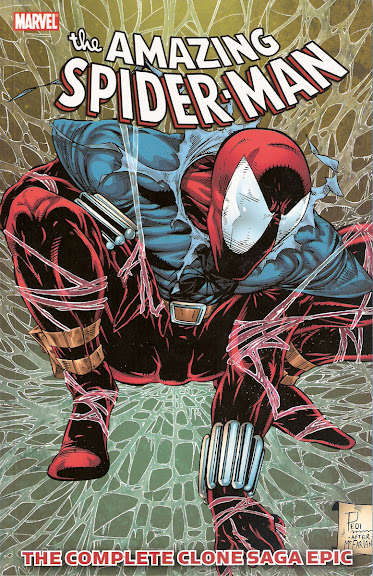
Spider-Man: The Complete Clone Saga Epic, v. 5

Collects: Amazing Spider-Man #405-6, Spectacular Spider-Man #228-9, Web of Spider-Man #128-9, Spider-Man #62-3, Spider-Man Unlimited #10, New Warriors #62-4, Spider-Man Team-Up #1, and backups from Amazing Spider-Man, Spectacular Spider-Man, Spider-Man, Venom, and Web of Spider-Man Super Specials (1995)

Released: January 2011 (Marvel)

Format: 472 pages / color / $39.99 / ISBN: 9780785150091

What is this?: The Clone Saga is wrapped up — ha! — Ben and Peter figure out what to do with their lives.

The culprits: Writers Tom DeFalco, Terry Kavanagh, J.M. DeMatteis, Todd DeZago, Howard Mackie, and Evan Skolnick and artists Patrick Zircher, Sal Buscema, Steven Butler, Gil Kane, and others


Spider-Man: The Complete Clone Saga Epic, Book 5 isn’t great, but I can praise some elements of the book without reservation. More importantly, little in Book 5 inspires the deep loathing the abysmal Book 4 did.

The high point of Book 5 is the five-part story that ran alongside “Planet of the Symbiotes” (reprinted in Book 3) in the Super Specials. Written by Terry Kavanagh, the tale introduces a new hero, Strongarm, who is created by a scientist’s reworking of Dr. Curtis Connors’s research. Strongarm’s story, which — of course — culminates in a battle with the Lizard, Connors’s alter ego, is forgettable, but Strongarm himself has a certain uncomplicated, Boy Scout charm about him. More interesting, though, is the attempt of Spider-clone Ben Reilly to assemble a life: a job, a love interest, a supporting cast. Heck, he even shows a hint of jealousy, and even though jealousy is a negative emotion, any emotion not connected to Peter Parker or clones is welcome. Chronologically, this story should probably have been included before Amazing Spider-Man #400 — it’s hard to believe Ben could get hired for a job without anyone remarking upon his resemblance to a front-page murder suspect — but it’s good to see the Spider-office spend some time on the man who will be Spider-Man for the next year.

Spider-Man: The Complete Clone Saga Epic, Book 5 cover I also like the New Warriors issues in Book 5. The three issues have nothing to do with Spider-Man, and most have little to do with the Scarlet Spider (Ben’s alter ego), but they are a nice, clone-free palate cleanser. Writer Evan Skolnick shows a different side to Ben, who relates to a team — something Spider-Man had not done up to this point — and even takes charge when necessary. The issues also have some intriguing subplots, which — again — have nothing to do with Spiders or clones … unfortunately, this makes it sound as if I’m tired of reading about Spider-Man or the Clone Saga.

Perhaps I am; the other three storylines in Book 5 don’t generate any interest in the clones. In quality, they range from dull (“Exiled” and most of “Greatest Responsibility”) to awful (“Time Bomb”).

The four-part “Exiled” crossover is mystifying, as the four issues have three unrelated stories in them. They are tied together by a subplot: Ben’s decision to leave New York, which he reverses almost immediately. The main stories are random. Web of Spider-Man #128 is a D’Spayre story — a D’Spayre story, for Odin’s sake! D’Spayre feeds on people’s, well, despair, and he’s always beaten when one of his victims overcomes that emotion. Web #128 is no exception. Amazing Spider-Man #405 and Spider-Man #62 shows Ben fighting a new adversary to protect his friend, Dr. Seward Trainer, and Trainer’s data; the B-plot shows some of Ben and Seward’s back story, which might be interesting except for the Clone Saga taint lingering over Seward. And Spider-Man Unlimited #10, the last part of “Exiled,” is a forgettable Vulture story that also has Ben helping Uncle Ben’s friend put his kid into college. Sure, why not?

The first two parts of the three-issue “Greatest Responsibility” are similarly forgettable. The new Dr. Octopus, who is also Trainer’s daughter, is revealed as the mystery villain from the middle of “Exiled,” to the collective yawn of the audience. Her conflict with her father and the Spider-Men features ‘90s conceptions of virtual reality, Trainer in an X-Men-style uniform, and one of the odder father-daughter relationships in comics. These issues aren’t awful, but the plot developments feel forced, and the plot and art are dated.

The final issue of “Greatest Responsibility,” Spectacular Spider-Man #229, is cut above the rest of the crossover, as creator Tom DeFalco, Sal Buscema, and Bill Sienkiewicz step up on what is ostensibly Peter’s last issue as Spider-Man before he is replaced forever. The plot is reminiscent of Amazing Spider-Man #33; since Amazing #33 is one of Spider-Man’s greatest moments, and echoing it to give Peter a sendoff is an excellent idea. Both issues have a battle vs. Dr. Octopus in an underwater base, Spider-Man trapped under broken machinery, and a loved one waiting for Spider-Man to return with medicine. Spider-Man’s escape is appropriately different from Amazing #33, and Spider-Man needing Ben’s assistance can be interpreted many ways. The execution on Spectacular #229 doesn’t do justice to the earlier issue, but the idea is so far ahead of the rest of the book I don’t mind.

Curiously, reprint editor Mike O’Sullivan inserted Spider-Man Team-Up #1 between the second and third chapters of “Greatest Responsibility.” In SMTU #1, Scarlet Spider and the X-Men ally to battle Shinobi Shaw’s Hellfire Club, and like Shinobi Shaw, the issue slips from the memory as soon as it’s out of sight. I don't see the logic of inserting the issue into the middle of a storyline, but I’m of two minds about including the issue at all; I like getting more stories, but SMTU #1 is of such negligible importance to Scarlet Spider and the Clone Saga that it feels like filler.

“Time Bomb” is a two-part story that, like Book 4, seems published solely to tear down Peter Parker. Premonitions in previous books showed Mary Jane, Peter’s wife, being killed by a mysterious assailant; writers DeFalco and Todd DeZago resolve the plot by making Peter, under the Jackal’s post-hypnotic, post-mortem control, the assassin. Scarlet Spider and the New Warriors attempt to stop him, but Mary Jane helps Peter break the Jackal’s control with the power of love — a clichéd ending that makes everyone other than Mary Jane look stupid.

The art suffers this time from a complete lack of the excellent Mark Bagley, although the inclusion of Patrick Zircher’s clean, clear, and exciting art on New Warriors helps make up the deficiency. Buscema and Sienkiewicz continue to contribute their not-so-excellent work on Spectacular Spider-Man, although through Stockholm Syndrome, I’m growing accustomed to them. (Buscema’s finishes of Tod Smith’s work on the Spider-Man Super Special are quite pleasing, reminiscent of Buscema’s earlier work.) Steven Butler’s work is sharp but entirely too over-the-top for me; the first image in Web of Spider-Man #128 is the Black Cat in a pin-up pose, her considerable chest thrust out, in the middle of swinging between buildings, which automatically discredits the artist in my eyes. The remaining pencilers range from good to serviceable in a ‘90s way, with no one so good you wonder what happened to them.

Book 5 is a significant improvement on Book 4, but that’s a backhanded compliment. If Marvel had drawn a line under the Clone Saga after this book and moved on, there would be something good to take away from Book 5 and some optimism for the future. But the Clone Saga will be back, as will Peter Parker, so everything will get churned up again. I can’t rate the mediocre Book 5 lower because of my dread of the future … but I want to.

Rating: Spider-Man symbol Spider-Man symbol
(2 of 5)

Labels: , , , , , , , , , , , , , , ,

29 March 2013

Spider-Man: The Complete Clone Saga Epic, Book 4

Collects: Amazing Spider-Man #402-4, Spectacular Spider-Man #225-7, Spider-Man #59-61, Web of Spider-Man #125-7, New Warriors #61, Spider-Man: The Jackal Files, and Spider-Man: Maximum Clonage Alpha and Omega (1995)

Released: November 2010 (Marvel)

Format: 480 pages / color / $39.99 / ISBN: 9780785149552

What is this?: The Clone Saga rushes toward its nadir.

The culprits: So much blame to hand out, so little time.


The Clone Saga, in which Spider-Man’s “clone” returns to his life, has a horrible reputation. Most comic book readers take this as an article of faith. I have read the first three volumes of the Clone Saga, and each were passable, if not always enjoyable. I was pleasantly surprised by this competence, but each competent volume only delayed the pain the Clone Saga’s reputation promised.

Now my waiting is over: Spider-Man: The Complete Clone Saga Epic, Book 4 is the awful sludge at the bottom of the cloning vat.

Spider-Man: The Complete Clone Saga Epic, Book 4 coverThe Clone Saga could go wrong in so many ways, and Book 4 finds a surprising number of them. The most important mistake is undermining Peter Parker, and Book 4 does that as often as possible. Peter is revealed to be the clone, not Ben Reilly, as was assumed. Peter does little to clear his name while Ben sits in prison for him. He hits his wife.81 He runs out on his responsibilities and joins up with the Jackal, a mass murderer and the man responsible for the chaos of the Clone Saga. And he doesn’t join the Jackal while in a fugue or amnesiac state: he buys the Jackal’s idiotic lies and watches, without intervening, as the Jackal does evil things.

I think the most disappointing part is that when the Jackal claims the role of Peter’s father, Peter doesn’t tell the Jackal he had a father, and his name was Ben Parker. But that’s because Peter sees “clone” as meaning “outsider” and “other” and “worthless”; he doesn’t see the past he shares with Ben Reilly as his, he sees no future for himself, and he sees his present as valueless, despite the love of his pregnant wife. And so he becomes a supervillain’s henchman.

Our hero, everyone! It makes you want to shake him and scream, “GREAT POWER / GREAT RESPONSIBILITY, YOU @#*($ING TWIT.”

Since the Jackal was the villain of the original story featuring Peter’s clone, he is appropriately the Clone Saga’s main villain. Unfortunately, this means the Spider-writers have made “clones” a theme of the mega-crossover, and nothing devalues the uniqueness of a character like a clone. Four major versions of Peter Parker wander through Book 4: Peter, Ben, the original clone, Kaine, and a third clone. The third clone was introduced in Book 3 as an amnesiac Peter; the writers tried to fake out the readers and convince them this clone might be the original, but he turned out to be the Jackal’s super-secret mind-controlled agent who had complete control over every atom of his body. Ben called him “Freak Face,” but in Book 4 Jackal renames him “Spidercide,” a name so awful even the Jackal later disavows it. The Jackal also releases a hundred half-baked clones to stop Ben, which he and Kaine defeat easily, and the Jackal keeps mini-servitors, dressed in Jackal costumes, that he claims are clones of Peter.

By the end of Book 4, you wonder who isn’t a clone of Peter Parker. Perhaps it’s Spider-Man who is the superhero who could be you, literally — because one of you is the clone of the other.

The Jackal gets his biggest moments in Book 4. The problem with the Jackal — other than his incessant cloning — is a failing consistent with many villains with mysterious, overreaching goals: he keeps his goals secret whenever he can, and when he can’t, he lies. But most of his peers have some core value they cling to; Mr. Sinister has his obsession with Summers DNA, for instance. But the Jackal doesn’t have an honest bone in his body.82 He says he wants to replace everyone in the world with genetically perfected clones, but he’s going to get distracted the first time he gets thwarted by Ben or Peter or distracted by a shiny object. Then his long-term plot will be something else, and the previous plot will be revealed as a lie, along with anything else he said.

The only positive is the Jackal makes other villains in the Clone Saga look better by comparison. The usually cryptic Judas Traveller seems forthright, and his assistant, Scrier, is merely annoyingly enigmatic.83 Helix, a mindless, rampaging superpowered man created by the Jackal’s Carrion Virus, is pointless but harmless. The identity of the newest Green Goblin is a happy diversion, rather than a frustrating non sequitur, when reader realizes the pages given to him could have been given to the Jackal instead. The Punisher, in a gratuitous cameo, becomes the greatest hero ever: he shoots the Jackal in the chest.84

The art helps the story a little. To say it is inconsistent is an understatement, though. Mark Bagley’s kinetic, graceful work is a beautiful oasis, but Sal Buscema, inked by Bill Sienkiewicz, pencils as many ugly, scratchy pages as Bagley does pretty ones. Ron Lim’s work on Spider-Man Unlimited is a nice change from the rest of the artists in the book, whose work is, on average, good but a bit too Todd McFarlane / Image influenced for me.

Not everything is awful, but typing that makes me grit my teeth. The idea of putting Spider-Man on trial, with Kaine as his defense attorney and the inmates of Ravenscroft Institution as the jury, has some possibilities, but it’s ended quickly in favor of the asinine criminal trial of Peter Parker.85 In a backup story, Ben Urich interviews Peter’s friends and family for a human-interest story on the man accused of a shocking murder; that’s a better idea for a full-length story than anything actually used for a full issue in Book 4. Readers finally get some closure when Kaine is revealed as Peter’s first clone. The best part, though? The relief of finishing the book.

Book 4 is everything fans objected to (except for the aimlessness and length) in the Clone Saga. There’s more to complain about than what I have listed; I didn't even get into how cavalierly the Spider-Men treat the presence of a Gwen Stacy clone or how little Det. Raven does to see justice is done or … or any number of things. The Complete Clone Saga, Book 4, is a black spot on Spider-Man’s half-century history.

Rating: Half Spider-Man symbol (0.5 of 5)

Labels: , , , , , , , , , , ,

15 February 2013

Spider-Man: The Complete Clone Saga Epic, Book 3

Collects: Amazing Spider-Man #400-1, Web of Spider-Man #123-4, Spider-Man #57-8, Spectacular Spider-Man #222-4, Spider-Man Unlimited #9, Amazing Spider-Man Super Special, Web of Spider-Man Super Special, Spider-Man Super Special, Spectacular Spider-Man Super Special, Venom Super Special, and Spider-Man: The Clone Journal (1995)

Released: September 2010 (Marvel)

Format: 464 pages / color / $34.99 / ISBN: 9780785149545

What is this?: Peter Parker deals with a trio of his clones, the police, and a death in the family.

The culprits: Writers Howard Mackie, Tom DeFalco, Terry Kavanagh, J.M. DeMatteis, and David Michelinie and artists Mark Bagley, John Romita Jr., Sal Buscema, Tom Lyle, and Steven Butler


I expected Spider-Man: The Complete Clone Saga Epic, Book 3, to be noticeably worse than Book 2. I was right; it isn’t very good, but fortunately, it’s not an irredeemable pile of crap or evidence the entire Clone Saga is unsalvageable.

Let me start with a positive, a strong positive: After reading Spider-Man: Identity Crisis, I’m struck by how much better the story-level editing is in Book 3; Danny Fingeroth keeps the stories from overlapping or contradicting themselves, even if I don’t care for the story being told. The stable of Spider-writers — Tom DeFalco on Spectacular Spider-Man, Terry Kavanagh on Web of Spider-Man, J.M. DeMatteis on Amazing Spider-Man, and Howard Mackie on Spider-Man — keep their characterizations consistent even as they struggle to move the plot along without revealing anything, because the Clone Saga has months to go yet. I mean, there’s a story here, but it doesn’t address the crossover’s big question: Is Ben or Peter the clone?

Spider-Man: The Complete Clone Saga Epic, Book 3 coverAll that lack of storytelling creates a lot of slow spots. “Players and Pawns,” which starts the collection, is stalling until Amazing Spider-Man #400, which falls in the middle of Book 3. In “Players and Pawns,” a third clone of Peter Parker is released into the wild, and he wanders around a bit, amnesiac; both Peter and Ben reject claims that he is the original Peter Parker. All this sounds important, but of course rejecting proof that could answer the Clone Saga’s central question doesn’t advance the story, and the third clone doesn’t become important until “Mark of Kaine,” which ends Book 3.

The five-part “Planet of the Symbiotes,” which follows “Players and Pawns,” is told in the year’s substitutes for annuals (“Super Specials” for each of the regular Spider-Man titles and Venom). The story, written by David Michelinie, is filler, divorced from continuity, that shouldn’t need five double-sized issues to complete. The story also is an ill fit in this book, part of the era of disposable summer crossovers in annuals. By themselves, the Super Specials might feel like a big event — although I doubt it — but contrasted with other stories in Book 3, which have a relatively grounded attempt at continuity, the story of a race of symbiotes taking over Earth is ridiculous, especially when it’s never mentioned again.

The only issue in Book 3 that’s not a part of a crossover is Amazing Spider-Man #400, and it’s no surprise it’s the highlight of the book; it’s also the only issue in Book 3 I’ll remember. In ASM #400, DeMatteis writes a surprisingly moving story about a death in Peter’s family, giving the characters a sense of closure, while ending the story with a development that opened new story possibilities. (It wasn’t a shock, as it had been teased for quite a while, but I was surprised how much it caught me off guard.) More amazingly, DeMatteis manages five pages without dialogue or narrative captions, which must be a record for him.

It’s a shame he’s teamed on the issue with Mark Bagley, who is miscast at this point in his career on an emotional, conversational issue. But that’s in keeping with the book overall, as the art in Book 3 is undistinguished, at best. The John Buscema (pencils) / Bill Sienkiewicz (inks) combo on Spectacular Spider-Man hurts the eyes; it pains me to say this, given how much I enjoy the work of both. Steven Butler draws pretty but plastic people in Web of Spider-Man; Tom Lyle and John Romita Jr. do unremarkable work on a Spider-Man issue each. The art on the Super Specials are vaguely Image-influenced, except for Darick Robertson’s strong work on the Spectacular Spider-Man Super Special.

The two-part “Aftershocks,” like “Players and Pawns,” plays a waiting game, but it’s a much more tolerable one; it gives everyone a chance to react to the genuinely important changes to the status quo from Amazing Spider-Man #400. Two issues seems about the right amount of time for that — even if it does waste too much time on cosmic-level busybody Judas Traveller and the Jackal chewing the scenery in the Ravencroft Institute.

Then the third clone steps front and center, making the five-part final crossover (“Mark of Kaine”) a chore to read. After the clone remembers who he is, he tries to claim Peter’s life and wife and gets all grabby with Mary Jane. Kaine, having had precognitive flashes of Mary Jane’s death, kidnaps her and plans to keep her stashed in the sewers until … until everything blows over, I guess, which should be when all the clones degenerate. Obviously not the greatest scheme, but no one has accused Kaine of being a great thinker. The hiding doesn’t work, there’s a big, confused brawl, and the newest clone turns out to be a super-secret agent of the Jackal (so secret even the clone didn’t know it) who hideously mutates into someone drawn by Buscema and inked by Sienkiewicz. (He’s supposed be transformed into a monstrosity, and he certainly looks it, but the collaboration between Buscema and Sienkiewicz uglifies everything, so it’s hard to tell how ugly he’s supposed to be.) The story has too many Peters and too little reason to exist; the third clone goes from amnesiac wanderer to paranoid loon to genetic weapon in less time than it takes to whip up a batch of web fluid, but he never finds a moment to be interesting. Peter comes across as short sighted and irritable; only Ben seems reasonable, which wouldn’t have been a good idea if the writers were planning for Peter to remain Spider-Man.

Lyle tries to salvage something in Part 5 of the crossover (Spider-Man Unlimited #9) by writing a story that has nothing to do with the rest of “Mark of Kaine”: the Sinister Six / Seven teams up to deal with Kaine, who has already killed Dr. Octopus and the most recent Kraven. It’s a good idea for a story, one that had to be addressed if the villains were going to keep their credibility. The villains bicker, and the plan isn’t very good — the Hobgoblin has neither the leadership or strategic abilities of Dr. Octopus, which is demonstrated by his giving Mysterio and Shocker (!) handguns — and the trap predictably goes awry. But I enjoyed Lyle’s turn as a writer.

Volume 3 isn’t a disaster; many parts are perfectly cromulent. ASM #400 is excellent, as befits an anniversary issue. But the book is weighed down by “Mark of Kaine” and “Planet of the Symbiotes,” neither of which has a reason to exist, story wise. There’s no reason Book 4 and 5 can’t be worth reading, but you should borrow someone else’s copy of ASM #400 instead of spending time on this.

Rating: Spider-Man symbol Spider-Man symbol (2 of 5)

Labels: , , , , , , , , , , ,

09 July 2010

Essential Moon Knight, v. 1

Collects: Werewolf by Night #32-3, Marvel Spotlight #28-9, Spectacular Spider-Man #22-3, Marvel Two-in-One #52, stories from Hulk! Magazine #11-5, 17-8, and 20, Marvel Preview #21, Moon Knight #1-10 (1975-6, 1978-81)

Released: February 2006 (Marvel)

Format: 560 pages / black and white / $16.99 / ISBN: 0785120920

What is this?: Moon Knight, a former mercenary, becomes a superhero with the worst secret identities ever.

The culprits: Writer Doug Moench, penciler Bill Sienkiewicz, and others

Two Essentials in two weeks — this time it’s Essential Moon Knight, v. 1.

I mentioned that Essential Daredevil, v. 4, fell between “classic” runs that people have actually read. There is, however, no real classic run of Moon Knight — unless you’re talking about the issues graced by Bill Sienkiewicz’s art.

Essential Moon Knight, v. 1 coverBut before I talk about the Sienkiewicz’s art, which is the highlight of v. 1, let’s go over what Moon Knight is. Moon Knight is yet another New York based vigilante. His two twists are that he wears all white — an odd choice for a man who fights crime in the dark — and that he has three different secret identities: a rich socialite, a cab driver, and a mercenary. The latter is the role he fulfilled before becoming Moon Knight, but none of the identities seem more natural than any of the others. In fact, both Moon Knight and his girlfriend, Marlene, believe the different roles are causing him mental problems. There are no real indications of that in the story, but it does lead to the least concealed secret IDs in Marvel history; it’s hard to believe any villains would have trouble unraveling the whole thing, and indeed, several villains (and a few normal New Yorkers) discover his secret.

Sienkiewicz didn’t co-create the character with writer Doug Moench — that honor belongs to Don Perlin — but he is identified with the character because he penciled 35 of the next 40 Moon Knight stories after he teamed up with Moench on Hulk! Magazine #13. It was his first comics work, and even though his work isn’t immediately polished, when he takes over the drawing of Moon Knight about a third of the way through this volume, the stories suddenly get a little jolt to them. It isn’t the more impressionistic work that I adored in his New Mutants run, but by the time Moon Knight gets his own title, Sienkiewicz’s command of action scenes is outstanding, and his draftsmanship is excellent — impressive superheroic art, in short. There are hints of more inspired work to come; his drawings of Marlene on hallucinogenic drugs in Moon Knight #7-8, for instance, are creepy and affecting without overly distorting her into a monster.

I’m not a big fan of Moench’s writing, but what I dislike isn’t unlike his contemporaries. There are a lot of over-the-top captions and thought bubbles — they’re at early Claremont levels, at times — but although they grate on my nerves, they were de rigueur at the time. Like many novice heroes, Moench does face the problem of establishing credible villains for Moon Knight. His nemesis, Raoul Bushman, is a black man who has no powers but does have a white death’s mask tattooed on his face; the only other recurring villain is a glorified thief. A lot of the villains come from Moon Knight’s past: Bushman, Moon Knight’s brother, CIA cohorts, etc. (In one case, it’s a sidekick’s abandoned son.) There are a couple of serial killers with specific kinds of targets — bums or nurses or what have you. It doesn’t, unfortunately, lead to memorable stories.

The identity angle is Moon Knight’s strongest idea, but it doesn’t quite work in v. 1. While readers are supposed to be watching Moon Knight’s core identity break down, Moench never quite shows what that core identity is. Is he more the mercenary he was before he became Moon Knight? Is the socialite readers (and Marlene) wish he was? Or is he the cabbie he seems most comfortable as? It’s not a question that’s answered, and Moench was probably keeping it open to further his plots. But that means Moon Knight is the dominant aspect of the book, and that’s not a good sign — Moon Knight is a bland hero, not that different from dozens of other Marvel heroes at the time. He fights crime, he has girlfriend and a supporting cast, he has mistakes in his past — or actually, he doesn’t; it’s the mercenary who has the latter.

The mercenary is most interesting aspect of his personality, one that raises questions that weren’t often raised by Marvel in the Silver and Bronze ages: was he as bad as the mercenaries and spies he associated with? Does he still have that killing streak? Was his transformation to hero as simple as a pretty girl, an Egyptian statue, and a sudden desire to stop killing senselessly? By the end of the book, Moench has wisely inserted a supernatural element to the story, making Moon Knight wonder whether the Egyptian god Khonshu is truly looking out for him or using him or whether Khonshu is just a story his mind has latched onto. That’s a hook for the character’s mental illness that is interesting; hopefully Essential Moon Knight, v. 2, follows up on this.

There have been three Essential volumes of Moon Knight — that’s more than there are for the Sub-Mariner (1), Nick Fury (0 — neither a SHIELD nor Howlin’ Commandos volume), Captain Marvel (1), Silver Surfer (2), or Power Man & Iron Fist (2).46 It’s as many Essentials as X-Factor, Ghost Rider, Marvel Team-Up, Marvel Two-in-One, or the Punisher have received. This is bizarre, given that it is a forgettable superhero book from the early ‘80s. So why are there three volumes? Either it’s nostalgia for a very strong creative period or Marvel, or the reprint editors at Marvel think Bill Sienkiewicz is as awesome as I do.

Rating: Marvel symbol Marvel symbol Half Marvel symbol (2.5 of 5)

Labels: , , , , , ,