


Essential Tomb of Dracula, v. 4
Collects: Stories from Tomb of Dracula Magazine #2-6 and Dracula Lives! #1-13 and Frankenstein’s Monster #7-9 (1973-5, 1979-80)
Released: March 2005 (Marvel)
Format: 576 pages / black and white / $16.99 / ISBN: 9780785117094
What is this?: A chronological retelling of Dracula’s life, from Marvel’s pre-1980 stories (except Tomb of Dracula)
The culprits: Too many to list; includes Marv Wolfman, Mike Friedrich, John Buscema, Gene Colan, and Gerry Conway
The release of Essential Tomb of Dracula, v. 4, was a bit of a surprise, given that the previous three volumes had completely collected the comic book series. But Marvel still had some vampire material lying around — mostly from black and white magazines it published in the ‘70s — so they bundled those stories together into another, presumably final, volume.
One aspect of v. 4 that sets it apart from other Essentials is that rather than reprinting the stories in the order they were published, Marvel ordered them by when they occurred in the life of Dracula, the central character. After reading through the stories, this is not only the better way to organize the stories but really the only way; Dracula Lives, for instance, published stories of Dracula’s past as one feature and a continuing serial of his present as another in the same issue. To publish those in periodical order would have split the present-day stories, ruining the flow.
 Ordering the stories this way works best if there is a narrative flow to them. Other than that present day feature, however, there is none. Worse yet, there seems to be no real plan behind Dracula’s reign of Euroterror. Dracula attacks and attacks and attacks; occasionally, he is attacked. Despite his claims to nobility and character, Dracula is constantly at the mercy of his animal nature. However, Dracula never seems to own up to this, and there is really no one to call him on it. Worse, there seems to be no consequence to the stories. New vampires are created and disappear before the next story. Dracula is staked and returns to unlife for the next tale.
After going through Dracula’s first few centuries, it’s easy to feel there’s no point to his stories — it’s just rehashing the same plot points over and over. There are few horror-comic plot twists or really cruel endings for Dracula’s victims, as if the writers feared making Dracula too awful.
Then there are the slips on vampire lore. Chirping about continuity problems on most comics can be seen as nitpicking, but the weaknesses and restrictions on Dracula and other vampires are part of popular culture. Does Dracula need to be invited inside a home? Sometimes, but not always. How long does it take for a vampire to rise from the grave? Everyone, including Dracula, says three days, but frequently they arise the next night. How effective are crosses — can Dracula attack someone with a cross, or does he need to have a proxy attack? Sources vary. Running water poses no problems; occasionally, no thought is given to the coffin filled with earth Dracula needs to rest in. How much power does daylight have — does it destroy a vampire, like decapitation, or does it merely immobilize the vampire, like a stake? Dunno. And this is putting aside things like Dracula not using his hypnotism or turning into mist or other errors in tactics.
But I don’t want to dwell on the negative, because I’m a negative person and have truly impressive negative dwelling skills. “Bounty for a Vampire,” by Tony Isabella and Tony DeZuniga, is an effective and nuanced Weird Western from Dracula Lives #13, with a former marshal who has seen weird things hunting vampires in Transylvania. Peter Gillis and John Buscema’s story of a ballet dancer who loses her humanity and empathy (“Pavanne from an Undead Princess,” Tomb of Dracula Magazine #5) is the most moving story in the collection. “A Death in the Chapel” from Dracula Lives #6 features the final combat of Dracula and Father Montesi, the discoverer of the vampire-destroying Montesi Formula. The continuity and continuing stories in Frankenstein’s Monster #7-9 (by Mike Friedrich and Buscema) and the modern tales in Dracula Lives! was a welcome respite from the episodic stories that dominate the collection. And although the story in “The Pit of Death” by Doug Moench and DeZuniga (Dracula Lives #10-1) didn’t make much of an impression on me, the protagonist’s revenge on Dracula was nicely innovative.
Also, Marvel does include some supplementary material to the collection. There is a prose recap of Dracula’s history near the beginning of v. 4, and there is an extensive cover and promotional image gallery near the end. Gene Colan’s original pencils from unused pages of Tomb of Dracula #70-2, which were collapsed into #70 when the title was canceled, are included for those who wondered how the story might have ended up had Colan and Wolfman been allowed a little more space for the stories.
The art, overall, is uneven, but Dracula art from Colan is always welcome. Colan contributed seven stories that appear in the collection, most of them in the book’s second half, and they are uniformly highlights — shadowy, evocative, with a Dracula who is simultaneously bestial and suave. Buscema drew the three issues of Frankenstein’s Monster, and although those issues are not going to go down as his greatest, they are John Buscema drawing Dracula, Frankenstein’s Monster, and shapely gypsy women, and there’s nothing wrong with that; his pencils on other stories in the collection, such as “Death Vow” (inks by Klaus Janson) from Tomb of Dracula Magazine #4, are more impressive, evocative and as shadowy as Colan’s work. Other artists who manage to convey more than a modicum of horror or menace include DeZuniga and Vicente Alcazar in “Here Comes the Death Man” in Dracula Lives #7.
Still, those enjoyable parts can’t really save the book. There’s a lot of repetition and stories that just aren’t worth the time. Also, the reproduction on v. 4 is strangely murky, making it difficult to read. I would have thought that since the original material was originally from black-and-white magazines, that wouldn’t have been a problem, but I was wrong.
The question you have to ask yourself is: how much do you want Gene Colan and John Buscema stories? If the answer is a lot … well, you might want to buy the original magazines. But if that isn’t an option and you still want to see them and are willing to wade through a lot of forgettable Marvel vampire stories, buy this book. Otherwise … borrow it from a vampire fanatic and skim it.
Rating: 
 (1.5 of 5)
Labels: 1.5, 2005 March, Doug Moench, Dracula, Essentials, Gene Colan, Gerry Conway, John Buscema, Marv Wolfman, Marvel, Mike Friedrich, Peter Gillis, Tony DeZuniga, Tony Isabella, Vicente Alcazar
posted by Raoul | 2:20 AM
|
3 comments

 But before I talk about the Sienkiewicz’s art, which is the highlight of v. 1, let’s go over what Moon Knight is. Moon Knight is yet another New York based vigilante. His two twists are that he wears all white — an odd choice for a man who fights crime in the dark — and that he has three different secret identities: a rich socialite, a cab driver, and a mercenary. The latter is the role he fulfilled before becoming Moon Knight, but none of the identities seem more natural than any of the others. In fact, both Moon Knight and his girlfriend, Marlene, believe the different roles are causing him mental problems. There are no real indications of that in the story, but it does lead to the least concealed secret IDs in Marvel history; it’s hard to believe any villains would have trouble unraveling the whole thing, and indeed, several villains (and a few normal New Yorkers) discover his secret.
 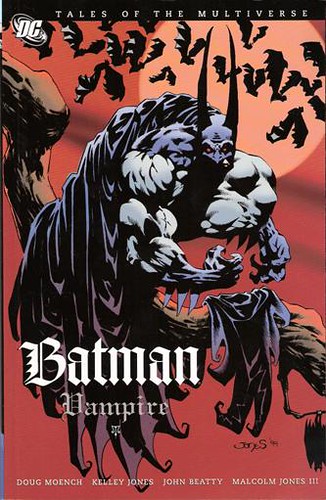 I was disappointed in “Red Rain.” I found Batman to be little more than the generic hero for the story. Other than the “bat” link between hero and villain, there’s not much to the conflict that couldn’t have been filled by some other street-level hero. Perhaps I am unappreciative of some natural link between vampires and Batman; perhaps I’m not properly reveling in the additive property awesomeness that results in super awesomeness when you add Batman to vampires. But the plot feels like a cheat, with Tanya, a vampire who fights against Dracula, imparting vampiric strength and attributes to Batman and starting him down the road to his eventual transformation. There’s also a mysterious red rain that literally falls from the sky here and throughout the book; I think it’s supposed to add to the spooky atmosphere, but mainly it looks like a coloring error.