Reviews of trade paperbacks of comic books (mostly Marvel), along with a few other semi-relevant comments / reviews.

13 July 2012

Batman: King Tut's Tomb

Collects: Brave and the Bold #164 and 171, Batman #353, and Batman Confidential #26-8 (1980, 1981, 1982, 2009)

Released: February 2010 (DC)

Format: 128 pages / color / $14.99 / ISBN: 9781401225773

What is this?: King Tut — last seen on Batman ’66 — is unleashed upon Gotham, and three ‘80s issues drawn by Jose Luis Garcia-Lopez are also included.

The culprits: Writers Nunzio DeFelippis, Christina Weir, Gerry Conway, and J.M. DeMatteis and artist Jose Luis Garcia-Lopez


The copy of Batman: King Tut’s Tomb that I have is an odd duck, and I’m not sure how it ended up in my hands.

What I have — and cannot find a record of anywhere online — is a hardback version of King Tut’s Tomb. Not only can I not find a record of the hardback, but I can’t find a reason for it to exist. King Tut’s Tomb reprints a three-issue storyline from Batman Confidential, a second-tier Bat-title from before the New 52 reboot that I was only vaguely aware existed. (In some places on the Web, King Tut’s Tomb is listed as Batman Confidential, v. 6.) Three issues is not enough to fill a hardback (or even a trade paperback), of course, so the book also contains two issues of Brave and the Bold and one issue of Batman from thirty years ago. One has a tenuous plot connection to the main Batman Confidential story; the other two have none. The real connection is that all six issues were penciled by Jose Luis Garcia-Lozpez.

Batman: King Tut’s Tomb coverIs Garcia-Lopez’s reputation strong enough to base an entire book off of? If so, I would expect his name in the title. On the other hand, this is part of the reprint series for Batman Confidential … but the words Batman Confidential show up only in tiny print in the indicia. The relatively obscure stories filling out the book make me think DC’s reprint editors were casting about desperately for something to bring up the page count, but if that’s the case, why reprint a secondary title in hardback when half the book is almost random? I mean — not that I’m complaining — Birds of Preycan’t get a hardcover, and that’s a title with an identity and a fan base.

Oh, well. It’s only slightly less strange if it’s a trade. A corporate decision, most likely, in both senses of the word.

What Birds of Prey did not have, however, was an artist as good as Garcia-Lopez. Thirty years is a long time in the life of an artist, and Garcia-Lopez’s style has definitely shifted. In the ‘80s stories, Garcia-Lopez’s art is very much in the style of Jim Aparo, whom he was filling in for on Brave and the Bold: a lithe but powerful Batman in a world of clear, solid lines. Even in Gotham and outer space, Batman’s world is bright and appealing. Though I have no nostalgia for that era, Garcia-Lopez’s art is comfortingly familiar.

In the Batman Confidential stories, Garcia-Lopez’s pencils are updated, modern — more Jim Lee than Jim Aparo. Batman is muscular and not as flexible, the backgrounds are busier, the cheesecake more plentiful. The panels are larger, with the occasional splash page. There is little to distinguish Garcia-Lopez’s modern style from a dozen others, except that his storytelling is superior. Present or past, there is little doubt what is supposed to be happening in the story. The older layouts, with more panels, are clear, but Garcia-Lopez knows how to tell a story even with the emphasis on flash. It explains why he has been getting work for 30 years.

It’s a shame the stories aren’t better, thought. The eponymous Batman Confidential stories have about two issues worth of interest dropped into three issues. Writers Nunzio DeFilippis and Christina Weir finally bring King Tut, an Egyptological-centered villain, from the ‘60s Batman TV show to the comics, an event that someone was probably waiting for. (Maybe.) It's the standard tale of presumed reincarnation and insane, petty revenges, and it’s not that interesting. But King Tut uses riddles related to the Hymn of Aten (an ancient song dedicated to Aten, an Egyptian god), which leads to the Riddler’s involvement in the case. The interaction between Batman and the Riddler is fun to watch, despite my nagging concern of where this fits in the Riddler’s history, since he was a semi-legitimate PI the last I had seen of him. However, the total of their intelligences is less than the sum of its parts. Riddler blunders into death traps, Batman is forced to rely on Riddler for information the plot would usually require him to remember himself — that sort of thing.

The ‘80s issues are a mixed bag. The two Brave and the Bold stories are quite forgettable, and by next week I’ll probably deny ever having read them. Batman teams with Hawkman in #164 to protect King Tut’s treasures, but aliens steal the entire museum to get back a pair of their artifacts. It’s a wacky, cosmic mix-up with a “cosmic hole” and possessions by alien spirits, but of course writer J.M DeMatteis ends it satisfactorily and forgettably. Writer Gerry Conway uses Professor Carter Nichols and his time-traveling hypnotism to send Batman back to the Civil War in #171, in which he meets a famous Union nurse and Scalphunter. A few moments of visceral satisfaction — Batman reconstructing the jaws of a few Rebels — can’t compensate for how boring the story is, especially since I have no idea why I should care about Scalphunter. (The character is named that only on the cover; in the story, he’s Ke-Woh-No-Tay.)

Conway’s Batman #353 is probably the best single issue in the collection, with Garcia-Lopez’s long-chinned Joker stealing the show. Conway writes the Joker as murderous and egomaniacal, and he almost wins … what more can you ask for in a Joker story? There's a subplot about Boss Rupert Throne getting back into Gotham politics, which was probably very exciting back in 1982 but serves only as a distraction in this collection.

So I still don’t understand why my local library has this in hardback. (Special library edition? There’s no indication that one was published, but who knows.) On its own merits, this isn’t a bad collection, although given the shift in styles, Garcia-Lopez’s art is not strong enough to unify King Tut’s Tomb despite its quality. The stories are mostly mediocre if inoffensive. For all you Jose Luis Garcia-Lopez fans, you’re in luck; for all you fans of Batman Confidential, you kinda get shafted. For the rest of us, this book is a big shrug.

Rating: Batman symbol Batman symbol (2 of 5)

Labels: , , , , , , , , , , , ,

18 March 2011

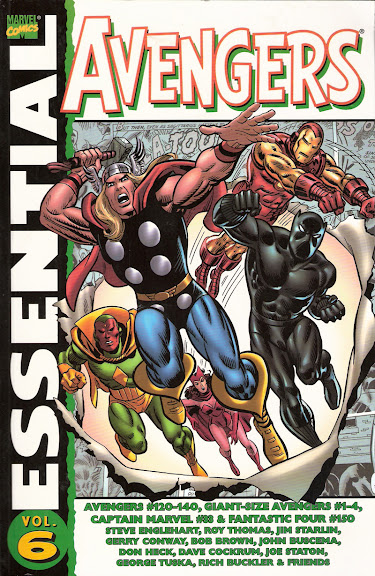
Essential Avengers, v. 6

Collects: Avengers #120-40, Giant-Size Avengers #1-4, Captain Marvel #33, and Fantastic Four #150 (1974-5)

Released: February 2008 (Marvel)

Format: 576 pages / black and white / $19.99 / ISBN: 9780785130581

What is this?: Kang tries to decide who the Celestial Madonna is; Mantis, the Vision, and the Scarlet Witch learn their origins; Zodiac and Thanos attack.

The culprits: Writer Steve Engelhart (with help from Roy Thomas and Gerry Conway) and art by Sal and John Buscema, Bob Brown, George Tuska, Rich Buckler, Don Heck, Dave Cockrum, and Tom Sutton

Having bought GIT Corp’s DVD-Roms of several Marvel series — Fantastic Four, Uncanny X-Men, Captain America, Amazing Spider-Man — I don’t have much use for Essentials featuring these characters. Which is fortunate, because Marvel seems like it isn’t all that interested in putting out new Essentials.

Unfortunately, these DVD collections, which have more than 40 years of comics and annuals, have one major flaw: they don’t include the Giant-Size series Marvel put out in the ‘70s. Now, I’ve read most of the Giant-Size Spider-Man, and there’s nothing that essential in them (although they can be enjoyable). And all you really miss in the Giant-Size Fantastic Four is Madrox the Multiple Man’s origin in #4. Fortunately, Giant-Size X-Men #1, which has the debut of the All-New, All-Different X-Men and is probably the most important Giant-Size issue, is included with the X-Men DVD-Rom. But the Giant-Size Avengers are important too, and they are left out of 40 Years of the Avengers.

Essential Avengers, v. 6 coverSo I purchased Essential Avengers, v. 6, which included all four issues of Giant-Size Avengers. Avengers, v. 6, also has another distinction among Essentials that makes it, if not unique, then very unusual: the issues collected in this book make up one storyline. That is, Essential Avengers, v. 6, makes an acceptable alternative to the Celestial Madonna Saga trade paperback, and it gives almost a year’s worth of issues that precede Celestial Madonna and a half year’s worth that follow the storyline. For these extra issues, you sacrifice color, but that’s a small price to pay.

One would expect a story that features the “Celestial Madonna” to have a long-lasting effect on the Marvel Universe — or at least the Avengers. But the most important event is the marriage of the Scarlet Witch and Vision; admittedly, that’s a pretty important moment, but neither of them are the Celestial Madonna. That honor goes to Mantis, a Vietnamese orphan who is trained by pacifist Kree monks after her uncle kills her mother and blinds her father. As with most storylines that revolve around the birth of a child unconceived, there has been little to no payoff from Mantis’s role. Mostly, the Celestial Madonna story is a time war vs. Kang, who returns again and again to kidnap Mantis and mate with her.

Oh, Kang. It doesn’t take much to get bored with Kang in this volume, despite writer Steve Englehart’s efforts. Why? Because Kang is the master of time, and his answer on how to use this temporal advantage is to steal dead heroes and villains out of the time stream and bring them to Limbo. Why use dead people? Who knows? Since he gains mental control of his new warriors, he could choose anyone — he could even steal future or past versions of the Avengers out of the time stream, which would at least make it an even fight. But no, he decides to create his Legion of the Unliving, none of whom, strangely, had died in their personal timelines yet. Kang’s other gambit include superrobots, Avenger-powered superrobots, and invading the present from several different points of his personal timeline simultaneously. This last is, at least, a good use of his advantages, but since his other versions seemed to have invaded from his Girl Scout days, anyone can beat them.

Once you get past a baby that won’t be born until after the book ends and a Kang who literally cannot even beat himself in a fight (and how could he, since he was outnumbered by himself two to one?), what do you have? Well, Giant-Size Avengers #4 has one of the oddest endings of any Avengers story outside Avengers #200: a half-Vietnamese, half-German girl who always talks of herself in the third person marries an alien tree who’s taking the form of her dead boyfriend, which takes her into space and will later impregnate her with the universal Messiah. Meanwhile, in the background, a mutant marries an android in a double marriage ceremony officiated by the future version of the supervillain the team just defeated (who also does not seem to have any real credentials that would allow him to perform marriages).

I wish I could say there were other parts of the story that rose to those heights, but that’s it — it’s hard to get that strange consistently, but other than the Legion of the Unliving, Essential Avengers doesn’t consistently rise to any notable level of insanity, nor does it get that exciting. “Celestial Madonna” is not exactly a disappointment, but it’s not a seminal Avengers story, despite its memorable name. The romantic tangle between Vision, Scarlet Witch, Swordsman, and Mantis is predictably resolved. This volume is also notable for the beginning of Vision’s confusing backstory; his body is that of the World War II android the Human Torch, a revelation that utterly fails to be interesting. The Scarlet Witch has an odd subplot with developing her “magical powers.” The Avengers have no problem operating in South Vietnam, which is a bit disorienting, but the issue was published just before North Vietnam won the war and unified the country under Communist rule.

The material that precedes the Celestial Madonna story is interesting as a snapshot of early Bronze-Age Avengers. The stories feature Zodiac, the revelation of who the parents of the Scarlet Witch and Quicksilver are (later revealed as false), the marriage of Quicksilver and the Inhuman Crystal, and the bizarre beginning of the Scarlet Witch’s training in witchcraft by Agatha Harkess (based, apparently, solely on the Scarlet Witch’s name). A battle with Thanos is a distraction —Captain Marvel #33 includes literally three pages of dense recap on Thanos’s history, which isn’t conducive to narrative flow — that comes to nothing, especially since it doesn’t end Thanos’s story as definitively as it pretends. And what comes after the Celestial Madonna heads into space is interesting as well; the introduction of new members Beast and Moondragon gives the team exciting new dynamics, despite the return of the slappingest, insanest Avenger, Hank Pym.

The art in Essential Avengers, v. 6, is top notch. The Buscema brothers provide the plurality of the art, with Sal penciling more than his brother John. Other pencilers include George Tuska, Dave Cockrum, Bob Brown, Don Heck, Rich Buckler, and Tom Sutton — a distinguished roster that needs no praise from me, however much it deserves it.

Despite the many interesting parts of Essential Avengers, v. 6, I think the main appeal is getting all four Giant-Size Avengers issues in one volume. There are other attractions — and I have to emphasize, the book is drawn by a lot of great artists who do not clash in style — but Marvel’s Giant-Size line is sadly neglected in reprint form. Englehart fans will find much to enjoy, as will those who like comic-book weddings — three in one volume, none of whom are married today!

Oh, and those who enjoy the thought of alien plants having consensual sex with human women will also find this appealing. You know who you are.

Rating:  symbol  symbol  symbol  symbol (3.5 of 5)

Labels: , , , , , , , , , , , , , , , ,

07 August 2010

Essential Tomb of Dracula, v. 4

Collects: Stories from Tomb of Dracula Magazine #2-6 and Dracula Lives! #1-13 and Frankenstein’s Monster #7-9 (1973-5, 1979-80)

Released: March 2005 (Marvel)

Format: 576 pages / black and white / $16.99 / ISBN: 9780785117094

What is this?: A chronological retelling of Dracula’s life, from Marvel’s pre-1980 stories (except Tomb of Dracula)

The culprits: Too many to list; includes Marv Wolfman, Mike Friedrich, John Buscema, Gene Colan, and Gerry Conway

The release of Essential Tomb of Dracula, v. 4, was a bit of a surprise, given that the previous three volumes had completely collected the comic book series. But Marvel still had some vampire material lying around — mostly from black and white magazines it published in the ‘70s — so they bundled those stories together into another, presumably final, volume.

One aspect of v. 4 that sets it apart from other Essentials is that rather than reprinting the stories in the order they were published, Marvel ordered them by when they occurred in the life of Dracula, the central character. After reading through the stories, this is not only the better way to organize the stories but really the only way; Dracula Lives, for instance, published stories of Dracula’s past as one feature and a continuing serial of his present as another in the same issue. To publish those in periodical order would have split the present-day stories, ruining the flow.

Essential Tomb of Dracula, v. 4, coverOrdering the stories this way works best if there is a narrative flow to them. Other than that present day feature, however, there is none. Worse yet, there seems to be no real plan behind Dracula’s reign of Euroterror. Dracula attacks and attacks and attacks; occasionally, he is attacked. Despite his claims to nobility and character, Dracula is constantly at the mercy of his animal nature. However, Dracula never seems to own up to this, and there is really no one to call him on it. Worse, there seems to be no consequence to the stories. New vampires are created and disappear before the next story. Dracula is staked and returns to unlife for the next tale.

After going through Dracula’s first few centuries, it’s easy to feel there’s no point to his stories — it’s just rehashing the same plot points over and over. There are few horror-comic plot twists or really cruel endings for Dracula’s victims, as if the writers feared making Dracula too awful.

Then there are the slips on vampire lore. Chirping about continuity problems on most comics can be seen as nitpicking, but the weaknesses and restrictions on Dracula and other vampires are part of popular culture. Does Dracula need to be invited inside a home? Sometimes, but not always. How long does it take for a vampire to rise from the grave? Everyone, including Dracula, says three days, but frequently they arise the next night. How effective are crosses — can Dracula attack someone with a cross, or does he need to have a proxy attack? Sources vary. Running water poses no problems; occasionally, no thought is given to the coffin filled with earth Dracula needs to rest in. How much power does daylight have — does it destroy a vampire, like decapitation, or does it merely immobilize the vampire, like a stake? Dunno. And this is putting aside things like Dracula not using his hypnotism or turning into mist or other errors in tactics.

But I don’t want to dwell on the negative, because I’m a negative person and have truly impressive negative dwelling skills. “Bounty for a Vampire,” by Tony Isabella and Tony DeZuniga, is an effective and nuanced Weird Western from Dracula Lives #13, with a former marshal who has seen weird things hunting vampires in Transylvania. Peter Gillis and John Buscema’s story of a ballet dancer who loses her humanity and empathy (“Pavanne from an Undead Princess,” Tomb of Dracula Magazine #5) is the most moving story in the collection. “A Death in the Chapel” from Dracula Lives #6 features the final combat of Dracula and Father Montesi, the discoverer of the vampire-destroying Montesi Formula. The continuity and continuing stories in Frankenstein’s Monster #7-9 (by Mike Friedrich and Buscema) and the modern tales in Dracula Lives! was a welcome respite from the episodic stories that dominate the collection. And although the story in “The Pit of Death” by Doug Moench and DeZuniga (Dracula Lives #10-1) didn’t make much of an impression on me, the protagonist’s revenge on Dracula was nicely innovative.

Also, Marvel does include some supplementary material to the collection. There is a prose recap of Dracula’s history near the beginning of v. 4, and there is an extensive cover and promotional image gallery near the end. Gene Colan’s original pencils from unused pages of Tomb of Dracula #70-2, which were collapsed into #70 when the title was canceled, are included for those who wondered how the story might have ended up had Colan and Wolfman been allowed a little more space for the stories.

The art, overall, is uneven, but Dracula art from Colan is always welcome. Colan contributed seven stories that appear in the collection, most of them in the book’s second half, and they are uniformly highlights — shadowy, evocative, with a Dracula who is simultaneously bestial and suave. Buscema drew the three issues of Frankenstein’s Monster, and although those issues are not going to go down as his greatest, they are John Buscema drawing Dracula, Frankenstein’s Monster, and shapely gypsy women, and there’s nothing wrong with that; his pencils on other stories in the collection, such as “Death Vow” (inks by Klaus Janson) from Tomb of Dracula Magazine #4, are more impressive, evocative and as shadowy as Colan’s work. Other artists who manage to convey more than a modicum of horror or menace include DeZuniga and Vicente Alcazar in “Here Comes the Death Man” in Dracula Lives #7.

Still, those enjoyable parts can’t really save the book. There’s a lot of repetition and stories that just aren’t worth the time. Also, the reproduction on v. 4 is strangely murky, making it difficult to read. I would have thought that since the original material was originally from black-and-white magazines, that wouldn’t have been a problem, but I was wrong.

The question you have to ask yourself is: how much do you want Gene Colan and John Buscema stories? If the answer is a lot … well, you might want to buy the original magazines. But if that isn’t an option and you still want to see them and are willing to wade through a lot of forgettable Marvel vampire stories, buy this book. Otherwise … borrow it from a vampire fanatic and skim it.

Rating: Marvel symbol Half Marvel symbol (1.5 of 5)

Labels: , , , , , , , , , , , , , ,

24 February 2009

Essential Hulk, v. 5

Collects: Incredible Hulk #171-200, Incredible Hulk Annual #5 (1974-6)

Released: November 2008 (Marvel)

Format: 616 pages / black and white / $16.99 / ISBN: 9780785130659

What is this?: Hulk smash! as usual, all around the world, vs. supervillains, Commies, and puny Banner.

The culprits: Writer Len Wein (and others) and pencilers Herb Trimpe and Sal Buscema

The Marvel Essentials line concentrated, in its early years, on the company’s Silver Age core and a few later classic titles, such as Uncanny X-Men and Wolverine. (Yes, I know Wolverine’s not really classic, but work with me here.)

Most of those Silver Age titles have wandered into the ‘70s. Overall, the ‘70s were a fallow time for Marvel; yes, X-Men were picking up steam with Chris Claremont and Captain America had some well received stories, like the Secret Empire, but the big titles — Fantastic Four, Amazing Spider-Man, Avengers — were not at the creative peaks that preceded and followed the Me Decade.

Essential Hulk, v. 5 coverWhich brings us to Essential Hulk, v. 5. For most people, Incredible Hulk didn’t really get memorable — from a story perspective, at least — until Peter David took over the title in the ‘80s; it’s the TV show, with Bill Bixby and Lou Ferrigno, that draws the attention before that. But I admit to a fondness for the Hulk title. As I mentioned in my review for the previous volume, all that mediocrity really doesn’t matter.

The Hulk fights supervillains. He travels the world. He gains friends, loses friends. He’s always wandering, getting out of stuffy New York to see the world. The only thing casual readers have heard of from this volume is the debut of Wolverine in #180-2, but the Hulk is not just doing the same things over and over again.

Roy Thomas wrote #171-5 (and plots #176), followed by Gerry Conway for three issues. Thomas, being Thomas, couldn’t resist bringing back forgotten or stranded characters, like the Juggernaut and the Cobalt Man. Conway got to write the results of the first time a group with Black Bolt shot the Hulk into space for his good and the good of society; it didn’t work either, but it was a lot less destructive to society than Planet Hulk and World War Hulk. (The first outer space exile is a boring story set on Counter-Earth, where Adam Warlock gets to play a very obvious golden-skinned Jesus. Don’t ask. Just … don’t, OK?)

Then Len Wein settled in for a long run, running through the end of the volume. Wein introduced Wolverine, which is one of the most significant moments in Marvel history, but most of the book is uneventful. I am fond of some bits. I enjoyed the return of Glenn Talbot, which included saving a nonplussed President Ford from a bomb and a breakout from a Soviet prison that featured a talking, rhyming orange dinosaur named Droogi. The Russians aren’t paper enemies; they manage to deal the imperial running dogs a good deal of damage, even taking out the Hulkbuster base and its commander. The story with the Shaper of Worlds, in which he and his protégé create a paradise for the Hulk that is ruined by the Toad Men and the Hulk’s own demands that “if paradise is not real … then it is not paradise!”, is touching.

The less said of Hulk vs. the Loch Ness (sorry, Loch Fear) Monster, the better. The same holds true of the two-issue story featuring Man-Thing and the Collector. Yes, calm down, form a line — there are copies enough for everyone.

The art comes from iconic Hulk pencilers Herb Trimpe and Sal Buscema, with Trimpe providing the work for all the stories up to #193 and Buscema doing the rest. Personally, I prefer Buscema, who is my favorite Hulk artist and one of my favorite comic artists of all time. There’s something about his ability to get across the Hulk’s power and frustration with a world that makes no sense. Trimpe, though, has a memorable Hulk, even if he does have a fondness for oddly shaped heads. As I mentioned in the review for v. 4, you can see a big difference in Trimpe’s work depending on the inker. I prefer the inking of Jack Abel, who worked on #171-81.

My recommendation for this title is the same as the previous volume: I like this volume because I like this style of Hulk. It’s occasionally strange, not infrequently boring … but it’s rarely the same for more than two issues. It’s like the weather; if you don’t like it, wait a while. That being said, I’m deducting a half point because of the “Adam Warlock as Messiah” thing.

Rating: Hulk head Hulk head Half of a Hulk head (2.5 of 5)

Labels: , , , , , , , , , , ,

24 May 2008

Essential Hulk, v. 4

Collects: Incredible Hulk #143-70 (1971-3)

Released: September 2006 (Marvel)

Format: 608 pages / black and white / $16.99 / ISBN: 0785121935

More than any other of the mainstay, stalwart titles at DC and Marvel, the Incredible Hulk can withstand mediocre runs.

Essential Hulk 4 coverPerhaps it’s just me. But even though I know the stories in Essential Hulk, v. 4 aren’t classic or iconic, they have a certain appeal that non-Hulk stories do not. The Hulk can go anywhere — the scope of his stories is immense, sprawling. He arrives like a meteor strike, his movements formed only by chance and villainy. In Essential Hulk, v. 4, he ranges from Canada to Latveria to the ocean floor and Jarella’s subatomic world. When most of the Marvel Universe is stuck in New York, this is refreshing.

If that doesn’t rock your socks, the highlight of this volume is the art of Herb Trimpe. Perhaps the artist most closely associated with the Hulk, Trimpe begins his long association with the Hulk in this volume. His work is good — more comfortable than standout, as gross exaggeration of the Hulk’s physique over the years has made his Hulk seem a little small in comparison. But for those who don’t pay attention to such things usually, this book shows the difference an inker (and reproduction, I fear) can have on a penciller’s work. Lines go from scratchy to clean and back again, heavy to light, etc. It’s not Trimpe’s fault, but it doesn’t bring out the best in his pencils.

Bi-Beast! The Hulk has a few of his B-grade villains created in this book: Bi-Beast, Zzzax, Harpy, the Wendigo. The creation of the Bi-Beast is bizarre and wonderful, something truly worthy of Jack Kirby’s fertile imagination. Instead, he was created by Steve Englehart and Trimpe.4 The thought of a comic with both Bi-Beast and MODOK but without the participation of Kirby makes me doubt Stan Lee’s all-encompassing wisdom.

As for the plots … well, they’re provided by a bunch of Marvel’s best in the ‘70s, but that doesn’t make the plots great. Roy Thomas, Gerry Conway, Archie Goodwin, Gary Friederich, and Englehart combined on the 28 stories in this volume, although few are memorable. (A side effect of the sprawling nature of the Hulk’s travels is that it often leaves a disconnect between stories.) Perhaps the worst of the stories is the “marry in haste, repent at leisure” wedding of longtime leading lady Betty to the man who had held a torch for her for years, Glen Talbot. The stories occasionally gain traction — the Hulk’s foray into Canada, for instance, when he first battles Wendigo — but mostly they’re as aimless as the hulk.

I liked this volume. But then again, I like this style of the Hulk.

Rating: Hulk head Hulk head Hulk head (3 of 5)

Labels: , , , , , , , , , , , , , ,

29 October 2006

Essential Marvel Team-Up, v. 2

Collects: Marvel Team-Up #25-51, Marvel Two-in-One #17 (1974-6)

Released: July 2006 (Marvel)

Format: 528 pages / black and white / $16.99 / ISBN: 0785121633

Marvel Team-Up is a title that doesn’t get much respect. It’s noted more for being a de facto second Spider-Man title — the first Marvel character to get a second solo title — rather than for being a medium for quality stories. Most of what passed through Marvel Team-Up is seen as either forgettable or silly, and the stories in Essential Marvel Team-Up, v. 2 is no exception.

But that’s not to say the stories aren’t enjoyable, even if they didn’t have a long-term effect on the Spider-mythos. (Three of the 27 stories in this volume are expressly forgotten by the protagonists at the end.) There is often a forgotten charm in these ‘70s stories, when Spidey was still in his salad days and some team-ups still hadn’t been tried.

These stories aren’t — or perhaps can’t — be told in the 21st century, but there’s no reason not to enjoy them here. The stories told by Gerry Conway and Len Wein at the beginning of Essential Marvel Team-Up tend toward the silly, with the silliest (or most mythic, if you’re charitable) being #28, in which Hercules tows the stolen island of Manhattan (roughly) back to its correct place. This story is rightly hooted at by modern fans, but it was a product of its times. That doesn’t make the stories good, but it does explain a few things.

The writing improves greatly when Bill Mantlo takes over. Mantlo is a writer who was the backbone of the marvel Universe in the ‘70s and ‘80s — he wrote nearly every character Marvel has at one time or another. Some of his work is reviled (his Alpha Flight comes to mind, and there may come a time when his name is much more associated with “Cloak and Dagger created by”), but you don’t write so many titles unless you have something on the ball. Mantlo certainly did.

After taking over this title, Mantlo wrote a series of connected storylines — difficult to do when Spidey’s supposed to have a new guest star every month. But Mantlo pulled it off, most impressively with a six-part time travel story that takes Spider-Man and a host of associates back to the witch trials at Salem. By the end, the team-up concept is showing its weaknesses (Moondragon? Really?), but overall, the story works — and it has Doom!, which can never be a bad thing. His two-part Big Man / Crimemaster story is surprisingly effective, if a little convenient. A later four-part storyline that introduces the Wraith and Jean DeWolff dispenses with adding guest stars, keeping Iron Man as the featured guest for three issues.

If Mantlo was the backbone of Marvel writing in the ‘70s and ‘80s, Sal Buscema is the apex of Marvel art between the end of the Silver Age and the beginning of the Image Age. In Essential Marvel Team-Up, he was frequently aided by Mike Esposito, but the result is still classic Buscema: excellent storytelling and a style that is nearly invisible until a few signature moments.8 Buscema’s work adapts to the black-and-white format of the Essential as well as any artist I’ve seen.

All right: despite my deep admiration for the work of Buscema and Mantlo, this is Marvel Team-Up. Even at its best, it was the “other” Spider-Man title — until Spectacular Spider-Man came along, when it became the third title. Nothing groundbreaking happens here, no chances in Peter Parker’s life and no world-shattering villains. The mandate for Marvel Team-Up seemed to be to tell entertaining stories that didn’t rock the boat. And that’s just what happens in Essential Marvel Team-Up, v. 2.

Rating: (3 of 5)

Labels: , , , , , , , , ,