Reviews of trade paperbacks of comic books (mostly Marvel), along with a few other semi-relevant comments / reviews.

28 February 2009

Batman: Strange Apparitions

Collects: Detective Comics #469-79 (1977-8)

Released: November 1999 (DC)

Format: 176 pages / color / $12.95 / ISBN: 9781563895005

What is this?: A memorable — or so they say — Batman run of the ‘70s.

The culprits: Writers Steven Englehart and Len Wein and pencilers Marshall Rogers and Walt Simonson

Batman: Strange Apparitions is a seemingly random slice of late ‘70s Batman stories — more than a year’s worth of Detective Comics in one volume.

Ostensibly, it’s a showcase of writer Steve Englehart’s Detective run. According to the book’s introduction by Englehart, after he was hired away from Marvel, Englehart had planned to make this run his comics swan song. With penciler Walt Simonson, Englehart planned to tell a story involving Dr. Hugo Strange, Boss Rupert Thorne, and Silver St. Cloud. Simonson bowed out after two issues, so Marshall Rogers was brought in.

Batman: Strange Apparitions coverEnglehart thinks pretty highly of his work, which he says formed a bit of the basis of the first Batman movie. (I don’t see it, even if Vicky Vale is supposed to be a proxy for Silver St. Cloud, but I’ll take his word for it.) But is it really that good?

There are definitely some iconic Batman stories here. The Joker’s battle to patent his Joker Fish (fish chemically treated to have the Joker’s grotesque smile) is one of the great Batman stories, rightly reprinted in “Best of” anthologies and the origin of one of the best Batman: The Animated Series episodes. The battle with Hugo Strange is nothing special, but its aftermath is exciting: Strange, who has discovered Batman’s secret identity, dies rather than give it to Rupert Thorne, then haunts Thorne until he confesses his crimes.

But the Penguin and Dr. Phosphorus stories are Silver Age stories with Bronze Age trappings, and Len Wein’s Clayface III story, which wraps up the collection, could have come a Spider-Man book, with its tragic villain, self-pitying hero, and near empathy for the villain’s plight. Batman’s battle with Deadshot is fun, involving a giant electric typewriter (no manual typewriter in the ‘70s, no no), but most of the story is given over to Bruce Wayne’s romance with Silver St. Cloud.

That romance is the thread that ties the entire volume together. Its believability and impact is what could transform the book from tripe to treasure. Unfortunately, I’m not sure where I stand on the matter. Bruce quickly falls for Silver, and vice versa; her dedication to him helps save him from Hugo Strange. Fine; that makes sense. But in a moment that truly does link Strange Apparitions to Tim Burton’s Batman, Bruce reveals his secret identity after Silver has figured it out. And immediately after, she’s written out. No consequences! No romance! I don’t know if this sort of storyline was common back then, but it’s not the type plotting I expect from a premier title like Detective Comics, although it’s common in consequence-free, continuity-light mini series and annuals.

I’m not entirely convinced by the art, either. Both Rogers and Simonson draw certain characters as dynamic, important, beautiful — Batman and the Joker, for example. They seem almost to be drawn in a house style. The other characters … are not. They seem to be appearing in another book, by other artists. The rest of the art almost seems locked in an even older style. Sometimes everything comes together, atmospheric and beautiful. Other times it looks like a mishmash. There are more of the former than latter, but it doesn’t take many of the latter to spoil the whole bunch.

Also: Why aren’t there any covers? I find this a major problem. At least when the Dark Horse Chronicles of Conan lacked the covers, you know it was probably because of rights issues. Is it some sort of artists’ compensation difficulty that prevented DC from showing the original covers? Did they just run out of room? There are worse sins when reprinting old comics, but this is a quite noticeable one.

I’m not as impressed by this volume as I think I should be. However, there are too few trade paperbacks covering this interesting period, after Batman starts being taken seriously and before Crisis. For that reason, I’m giving Strange Apparitions a bit of a bump on the rating.

Rating: Batman symbol Batman symbol Batman symbol (2.5 of 5)

Labels: , , , , , , ,

24 February 2009

Essential Hulk, v. 5

Collects: Incredible Hulk #171-200, Incredible Hulk Annual #5 (1974-6)

Released: November 2008 (Marvel)

Format: 616 pages / black and white / $16.99 / ISBN: 9780785130659

What is this?: Hulk smash! as usual, all around the world, vs. supervillains, Commies, and puny Banner.

The culprits: Writer Len Wein (and others) and pencilers Herb Trimpe and Sal Buscema

The Marvel Essentials line concentrated, in its early years, on the company’s Silver Age core and a few later classic titles, such as Uncanny X-Men and Wolverine. (Yes, I know Wolverine’s not really classic, but work with me here.)

Most of those Silver Age titles have wandered into the ‘70s. Overall, the ‘70s were a fallow time for Marvel; yes, X-Men were picking up steam with Chris Claremont and Captain America had some well received stories, like the Secret Empire, but the big titles — Fantastic Four, Amazing Spider-Man, Avengers — were not at the creative peaks that preceded and followed the Me Decade.

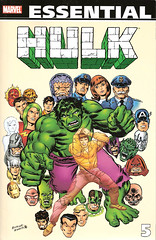
Essential Hulk, v. 5 coverWhich brings us to Essential Hulk, v. 5. For most people, Incredible Hulk didn’t really get memorable — from a story perspective, at least — until Peter David took over the title in the ‘80s; it’s the TV show, with Bill Bixby and Lou Ferrigno, that draws the attention before that. But I admit to a fondness for the Hulk title. As I mentioned in my review for the previous volume, all that mediocrity really doesn’t matter.

The Hulk fights supervillains. He travels the world. He gains friends, loses friends. He’s always wandering, getting out of stuffy New York to see the world. The only thing casual readers have heard of from this volume is the debut of Wolverine in #180-2, but the Hulk is not just doing the same things over and over again.

Roy Thomas wrote #171-5 (and plots #176), followed by Gerry Conway for three issues. Thomas, being Thomas, couldn’t resist bringing back forgotten or stranded characters, like the Juggernaut and the Cobalt Man. Conway got to write the results of the first time a group with Black Bolt shot the Hulk into space for his good and the good of society; it didn’t work either, but it was a lot less destructive to society than Planet Hulk and World War Hulk. (The first outer space exile is a boring story set on Counter-Earth, where Adam Warlock gets to play a very obvious golden-skinned Jesus. Don’t ask. Just … don’t, OK?)

Then Len Wein settled in for a long run, running through the end of the volume. Wein introduced Wolverine, which is one of the most significant moments in Marvel history, but most of the book is uneventful. I am fond of some bits. I enjoyed the return of Glenn Talbot, which included saving a nonplussed President Ford from a bomb and a breakout from a Soviet prison that featured a talking, rhyming orange dinosaur named Droogi. The Russians aren’t paper enemies; they manage to deal the imperial running dogs a good deal of damage, even taking out the Hulkbuster base and its commander. The story with the Shaper of Worlds, in which he and his protégé create a paradise for the Hulk that is ruined by the Toad Men and the Hulk’s own demands that “if paradise is not real … then it is not paradise!”, is touching.

The less said of Hulk vs. the Loch Ness (sorry, Loch Fear) Monster, the better. The same holds true of the two-issue story featuring Man-Thing and the Collector. Yes, calm down, form a line — there are copies enough for everyone.

The art comes from iconic Hulk pencilers Herb Trimpe and Sal Buscema, with Trimpe providing the work for all the stories up to #193 and Buscema doing the rest. Personally, I prefer Buscema, who is my favorite Hulk artist and one of my favorite comic artists of all time. There’s something about his ability to get across the Hulk’s power and frustration with a world that makes no sense. Trimpe, though, has a memorable Hulk, even if he does have a fondness for oddly shaped heads. As I mentioned in the review for v. 4, you can see a big difference in Trimpe’s work depending on the inker. I prefer the inking of Jack Abel, who worked on #171-81.

My recommendation for this title is the same as the previous volume: I like this volume because I like this style of Hulk. It’s occasionally strange, not infrequently boring … but it’s rarely the same for more than two issues. It’s like the weather; if you don’t like it, wait a while. That being said, I’m deducting a half point because of the “Adam Warlock as Messiah” thing.

Rating: Hulk head Hulk head Half of a Hulk head (2.5 of 5)

Labels: , , , , , , , , , , ,

08 August 2008

Essential Spider-Man, v. 8

Collects: Amazing Spider-Man #161-85, Amazing Spider-Man Annual #11, Giant-Size Spider-Man #6, Nova #12 (1976-8)

Released: April 2007 (Marvel)

Format: 512 pages / black and white / $16.99 / ISBN: 9780785125006

I really enjoy older Spider-Man stories — and by that, I mean stories before 1990. Back when Spider-Man’s simple life was very complicated, when the supporting cast was regularly used, when Norman Osborn was dead, when Spider-Man’s rogues gallery cold be taken seriously (even if everyone knew how ridiculous they were) without making them dark and gritty.

Essential Spider-Man, v. 8 cover So I have been a supporter of Marvel’s Essential Spider-Man series (as well as the Essential Spectacular Spider-Man and Essential Marvel Team-Up). The series has now reached Essential Spider-Man, v. 8, a landmark of sorts; this volume markes then end of Amazing Spider-Man runs for writer / editor Len Wein (with #180) and artist Ross Andru (with #185). Andru’s style is almost the epitome of Spider-Man art; like Romita, his Spider-Man is streamlined, sleek but muscled, with no distracting, unnecessary details (like Ditko’s underarm webs — which I like — and McFarlane’s many eccentricities — which I don’t). Andru is best known for his Spider-Man work; this is, in many ways, the apex of his career.

Too bad the stories aren’t quite worthy of him. Spider-Man is always judged by his villains, and there’s a decided lack of quality villainy here. There’s Jigsaw, essentially someone to be the Punisher’s foil; the Lizard-knockoff Stegron; the ephemeral Will o’ the Wisp; the forgettable Dr. Faustus; and a host of even lesser lights. Wein did pull the Kingpin and Molten Man back from obscurity, but I’m not sure making Molten Man Liz Allen’s stepbrother was a wise idea at the time, since he serves more as a complication than a character. Kingpin’s return is welcome, but he’s put out of commission again immediately, and the whole “draining life-force” plot is a little out of place in Spider-Man. (Fine for the Fantastic Four or Superman, though; each is more high-concept sci-fi than Spider-Man.)

Wein succeeds in the subplots. He gives Aunt May a purpose beyond Peter, making her a militant Gray Panther; this doesn’t go very far for later writers. Jameson becomes suspicious about Peter’s secret ID in the aftermath of the Clone Saga; Peter dissuades him distressingly easily. In building another Spider Slayer, Jameson meets Marla, his true love. This is probably most lasting legacy, humanizing Jameson.

Wein’s lone excellent job is a Green Goblin story that introduces the third version of the villain. It’s filled with suspense, drama, and ethical dilemma’s for Spider-Man; it ends with a Green Goblin vs. Green Goblin fight. This was really the last hurrah10 for the Goblin, upstaged by the Hobgoblin a few years later, but Wein and Andru give him a hell of a sendoff.

After a fill-in issue by Bill Mantlo, Marv Wolfman takes over for Wein, and his four issues … well, they ain’t exactly masterworks — Rocket Racer, the Big Wheel, and the somewhat less-than-sociopolitically-correct White Dragon. It isn’t really fair to expect greatness in just four stories, but they don’t help the volume. Wolfman also has Peter fail to graduate for not completing a gym credit — incredibly stupid, I’ve always felt — and writes Mary Jane out of the book before having the married Betty Brant throw herself at Peter.

Compared to a modern comic, there’s a lot going on in this background: Peter and his supporting cast are changing, usually in an interesting way. But Spider-Man … His stories, other than the Green Goblin arc, are nothing exceptional. Spider-Man is reduced to being a co-star for Nova in a crossover, for heaven’s sake. 11

Amazing Spider-Man is going into the doldrums here and in v. 9. It won’t stop me from buying the next volume, but I can’t recommend v. 8 for the non-Amazing Spider-Man fan.

Rating: Spider-Man symbol Spider-Man symbol Half-Spider symbol (2.5 of 5)

Labels: , , , , , ,

16 April 2008

Wonder Woman: Gods and Mortals

Collects: Wonder Woman #1-7 (1987)

Released: February 2004 (DC)

Format: 192 pages / color / $19.99 / ISBN: 1401201970

When Carrier Library at James Madison University began adding trade paperbacks to their collection, I jumped at the first two collections that hit the shelves, both of which were Wonder Woman trades. I am not a Wonder Woman fan, but my interest in these books high, and driving up circulation statistics is never a bad thing.

Wonder Woman: Gods and Mortals cover Wonder Woman: Gods and Mortals reprints the first Wonder Woman issues after Crisis reset DC's continuity. George Perez was given the opportunity to both write and draw the title, essentially setting Wonder Woman's status quo (with writing help from Len Wein and Greg Potter). He makes long-time love Steve Trevor a dovish captain in the air force, and Etta Candy, her former sidekick, is a lieutenant in the Air Force and Trevor's aide. Diana is sent into Man's World from the Amazon paradise after Ares sends a bomber through a portal to nuke their island and is named Wonder Woman by the press.

The art is excellent; this is Perez at the height of his powers. His Diana is beautiful and powerful, and he tries his best to explain that ridiculous costume that he draws so well. Really, nothing more needs to be said about it.

The plot is simple in a Cold War way: Ares is manipulating the world into a huge war while his children give Wonder Woman some trouble. There's some fighting, some magical talismans ... really, the plot is not as important as establishing who Wonder Woman and her supporting cast are and showing Ares as a nemesis. That it does, although the exact plot isn't exactly remarkable.

There are a couple of choices that mar the book, however. Perhaps not seriously, but ... First, Perez chooses to fill most of the first issue with the story of the Amazons, from their creation by some of the Greek gods to Diana's winning of the Wonder Woman regalia. That's a lot to fit into one issue, and it also shoves Diana into a supporting character for the first issue of her new, relaunched title. That's sort of a weak start to the story, in my opinion, given that Perez tells the story strictly chronologically. Perez could have shown Wonder Woman as already a hero, but he chose to build up her bona fides. An interesting choice, but one that contributes to the forgetability of the plot; diehard fans of superheroes often get impatient with restatement of origin stories (see: any superhero movie).

It was a lot of inertia for me to overcome, reading about a bunch of characters who I knew wouldn't be all that important by the time the book was half over. Besides, none of the travails the Amazons are subjected to are particularly relevant for this book. (Perhaps they set up more down the line, but I don't need to know them.)

More serious is Perez's Greek gods. The gods of the Amazons — Artemis, Demeter, Aphrodite, Hermes, and Hestia — are passive. They see their vulnerabilities, and their only response is to create the Amazons. They don't oppose Ares, the villain of the piece, in any meaningful way; what does it say about the gods when they have mortals fighting their battles for them? It says it's time for new gods, that's what. Ares isn't all that bright of an opponent, given that he doesn't realize a nuclear apocalypse that kills all humans will wipe out all his worshipers; certainly Athena, goddess of wisdom, could have thought of a better plan to outsmart him.

Still, this has to be labeled a success. Gods and Mortals is never going to be compared to the great stories of the DC canon, but Perez crafted a recognizable, superheroic Wonder Woman and launched her supporting cast. Anything more could be accomplished going forward.

Rating: Wonder Woman symbol Wonder Woman symbol Wonder Woman symbol (3 of 5)

Labels: , , , , , , , , ,

29 October 2006

Essential Marvel Team-Up, v. 2

Collects: Marvel Team-Up #25-51, Marvel Two-in-One #17 (1974-6)

Released: July 2006 (Marvel)

Format: 528 pages / black and white / $16.99 / ISBN: 0785121633

Marvel Team-Up is a title that doesn’t get much respect. It’s noted more for being a de facto second Spider-Man title — the first Marvel character to get a second solo title — rather than for being a medium for quality stories. Most of what passed through Marvel Team-Up is seen as either forgettable or silly, and the stories in Essential Marvel Team-Up, v. 2 is no exception.

But that’s not to say the stories aren’t enjoyable, even if they didn’t have a long-term effect on the Spider-mythos. (Three of the 27 stories in this volume are expressly forgotten by the protagonists at the end.) There is often a forgotten charm in these ‘70s stories, when Spidey was still in his salad days and some team-ups still hadn’t been tried.

These stories aren’t — or perhaps can’t — be told in the 21st century, but there’s no reason not to enjoy them here. The stories told by Gerry Conway and Len Wein at the beginning of Essential Marvel Team-Up tend toward the silly, with the silliest (or most mythic, if you’re charitable) being #28, in which Hercules tows the stolen island of Manhattan (roughly) back to its correct place. This story is rightly hooted at by modern fans, but it was a product of its times. That doesn’t make the stories good, but it does explain a few things.

The writing improves greatly when Bill Mantlo takes over. Mantlo is a writer who was the backbone of the marvel Universe in the ‘70s and ‘80s — he wrote nearly every character Marvel has at one time or another. Some of his work is reviled (his Alpha Flight comes to mind, and there may come a time when his name is much more associated with “Cloak and Dagger created by”), but you don’t write so many titles unless you have something on the ball. Mantlo certainly did.

After taking over this title, Mantlo wrote a series of connected storylines — difficult to do when Spidey’s supposed to have a new guest star every month. But Mantlo pulled it off, most impressively with a six-part time travel story that takes Spider-Man and a host of associates back to the witch trials at Salem. By the end, the team-up concept is showing its weaknesses (Moondragon? Really?), but overall, the story works — and it has Doom!, which can never be a bad thing. His two-part Big Man / Crimemaster story is surprisingly effective, if a little convenient. A later four-part storyline that introduces the Wraith and Jean DeWolff dispenses with adding guest stars, keeping Iron Man as the featured guest for three issues.

If Mantlo was the backbone of Marvel writing in the ‘70s and ‘80s, Sal Buscema is the apex of Marvel art between the end of the Silver Age and the beginning of the Image Age. In Essential Marvel Team-Up, he was frequently aided by Mike Esposito, but the result is still classic Buscema: excellent storytelling and a style that is nearly invisible until a few signature moments.8 Buscema’s work adapts to the black-and-white format of the Essential as well as any artist I’ve seen.

All right: despite my deep admiration for the work of Buscema and Mantlo, this is Marvel Team-Up. Even at its best, it was the “other” Spider-Man title — until Spectacular Spider-Man came along, when it became the third title. Nothing groundbreaking happens here, no chances in Peter Parker’s life and no world-shattering villains. The mandate for Marvel Team-Up seemed to be to tell entertaining stories that didn’t rock the boat. And that’s just what happens in Essential Marvel Team-Up, v. 2.

Rating: (3 of 5)

Labels: , , , , , , , , ,