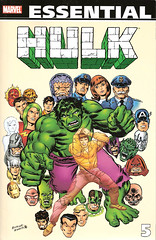
Reviews of trade paperbacks of comic books (mostly Marvel), along with a few other semi-relevant comments / reviews.

08 July 2016

Moon Girl and Devil Dinosaur, v. 1: BFF

Collects: Moon Girl and Devil Dinosaur #1-6 (2016)

Released: June 2016 (Marvel)

Format: 136 pages / color / $17.99 / ISBN: 9781302900052

What is this?: A girl with the Inhuman gene finds a Kree device coveted by time-lost cavemen, who are pursued by Devil Dinosaur, a literal dinosaur.

The culprits: Written by Amy M. Reeder and Brandon Montclare and penciled by Natacha Bustos


I can’t say I’ve ever been enchanted by the idea of Devil Dinosaur.

I mean, yes, I get the appeal: giant red T-Rex. But I’m not a big fan of high-concept ideas that go nowhere, and eventually the appeal of what amounts to a giant carnivorous (within the bounds of the Comics Code Authority) horse / dog has to wear thin after a while. It’s not like Devil Dinosaur has a huge range of emotions by himself (herself?).
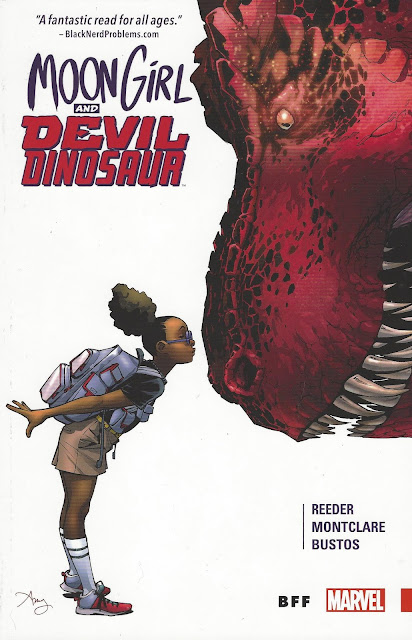
Moon Girl and Devil Dinosaur, v. 1: BFF coverBut I decided to give Moon Girl and Devil Dinosaur, v. 1: BFF a shot, and I’m glad I did.

Writers Amy Reeder and Brandon Montclare create a sympathetic lead in Lunella Lafayette, a grade-school genius (her age is unclear) who is trying to keep her Inhuman gene from expressing. Unfortunately, she’s surrounded by those not only of lesser intellect but also of much greater obliviousness. Her parents want her to be normal, which she clearly is not; her science teacher (or maybe her only teacher, who knows) teaches the students as if they are half-wits and is not prepared to deal with a gifted child. The token jock, Coach Hrbek, picks up an alien artifact as if it is a basketball.

It’s always easy to make the smart, picked-on kid sympathetic, and Lunella is no different. She has been rejected by the Future Foundation and other gifted schools, showing that while she’s very smart, she’s not considered Marvel Universe elite yet. Those schools would be Lunella’s ticket out of the unfair world she lives in, where she has to endure her underprepared teachers and classmates’ taunts (including the convenient nickname “Moon Girl”) in class. Outside the classroom, she retreats into her own world. It’s all by the book, but damned if I didn’t fall for it.

Lunella’s antagonists, the Killing Folk, are the standouts of the book. The Killing Folk are primitive humans who are the archenemies of Devil Dinosaur’s original sidekick, Moon Boy. In the distant past, Moon Boy manages to send the Killing Folk away, saving his people — the Small Folk — as he himself dies. Moon Boy has only delayed the problem, though, as the Killing Folk appear in the present and continue their dominance displays as soon as they acclimatize to the modern world. They are ridiculous — there’s no way they should dominate the Yancy Street Gang and New York police so quickly — but Reeder and Montclare use that to their benefit. To the people of Lunella’s neighborhood, the Killing Folk are just another gang, and the Killing Folk do their best to fulfill that explanation: after all, they’re terrorizing the Small Folk again, just like they did in their own time, and if that requires wearing hoodies and flashing gang signs, they are up for it.

The Killing Folk are in pursuit of what they call “the Nightstone,” although Lunella, who found it before they arrived, surmises it’s a Kree Omni-Wave Projector. Lunella hopes she’ll be able to use the projector to somehow suppress her Inhuman genes. This quest is a tricky point, literally and figuratively, that the writers don’t engage with. Twenty or more years ago, Lunella would have been afraid her mutant gene would express. That’s an easier metaphor for the reader to parse: as mutant powers come out in adolescence, mutancy goes along with puberty, a general change from child the person was to adult they will become. But the Inhuman gene might not ever express if the bearer doesn’t come in contact with Terrigen mist. Does that make the Inhuman gene more like a gene that triggers cancer, something that should be avoided if possible? Or is it still like the X-gene, a natural part of personal evolution?

How am I supposed to feel about Lunella’s quest? I don’t know. Lunella simply doesn’t want to go through the Inhuman change, which doesn’t clarify matters, and her parents don’t seem that troubled by it. Lunella’s motivations seem reasonable — I don’t know that I would want to be radically changed — but if Inhumans are the 21st-century mutants, then she should make her peace with it. Man, I’m confused, and not in a good way.

Devil Dinosaur makes his appearance pursuing the Killing Folk from the past into the present. Unfortunately, Devil Dinosaur is the book’s weak point. The scenes with Devil are the weakest — except perhaps his fight with the Hulk in #4 — in the book. Nothing is surprising about his meeting with Lunella or their interactions after that; of course Lunella dislikes him at first, and of course they become friends. After the Hulk captures DD, of course she springs him. It’s Buddy Cop 101, and it’s a bit tiresome. DD is at best a friendly dog, but he has little character beyond that.

And despite all the good things in BFF — and they are considerable — the big red doughnut hole in the center of the book holds it back considerably. I want to like the book more, but when Clifford Rex galumphs onto the page, the book’s development grinds to a halt for an action set piece, robbing Lunella’s story of momentum.

It’s not the artist’s fault those action scenes make the book drag, though. Natacha Bustos does a great job: her art is so clear, so precise, so … perfect. Her designs for the Killer Folk are great and make them a treat every time they show up. Occasionally, I find I have questions — how old are Lunella and her classmates, exactly? How did the fire at school start? (After I puzzled out that it was the careless use of matches in the girls’ bathroom, I was left with the question of how a porcelain floor catches fire and burns a classroom some distance away, but that’s a script problem, most likely.) Colorist Tamra Bonvillain gives the book a bright, optimistic color scheme that’s perfect for a young genius.

The brief appearance of the new Hulk in #4 is a separate problem from the rest of the book. Reeder and Montclare do their best to make the Cho Hulk unsympathetic: he’s vain, too cocksure, and learns nothing, which is always a problem for an intelligent protagonist. I realize they were trying to make Cho another adult who won’t listen to or help Lunella, forcing her to rely on her own wits to survive, but I’m also assuming their characterization of the new Hulk is accurate. If so, they considerably dampened my desire to read Totally Awesome Hulk, v. 1: Cho Time. I suppose Cho’s unappealing presence could be seen as a survival strategy for Moon Girl and Devil Dinosaur, driving the audience away from a competing new book.

I want to like Moon Girl and Devil Dinosaur, but I can’t help but think the book would be better off if Lunella was cut loose from the “Moon Girl” nonsense and Devil Dinosaur and left to her own devices. I’ll probably pick up v. 2, but that’s mostly because of the cliffhanger at the end of BFF

Rating: Devil Dinosaur symbol Devil Dinosaur symbol Devil Dinosaur symbol (3 of 5)
Labels: , , , , , , , , , , ,

01 February 2013

Incredible Hulk: Pardoned

Collects: Incredible Hulk #269-85 (1982-3)

Released: April 2012 (Marvel)

Format: 400 pages / color / $39.99 / ISBN: 9780785162087

What is this?: The mind of scientist Bruce Banner gains control of the Hulk’s monstrous body.

The culprits: Writer Bill Mantlo and artist Sal Buscema


Even though I had all the issues collected, I was looking forward to Incredible Hulk: Pardoned. The book collects one of the best writer / artist teams in Hulk’s history: writer Bill Mantlo and artist Sal Buscema.

Mantlo isn’t the greatest Hulk writer; that honor belongs to Peter David, whose almost universally praised run on Incredible Hulk lasted for more than a decade. But some of Mantlo’s nearly seventy-issue run presaged and inspired David’s, and David never worked with an artist like Buscema. To me, Buscema will always be the Hulk artist, with his knack for imbuing brutes with human expression and humans with almost monstrous expressions.

Incredible Hulk: Pardoned coverIn Pardoned, Bruce Banner finally gets control of his Hulk persona after massive doses of gamma rays. (One might think Banner had futzed around with gamma rays so often that they wouldn’t have much effect, but that’s what Mantlo has chosen, so roll with it.) After that, Banner / the Hulk seeks a pardon and acceptance; with the help of the Avengers, he fights his old enemy, the Leader. The Hulk having the mind of Banner is interesting — and it’s hard to believe it two decades for Marvel to publish such a storyline — but it’s the implications, studded among the slugathons, that are the reward in this story.

You might think, as Banner does, that the fusion of brawn and brilliance will make life easy, especially after the pardon and support of the superhero community. But the change presents a new set of challenges. When longtime girlfriend Betty learns Banner wants to remain the Hulk, whom she hates, she rejects Banner. Former sidekick Rick Jones, who helped the scientist and his alter ego interface with humanity, feels useless now that the Hulk can function within society. Banner realizes the Hulk’s savage mind had an advantage to his more reasoning one: the Hulk was too stupid to fear danger, which made him furious and stronger. Banner also fares poorly under the media’s fawning attention. Fortunately, there is some compensation: the Avengers accept the new Hulk without reservation, and She-Hulk is happy her cousin is now, like her, in control of his gamma form.

So overall, it’s an action story with some exploration of how personal growth changes life. But this is also an early ‘80s comic story, and that means certain tropes that seem outdated appear. A couple of unnecessary fights break out because of miscommunication. Three alien Hulk foes appear, calling themselves “Hulk Hunters,” and wonder why the Hulk won’t go with them; alien insects devour a Canadian town’s wheat crop without a word of explanation, then blame the Hulk when he strikes back at them and ruins the boon they were going to give humanity. Of course, some hoary old story holes are eternal: the Leader refuses to kill the Hulk after defeating him, and the herald for the cosmic threat the Hulk Hunters want to Hulk to deal with is, of course, Hulk’s old foe, the Abomination.

(That last story ends with the Hulk punching a giant space mouth, though, so that makes it OK.)

Although Pardoned is a recognizable character arc, it obviously wasn’t written for the trade paperback form. Bereet, an alien filmmaker, plays an important role early on, but after a liaison70 with the Hulk about two-thirds the way through, she almost entirely disappears. 71 The pun-filled issue with funny animal Rocket Raccoon sticks out like a stalk of broccoli in a jelly bean jar. Rick Jones’s radiation poisoning is mostly pointless, and the fight vs. Galaxy Master and Abomination serves only to deliver an extra dose of gamma radiation to the Hulk — not much of a payoff for two issues. The Hulk fights a great deal of villains without much purpose, but as the stories in Pardoned were written around the Hulk’s 20th anniversary, that’s no bad thing. Besides, most of the villains are a threat — the Leader is the most important, but Pardoned also has Abomination, Wendigo, Zzzax, the U-Foes, and a cameo from the U.S. Army.

As I mentioned, I think Buscema is the greatest Hulk artist, based both on the quality of his work and his longevity (he came onto the title well before Mantlo and left a few issues before, with #309). Pardoned gives him a chance to do something few artists get to do: humanize Hulk. Buscema succeeds admirably, and he also keeps the savage Hulk in his back pocket for when he needs him. Writer and editor Mark Gruenwald is credited with the art on #279, and he does a fine job on an issue without action and full of crowd shots — an excellent job, really, for someone with no reputation as an artist.

Pardoned, at times, reads like Mantlo was plotting by the seat of his pants; the first three issues have little to do with the rest of the story, and they feel as if Mantlo was trying to figure out how to start the story. But Mantlo and Buscema combine for a story that is surprisingly nuanced and innovative. My enthusiasm for Pardoned was not misplaced … although it was dampened by those first three issues.

Rating: Hulk head Hulk head Hulk head Hulk head (4 of 5)

Labels: , , , , ,

06 May 2010

A Real Excuse, This Time

I missed putting up a review today. You, the loyal reader, deserve a better excuse than “my personal life was crazy” or “I was crushed by the amount of work I had to do this week.” Frankly, you can get those kind of excuses anywhere, and we all know they’re lies, just excuses for being too lazy to put in the kind of quality work an unpaid “labor of love” deserves. So you get a better excuse. Like this one:

OK, this isn’t one of my normal excuses. It’s the real reason I haven’t been posting any reviews here.

I’ve been finishing up the book my wife and I are writing. It’s called Comic Book Collections for Libraries. It’s not a general interest title, but it tries to make the case to librarians that libraries should start graphic novel collections and should, in fact, make a solid part of that collection books that comic-book fans actually buy and read. The manuscript was due on April 30, and I managed to turn in the 60,000 words my wife and I had written over the past ten or eleven months on time.

The book will come out in December. It will have (some) pictures. I fear it will have some omission or misstatement that will leave me open to humiliation; I hope it will sell out and have to go back for more printings. Realistically, it will probably end up somewhere in between.

So. It was a big drain on my time and my brain; last Friday, I walked around in a daze. I’m getting back to normal, although this is what I’ve been reading lately:

Incredible Hulk #270 cover

It’s the Hulk. In this issue, he punches a giant space mouth. And it makes me happy.

Labels: , , ,

10 July 2009

Hulk, v. 1: Red Hulk

Collects: Hulk (v. 2) #1-6, stories from Wolverine #50 and Mini Marvels (2007-8)

Released: February 2009 (Marvel)

Format: 176 pages / color / $19.99 / ISBN: 9780785128823

What is this?: Who is the Red Hulk? And who will he beat up / shoot next?

The culprits: Writer Jeph Loeb and penciler Ed McGuinness

We finish our fortnight of Hulk reviews with Hulk, v. 1: Red Hulk. If you have any hopes of this troika of reviews ending on a high note, please wad those hopes up and drop them in the nearest recycling bins now. 36

After World War Hulk, Bruce Banner is imprisoned, but a new Red Hulk stalks the land, pummeling and shooting the Hulk’s enemies … or anyone else who gets in his way, or meets, for that matter. Writer Jeph Loeb asks the question, “Who is the Red Hulk?” The follow-up question is, “Who the hell cares?” The Red Hulk is a snarling force of nature that only destroys and doesn’t have the magnetism or even simple charm of the “Hulk-Smash!” Hulk. An earthquake would have been more efficient and has more character. He uses guns, for heaven’s sake; Hulk punches harder than guns! Even the best SHIELD tech can’t compete with the Hulk’s punches.

Hulk: Red Hulk coverThe trouble is, I am curious who the Red Hulk is. God help me, I want to know. Loeb is blatant about not revealing who the Hulk is, having people knocked over the head or whisked off stage just as the Red Hulk’s identity is revealed. The Red Hulk’s identity can’t be withheld forever; it isn’t revealed here and hasn’t been revealed yet, and there’s only so long a writer can keep the mystery alive without alienating the audience. This sort of obvious dangler (Who is Stryfe?) is simultaneously what kept the X-Men at the top of the comics heap for so long and caused its popularity to dip in the new millennium.

When it comes down to it, the Red Hulk is stupid. He punches (and shoots) everybody: Iron Man, She-Hulk, Thor, even Uatu the Watcher. (Why? Since when has punching the Watcher been a mark of might?) He rages throughout the story without betraying any emotion other than smug vindictiveness. That’s not a character: that’s a character note, something the writer reminds himself to work in or refer back to while doing more worthwhile things with the character. I’m not about to get into “A-Bomb,” the new gamma-spawned halfwit monster who’s really Rick Jones, but rest assured the idea is even less rewarding than you’re thinking. And who thought, “The madder Red Hulk gets, the hotter he gets” was a bright idea? And why would overheating be a problem for the Red Hulk?

I don’t know. But plotting isn’t an important consideration for Loeb. He wastes most of the first issue with a pointless “investigation” into the Abomination’s death and a fight with the Winter Guard, Russia’s superheroes. Space is wasted on heroes trying to shore up San Francisco and save its residents while the Hulks fight; I can do without that. Loeb could have used that space for … something interesting, if he could find it. Uatu shows up out of nowhere just to get punched. So does Thor, for that matter. And I don’t believe for a second that Red Hulk can pick up Thor’s hammer.

There are a few bits of dialogue that are amusing, and the extra touches on the Gamma Base are interesting — robot guards and robot harpies that look like Betty Banner as the Harpy — but mostly it’s smashing and dumb Hulk (and dumb A-Bomb) talking in broken sentences while the Red Hulk is insufferable. It gets irritating quickly.

Penciler Ed McGuinness is better than the material he’s given. His work is larger than life, gleefully dynamic, and fun to look at. Really, he’s almost the perfect fit for this storyline, and there’s not much negative to say about his pencils. However, I will anyway: either he has a dental fetish or he really enjoys drawing teeth; the Hulks look like supersized PSAs for dental care. I’m not sure what emotion the final panel is supposed to inspire: the incapacitated Red Hulk grits his teeth and glares at the reader in front of a featureless background after he’s been berated by puny humans. Fear? Amusement? It actually managed to confuse me, so that’s an emotion right there. There’s also a small error in that he draws the Red Hulk’s gun in two different ways: humongous revolver and ginormous automatic. Well, I say it’s an error; it could be Loeb doubling his idiotic idea by having the Red Hulk steal two Hulk-sized guns. (Why would SHIELD even make one? What possible advantage could that give them?)

There are also some interesting extras at the end of the book. The three Red / Green / Blue Hulk Mini Marvels strips, by Audrey Loeb and Chris Giarrusso, are reprinted from the second Mini Marvels collection. They’re fun, as is anything Mini Marvel related. Loeb and McGuinness’s backup from Wolverine (v. 3) #50, “Puny Little Man,” is also included; it retells the story of Wolverine’s first confrontation with the Hulk, although Wolverine admits he doesn’t quite know what’s true and what’s story (and for good measure, the Hulk tearing Wolverine in half from Ultimate Hulk vs. Wolverine is included to muddy the waters). Decent backup, although it’s more Wolverine related than Hulk.

Still, neither McGuinness nor the extra features should be enough to induce buyers to pick this up. Stay away, save your money, and keep watching comic-book news sites and Wikipedia for the revelation of who the Red Hulk is.

Rating: Hulk head (1 of 5)

Labels: , , , , , , ,

07 July 2009

Incredible Hulk: Incredible Hercules

Collects: Incredible Hulk #106-11 (2007)

Released: May 2008 (Marvel)

Format: 152 pages / color / $14.99 / ISBN: 9780785129912

What is this?: Amadeus Cho, the seventh-smartest person on the planet, gathers a ragtag bunch to save the Hulk and prove he’s not a killer.

The culprits: Writer Greg Pak and pencilers Gary Frank, Leonard Kirk, and Carlo Pagulayan

The follow-up to Planet Hulk, which ran from Incredible Hulk #92-105, should logically run in Incredible Hulk #106-111. That just makes sense, right? Of course.

But Hulk: The Incredible Hercules, which reprints those issues, is not the logical continuation of the story. No, sir. That story is too big to be continued in Incredible Hulk, instead getting its own miniseries, World War Hulk.

So Incredible Hercules can’t tell the main story. What’s left for it to do? Tell a story in which the Hulk is a secondary character — maybe even tertiary. Bold! Daring! Perhaps incredibly stupid!

Hulk: Incredible Hercules coverThe protagonist is teenager Amadeus Cho, the “seventh smartest person in the world,” who can take out tanks with a pebble. Thanks to a chance meeting with the Hulk before Planet Hulk, Cho is certain the Hulk isn’t a monster; to prove it, he gathers a team including Namora and former Champions Angel and Hercules. They hie themselves to New York to stop Hulk from committing atrocities or maybe verify he isn’t doing so.

Writer Greg Pak has to be certain not to tread on the toes of the main story. He can reference Hulk destroying New York or capturing the heroes who shanghaied him to a gladiator planet or taking out Sentry, but he can’t delve into it as fully as one might want. He has to stay on the periphery of the story. Cho is his vehicle to do this, leading his team to prevent New York from blowing up and convincing the Hulk he’s not a monster. The estimate of Cho’s intelligence seems entirely too low; if he were a supervillain, he would be entirely too effective. Cho’s character is that of an irritant: he’s so smart he thinks he knows better than everyone else, and the most annoying thing is he’s right. It’s fun to watch him run mental rings about Angel; Hercules certainly thinks so too.

The pacing is entirely off. It takes Cho two issues to get to New York and confront Hulk, and the next (#108) is wasted on contrasting the attitudes of Rick Jones and Miek, the Hulk’s first and latest sidekicks. The issue feels like filler, a needless flashback, and it saps the momentum of the story: the conflict has been launched, and then Pak presents readers with two opposing visions of what the Hulk is, a philosophical argument in text boxes. Never mind that neither Rick nor Miek makes an important contribution to Incredible Hercules; their views are put forward as credible and significant. (NOTE: After writing this review, I learned the conflict between these two is important in the main World War Hulk story. Given that I had no idea about the tie-in, I have to feel this element of the story is a failure.)

The second half is divided between saving the collapsing rubble that is New York, Cho arguing with Hulk over the Hulk’s essential nature, and absorbing the spillover from World War Hulk. Either of the first two could have been an effective story, given the space and development afforded by this book. But with three issues to work with, and working with that spillover, there’s not enough room for any of those threads to support significant interest.

So the overall story is weak and disjointed. Does this work to launch the book in its new direction, a Cho / Hercules team up? Yes and no. Cho is definitely developed enough in the book, and although he’s an annoying little know-it-all, I could see him as a sidekick / partner in a book. However, Hercules is just one of his teammates, despite getting cover billing — perhaps the supporting character with the most screen time, but without anything other than a willingness to listen to Cho and an ability to believe the best in Hulk to distinguish him. This book doesn’t make me want to read a Hercules solo book. It doesn’t make me want to read a Cho book, for that matter; he’s just too annoying.

A sign of Incredible Hercules’s second-rate status is in the art: pencils are divvied equally between Gary Frank, Leonard Kirk, and Carlo Pagulayan. Marvel can’t even be bothered to make them in sets of two; Frank has the first two issues, then one by Kirk, two by Pagulayan, then the final issue by Kirk. They’re all good artists with connections to the characters — Pagulayan worked on Planet Hulk, Frank worked on several Incredible Hulk issues during the Peter David run, and Kirk is the definitive modern artist of Namora, given his work on Agents of Atlas. Still, three pencilers in six issues is never a good sign.

Despite the book’s many flaws, I can’t deny there are more than a few fun moments, with Cho’s calm contrasting against the panic of Angel and others. Although I don’t think Hercules is a strong enough character to deserve his name in the title, Pak does seem to have a soft spot for him, giving him the larger-than-life good cheer and brawling nature that has marked his appearances and adding a strong, stubborn streak of loyalty to both Cho and the Hulk.

There are some small gems in here. This story can’t support itself; to be mine those gems, you have to also read World War Hulk.

Rating: Hulk head Hulk head (2 of 5)

Labels: , , , , , , , ,

01 July 2009

Incredible Hulk: Planet Hulk

Collects: Incredible Hulk # 92-105, Giant-Size Hulk #1, Amazing Fantasy v. 2 #15 (2006-7)

Released: June 2007 (Marvel)

Format: 416 pages / color / $39.99 / ISBN: 9780785122456

What is this?: Hulk, exiled by not-so-smart guys, smashes a whole new planet.

The culprits: Writer Greg Pak and pencillers Aaron Lopresti and Carlo Pagulayan

I’ve said in other reviews that I am a fan of the Hulk because of his changeability, his not being tied to New York City or the same superhero ethos of his Marvel brethren. The Hulk does stranger things than the other heroes; even Marvel’s scientist-explorers, the Fantastic Four, confront the world through rationality and scientific inquiry. The Hulk has no such schema to help him; he’s just as bewildered wherever he goes, and brother, he sees some bewildering things. It can make even a repetitive Hulk adventure mildly enjoyable.

Then there is Incredible Hulk: Planet Hulk. Hulk has been exiled to another planet by people who should be smarter; unfortunately, he doesn’t end up on the planet he was aimed at, falling instead on Sakaar, a world ruled by a despotic emperor, where gladiatorial combats are a popular entertainment. The Hulk is taken into slavery when he arrives, and of course, after slavery comes the gladiatorial combats.

Incredible Hulk: Planet Hulk coverYou can guess what’s coming next.

Writer Greg Pak guides the Hulk through this alien setting, with the Hulk meeting aliens from all over the Marvel Universe (plus new species). Weird new settings is Hulk’s forte, and certainly, the Hulk is the star of the show. Pak does an excellent job taking him through an emotional range that in earlier incarnations might have been overlooked. But the other aliens in his army — his Warbound — are interesting in their own right, each with their own personality and story. The Hulk swaggers through the story, smashing and creating havoc, but it’s his fellow gladiators who hold the story together.

It’s an amazing story, really: more than a year dedicated to one Hulk story with a large scope, from slavery to revolution to remaking a world. To a certain extent, such a thing couldn’t have been done before. Before Peter David, such extended storylines — more than a year on a single non-Earth planet — would have been a difficult sell (although Bill Mantlo did a long story about a mindless Hulk stranded at the crossworlds of reality, it traveled through several different settings). David’s long run could have had such a story, but David favored humor over the stark, violent world that Planet Hulk embraces. (Not that David couldn’t have done something similar, but it would have been an odd fit.) And the less said of the Bruce Jones run, the better.

Pak has created an entire new world for the Hulk to play in. He uses some of the established parts — the Brood, the Stone Men of Saturn that Thor fought in his origin — but the world of Sakaar is imaginative and detailed, as the appendix describing the history, society, creatures, and technology of Sakaar show. Pak has created a world that is a hodgepodge, and then he and the artists let their imagination go wild.

Both Aaron Lopresti and Carlo Pagulayan are up to the task. They both do excellent work, and their styles mesh well together. I prefer Lopresti’s work by a small margin, but both are imaginative, producing detailed work on one page and sweeping vistas on the next. Marvel scored a coup here, finding not one but two artists who could put into pictures what they and Pak imagined.

It’s hard for me to say how much I like Planet Hulk. Rarely do I read such a large superhero story and find it interesting; even more rarely am I absorbed by it. Planet Hulk is that story. It’s not perfect — the “Mastermind Excello” story at the end is a confusing trailer for the next story, and there are times the plot seems to wallow in misery for the purpose of making the story grittier. But Planet Hulk is among the best of the Hulk stories ever — certainly the best of the last decade, standing alongside the best of David’s run.

Rating: Hulk head Hulk head Hulk head Hulk head Half of a Hulk head (4.5 of 5)

Labels: , , , , , , ,

24 February 2009

Essential Hulk, v. 5

Collects: Incredible Hulk #171-200, Incredible Hulk Annual #5 (1974-6)

Released: November 2008 (Marvel)

Format: 616 pages / black and white / $16.99 / ISBN: 9780785130659

What is this?: Hulk smash! as usual, all around the world, vs. supervillains, Commies, and puny Banner.

The culprits: Writer Len Wein (and others) and pencilers Herb Trimpe and Sal Buscema

The Marvel Essentials line concentrated, in its early years, on the company’s Silver Age core and a few later classic titles, such as Uncanny X-Men and Wolverine. (Yes, I know Wolverine’s not really classic, but work with me here.)

Most of those Silver Age titles have wandered into the ‘70s. Overall, the ‘70s were a fallow time for Marvel; yes, X-Men were picking up steam with Chris Claremont and Captain America had some well received stories, like the Secret Empire, but the big titles — Fantastic Four, Amazing Spider-Man, Avengers — were not at the creative peaks that preceded and followed the Me Decade.

Essential Hulk, v. 5 coverWhich brings us to Essential Hulk, v. 5. For most people, Incredible Hulk didn’t really get memorable — from a story perspective, at least — until Peter David took over the title in the ‘80s; it’s the TV show, with Bill Bixby and Lou Ferrigno, that draws the attention before that. But I admit to a fondness for the Hulk title. As I mentioned in my review for the previous volume, all that mediocrity really doesn’t matter.

The Hulk fights supervillains. He travels the world. He gains friends, loses friends. He’s always wandering, getting out of stuffy New York to see the world. The only thing casual readers have heard of from this volume is the debut of Wolverine in #180-2, but the Hulk is not just doing the same things over and over again.

Roy Thomas wrote #171-5 (and plots #176), followed by Gerry Conway for three issues. Thomas, being Thomas, couldn’t resist bringing back forgotten or stranded characters, like the Juggernaut and the Cobalt Man. Conway got to write the results of the first time a group with Black Bolt shot the Hulk into space for his good and the good of society; it didn’t work either, but it was a lot less destructive to society than Planet Hulk and World War Hulk. (The first outer space exile is a boring story set on Counter-Earth, where Adam Warlock gets to play a very obvious golden-skinned Jesus. Don’t ask. Just … don’t, OK?)

Then Len Wein settled in for a long run, running through the end of the volume. Wein introduced Wolverine, which is one of the most significant moments in Marvel history, but most of the book is uneventful. I am fond of some bits. I enjoyed the return of Glenn Talbot, which included saving a nonplussed President Ford from a bomb and a breakout from a Soviet prison that featured a talking, rhyming orange dinosaur named Droogi. The Russians aren’t paper enemies; they manage to deal the imperial running dogs a good deal of damage, even taking out the Hulkbuster base and its commander. The story with the Shaper of Worlds, in which he and his protégé create a paradise for the Hulk that is ruined by the Toad Men and the Hulk’s own demands that “if paradise is not real … then it is not paradise!”, is touching.

The less said of Hulk vs. the Loch Ness (sorry, Loch Fear) Monster, the better. The same holds true of the two-issue story featuring Man-Thing and the Collector. Yes, calm down, form a line — there are copies enough for everyone.

The art comes from iconic Hulk pencilers Herb Trimpe and Sal Buscema, with Trimpe providing the work for all the stories up to #193 and Buscema doing the rest. Personally, I prefer Buscema, who is my favorite Hulk artist and one of my favorite comic artists of all time. There’s something about his ability to get across the Hulk’s power and frustration with a world that makes no sense. Trimpe, though, has a memorable Hulk, even if he does have a fondness for oddly shaped heads. As I mentioned in the review for v. 4, you can see a big difference in Trimpe’s work depending on the inker. I prefer the inking of Jack Abel, who worked on #171-81.

My recommendation for this title is the same as the previous volume: I like this volume because I like this style of Hulk. It’s occasionally strange, not infrequently boring … but it’s rarely the same for more than two issues. It’s like the weather; if you don’t like it, wait a while. That being said, I’m deducting a half point because of the “Adam Warlock as Messiah” thing.

Rating: Hulk head Hulk head Half of a Hulk head (2.5 of 5)

Labels: , , , , , , , , , , ,

05 September 2008

Essential Defenders, v. 4

Collects: Defenders #61-91 (1978-81)

Released: July 2008 (Marvel)

Format: 584 pages / black and white / $16.99 / ISBN: 9780785130611

It’s probably safe to say that the Essential Defenders, v. 4 is not the Defenders you remember.

There’s none of the inspired Steve Gerber madness, the stuff that made Gerber and the comics he worked on intensely interesting and occasionally baffling in the ‘70s. It never has the Big 4 — Silver Surfer, Namor, Dr. Strange, and the Hulk — together at once, although it does have the latter three a few times. But Namor shows up only reluctantly, it seems, and Dr. Strange appears in less than half the book. Heck, his apprentice / lover Clea seems to be around as much. And it’s not quite what it would become, with a full cast of B-level heroes (Son of Satan, Gargoyle, Demon Slayer, Beast, etc.).

Essential Defenders 4 coverSo for the most part, you have Nighthawk, Valkyrie, Hellcat, and the Hulk. These are great characters,although the modern Marvel Universe seems to do just fine without them. (The Hulk in this era of The Defenders — simple, touchy, and bean-loving — is not the current incarnation of the Jade Giant.) But they are all seemingly supporting characters, none of whom can support a title. I mean, the Hulk had his own comic, so he could obviously drive a plot, but when he goes, he goes alone. There’s no one stable on this non-team, perhaps by desire, and there’s no one for the team to rally around or be the leader in tough times. (Nighthawk pointedly shoves that obligation away repeatedly.) There’s a reason the X-Men have almost always had either Cyclops or Colossus, despite both of them being as dull as Point Barrow in January.

Writers Ed Hannigan and David Anthony Kraft hatch some good ideas here — excellent ideas, actually. The Mandrill storyline is the best, stretching throughout the volume. Mandrill, the mutant man-ape who can control any female who breathes his pheromones, is a creepy villain who is underplayed (and underused); I can’t tell whether this is because going all out with his powers would be too unsettling for kids (or adults, really) or would have violated the Comics Code. In any event, it’s fascinating to watch Valkyrie’s struggle against a villain simple biology has made an easy target for male heroes but near impossible for her to defeat. Her rage and frustration are nicely played.

A confrontation between Black Panther and Namor is interesting, for no other reason than I don’t think the two rulers had ever clashed before, but the near war between their two nations gets overlooked in the Marvel Universe proper because it happened in Defenders. The “Defenders for a Day” story, in which hanger-on Dollar Bill throws open Defenders membership to anyone, starts off with the chaos of a dozen or two unaffiliated superheroes showing up at Defenders HQ but disappointingly ends with an ineffectual fight against supervillains and petulant heroes.

Unfortunately, there’s a lot of ideas that fall flat. I don’t care about the Defenders battling the Unnameable, although I am interested in what Hannigan has against — or for — Houghton-Mifflin. (He uses the company’s name, written backwards, as a foreign language.) When Lunatik went from some weird vigilante to fragments of an interstellar pirate prince, I stopped caring. Foolkiller just doesn’t quite work in the Defenders framework — should a guy with a ray gun really be such a challenge? — and although I’m sure Omega the Unknown’s story deserved to be finished, I wish it hadn’t been dragged into Defenders, even if Ruby Thursday was used to help finish it up. Nighthawk’s millionaire playboy identity is investigated by federal agents, but that story has already been done in Defenders. I don’t care about Valkyrie’s duties in Valhalla; although her interactions with our world are interesting, I don’t care about the war among the Asgardians, especially since it seems to be between Hela (the good guy!) and some upstart. A war in Asgard without Thor or Odin or Loki is pointless.

And there’s only so much of Hellcat’s “golly-whillikers-gee-whiz-shucks” dialogue I can take before I just pray someone beats the cornball right out of her.

The art comes mainly from Herb Trimpe and Don Perlin. Trimpe’s art is good, and as one of the definitive Hulk artists, he’s a good fit for the title. However, his run is marred by multiple inkers and is a good study in the effect different inkers can have on the same penciller. Perlin is a solid ‘70s / ‘80s artist, although perhaps not quite the equal of Trimpe. There’s also a few issues by Sal Buscema, and any chance to see him draw the Hulk is always a bonus.

I want to recommend this book, but I feel it’s missing something. It feels ragged, sometimes; the transitions between status quos aren’t quite as smooth as they should be. It also feels like it’s still having a bit of a hangover from Gerber’s days. It has big ideas that it can’t quite deliver on. To be fair, however, this book was quite forward thinking for its day, featuring strong, independent female leads in the ‘70s. (Not quite as strong as Chris Claremont women — there is such a thing as going too far, after all.)

Still, it falls short of being excellent.

Rating: Defenders symbol Defenders symbol (2 of 5)

Labels: , , , , , , , , , , , ,

24 May 2008

Essential Hulk, v. 4

Collects: Incredible Hulk #143-70 (1971-3)

Released: September 2006 (Marvel)

Format: 608 pages / black and white / $16.99 / ISBN: 0785121935

More than any other of the mainstay, stalwart titles at DC and Marvel, the Incredible Hulk can withstand mediocre runs.

Essential Hulk 4 coverPerhaps it’s just me. But even though I know the stories in Essential Hulk, v. 4 aren’t classic or iconic, they have a certain appeal that non-Hulk stories do not. The Hulk can go anywhere — the scope of his stories is immense, sprawling. He arrives like a meteor strike, his movements formed only by chance and villainy. In Essential Hulk, v. 4, he ranges from Canada to Latveria to the ocean floor and Jarella’s subatomic world. When most of the Marvel Universe is stuck in New York, this is refreshing.

If that doesn’t rock your socks, the highlight of this volume is the art of Herb Trimpe. Perhaps the artist most closely associated with the Hulk, Trimpe begins his long association with the Hulk in this volume. His work is good — more comfortable than standout, as gross exaggeration of the Hulk’s physique over the years has made his Hulk seem a little small in comparison. But for those who don’t pay attention to such things usually, this book shows the difference an inker (and reproduction, I fear) can have on a penciller’s work. Lines go from scratchy to clean and back again, heavy to light, etc. It’s not Trimpe’s fault, but it doesn’t bring out the best in his pencils.

Bi-Beast! The Hulk has a few of his B-grade villains created in this book: Bi-Beast, Zzzax, Harpy, the Wendigo. The creation of the Bi-Beast is bizarre and wonderful, something truly worthy of Jack Kirby’s fertile imagination. Instead, he was created by Steve Englehart and Trimpe.4 The thought of a comic with both Bi-Beast and MODOK but without the participation of Kirby makes me doubt Stan Lee’s all-encompassing wisdom.

As for the plots … well, they’re provided by a bunch of Marvel’s best in the ‘70s, but that doesn’t make the plots great. Roy Thomas, Gerry Conway, Archie Goodwin, Gary Friederich, and Englehart combined on the 28 stories in this volume, although few are memorable. (A side effect of the sprawling nature of the Hulk’s travels is that it often leaves a disconnect between stories.) Perhaps the worst of the stories is the “marry in haste, repent at leisure” wedding of longtime leading lady Betty to the man who had held a torch for her for years, Glen Talbot. The stories occasionally gain traction — the Hulk’s foray into Canada, for instance, when he first battles Wendigo — but mostly they’re as aimless as the hulk.

I liked this volume. But then again, I like this style of the Hulk.

Rating: Hulk head Hulk head Hulk head (3 of 5)

Labels: , , , , , , , , , , , , , ,