


Essential Avengers, v. 6
Collects: Avengers #120-40, Giant-Size Avengers #1-4, Captain Marvel #33, and Fantastic Four #150 (1974-5)
Released: February 2008 (Marvel)
Format: 576 pages / black and white / $19.99 / ISBN: 9780785130581
What is this?: Kang tries to decide who the Celestial Madonna is; Mantis, the Vision, and the Scarlet Witch learn their origins; Zodiac and Thanos attack.
The culprits: Writer Steve Engelhart (with help from Roy Thomas and Gerry Conway) and art by Sal and John Buscema, Bob Brown, George Tuska, Rich Buckler, Don Heck, Dave Cockrum, and Tom Sutton
Having bought GIT Corp’s DVD-Roms of several Marvel series — Fantastic Four, Uncanny X-Men, Captain America, Amazing Spider-Man — I don’t have much use for Essentials featuring these characters. Which is fortunate, because Marvel seems like it isn’t all that interested in putting out new Essentials.
Unfortunately, these DVD collections, which have more than 40 years of comics and annuals, have one major flaw: they don’t include the Giant-Size series Marvel put out in the ‘70s. Now, I’ve read most of the Giant-Size Spider-Man, and there’s nothing that essential in them (although they can be enjoyable). And all you really miss in the Giant-Size Fantastic Four is Madrox the Multiple Man’s origin in #4. Fortunately, Giant-Size X-Men #1, which has the debut of the All-New, All-Different X-Men and is probably the most important Giant-Size issue, is included with the X-Men DVD-Rom. But the Giant-Size Avengers are important too, and they are left out of 40 Years of the Avengers.
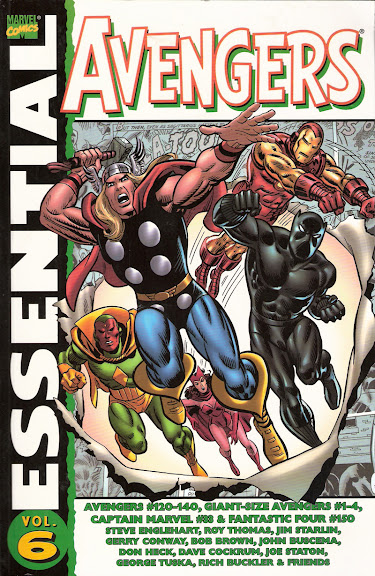 So I purchased Essential Avengers, v. 6, which included all four issues of Giant-Size Avengers. Avengers, v. 6, also has another distinction among Essentials that makes it, if not unique, then very unusual: the issues collected in this book make up one storyline. That is, Essential Avengers, v. 6, makes an acceptable alternative to the Celestial Madonna Saga trade paperback, and it gives almost a year’s worth of issues that precede Celestial Madonna and a half year’s worth that follow the storyline. For these extra issues, you sacrifice color, but that’s a small price to pay.
One would expect a story that features the “Celestial Madonna” to have a long-lasting effect on the Marvel Universe — or at least the Avengers. But the most important event is the marriage of the Scarlet Witch and Vision; admittedly, that’s a pretty important moment, but neither of them are the Celestial Madonna. That honor goes to Mantis, a Vietnamese orphan who is trained by pacifist Kree monks after her uncle kills her mother and blinds her father. As with most storylines that revolve around the birth of a child unconceived, there has been little to no payoff from Mantis’s role. Mostly, the Celestial Madonna story is a time war vs. Kang, who returns again and again to kidnap Mantis and mate with her.
Oh, Kang. It doesn’t take much to get bored with Kang in this volume, despite writer Steve Englehart’s efforts. Why? Because Kang is the master of time, and his answer on how to use this temporal advantage is to steal dead heroes and villains out of the time stream and bring them to Limbo. Why use dead people? Who knows? Since he gains mental control of his new warriors, he could choose anyone — he could even steal future or past versions of the Avengers out of the time stream, which would at least make it an even fight. But no, he decides to create his Legion of the Unliving, none of whom, strangely, had died in their personal timelines yet. Kang’s other gambit include superrobots, Avenger-powered superrobots, and invading the present from several different points of his personal timeline simultaneously. This last is, at least, a good use of his advantages, but since his other versions seemed to have invaded from his Girl Scout days, anyone can beat them.
Once you get past a baby that won’t be born until after the book ends and a Kang who literally cannot even beat himself in a fight (and how could he, since he was outnumbered by himself two to one?), what do you have? Well, Giant-Size Avengers #4 has one of the oddest endings of any Avengers story outside Avengers #200: a half-Vietnamese, half-German girl who always talks of herself in the third person marries an alien tree who’s taking the form of her dead boyfriend, which takes her into space and will later impregnate her with the universal Messiah. Meanwhile, in the background, a mutant marries an android in a double marriage ceremony officiated by the future version of the supervillain the team just defeated (who also does not seem to have any real credentials that would allow him to perform marriages).
I wish I could say there were other parts of the story that rose to those heights, but that’s it — it’s hard to get that strange consistently, but other than the Legion of the Unliving, Essential Avengers doesn’t consistently rise to any notable level of insanity, nor does it get that exciting. “Celestial Madonna” is not exactly a disappointment, but it’s not a seminal Avengers story, despite its memorable name. The romantic tangle between Vision, Scarlet Witch, Swordsman, and Mantis is predictably resolved. This volume is also notable for the beginning of Vision’s confusing backstory; his body is that of the World War II android the Human Torch, a revelation that utterly fails to be interesting. The Scarlet Witch has an odd subplot with developing her “magical powers.” The Avengers have no problem operating in South Vietnam, which is a bit disorienting, but the issue was published just before North Vietnam won the war and unified the country under Communist rule.
The material that precedes the Celestial Madonna story is interesting as a snapshot of early Bronze-Age Avengers. The stories feature Zodiac, the revelation of who the parents of the Scarlet Witch and Quicksilver are (later revealed as false), the marriage of Quicksilver and the Inhuman Crystal, and the bizarre beginning of the Scarlet Witch’s training in witchcraft by Agatha Harkess (based, apparently, solely on the Scarlet Witch’s name). A battle with Thanos is a distraction —Captain Marvel #33 includes literally three pages of dense recap on Thanos’s history, which isn’t conducive to narrative flow — that comes to nothing, especially since it doesn’t end Thanos’s story as definitively as it pretends. And what comes after the Celestial Madonna heads into space is interesting as well; the introduction of new members Beast and Moondragon gives the team exciting new dynamics, despite the return of the slappingest, insanest Avenger, Hank Pym.
The art in Essential Avengers, v. 6, is top notch. The Buscema brothers provide the plurality of the art, with Sal penciling more than his brother John. Other pencilers include George Tuska, Dave Cockrum, Bob Brown, Don Heck, Rich Buckler, and Tom Sutton — a distinguished roster that needs no praise from me, however much it deserves it.
Despite the many interesting parts of Essential Avengers, v. 6, I think the main appeal is getting all four Giant-Size Avengers issues in one volume. There are other attractions — and I have to emphasize, the book is drawn by a lot of great artists who do not clash in style — but Marvel’s Giant-Size line is sadly neglected in reprint form. Englehart fans will find much to enjoy, as will those who like comic-book weddings — three in one volume, none of whom are married today!
Oh, and those who enjoy the thought of alien plants having consensual sex with human women will also find this appealing. You know who you are.
Rating: 
 (3.5 of 5)
Labels: 2008 February, 3.5, Avengers, Bob Brown, Dave Cockrum, Don Heck, George Tuska, Gerry Conway, John Buscema, Mantis, Marvel, Rich Buckler, Roy Thomas, Sal Buscema, Steve Englehart, Tom Sutton, Vietnam
posted by Raoul | 4:17 PM
|
0 comments

 The first volume of Champions (Classic!) ended with the Stilt-Man fighting Black Goliath. Where I’m from, that spells awesome, but unfortunately, the Stilt-Man can’t even last one issue in the second volume. He’s barely even a distraction, and the Champions can’t even be bothered to take him out — he’s beaten up by third-stringer Black Goliath. (Such is Stilt-Man’s lot in life.)