


Essential Silver Surfer, v. 2
Collects: Silver Surfer (v. 2) # 1 and (v. 3) #1-18, Silver Surfer Annual #1, Epic Illustrated #1, and Marvel Fanfare #51 (1980, 1982, 1987-8, 1990)
Released: June 2007 (Marvel)
Format: 600 pages / black and white / $16.99 / ISBN: 9780785127000
What is this?: The Silver Surfer slips the surly bonds of earth and gets involved in interstellar war.
The culprits: Writers Stan Lee and Steve Englehart and artists Marshall Rogers, Joe Staton, Ron Lim, and others
I’m not a fan of the Silver Surfer. It’s not that I dislike the character, it’s just that I have the same problem with him that many people have with Superman: he’s dull, nigh indestructible (without raising the stakes ridiculously high), and a bit too much of a goody two-shoes.58
So why did I buy Essential Silver Surfer, v. 2? Mostly because I picked it up for $3 or $4. But also partially because it was an unusual choice to be made into an Essential in the first place. It’s not a legendary run. The issues included aren’t from the Silver Age, nor are they some Bronze Age genre mashup or weirdness. It isn’t yet another volume of a title that started in the Silver Age. It doesn’t feature a female lead. And it doesn’t star mutants, which accounts for most of the more modern series. There just aren’t that many Essentials that don’t meet those standards: Punisher, Moon Knight, Nova … Power Man, if you don’t consider Blaxploitation a genre, plus the reference books.
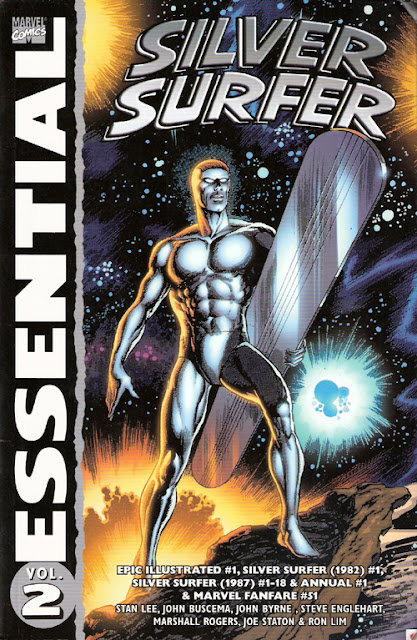 Is Silver Surfer something different, though? The Surfer is a Silver Age construct, and arguably by the mid-‘80s, he was the least changed from his Silver Age roots of any of Marvel’s major characters, given his inflexible personality and his status as the near-exclusive domain of Stan Lee.
Stan is the writer for the first two stories in this book. The first, a rather forgettable short from Epic Illustrated #1, has the Surfer confronting the concept that there are some answers beyond himself and his master, Galactus. The second, a 1982 one-shot drawn by John Byrne, pits the Silver Surfer against his incongruous archenemy, Mephisto — because what’s a more appropriate opposite for a cosmic-powered servitor of a planet predator than the Devil? It advances the Surfer’s story somewhat, but in the end, Lee puts all the pieces back where they started.
And then Steve Englehart takes over for the ongoing series, and everything changes. The Surfer is freed of Earth in a way that reads like Englehart wanted it done as quickly as possible so he and Marshall Rogers could go on to the space stuff. Then Shalla-Bal and Zenn-La are dealt with, zip zoom. Suddenly, Silver Surfer becomes Marvel’s first cosmic title in a long time, dealing with the Kree, the Skrulls, Galactus and his herald Nova, and the Elders of the Universe.
Once the book stops being about the Silver Surfer, it gets a lot more interesting. Or, I suppose I should say, it gets more interesting when the book stops being solely about the Silver Surfer and concentrates on the opportunities outer space gives the book. There is a large part of the Marvel Universe that can be settings for interesting stories, and whether that’s San Francisco, Sydney, or Kree-Lar, any book that can take advantage of those creative vacuums is worth supporting.
Englehart picks up several loose threads and characters, from the disintegration of the Skrull Empire and the loss of the Skrulls’ shapeshifting powers to what the various Elders of the Universe, Celestial Madonnas, and Soul Gems are up to. The machinations of the Kree and Skrulls in the new Kree-Skrull war are interesting, and the war is allowed to escalate in background scenes that are nice cutaways from the main plot. The Elders of the Universe’s plan to kill Galactus is what drives most of the book, and while I can’t say I’m greatly interested in the Elders, I can’t deny they are a great set of adversaries for the Silver Surfer and are an interesting part of the cosmic side of the Marvel Universe. (Such high-power characters do lead to a lot of “not really dead” moments, but that’s comics, I suppose.)
As for the Silver Surfer, he becomes a completely different person once Shalla-Bal is written out of his love life. In his previous quarter century, he had shown little desire for romantic attachments, but in the space of a few issues, he manages to pick up two “loves”: Mantis and Nova (Galactus’s herald, not Richard Ryder). It seems so alien for him to be portrayed as amorous — I suppose it’s Englehart trying to grow the character from the spotless, emotionless paragon he previously was, but the change is a little swift. The Surfer seems surprisingly weak, as well; he’s captured and helpless three times, and none of those captors are beings who should have the power to capture him. (I mean, Cap’n Reptyl? Honestly.)
The final issue in Essential Silver Surfer, v. 2, Marvel Fanfare #51, is not in continuity; it’s the original #1 for Silver Surfer v. 3, with beautiful art from v. 1 artist John Buscema. It’s an interesting look at what Englehart originally had planned for the character; the escape from Earth in Silver Surfer v. 3 #1 seems even more last-minute than I expected, and the interaction with Mantis makes more sense after we see Englehart’s original plans.
Art from this book comes mainly from Marshall Rogers, who drew #1-10 and #12. I’m more familiar with his art from his run on Detective Comics in the ‘70s, so it’s a little jarring seeing Rogers’ work here. (He collaborated with Englehart on that run as well.) His Surfer is more rounded and streamlined than most artists’, reminding me of Kevin Maguire’s Surfer in Defenders: Indefensible. I’m also not a fan of his design of some of the lesser-known Elders — there’s little distinctive about the Runner, and the Obliterator looks more mentally handicapped than murderous or alien. There are also a few storytelling lapses where it’s difficult to distinguish what’s happening. On the other hand, Rogers does have a flair for Marvel’s more established aliens — his Celestials are imposing, if not quite Kirby-esque (the same goes for some of the huge alien machines), and I like his Skrulls, as Rogers is able to both vary the Skrull template and show emotion on Skrull faces.
Joe Staton does a few issues as well, excelling when the action is on Cap’n Reptyl’s ship: Reptyl is intimidating, and the background aliens in his crew are suitably alien. Ron Lim, in some of his first Marvel work, drew #15-8; it looks like Ron Lim work — especially the Elder called the Possessor, who seems the most Lim character in the book, even before Lim starts drawing him — and you probably already know how you feel about Lim’s art.
I didn’t especially expect to enjoy Essential Silver Surfer, v. 2, but I was pleasantly surprised. If you’ve ever been interested in what was happening in outer space beyond those ‘80s Fantastic Four and Avengers stories you’ve probably read, then you really should read this book.
Rating: 
Labels: 2007 June, 3, Elders, Galactus, Joe Staton, Mantis, Marshall Rogers, Marvel, Ron Lim, Silver Surfer, Steve Englehart
posted by Raoul | 3:02 PM
|
0 comments

 So I purchased
 (3.5 of 5)