Reviews of trade paperbacks of comic books (mostly Marvel), along with a few other semi-relevant comments / reviews.

21 September 2012

Gotham City Sirens, v. 1: Union

Collects: Gotham City Sirens #1-7 (2009-10)

Released: April 2010 (DC)

Format: 176 pages / color / $19.99 / ISBN: 9781401225704

What is this?: Villainesses Harley Quinn and Poison Ivy move in with Catwoman; wackiness ensues.

The culprits: Writer Paul Dini (and Scott Lobdell) and artist Guillem March (and penciler David Lopez)


Writers and artists are not automatons. Their output varies in quality, quantity, and style, even when conditions seemed close to the ideal. For instance, sometimes when Paul Didn writes about Batman villains Harley Quinn and Poison Ivy, you get Batman: Mad Love, which many readers and critics love. And sometimes you get Gotham City Sirens, v. 1: Union.

Gotham City Sirens is ostensibly a comedy with wacky roommates — Batman villainesses Harley, Ivy, and Catwoman — or perhaps it’s a reality show without cameras. In any event, the three criminals move in together for almost nonexistent reasons and try to live noncriminal lives. Dini’s stories are action-oriented, with very little character development … or motivation, really.
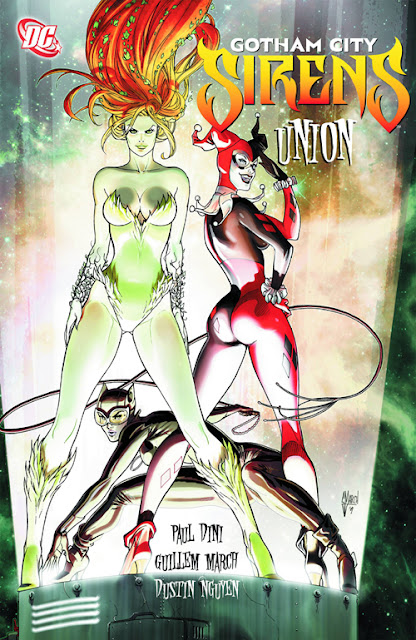
Gotham City Sirens, v. 1: Union coverThere are three interesting moments in Union:

1) The girlfriends of Batman, Catwoman and Talia al-Ghul, once met to figure out how to protect Batman’s secret ID.
2) Harley visits her dysfunctional family.
3) The Riddler, as a private investigator, takes a case.

The last is the best part of Union, taking up most of issue #3. That shouldn’t be a surprise; sometimes, when a creator revisits a character he or she had success with, you do get the same level of quality, and Riddler as a PI was my favorite part of Dini’s Batman: Detective. (Also my favorite thing done with the Riddler ever and my favorite little Batman idea.) Unfortunately for that theory, though, the writer for #3 is Scott Lobdell, but Lobdell does do a good job with Dini’s idea. In #3, Riddler teams up with the replacement Batman to solve some faked suicides; with Dick Grayson as Batman, it’s possible Riddler will outthink him. (Not likely, but possible.) Riddler narrates #3 with good but edged humor, and his rivalry with Batman adds a little spice to the team-up.

But it’s unsurprising that switching to a number of the book’s secondary cast is necessary to get a good story, as Dini seems unable to get much entertainment out of the relatively amiable main trio. Harley and Ivy try to drag Batman’s identity out of Catwoman early on, but after that, the three untrustworthy women are pretty chummy — somehow without even showing a spark of friendship that would make them interesting.

So unless you were hoping to see the return of Gagsworth A. Gagsworthy, the Joker’s Silver Age sidekick, or more of Hush forced to impersonate Bruce Wayne, there’s nothing here … and I wasn’t wanting to see either. I admit, there’s something to be said about contrasting Silver Age Joker with the more modern, psychotic version, but spreading “Gaggy’s” story over two issues is a waste of pages. As for Hush, I found it hard to discern his motivation, other than a near-pathological need to murder. If there was a hint he wanted to use Harley to escape his Bat captors, there might be something interesting.

Pander, young man, panderI wanted to start this review by saying something about breasts and (women’s) butts, but glancing through Union again, I decided artist Guillem March’s work wasn’t as full of cheesecake as I had originally thought. Oh, make no mistake: there’s a lot of art showing how shapely and well endowed Harley Quinn, Poison Ivy, and Catwoman are. But almost all artists draw them like that, and despite some questionable choices (Harley Quinn in Daisy Dukes? Really?), March saves his over-the-top work for Gotham City Sirens covers and one character in #3, an issue in which the three main pin-ups — sorry, characters — are mainly absent; March draws a bookstore clerk in a see-through mesh top, pleated microskirt, visible panties, and torn fishnets. Yes, the bookstore is The Heart of Poe — possibly more Goth-friendly than most — but I know pandering when I see it.

Other than how he draws women’s bodies — not to brush the topic aside — I liked March’s style. I can see the manga influence, especially in certain characters’ faces, but March has a heavier line and less androgyny than most manga I’ve read. The little manga-esque touches — the giant sweat droplets on Hush when he things Harley has found him out or the flower petals drifting past Harley and Hush in an intimate moment — are nicely matched with the book’s light tone. I also liked David Lopez’s fill-in work on #7: it had strong, expressive character work (although sometimes the expressions are a bit broad) and much less exploitative female drawings.

The book’s main appeal is the female form, and Dini doesn’t give a reason for Gotham City Sirens to exist beyond that. I’d buy a Riddler solo book, but given that his PI work seems to have been scrubbed by the New 52, there’s little chance of that. Union is Supervillain Team-Up with T&A, and that’s not worth reading.

Rating: Batman symbol (1 of 5)

Labels: , , , , , , , , , , , ,

13 July 2012

Batman: King Tut's Tomb

Collects: Brave and the Bold #164 and 171, Batman #353, and Batman Confidential #26-8 (1980, 1981, 1982, 2009)

Released: February 2010 (DC)

Format: 128 pages / color / $14.99 / ISBN: 9781401225773

What is this?: King Tut — last seen on Batman ’66 — is unleashed upon Gotham, and three ‘80s issues drawn by Jose Luis Garcia-Lopez are also included.

The culprits: Writers Nunzio DeFelippis, Christina Weir, Gerry Conway, and J.M. DeMatteis and artist Jose Luis Garcia-Lopez


The copy of Batman: King Tut’s Tomb that I have is an odd duck, and I’m not sure how it ended up in my hands.

What I have — and cannot find a record of anywhere online — is a hardback version of King Tut’s Tomb. Not only can I not find a record of the hardback, but I can’t find a reason for it to exist. King Tut’s Tomb reprints a three-issue storyline from Batman Confidential, a second-tier Bat-title from before the New 52 reboot that I was only vaguely aware existed. (In some places on the Web, King Tut’s Tomb is listed as Batman Confidential, v. 6.) Three issues is not enough to fill a hardback (or even a trade paperback), of course, so the book also contains two issues of Brave and the Bold and one issue of Batman from thirty years ago. One has a tenuous plot connection to the main Batman Confidential story; the other two have none. The real connection is that all six issues were penciled by Jose Luis Garcia-Lozpez.

Batman: King Tut’s Tomb coverIs Garcia-Lopez’s reputation strong enough to base an entire book off of? If so, I would expect his name in the title. On the other hand, this is part of the reprint series for Batman Confidential … but the words Batman Confidential show up only in tiny print in the indicia. The relatively obscure stories filling out the book make me think DC’s reprint editors were casting about desperately for something to bring up the page count, but if that’s the case, why reprint a secondary title in hardback when half the book is almost random? I mean — not that I’m complaining — Birds of Preycan’t get a hardcover, and that’s a title with an identity and a fan base.

Oh, well. It’s only slightly less strange if it’s a trade. A corporate decision, most likely, in both senses of the word.

What Birds of Prey did not have, however, was an artist as good as Garcia-Lopez. Thirty years is a long time in the life of an artist, and Garcia-Lopez’s style has definitely shifted. In the ‘80s stories, Garcia-Lopez’s art is very much in the style of Jim Aparo, whom he was filling in for on Brave and the Bold: a lithe but powerful Batman in a world of clear, solid lines. Even in Gotham and outer space, Batman’s world is bright and appealing. Though I have no nostalgia for that era, Garcia-Lopez’s art is comfortingly familiar.

In the Batman Confidential stories, Garcia-Lopez’s pencils are updated, modern — more Jim Lee than Jim Aparo. Batman is muscular and not as flexible, the backgrounds are busier, the cheesecake more plentiful. The panels are larger, with the occasional splash page. There is little to distinguish Garcia-Lopez’s modern style from a dozen others, except that his storytelling is superior. Present or past, there is little doubt what is supposed to be happening in the story. The older layouts, with more panels, are clear, but Garcia-Lopez knows how to tell a story even with the emphasis on flash. It explains why he has been getting work for 30 years.

It’s a shame the stories aren’t better, thought. The eponymous Batman Confidential stories have about two issues worth of interest dropped into three issues. Writers Nunzio DeFilippis and Christina Weir finally bring King Tut, an Egyptological-centered villain, from the ‘60s Batman TV show to the comics, an event that someone was probably waiting for. (Maybe.) It's the standard tale of presumed reincarnation and insane, petty revenges, and it’s not that interesting. But King Tut uses riddles related to the Hymn of Aten (an ancient song dedicated to Aten, an Egyptian god), which leads to the Riddler’s involvement in the case. The interaction between Batman and the Riddler is fun to watch, despite my nagging concern of where this fits in the Riddler’s history, since he was a semi-legitimate PI the last I had seen of him. However, the total of their intelligences is less than the sum of its parts. Riddler blunders into death traps, Batman is forced to rely on Riddler for information the plot would usually require him to remember himself — that sort of thing.

The ‘80s issues are a mixed bag. The two Brave and the Bold stories are quite forgettable, and by next week I’ll probably deny ever having read them. Batman teams with Hawkman in #164 to protect King Tut’s treasures, but aliens steal the entire museum to get back a pair of their artifacts. It’s a wacky, cosmic mix-up with a “cosmic hole” and possessions by alien spirits, but of course writer J.M DeMatteis ends it satisfactorily and forgettably. Writer Gerry Conway uses Professor Carter Nichols and his time-traveling hypnotism to send Batman back to the Civil War in #171, in which he meets a famous Union nurse and Scalphunter. A few moments of visceral satisfaction — Batman reconstructing the jaws of a few Rebels — can’t compensate for how boring the story is, especially since I have no idea why I should care about Scalphunter. (The character is named that only on the cover; in the story, he’s Ke-Woh-No-Tay.)

Conway’s Batman #353 is probably the best single issue in the collection, with Garcia-Lopez’s long-chinned Joker stealing the show. Conway writes the Joker as murderous and egomaniacal, and he almost wins … what more can you ask for in a Joker story? There's a subplot about Boss Rupert Throne getting back into Gotham politics, which was probably very exciting back in 1982 but serves only as a distraction in this collection.

So I still don’t understand why my local library has this in hardback. (Special library edition? There’s no indication that one was published, but who knows.) On its own merits, this isn’t a bad collection, although given the shift in styles, Garcia-Lopez’s art is not strong enough to unify King Tut’s Tomb despite its quality. The stories are mostly mediocre if inoffensive. For all you Jose Luis Garcia-Lopez fans, you’re in luck; for all you fans of Batman Confidential, you kinda get shafted. For the rest of us, this book is a big shrug.

Rating: Batman symbol Batman symbol (2 of 5)

Labels: , , , , , , , , , , , ,

27 January 2009

Batman: Detective

Collects: Detective Comics #821-6 (2006-7)

Released: March 2007 (DC)

Format: 144 pages / color / $14.99 / ISBN: 9781401212391

What is this?: Batman battles the predators and freaks in Gotham.

The culprits: Writer Paul Dini and pencillers Don Kramer, John H. Williams III, Joe Benitez, and Marcos Marz

I don’t keep up with DC continuity very much, despite a fondness for Batman. The impression I have received, hearing stories of Batman: RIP, the Battle for the Cowl, and Crises of various finalities and finiteness, is that if you aren’t into a DC in a major way, reading bits and pieces is not going to be productive. To be fair, those who don’t read Marvel regularly might get the same idea about its annual mega-crossovers.

But it obviously doesn’t have to be that way. The most popular characters — the evergreen ones, the ones that stay at the top of the comics world for years — don’t need events to drive their sales. Batman, Spider-Man, the Avengers, Superman … the concepts are probably strong enough to support an audience, if the audience gets good stories. Even if those stories are a bit repetitive, they still have appeal; Kurt Busiek’s Untold Tales of Spider-Man didn’t break much new ground from a storytelling standpoint, but they’re entertaining because they simply tell a story about a character we already enjoy.

Batman: Detective coverThat’s what writer Paul Dini does in Batman: Detective. There are no surprising revelations. There are no events. There’s Batman (and Robin) beating the snot out of Gotham’s criminals, (mostly) new and old.

For the most part, the criminals are newcomers or smalltimers who haven’t earned a place in Batman’s rogue’s gallery. Dini still keeps some of those classic villains involved — Poison Ivy is stalked by her victims, the Riddler and Penguin seemingly reform — while telling these detective stories. At times, these stories seem to suffer from the time given to the rogues; the first couple of stories seem a little undeveloped as mysteries, while the Poison Ivy and Joker stories seem to need a little extra development. That doesn’t take away from their enjoyment, but it should cause comment in a book titled Batman: Detective.

Dini, a writer, producer and editor for Batman: The Animated Series, does impressive work with the old villains. The reformations of the Riddler and Penguin make sense, and each works with their characters, if not necessarily with their gimmick. (There are surprisingly few legitimate lines of work for a man with the Penguin’s schtick, unless you count his deformations.) The highlight of the book is the final story, in which the Joker captures Robin and torments him by killing innocent bystanders. I could almost hear Mark Hamill’s voice from the animated series laughing throughout the story.

Despite the multiple artists, the art is of high quality. Don Kramer does half the book and does a great job, although perhaps a little smooth for the gritty nighttime underworld Batman inhabits. Still, he tells the story well. John H. Williams, who drew Detective Comics #821, might have a style better suited for the character, but his work is marred by some monochrome coloring; it’s not as bad as what they tried with Detecive Comics a decade ago, but it doesn’t help. Marcos Marz’s pencils (#825) are given the look of a painted style, which works well for a story featuring the perpetually on fire Dr. Phosphorus — the artistic highlight of a book with consistently good art. That story was written by Royal McGraw, although the story doesn’t match the distinctiveness of the art.

Joe Benitez, who drew #823, is a little cheesecake for my taste, enjoying drawing Ivy as a long-limbed, voluptuous lady. This isn’t unusual in comics, true, but it clashes with the tone of the rest of the TPB, especially a full-page Poison Ivy clad in the remains of an Arkham jumpsuit that has been strategically torn to ribbons without revealing anything that would give the Comics Code a coronary. I can’t deny he draws a good Batman, though I don’t care for his juvenile-looking Robin. (Especially given Kramer’s much more mature and appealing Robin in #826.) In another book, Benitez’s work would go unremarked or draw praise, I must admit.

If you just want a straight Batman story — something in short supply, given the last year or two of Batman under Grant Morrison’s control — this will serve the purpose admirably.

Rating: Batman symbol Batman symbol Batman symbol Batman symbol (3.5 of 5)

Labels: , , , , , , , , , , , ,