


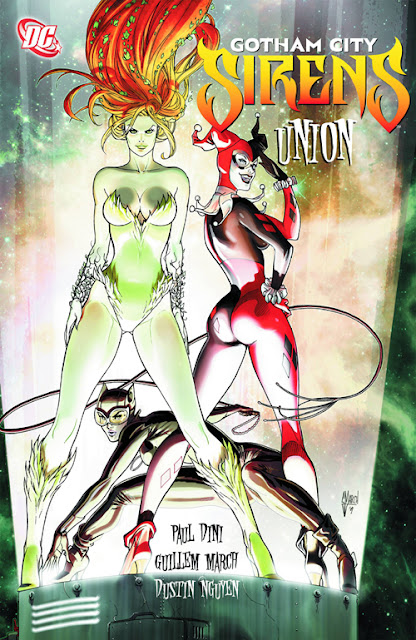
Gotham City Sirens, v. 1: Union
Collects: Gotham City Sirens #1-7 (2009-10)
Released: April 2010 (DC)
Format: 176 pages / color / $19.99 / ISBN: 9781401225704
What is this?: Villainesses Harley Quinn and Poison Ivy move in with Catwoman; wackiness ensues.
The culprits: Writer Paul Dini (and Scott Lobdell) and artist Guillem March (and penciler David Lopez)
Writers and artists are not automatons. Their output varies in quality, quantity, and style, even when conditions seemed close to the ideal. For instance, sometimes when Paul Didn writes about Batman villains Harley Quinn and Poison Ivy, you get Batman: Mad Love, which many readers and critics love. And sometimes you get Gotham City Sirens, v. 1: Union.
Gotham City Sirens is ostensibly a comedy with wacky roommates — Batman villainesses Harley, Ivy, and Catwoman — or perhaps it’s a reality show without cameras. In any event, the three criminals move in together for almost nonexistent reasons and try to live noncriminal lives. Dini’s stories are action-oriented, with very little character development … or motivation, really.
 There are three interesting moments in Union:
1) The girlfriends of Batman, Catwoman and Talia al-Ghul, once met to figure out how to protect Batman’s secret ID.
2) Harley visits her dysfunctional family.
3) The Riddler, as a private investigator, takes a case.
The last is the best part of Union, taking up most of issue #3. That shouldn’t be a surprise; sometimes, when a creator revisits a character he or she had success with, you do get the same level of quality, and Riddler as a PI was my favorite part of Dini’s Batman: Detective. (Also my favorite thing done with the Riddler ever and my favorite little Batman idea.) Unfortunately for that theory, though, the writer for #3 is Scott Lobdell, but Lobdell does do a good job with Dini’s idea. In #3, Riddler teams up with the replacement Batman to solve some faked suicides; with Dick Grayson as Batman, it’s possible Riddler will outthink him. (Not likely, but possible.) Riddler narrates #3 with good but edged humor, and his rivalry with Batman adds a little spice to the team-up.
But it’s unsurprising that switching to a number of the book’s secondary cast is necessary to get a good story, as Dini seems unable to get much entertainment out of the relatively amiable main trio. Harley and Ivy try to drag Batman’s identity out of Catwoman early on, but after that, the three untrustworthy women are pretty chummy — somehow without even showing a spark of friendship that would make them interesting.
So unless you were hoping to see the return of Gagsworth A. Gagsworthy, the Joker’s Silver Age sidekick, or more of Hush forced to impersonate Bruce Wayne, there’s nothing here … and I wasn’t wanting to see either. I admit, there’s something to be said about contrasting Silver Age Joker with the more modern, psychotic version, but spreading “Gaggy’s” story over two issues is a waste of pages. As for Hush, I found it hard to discern his motivation, other than a near-pathological need to murder. If there was a hint he wanted to use Harley to escape his Bat captors, there might be something interesting.
 I wanted to start this review by saying something about breasts and (women’s) butts, but glancing through Union again, I decided artist Guillem March’s work wasn’t as full of cheesecake as I had originally thought. Oh, make no mistake: there’s a lot of art showing how shapely and well endowed Harley Quinn, Poison Ivy, and Catwoman are. But almost all artists draw them like that, and despite some questionable choices (Harley Quinn in Daisy Dukes? Really?), March saves his over-the-top work for Gotham City Sirens covers and one character in #3, an issue in which the three main pin-ups — sorry, characters — are mainly absent; March draws a bookstore clerk in a see-through mesh top, pleated microskirt, visible panties, and torn fishnets. Yes, the bookstore is The Heart of Poe — possibly more Goth-friendly than most — but I know pandering when I see it.
Other than how he draws women’s bodies — not to brush the topic aside — I liked March’s style. I can see the manga influence, especially in certain characters’ faces, but March has a heavier line and less androgyny than most manga I’ve read. The little manga-esque touches — the giant sweat droplets on Hush when he things Harley has found him out or the flower petals drifting past Harley and Hush in an intimate moment — are nicely matched with the book’s light tone. I also liked David Lopez’s fill-in work on #7: it had strong, expressive character work (although sometimes the expressions are a bit broad) and much less exploitative female drawings.
The book’s main appeal is the female form, and Dini doesn’t give a reason for Gotham City Sirens to exist beyond that. I’d buy a Riddler solo book, but given that his PI work seems to have been scrubbed by the New 52, there’s little chance of that. Union is Supervillain Team-Up with T&A, and that’s not worth reading.
Rating:
 (1 of 5)
Labels: 1, 2010 April, Catwoman, David Lopez, DC, Gotham City, Gotham City Sirens, Guillem March, Harley Quinn, Hush, Paul Dini, Poison Ivy, Riddler
posted by Raoul | 3:05 PM
|
0 comments

 The tone of Preludes is confusing. On one hand, you get the corny Silver-Age alliteration and exclamations that marks it as a silly throwback. On another, there’s Dodson’s eye candy, posing women in uncomfortable positions to accentuate the more salacious aspects of their bodies. And then, if you cover your eyes with both hands and look through the fingers, you occasionally get glimpses of panels that are reminiscent of the B:TAS style, reminding readers why they liked Harley in the first place. It makes it difficult to determine what Preludes is about.