


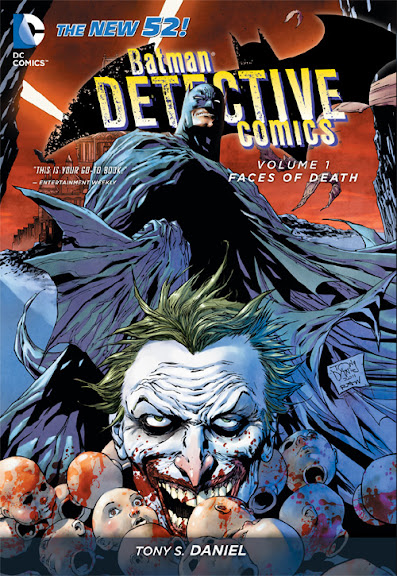
Batman: Detective Comics, v. 1: Faces of Death
Collects: Detective Comics #1-7 (2011-2)
Released: June 2012 (DC)
Format: 176 pages / color / $22.99 / ISBN: 9781401234669
What is this?: The Joker makes his New 52 debut, Batman battles the Dollmaker, and a Gotham heist shockingly has twists and double crosses.
The culprits: Tony S. Daniel
Continuing my brief tour through the New 52 is Batman: Detective Comics, v. 1: Faces of Death. Faces of Death contains two stories, both written and penciled by Tony S. Daniel: four-issue story featuring Joker and the Dollmaker, who cuts up and stitches together pieces of people to make masks and augment thugs, and a three-issue tale involving the Penguin, Batman’s girlfriend (or one of them), and a pair of lovers trying to make the criminal big time.
Of the two, the latter is superior. It’s a heist plot, not overly complicated; the Penguin opens his Iceberg Casino on the same night he cajoles new Gotham villains to deposit their money in his impenetrable vaults, and of course someone tries to rob that vault. As a crime tale, the story works well and has many elements that give it a noir shading without seeming clichéd: desperate criminal lovers in over their heads, a colorful cast, and a villainous plan that makes sense on its first read-through but fits together even better on a second read-through. It’s admirably short — three issues — and although I think it could have been wrapped up in two, the extra issue did allow Daniel to insert subplots and introduce other characters who may be important later.
 On the other hand, the story has extra complications that water down the story, all of them connected with Bruce’s girlfriend, television reporter Charlotte Rivers. Bruce says, “I like this one” in issue #1, which is intended to convey to readers that Charlotte is special but translates as “She’s my girlfriend in this storyline” to anyone who has read more than a handful of Batman stories. And of course liking her didn’t stop him from having sex with Catwoman on a rooftop in Catwoman #1. By the end of #6, though, Batman is willing to jeopardize his secret identity by crying out her name in front of a villain after she has been stabbed. Do I believe Batman cares so much about a woman he has been dating for a short time that he loses his professionalism and jeopardizes his mission? No. No, I don’t.
Some characters are overcomplicated by details that don’t add any emotional weight to the story. Charlotte and one of the robbers are twins who were separated at birth, their father is Gotham’s mayor, and the sisters have a covert but long-running stand-off. It doesn’t add anything to Charlotte or the robber twin’s characters. If Charlotte had discovered the heist because she’s good at her job and hungry for a scoop, she would seem a more impressive reporter; Daniel could have added depth to the robber’s character by giving her some other reason not to kill Charlotte. Their parentage could have been worked into other spots in the story — certainly Bruce Wayne dating the daughter of the mayor is big news, or someone might think it would be a big story if the public knew (it’s not stated whether Mayor Hady’s paternity has been acknowledged). Instead, readers get a complication they’ve seen frequently before.
One odd touch to the villainous twin’s crime spree is the mutilation of one of the victims. All the ones murdered are marked in a signature way, but one in particular is chopped into pieces and stuffed into a trunk full of ice. It seems out of character for such a professional villain, but it does echo the gore seen in the first story …
Which starts as a Joker vs. Batman story but morphs into a horror story, one rather less successful than the heist tale. In issue #1, Batman pursues and ends the Joker’s murder spree, one owing more than a little to The Dark Knight. The issue ends with a new villain, Dollmaker, cutting off the Joker’s face and spiriting him out of Arkham, the implication being that the Joker is either dead (ha!) or has a new face. In #2-4, Batman tracks down the Dollmaker, who cuts people and bodies apart, then puts them back in different configurations. He also has a sideline as an organ harvester.
The problem with the story is that it seems a bit too derivative. Following the Joker’s terrorism in #1, the story has a dead cop used as a decoy, sloppy police work that places cops in the villain’s trap, and corrupt officers. The villain catches Batman but declines to kill him, claiming the villains he is selling Batman to need to see him in action. Jim Gordon is captured, used as bait, and also is not killed, even though there’s no reason to keep him alive. Tried and true tropes, yes, but not exactly a way to distinguish Batman in the New 52. (Daniel does have Batman shrug off an anesthetic’s effect without an antidote or comment — that’s new, but it’s not good.)
From what I can tell, Daniel is writing a slightly different Batman than the other New 52 titles I’ve read. Daniel’s Batman is a humorless dick who is isolated from everyone except Alfred and Gordon. (He’s mostly humorless in Batman and Batman and Robin, but his interactions make him more human.) His dialogue is flat and forgettable. A little violence is necessary when it comes to Batman stories, but Daniel’s Batman seems to relish it a more than other versions: he thrashes one of Dollmaker’s thugs he has captured, trying to beat information out of him, and as a threat, he claims he has “broken” men. He gives Raju, the Penguin’s underling, a swirly, which seems less like a high school prank and more of an unhygienic waterboarding. This Batman is very violent; he may be a torturer. He’s also a two-timer, as I said before, making time with Catwoman as Batman (in other titles) and Charlotte as Bruce. Not very admirable, and I think less of this Batman than other versions.
One of Daniel’s successes is setting up subplots that actually feel like subplots rather than loose ends. Hugh Marder, owner of a tech company Bruce is buying, will eventually be important. Charlotte Rivers obviously has more of a story. Olivia Carr, a girl abducted by / collaborating with the Dollmaker, should show up again, although she might be dropped. Batman learns someone is stealing Wayne technology in the first story, and even though he doesn’t investigate that mystery in the second, it does feel important. An interesting enough backup, drawn by Szymon Kudranski, introduces Hugo Strange and his son in a story about a Catwoman heist. This certainly isn’t the old style of simmering subplots, but it is better than a lot of modern comics.
Daniel’s pencils are a mixed bag. It’s strong in Jim Lee-fu, pretty and bold and big. On the other hand, sometimes it misses on the details: for instance, Raju adds 50 pounds of fat between appearances, Hugh Marder loses 50 pounds of muscle, and a character whom Batman claims has had his tongue removed is shown, mouth open, with his tongue visible. Raju I recognized because he’s the only brown person of note in the story, but I didn’t figure out who Hugh was until the second read-through. (I’m sure the tongue was supposed to be a stump, but it doesn’t come across in the art. Since Daniel is the writer and penciler, it’s not like there’s miscommunication.) There are other strange artistic moments — Alfred’s eyes opening wider than the lifeless, staring eyes of the corpse two panels before, for instance — but you get the point. His designs need work. He never settles on a theme for Dollmaker’s henchmen — Jack in the Box and the monkey with cymbals suggest a toy motif, the naughty nurse for a doctor theme, and the mismatched flesh golems suggest a mad scientist. His new villain designs in the second story are amusing but not that original (except Mr. Combustible, who has a light bulb for a head), but they are probably meant to be throwaways.
Oh, someone should tell colorist Tomeu Morey that not everyone's nose is always a different color than the rest of his or her face.
While Faces of Death is competent and — in the second story, at least — occasionally more, it feels like a joyless exercise in putting out more Batman every month. And I’m not interested in that.
Rating:
 (2 of 5)
Labels: 2, 2012 June, DC, Detective Comics, Dollmaker, Gotham City, Joker, Penguin, Szymon Kudranski, Tomeu Morey, Tony S. Daniel
posted by Raoul | 1:32 PM
|
0 comments

 That’s what writer Paul Dini does in
  (3.5 of 5)
 “Soft Targets,” written by series co-writers Greg Rucka and Ed Brubaker, touches on one of the series’s central themes: how does the GCPD function competently against Batman’s villains when citizens expect their protection to come from Batman alone? Even some of the GCPD expect Batman to save them. How can they keep from being hopelessly overmatched by the Joker at the top of his game if the Bat doesn’t save them?