Reviews of trade paperbacks of comic books (mostly Marvel), along with a few other semi-relevant comments / reviews.

20 July 2012

X-Men Forever, v. 2: The Secret History of the Sentinels

Collects: X-Men Forever #6-10 (2009)

Released: March 2010 (Marvel)

Format: 120 pages / color / $16.99 / ISBN: 9780785136804

What is this?: Before they bury Wolverine, the X-Men dig deeper into the conspiracy against them and find Sentinels.

The culprits: Writer Chris Claremont and artists Paul Smith and Steve Scott


Whatever goodwill I had for X-Men Forever led me to buy X-Men Forever, v. 2: The Secret History of the Sentinels. After the newness of the concept of writer Chris Claremont’s elaborate What If? series (featuring the X-Men) wore off, what would be left?

The answer — as if you needed to be told — is writer Chris Claremont.

Claremont’s distinctive dialogue and cadences overwhelm everything else in Secret History. If this were a decade ago, when Claremont was returning the X-titles and this might do any good, an intervention would be in order, with his colleagues and editors showing him how his verbal tics and word balloons were hurting those around him. Given that an intervention is out of the question, Claremont needs someone to do something similar to what former Marvel editor Christopher Priest said his assistant, Maddie / Adam Blaustein, did with Peter David — winnow down his excesses while leaving the essential, appealing essence of the writer. Isn’t that what an editor is for? Perhaps not. In any event, it’s not worth the effort now; Claremont is who he is, his work is what it is, and almost everyone knows how he or she feels about that.

X-Men Forever, v. 2: The Secret History of the Sentinels coverFor those of you playing Claremont cliché bingo, using Secret History, I will serve as caller: Baseball. Vintage plane fetishism. X-Men cleaning up the wreckage of one of their fights. Obtrusive military slang. Danger Room malfunction. Bad accent (Gambit only, oddly, even though Nightcrawler and Cannonball are in this book). “Best at what I do” (non-Wolverine division). If you did not win, best of luck next time; I’m sure the “mind control” square on your card is certain to be covered next time.

The story involves the return of the Sentinels, as you would guess form the title. With Nick Fury part of the book’s cast, Claremont makes the dramatic choice to tie the Trask family, who created the Sentinels, to the Nazis. This seems unnecessary but ultimately harmless, but Claremont links a couple of other characters to World War II and the Fury’s old commando group: SHIELD agents Daisy Dugan and Tommy Juniper, the latter explicitly the great-nephew of Howler casualty Junior Juniper. If this were a SHIELD book, these generational links would be a great idea. But this isn’t a SHIELD book; it’s an X-Men book. And the X-Men are firmly tied to the beginning of Marvel’s ten-year (or twelve-year or fifteen-year) timeline. Delving into their past tends to lead into Xavier, Juggernaut, or Magneto stories, areas that have long since been overmined.

On the other hand, the X-Men do have one character with whom the theme of family does work: Cyclops, who ironically started as an orphan. The book’s most affecting scene is its final one, two pages of Cyclops flying to Alaska to visit his grandparents, father, and son in Alaska. Scott reuniting with his son, Nathan, and their interaction feels real and is touching because of that.

That last issue is the best in Secret History. In #10, the X-Men hold a funeral for Wolverine, who died all the way back in #1. It’s not a perfect issue, God knows — unrestrained by action, Claremont's word balloons overrun everything, like a sort of verbal kudzu. But given that the action in the rest of the book is nothing to remember, something different is welcome. The issue gives everyone a chance to take stock and reflect. The New Mutants, Excalibur, Fantastic Four, and an abbreviated Avengers team show up, as do various X-Men hangers-on and ex-X-Men. It feels like an important event without being too clichéd or overwrought; the funeral itself takes only two pages, with Cyclops giving the eulogy.

The rest of the volume is forgettable, at best. Issue #6 is an embarrassment of X-clichés, with the X-Men playing baseball among wreckage in the Danger Room, which as a matter of course malfunctions. The next three issues feature a battle against a Trask and her Sentinels, ending with a particularly anticlimactic fight that Jean Grey ends by throwing a tantrum.

The subplots are ignorable. Claremont tries to interest readers in a conspiracy vs. the X-Men, but it’s not working. “Continuum” is a dull name, there’s no hint of what exactly the group’s agenda or grief with the X-Men is, and revealing one of the conspiracy's heads is the newly introduced mother of another newly introduced character is underwhelming. The flashbacks — Logan teaming up with Fury’s Howling Commandos in World War II and Bolivar Trask showing his family his Sentinel works — are old hat and dull. The only interesting subplot involves the child Storm, who is trying to figure out what she is and where she should go; this actually gives Gambit a bit of relevance, since he serves as Storm’s hedonistic counsel against the moralistic X-Men. Forge and lil’ Storm’s reactions toward each other at Wolverine’s funeral is a nice touch.

The art is fine. Paul Smith draws #6 and #10, and he’s exactly the type of artist you’d expect Marvel to assign to Claremont’s nostalgia title. Smith worked with Claremont on Uncanny X-Men #165-70 and 172-5, including most of the issues from the classic X-Men: From the Ashes storyline. Smith’s art has changed over 30 years, of course, and at times it looks like it’s taken on some characteristics of fellow Claremont collaborator Rick Leonardi’s work. On the other hand, Steve Scott isn’t a classic Marvel artist, and the bulk of his work for the company comes on the Marvel Adventures line. He’s a good choice for that, as his line is clean and his characters are bright and attractive, easy to tell apart. It’s not a distinctive style, though, which might have been what Marvel was aiming for; if you’re reading Claremont in the 21st century, do you really want something to distract you from Claremont’s plot and words? No, you do not; Claremont’s the feature here.

Secret History isn’t bad; its sin is larger. This book is just not that interesting, and the greatest emotion it arouses in me is occasional annoyance. Some will feel the warm flush of nostalgia when they read Secret History, and there’s nothing wrong with that. I’m well insulated against that warmth, however, and I think most readers are as well.

Rating: X-Men symbol Half X-Men symbol (1.5 of 5)

Labels: , , , , , , , , , , , , , ,

23 April 2012

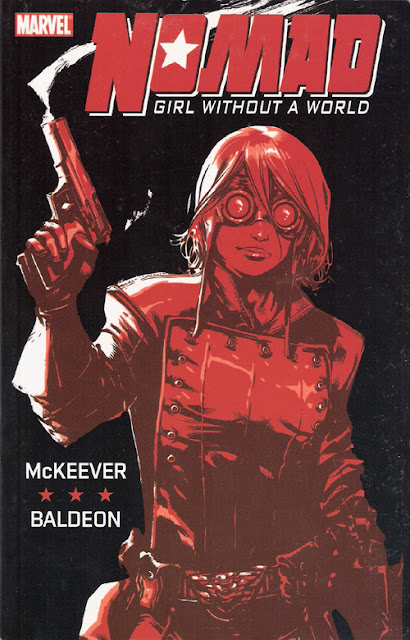
Nomad: Girl without a World

Collects: Nomad #1-4 and a story from Captain America #600 (2009-10)

Released: March 2010 (Marvel)

Format: pages / color / $14.99 / ISBN: 9780785144199

What is this?: Captain America’s sidekick from the Heroes Reborn universe tries to fit into the normal Marvel Universe

The culprits: Writer Sean McKeever and artist David Baldeon


I’ve discussed Marvel’s lack of success with series starring newer characters and the relentless use of the same old concepts by Marvel and DC. Sometimes, however, reusing old ideas can win a deserving new character a series (or miniseries) that otherwise wouldn’t be published.

Take, for instance, Nomad: Girl without a World. “Superhero’s sidekick from a parallel world” is not a concept that sets fans’ hearts afire. It’s a workable idea, but any time you have parallel worlds or alternate universes or possible futures, readers drift away.

Nomad: Girl without a World coverThe character of Bucky (Rikki Barnes) from the Heroes Reborn universe isn’t one fans were clamoring to see more of. But given the popularity of Captain America around the time of the original’s “death,” writer Sean McKeever was given a chance to tell what happens when an alternate version of Captain America’s sidekick tries to fit into an entirely different world, one where “her” Cap has died and been replaced.

Bucky, who becomes Nomad early in Girl without a World, is not a McKeever creation. (You can tell because she has nothing to do with Wisconsin.) Instead, she is a Rob Liefeld and Jeph Loeb character, created for a maligned mid-‘90s event. She is the definition of a throw-away character; no one would have complained if she had never been seen again. But McKeever does the responsible thing and recycles the character here and in Young Allies. And he manages to tell an interesting story, one that is well constructed and enjoyable. I actually cared about Rikki by the end of Nomad. I want to know what happened to her next — although given the quick cancellation of Young Allies, I may be alone in that desire.

McKeever tells a simple story — one I could imagine seeing in Spider-Girl, or given the throwback villains, Nova (v. 1). Something strange is happening in Rikki’s school, as students from different social strata band together to impose their version of order on the school in the name of a school presidential candidate. Rikki investigates and finds far more than she bargained for.

McKeever does a good job isolating Rikki throughout the book. Her only friend in this world is John Barnes, the counterpart of her brother from the Heroes Reborn world. When she reaches out to make friends in the superhero community she is either rebuffed, as Black Widow does when Rikki tries to talk to the new Cap, or she can't seem to capitalize on her meetings with friendlier heroes, like Patriot and Falcon. Like most teenagers, she feels separate from everyone else, and her alternate-world origins give her a better reason than most; when she is separated from John, she feels completely alone. Her mysterious benefactor, who gives her the Nomad costume, and the mental manipulations of Nomad’s villain makes her think the adult world she’s trying to fit into is making all her decisions for her. The conflict between Nomad’s teen world and the adult she finds herself fighting her way into makes a good parallel to the student activism and teen suffrage subplots in the background.

Needles to say, I think McKeever does a great job with teenage heroes, and I think it’s a shame Young Allies was cancelled so quickly.

Nomad is not without its faults, of course. Flagsmasher shows up as a random villain, and even the footnote listing his recent appearances seems to say he’s a bit overused — he’s fought the Runaways, the Liberteens (in Avengers: The Initiative), and Araña. (Issue numbers would have been nice.) I doubt if any of those used Flagsmasher as anything but a throwaway villain; they could have fought anyone. A more serious complaint is that the death at the end of the story feels gratuitous; it’s a death meant to give the story an emotional punch it didn’t need or to get the character of Rikki out of a plot-related bind. Still, these are small complaints.

I enjoyed David Baldeón’s artwork. Really, it’s everything I could ask for from an artist. The teen characters aren’t oversexualized — or sexualized at all, really. Characters are easily distinguishable, despite the similar, almost uniform, facial shape his characters have. Action scenes are dynamic and easy to follow. There’s nothing bizarre to distract the eye or mind from the story. Baldeón’s pencils aren’t flashy, but I love them.

For some reason, Marvel published the Nomad TPB at an odd size. It’s not the standard trade paperback size, and it’s not as small as a digest book. Nomad is similar to those teen titles that Marvel reprinted as digests in the early 21st century (Runaways, Araña, Spider-Girl, etc.), but for some reason, Marvel chose to reprint Nomad at 8¾ x 5¾ inches. Had Marvel abandoned the digest size by the time it published Nomad in March 2010? The last non-Marvel Adventures digest I can find is Thor and the Warriors Four, which was published in October 2010; two Runaways volumes were also published as digests between Nomad’s publication in March 2010 and Warriors Four. So if digests were on their way out, why not choose to print Nomad at full trade paperback size (10 1/8 x 6½ inches)? The smaller size might be cheaper, but it surely ensured Nomad was more easily lost in the shuffle. (Nomad was already out of print by the end of 2011.)

McKeever’s grasp of what it’s like to be a teen is excellent, and the story is simple but satisfying. Baldeón’s art is perfect for the story. It’s a great book, if you can find it.

Rating: 5 of 5 Captain America’s shield Captain America’s shield Captain America’s shield Captain America’s shield Captain America’s shield

Labels: , , , , , , ,

18 June 2010

Spider-Man: The Complete Clone Saga Epic, Book 1

Collects: Amazing Spider-Man #394, Spectacular Spider-Man #217, Spider-Man #51-3, Spider-Man Unlimited #7, Web of Spider-Man #117-9, Spider-Man: The Lost Years #1-3 (1994-5)

Released: March 2010 (Marvel)

Format: 424 pages / color / $34.99 / ISBN: 9780785144625

What is this?: Oh, the Clone Saga? You know, the ‘90s? Well, a duplicate Peter Parker, calling himself Ben Reilly, shows up.

The culprits: Many, many people, including writers Tom DeFalco, Howard Mackie, and J.M. DeMatteis and artists John Romita Jr., Steven Butler, Sal Buscema (really?), and Tom Lyle

When I first saw Spider-Man: The Complete Clone Saga Epic, Book 1 in the solicitations, I thought, “Man, what a waste — who’s going to want to buy that?” Because as everyone reading comics in the ‘90s remembers, the Clone Saga was Marvel’s biggest misstep of the decade, and that’s competing against some intensely stiff competition: Onslaught, The Crossing, Marvel’s bankruptcy. … What I’m trying to say is that the ‘90s were a crappy decade for the company, and the Clone Saga was the crap cherry on top of the crap sundae — the crap de resistance, if you will. But Marvel, always trying to put a little polish on that turd, has labeled the story both a “Saga” and an “Epic.”

So of course a few months after its release, I’m reading Book 1 of the Clone Saga. In my defense, I can say it’s a hell of a bargain after an Amazon discount — that’s a lot of story for $23 and change. Of course, it’s the quality of the story that matters.

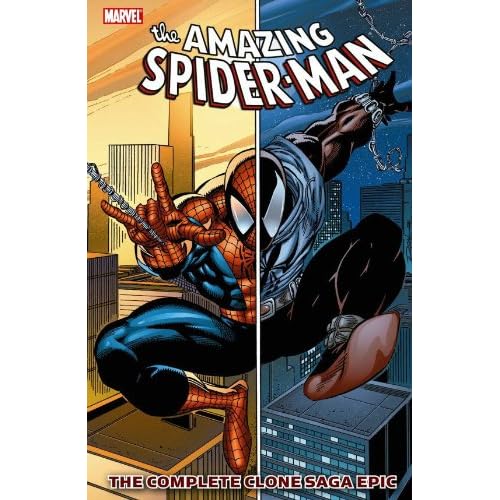
Spider-Man: The Complete Clone Saga Epic, Book 1 coverTo be fair, the beginning of the Clone Saga was never what was at issue. Marvel has decided to tell the story in the order it takes place in the life of Spider-Man’s clone (Ben Reilly). This is an odd decision but a defensible one; rather than reading the stories as they were originally issued, Marvel is trying to tell a coherent story with the reprint.

That may be trouble later on, but for now, the backup stories telling about the clone’s awakening (from about Amazing Spider-Man #149 or so) are presented at the beginning rather than interspersed among the first real crossover of the Clone Saga. So much to the good; on the other hand, that means the Spider-Man: The Lost Years miniseries is presented next, which was written when the clone thought he was the original Peter Parker. This means there are several confusing references to Ben being the real Spider-Man when the story has him still as the clone (and that’s how he’ll end the Saga). There aren’t any footnotes or explanations, so it seems Marvel will trust everyone to stay calm and carry on.

The story begins in earnest when Peter (and Ben’s) Aunt May has a spell and has to be hospitalized. Ben rushes back to New York, the identical pair clash with each other, they find other enemies to fight. Peter has, at this point in the storyline, become a deranged ass, unhinged by the Chameleon passing a pair of robotic duplicates off as Peter’s dead parents. He calls himself “the Spider,” avoids May and Mary Jane, and generally is unpleasant and violent. (Thankfully, there’s a text page that describes all this.) It’s a great way to make Ben the sympathetic one, as Peter assumes Ben is there to replace him. But at this point these are still supposed to be Peter’s books, so making him unsympathetic is a risk — some would say stupid.

The stories themselves are unremarkable. The backups that introduce the clone, written by J.M. DeMatteis, are forgettable. The “Power and Responsibility” crossover, in which Ben made his debut, features Judas Traveller as the villain — the less said about Traveller, a ‘90s kind of villain with vague mental powers, ambiguous goals, and weird, slightly multicultural minions, the better. The whole Spider-writing staff — Terry Kavanagh, DeMatteis, Howard Mackie, and Tom DeFalco — grabs an issue each; each has done better work elsewhere (well, maybe not Mackie). The story that rounds out the collection has Ben choosing Venom as his first villain to fight, taking offense with Peter’s peace treaty with the villain. The choice is logical, and Mackie and Kavanagh establish Ben as having Peter’s moral code while putting a few new trappings on the character, but the issue is muddled with a second symbiote wandering around and a Bugle reporter trying to ride superheroes to the top of his profession.

The Lost Years miniseries is a bit of a standout, though; a younger Ben finds love in Salt Lake City, managing to eschew full-blown superheroics while still trying to do right. The story is as much about Kaine, another Spider-clone who is embittered by being an earlier, imperfect attempt at cloning; he too thinks he’s found love, only to find it being as imperfect as he is. DeMatteis manages to make parallels between the two clones without bashing the reader over the head and write a decent crime story. As DeMatteis writes in the afterword, the Lost Years setup — essentially Spider-Man stories without the Spider-Man, set around the world — seems like a gold mine of stories.

Kaine by John Romita Jr. in The Lost YearsThe Lost Years is also the winner in the art department. I’m not a big John Romita, Jr. fan, but his work for the miniseries is excellent — it is, by far, my favorite work of his post-‘80s portfolio. Credit has to be given to inker Klaus Janson and colorist Christie Steele; the pair give Romita’s art a gritty, washed-out look appropriate for a crime story set in a rainy city.

The rest of the volume mostly manages to avoid the crossover syndrome, except for “Power and Responsibility.” Still, most of it is forgettable ‘90s art. Exceptions are Sal Buscema, whose work I love dearly but is clearly miscast for this story, and Tom Lyle, who manages to give Ben a lithe and powerful Mark Bagley-esque look in his issues. On the other hand, his original design for Kaine is hideous in a very ‘90s way and in no way captures the menace that Romita gives him in The Lost Years. Liam Sharpe draws an empty-eyed series of backups, but he’s drawing unformed clones, so empty-eyed is appropriate.

Kaine by Tom Lyle in Spider-Man #53Marvel has done some very good things here. The ordering of the issues is probably the best choice, as mentioned. The text page setting up the clone’s introductory crossover is much appreciated. The book also includes numerous fragments from many Spider-titles leading up to the initial crossover in which someone is rushing to New York to see May; Marvel wisely didn’t claim the book reprinted the comics the fragments came from. The afterword from J.M. DeMatteis (reprinted from the 1996 TPB of The Lost Years) is more vital than the usual nattering of a writer or artist; this is a disaster in the making, and it’s useful for readers to get a sense of how things started to fall apart.

I had a thought, while writing this review, that wanting to read this book not out of morbid curiosity or completionism — that you sincerely have a desire to read a Spider-Man story from an era that doesn’t get reprinted much — is a mark of a real Spider-Man fan. Not necessarily a better Spider-Man fan, since “real” fans can also disdain what they are pretty sure is going to be a steaming pile of Rhino scat. But someone could put that forward as part of their Spider-Fan bona fides.

Book 1 isn’t as bad as the Clone Saga is supposed to be. (Is it really that bad? Well, Book 2 is out, Book 3 has been solicited for August, and Book 4 already has a (possibly bogus) page on Amazon. (Reading the description for that last one makes me think that one’s going to be awful — and there will still be about a year of the Clone Saga to reprint. That’s one to send shivers up your spine.) But is Book 1 compelling? As a story, no. As a ‘90s artifact? Probably. As part of the anatomy of a disaster? Oh, yes — such a lackluster start to a major event doesn’t bode well.

Rating: Spider-Man symbol Spider-Man symbol (2 of 5)

Labels: , , , , , , , , , , , , , ,

07 May 2010

Runaways (v. 11): Homeschooling

Collects: Runaways v. 3 #11-4, What If the Runaways Became the Young Avengers? backups in five What If? stories (2009)

Released: March 2010 (Marvel)

Format: 136 pages / color / $14.99 / ISBN: 9780785140399

What is this?: The Runaways’ house is hit by a UFO, and Chase is reunited with his dead uncle.

The culprits: Kathryn Immonen (writer) and Sara Pichelli (artist) for the Runaways; C.B. Cebulski (writer) and Patrick Spaziante (penciler) for What If?

So my review of Runaways: Homeschooling was supposed to be written a few weeks ago, but writing the book took up a lot of time, and then my wife suggested we go to Harrisburg, Pa., to see Stephen Strasburg, the #1 draft pick in last year’s baseball draft, pitch for the AA Harrisburg Senators. That didn’t work out so well; rain delayed the game for two hours, and then Strasburg pitched only 2 1/3 innings before another rain delay forced him from the game. Big disappointment, and we didn’t get home until 5 in the morning.

So, as an awkward segue: Is Homeschooling, the latest volume about the team of unwilling teen superheroes, a disappointment as well?

Runaways: Homeschooling coverOn one hand, it would be hard to be a big a disappointment as Terry Moore and Humberto Ramos’s Dead Wrong, which left such a sour taste in my mouth that I skipped the next volume, Rock Zombies. (Thinly veiled Howard Stern with mind-control powers? Dear God no.) Writer Kathryn Immonen and artist Sara Pichelli definitely put together something better than Dead Wrong here. On the other hand, it’s definitely not up to Brian K. Vaughn’s run, but no one could expect that anyway.

Immonen seems to be able to get the characters right but not, particularly, the larger picture. The dialogue sounds right, as does the team’s floundering in a crisis situation. Molly seems to be a particular favorite for the writer, or maybe she’s just fun to write; she gets the best lines and the clearest moral sense. In particular, the dialogue between Chase and Molly about their transportation, the new Leap Frog, brought a smile to my face as well.

However, the plot takes weird turns. I don’t believe that Karolina’s grief over her lost girlfriend would cause her to a) want a prom or b) throw herself at a guy; I also don’t believe in Nico’s semi-random hookup. And the character death in the book was completely random — a unmanned drone accidentally dropping on a house will seem random no matter how well it’s set up, and this isn’t all that well set up. I’m also not sure I followed some of Nico’s spells, despite not having any trouble in previous books. (“Mood ring”? What did that do?)

On the other hand, Immonen introduces Chase’s uncle, Hunter. He’s a high-tech genius like Chase’s father, although intriguingly successful without being overtly supervilainous. And reintroducing family — especially family that Chase thinks is dead — brings up interesting character areas: do the Runaways trust Hunter because he’s family, or do they distrust him because he’s an adult? Does this alleviate any of Chase’s guilt? Is Hunter evil like Chase’s dad or relatively good-hearted like Chase? How is he still alive? Is he really Hunter, or is he an imposter, as Chase suggests at the beginning? Not all of these have to be answered, but some of them should. None are, not even partially. Instead, we get Hunter showing us how incompetent the kids are — even the tech-savvy Victor.

But like I said, it’s at least intriguing, and combined with Immonen’s command of the dialogue and characters, intriguing enough to cover for the odd twists of the plot. (Mostly.) But the story ends with a triple cliffhanger — just before the series was cancelled. The last issue came out fall 2009, and here we are in May 2010 … I understand Immonen probably had ideas of how to continue the story, but I don’t think she (or anyone else) will. Which makes Homeschooling, for plot purposes, useless.

I’m not a big fan of Pichelli’s artwork. This is personal preference, in part; the more overtly manga-influenced artists usually aren’t my cup of tea, especially when the characters seem to be embarrassed or dirty-nosed in nearly every panel. (Or perhaps careless with rouge.) In a practical sense, Pichelli seems to have made a conscious decision to make the teenagers have little personal space between them, especially Nico and Karolina. I can’t decide whether that’s a good idea; I suppose it mainly hinges on whether Karolina’s acting on her attraction to Nico. The storytelling #13 seem a bit muddled as well; from the destruction of the house and Nico’s “Abraham Lincoln” spell and the secret chambers, I had trouble telling exactly what was going on and where everything was supposed to be happening. Still, I have to reiterate: my opinion on Pichelli’s are is, even more than usual, personal preference.

What If the Runaways Became the Young Avengers? ran as a backup in several What If? issues released around the end of 2008, and I have to admit that C.B. Cebulski and Patrick Spaziante’s story doesn’t read like it had been broken up into five uneasy pieces for another “What If?” event. It also isn’t all that interesting, though; it’s mainly interesting if you had a hankering to see what Molly would look like a teenager. (Why is she a teenager? I don’t know.)

Like when Joss Whedon or Moore took over Runaways, I had high hopes for an Immonen run. There wasn’t a run, though, and this single volume isn’t really worth a look.

Rating: Marvel symbol Half Marvel symbol (1.5 of 5)

Labels: , , , , , , ,

10 April 2010

Dark Avengers: Ares

Collects: Ares: God of War #1-5, Dark Avengers: Ares #1-3 (2006, 2009-10)

Released: March 2010 (Marvel)

Format: 192 pages / color / $24.99 / ISBN: 9780785144069

What is this?: In Ares, the God of War’s son is kidnapped by the Japanese god of death, and Ares and the Olympians fight to get him back (and for their lives); in Dark Avengers: Ares, Norman Osborn asks Ares to train an elite cadre.

The culprits: Michael Avon Oeming and Travel Foreman for Ares, Kieron Gillen and Manuel Garcia for Dark Avengers: Ares

Dark Avengers: Ares is an odd collection.

The reason for its publication is the recent Dark Avengers: Ares miniseries. At three issues, it isn’t long enough to support a trade paperback by itself. This gave Marvel three options:

  1. Add in an older reprint or two, such as Thor #129, Ares’s first Marvel appearance;
  2. Add other Dark Avengers material; or
  3. Add more recent Ares material.

Dark Avengers: Ares coverObviously, the third option is what Marvel chose, an interesting choice because the Michael Avon Oeming / Travel Foreman Ares: God of War miniseries had been reprinted about 3 ½ years ago. Admittedly, it is out of print, but there are plenty of stories Marvel doesn’t bother keeping in print, so I’m not sure why that miniseries rated special treatment. Because the other options weren’t as appealing as keeping Oeming happy, I suppose. On the other hand, Amazon lists the first option as the book’s content.

Anyway. My comments about God of War — a whole lot of fighting that isn’t as interesting as the first few pages, with Ares and his son in the real world — still stand, and there’s no purpose going over them again. But what about the new material?

In the Marvel Universe, Norman Osborn is running HAMMER, a replacement for SHIELD, and he gets the amusing idea to have Ares mold an elite fighting unit. So Ares picks out four HAMMER soldiers and has a go at it … starting with shooting at them. The first lesson he teaches them ends with them tossing grenades at him. This is not a kindly, cuddly group, and Ares is not R. Lee Ermey, using words as weapons. Ares always uses weapons as weapons.

The plot is short, filling the final two issues of the mini (after one issue of setup). Hera tells Ares his son is being held in an abandoned SHIELD base; Ares leads his men in, assuming the son is Alexander, from the Oeming / Foreman mini. Instead, it’s another, demonic-looking son, resurrected from Hades by Hera to take his father’s place. Writer Kieron Gillen gets major points for re-using a real but obscure story from Greek myth in addition to some better-known tales as details for this story. It gives a real feeling of Ares being part of an old story carried into modern times. (I’m not sure why that is and why it doesn’t feel like some Silver-Age shoehorning. But it does.)

It’s an enjoyable but violent read. Gillen spreads the almost gleeful fighting throughout the books, and he has a real feel for his characters — all of whom are a bit psychopathic, although none of them can touch Ares himself. Gillen also manages to get across Ares’s mercurial nature: none of his soldiers can ever be sure whether they are going to suffer physical retribution for a comment or action, but there’s no doubt Ares is trying to teach something with his strange methods.

Despite Manuel Garcia’s many credits, this is the first thing I’ve seen from him other than his pencils from Wisdom: Rudiments of Wisdom. I liked that work quite a bit, but for this series, Garcia has a darker, scratchier style. (Different inkers, perhaps?) It fits the dark and dirty tone of the series, but sometimes it makes it difficult to tell the human protagonists apart. Also, this sort of style makes everyone look like they have scars; in this case, they probably do, but it’s difficult to tell the scars from the stylistic marks. In any case, I had no trouble following the action (other than the aforementioned resemblance between characters), and I really like the skeletons in Hydra uniforms visuals.

The Dark Avengers: Ares series if fun, brutal, and short, like the best of human lives. It certainly elevates the material from God of War, which is mainly brutal.

Rating: Marvel symbol Marvel symbol Marvel symbol (3 of 5)

Labels: , , , , , , ,