Reviews of trade paperbacks of comic books (mostly Marvel), along with a few other semi-relevant comments / reviews.

10 April 2010

Dark Avengers: Ares

Collects: Ares: God of War #1-5, Dark Avengers: Ares #1-3 (2006, 2009-10)

Released: March 2010 (Marvel)

Format: 192 pages / color / $24.99 / ISBN: 9780785144069

What is this?: In Ares, the God of War’s son is kidnapped by the Japanese god of death, and Ares and the Olympians fight to get him back (and for their lives); in Dark Avengers: Ares, Norman Osborn asks Ares to train an elite cadre.

The culprits: Michael Avon Oeming and Travel Foreman for Ares, Kieron Gillen and Manuel Garcia for Dark Avengers: Ares

Dark Avengers: Ares is an odd collection.

The reason for its publication is the recent Dark Avengers: Ares miniseries. At three issues, it isn’t long enough to support a trade paperback by itself. This gave Marvel three options:

  1. Add in an older reprint or two, such as Thor #129, Ares’s first Marvel appearance;
  2. Add other Dark Avengers material; or
  3. Add more recent Ares material.

Dark Avengers: Ares coverObviously, the third option is what Marvel chose, an interesting choice because the Michael Avon Oeming / Travel Foreman Ares: God of War miniseries had been reprinted about 3 ½ years ago. Admittedly, it is out of print, but there are plenty of stories Marvel doesn’t bother keeping in print, so I’m not sure why that miniseries rated special treatment. Because the other options weren’t as appealing as keeping Oeming happy, I suppose. On the other hand, Amazon lists the first option as the book’s content.

Anyway. My comments about God of War — a whole lot of fighting that isn’t as interesting as the first few pages, with Ares and his son in the real world — still stand, and there’s no purpose going over them again. But what about the new material?

In the Marvel Universe, Norman Osborn is running HAMMER, a replacement for SHIELD, and he gets the amusing idea to have Ares mold an elite fighting unit. So Ares picks out four HAMMER soldiers and has a go at it … starting with shooting at them. The first lesson he teaches them ends with them tossing grenades at him. This is not a kindly, cuddly group, and Ares is not R. Lee Ermey, using words as weapons. Ares always uses weapons as weapons.

The plot is short, filling the final two issues of the mini (after one issue of setup). Hera tells Ares his son is being held in an abandoned SHIELD base; Ares leads his men in, assuming the son is Alexander, from the Oeming / Foreman mini. Instead, it’s another, demonic-looking son, resurrected from Hades by Hera to take his father’s place. Writer Kieron Gillen gets major points for re-using a real but obscure story from Greek myth in addition to some better-known tales as details for this story. It gives a real feeling of Ares being part of an old story carried into modern times. (I’m not sure why that is and why it doesn’t feel like some Silver-Age shoehorning. But it does.)

It’s an enjoyable but violent read. Gillen spreads the almost gleeful fighting throughout the books, and he has a real feel for his characters — all of whom are a bit psychopathic, although none of them can touch Ares himself. Gillen also manages to get across Ares’s mercurial nature: none of his soldiers can ever be sure whether they are going to suffer physical retribution for a comment or action, but there’s no doubt Ares is trying to teach something with his strange methods.

Despite Manuel Garcia’s many credits, this is the first thing I’ve seen from him other than his pencils from Wisdom: Rudiments of Wisdom. I liked that work quite a bit, but for this series, Garcia has a darker, scratchier style. (Different inkers, perhaps?) It fits the dark and dirty tone of the series, but sometimes it makes it difficult to tell the human protagonists apart. Also, this sort of style makes everyone look like they have scars; in this case, they probably do, but it’s difficult to tell the scars from the stylistic marks. In any case, I had no trouble following the action (other than the aforementioned resemblance between characters), and I really like the skeletons in Hydra uniforms visuals.

The Dark Avengers: Ares series if fun, brutal, and short, like the best of human lives. It certainly elevates the material from God of War, which is mainly brutal.

Rating: Marvel symbol Marvel symbol Marvel symbol (3 of 5)

Labels: , , , , , , ,

05 June 2009

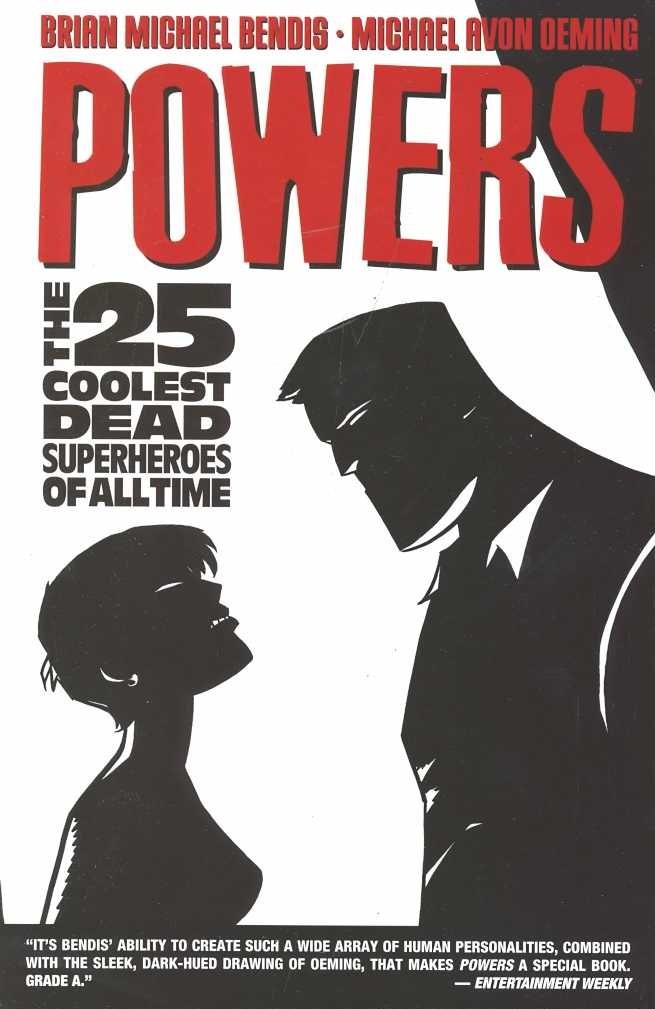
Powers, v. 12: The 25 Coolest Dead Superheroes of All Time

Collects: Powers #25-30, Powers Annual 2008 (2007-8)

Released: February 2009 (Marvel / Icon)

Format: 200 pages / color / $19.95 / ISBN: 9780785122623

What is this?: Deena Pilgrim’s mysterious powers finally are explained and her storyline ends.

The culprits: Writer Brian Michael Bendis and artist Michael Avon Oeming

(While researching this review, I was poking around Jinxworld, Bendis’s site. Somehow, I ran across the Bendisizer — I don’t remember how I got there, and I’ve lost the URL. Anyway, the Bendisizer recasts any text put into it into Bendis-flavored text. There’s even three settings: Low Bendis, Medium Bendis, and Entirely Verbalized Pauses. I selected the “low” setting because anything greater would result in an incomprehensible review; it promised not to use explicit obscenities. Also, I admit I cleaned up the result since I didn’t have the heart to leave in all the misspellings and grammatical errors that comprises Powers’s writing style.)

So this is the direction they decided to go, huh?

Really.

Geez.

You’d think that — I mean, really, now — you’d think Bendis would be able to figure out a better ending for this storyline. I mean, writer Brian Michael Bendis had — what? — four years to figure out what was going to happen. And artist Michael Avon Oeming can plot, too — he’s not a halfwit with a sharp pen. Well, not just a halfwit with a sharp pen.

Four years. And this is what we get.

For f*#@’s sake.

Powers, v. 12: The 25 Coolest Dead Superheroes of All Time coverPowers, v. 12: The 25 Coolest Dead Superheroes of All Time is disappointing, to say the least. I’ve had trouble keeping interested, with all the, you know, delays. The delays were — let’s be honest: they’re embarrassing for a job that you actually get paid to do. I know, I know, Bendis and Oeming have better things to do, but I’ve been waiting for v. 12 for a while now, and I thought the delays meant Bendis and Oeming were working hard on making a quality product. Instead, Bendis was working hard on his Avengers projects and Bend-overs24 and Oeming’s working on whatever Oeming works on.

But I kid Oeming. I’m sure he wasn’t working on anything.

In short, at the end of Powers, v. 11: Secret Identities, Det. Deena Pilgrim, infected with a virus that gives her powers and apparently some sort of insanity, freaked out and disappeared when she saw her partner, Det. Christian Walker, had been keeping his own powers from her. Rather than see any of the interesting fallout from that development, v. 12 starts eight months later.

Hey, those eight months don’t matter. I’m sure — I mean, who cares? Really.

Walker’s got a new partner, Pilgrim’s unraveling from the effects of the virus, Internal Affairs wants to nail Pilgrim (wherever she is), and the virus is starting to reach critical mass, as the infected are using it as a weapon against underage girls. Walker, saddled with a new partner, investigates, and Pilgrim traces the killers as well as her condition steadily deteriorates. I guess “deteriorates” — she looks like hell. That has to be bad, right?

And, of course, everything comes out OK in the end. Not for — the dead girls, they aren’t OK, but everyone else. Not to burden you with spoilers, but — well, this TPB came out four months ago, and the single issues four months before that. So: Spoilers. Yeah.

Triphammer — remember Triphammer, been seen once since the first TPB? Red armor, pain in the ass? Of course you do, he’s f*#@ing unforgettable — cures the virus, just as it is about to overwhelm everything. Didn’t know Triphammer was a brilliant f*#@ing biologist? Neither did I. Neither did anyone. But that’s OK. You don’t — I mean, who looks a gift cure in the mouth? And Pilgrim, cured, is absolved of all the horrible things she’s done. Just like that. Even gets a $3 million payoff from her employers to go away forever.

And then — big reveal! — her big regret is killing some scumbag years ago. The readers had forgotten. Mostly, yeah, I know you didn’t forget. But did you care? I mean, really? No. We’d all moved on. That was — I mean, look, it was ancient history, and no one cares about ancient history. Ask somebody if they care about Hannibal invading Greece with elephants, and they’ll tell you to go f*#@ yourself. She’s not haunted by killing her ex-boyfriend, because, hey, he was creepy. No loss there. And her brother, the until-now-unmentioned minor superhero? Just a blip on the radar, baby, and then he’s f*#@ing gone. Killing his adversary is a momentary thought. No, shooting someone — someone she killed long ago, and for all we know never crossed her — never even entered her mind since then …

I mean, we’ve never seen the murder affect her. She must have been hiding it well. Some people — you know some people are like stone outside. And inside, when they know readers are looking in their head. They don’t show anything.

Who’s killing the dead girls? Some random people with the virus. Supposedly, they’ll be legally absolved as well, but they ain’t Deena Pilgrim, so f*#@ them. Who cares? Sure, the dead girls — the dead girls are dead, though. They don’t start too many arguments.

As a side issue, no one asked for a sequel to the monkeysex issue from v. 1 of Powers, but we got it anyway, in the reprinted Powers Annual 2008. I mean — don’t get me wrong, your science teachers must be very proud of you and your knowledge of comic-book evolution — but no one liked it as anything more than a joke the first time. We sure as hell didn’t want to see it again.

And the title — cute. Nice joke. Must have knocked them dead on the playground, but this is the big leagues, Bendis. Try something that actually had something to do with the story next time. I mean, I know you’re busy deciding who gets to abuse whatever female reserve Avenger you have “respect” for this month, but see if you can buy an assistant editor to do it for you. They work for sandwiches and comp copies, right?

I admit Oeming’s gotten off lightly on this one. He has — I guess you’d say tics of his own, although I like his style usually. But there’s no — I don’t have much to say about his work this time. Since this will be my last volume of Powers, I have to say I won’t miss his unnecessary double-page spreads. I have a lifetime — I’ve been reading from left to right on a single page my entire life, and when it becomes a guessing game as to whether I should read both pages or just one at a time and I guess wrong, well, I’m not going to blame myself. Half the time it takes me an entire issue to figure out I made a mistake. Of course, if there was any action on the page, it would help me decide, but instead it’s Bendis’s disjointed — OK, punchy dialogue. I think — really, it could be read in any order and come out all right.

I sincerely won’t miss the double-page, 5x7 panel (per page) sex scene. Because — no offense, that’s the least interesting sex scene I’ve ever scene. What’s the purpose? Really? No purpose? It’s not relevant or interesting or sexy — for … Why? Does Oeming have a fetish for miniatures? Is there a minisex Internet community or something?

Goodbye, Powers. I’ve been reading since the beginning, and I’ve excused your foibles. I can’t any more. I’ll miss the three or four issues Bendis and Oeming put out a year. But it’s kinda appropriate: Bendis and Oeming have better things to do, and so do I.

Rating: Half Marvel symbol (0.5 of 5)

Labels: , , , , , ,

29 August 2008

Powers, v. 11: Secret Identities

Collects: Powers v. 2 #19-24 (2006-7)

Released: January 2008 (Marvel)

Format: 200 pages / color / $19.95 / ISBN: 9780785122616

And for a contrast, one of Brian Michael Bendis’s latest works, Powers, v. 11: Secret Identity.

In Secret Identities, the former supervillain husband of Queen Noir — a member of a prominent superhero group — is found dead. Detectives Deena Pilgrim and Christian Walker are called in, causing them to deal with high-strung superheroes with secrets and a media circus. And as always in the Powers Universe, whenever someone near a superteam dies, the whole team turns to ruin, and the bodies start piling up. (Bendis seems to believe superteams are an anomaly, something nature abhors only slightly less than a vacuum.)

Powers, v. 11: Secret Identities cover I remember liking Secret Identities much more on the first reading than the second. That may be because of the longstanding plot of Pilgrim’s new, secret powers and the investigation into the disappearance of a former boyfriend. It’s a subplot that started with Powers’s switch to Marvel in 2004, and it really rewards long-time readers. Pilgrim’s slowly been going through the emotions, and here, her defiance is beginning to crumble, and she hits rock bottom. It’s characterization that’s a cut above, and Bendis deserves a great deal of credit for it.

On the other hand, the plot is reminiscent of other Powers plots, with a culprit who comes from (mostly) nowhere. (It does make the second gratuitous sex scene less gratuitous and more a plot point, though.) There’s an interesting and plausible red herring, and a couple of uniformed cops (one of whom has a crush on Pilgrim) who are amusing, but Walker’s new powers leave me cold, and there’s only so much sex and disturbing violence I can take; at times, it seems Bendis is trying to top himself with the violence. At least there’s no monkey sex in here (that I noticed).

I love Michael Avon Oeming’s art, I really do; his square jawed, angular art and Bendis’s dialogue (and other quirks) define the Powers universe. This volume is no exception, with Oeming turning in his usual excellent work, with the bonus of seeing his gag version of a cover for a ‘50s romance comic. However, there are some worrying bits; a few panels are more than confusing, and judging from the script for #23, what he draws certainly doesn’t convey what Bendis is going for. (The scene with Pilgrim in her car, specifically.) It’s only a niggling worry, for the moment.

Really, this is not a book for new readers — not really because it’s confusing to new readers but because it’s not the best. So go to the beginning, become a Powers fan, and then read this.

Rating: Marvel symbol, because I couldn't find anything better Marvel symbol, because I couldn't find anything better (2 of 5)

Labels: , , , , ,

07 May 2008

Ares: God of War

Collects: Ares #1-5 (2006)

Released: October 2006 (Marvel)

Format: 128 pages / color / $13.99 / ISBN: 0785123334

I’m used to Michael Avon Oeming’s work as the artist for Powers, but I’d never read anything he’d written before Ares: God of War. The results here are not so impressive as his art.

With the Asgardians being killed in the pages of Thor, the Olympians are next under fire. But Ares, one of their greatest warriors, has given up his war gig to be a single father in Los Angeles. Then, in a plot that strongly recalls the oft-mocked Kitty Pryde and Wolverine limited series, Ares’s son Alex is kidnapped — first by the Olympians to force Ares to fight for them, then by the forces of an undead Japanese army.

Ares: God of War cover After that, a whole lot of fighting, a whole lot of arguing between Ares and Hercules, and more than few scenes of Alexander being seduced away from his family by Mikabushi, the Japanese god of Evil. The series drags on in the middle and could have stood to be shortened by an issue. The method used to justify the conclusion is barely tolerable, a loose plotline that didn’t get enough play earlier in the story.

The best part of the book is Ares’s relationship with his son and with the real world. Ares can just fit in, and although his relationship with his son is unorthodox, it’s still a loving relationship. Unfortunately, all that goes away when Alex is kidnapped, which hands us over to four unrelenting issues of carnage.

Travel Foreman provides the art. He draws a lot of double-paged spreads of battle scenes, which, while difficult to do, are often more impressionistic5 in purpose than realistic — e.g., he’s trying to get across the violence and chaos without showing one side or another winning. Other than recognizably drawing a few Greeks, it’s not necessary to be precise. I find the spreads a little dull, and the two-page art frequently requires full-page fuller art to make sure the two pages face one another.

This is most likely of interest to fans of Hercules and Marvel’s Greek pantheon, especially since those rumors of Ares as a member of the Avengers have seemed to come to naught.

Rating: Marvel logo Marvel logo 2 of 5

Labels: , , , , ,