Reviews of trade paperbacks of comic books (mostly Marvel), along with a few other semi-relevant comments / reviews.

12 October 2013

Spider-Man: The World's Greatest Super Hero

Collects: Peter Parker: Spider-Man #156.1, Sensational Spider-Man #33.1-33.2, and Web of Spider-Man #129.1-129.2 (2012)

Released: November 2012 (Marvel)

Format: 112 pages / color / $14.99 / ISBN: 9780785165729

What is this?: Anniversary cash-in for Spider-Man’s fiftieth anniversary.

The culprits: Writers Roger Stern, Tom DeFalco, and Stuart Moore and artists Roberto de la Torre, Carlo Barberi, and Damion Scott


Is it a shameless cash grab, or is it an inconsequential, harmless story?

That’s the question I ask when I see a prominent hero headlining a limited series or trade paperback that is not part of the hero’s regular series. Is this something I might enjoy, albeit in a continuity-light manner, or is it something designed to sucker in the completists and unobservant?

I don’t think Spider-Man: The World's Greatest Super Hero is a cash grab. The numbering of the issues in the collection — continuing cancelled Spider-series with decimals — suggests Marvel wants people who don’t understand what “anniversary story” means to think of these tales as a continuation, as somehow important. Still, I can’t see anyone falling for that trap. I mean, decimals? That screams desperation.

Spider-Man: The World’s Greatest Super Hero coverThe stories in World’s Greatest are helpfully arranged in order of quality, so if you’d like, you can read the first story, then toss the book aside or resell it. (Note the “re” in “resell”; do not sell this book if you have not legally obtained the book through purchase or barter or as a gift. You will likely be disappointed in the results anyway.) The first story, “Old Haunts,” is written by highly regarded former Spider-Man writer Roger Stern. The second, the first of two two-parters, is “Monsters,” written by veteran Spider-Man writer Tom DeFalco. The second two-parter, “The Brooklyn Avengers,” is written by Stuart Moore, who has written a few miscellaneous Spider-stories.

Stern’s story revisits the old Acme Warehouse, which is where Spider-Man confronted the man who killed Uncle Ben. Reporter Norah Winters asks Peter to accompany her while she pokes around the old place; Peter senses something fishy and pushes Norah to give up her questioning before he investigates the place as Spider-Man. The criminals are tied to the Brand Corporation, Spider-Man rescues innocents while punishing those who try to cover up the illegal operation with explosives, Norah learns a lesson; it lacks a bit of heft, but not in a bad way. Spider-Man gets to be a hero, an old Stern-era baddie shows up to remind us about how bad it is, and life goes on. There are many worse ways to mark an anniversary …

And one of those ways is telling a story that has absolutely nothing to do with the anniversary. DeFalco’s “Monsters” is another modern Spider-tale, set in the period before Peter Parker’s fall from grace as a photog and the beginning of his romantic relationship with Carlie Cooper. (“Old Haunts” probably falls into the same time period.) “Monsters” makes no reference to the past, evokes none of Spider-Man’s dominant themes, and is as much a Carlie Cooper story as it is a Spider-Man story. That last is the most damning, given this collection’s goal.

Of the three stories in World’s Greatest, I can most easily see “Monsters” fitting into the regular series; it seems just about perfect for a Web of Spider-Man v. 1 two-parter, although ironically it was published in Sensational #33.1 and 33.2. The story is terribly earnest about human trafficking, which is better than being flip about it, but Carlie seems to be randomly chosen to be the one who cares so much. The title refers to the parallels DeFalco makes between mobster Balik Vorski, a corrupt FBI agent, and the physically mutated Vulture. If Vorski deals in human trafficking, and the FBI agent shields him from the law, then who is the real monster? The answer is all of them, of course.

“The Brooklyn Avengers,” however, is the worst kind of anniversary story: the continuity implant. The Brooklyn Avengers aren’t one of the countless current Avengers teams; they are a group of no-hopers, worse than the Great Lakes Avengers at their worst. The GLA would probably laugh at the Brooklyn Avengers, especially as one Brooklyn Avenger’s power is to generate paintballs. Spider-Man allegedly joined up with the BA early in his career and dropped them after a few missions proved they weren’t at his power or competence level; in “The Brooklyn Avengers,” a couple of members have died, and Spider-Man reunites with them to investigate their old foes.

Unfortunately, the BA don’t rise above one-note jokes, never quite gaining the humanity necessary for me to care whether they live or die. Given the team’s reactions at the end of the story, the survivors aren’t too broken up over the deaths either, even though one member had a sibling die. By the end, like Spider-Man, I don’t wish the Brooklyn Avengers ill. I just want them to go away.

The quality of the art matches the quality of writing. Roberto de la Torre gives “Old Haunts” an atmospheric look vaguely reminiscent of Michael Gaydos or Michael Lark, although de la Torre’s work is not as polished or detailed. Still, it’s exactly what a story about a fight under a warehouse calls for. Carlo Barberi’s work on “Monsters” is pretty to look at, and I like how he draws the new Vulture, but his Peter Parker is a pretty boy who looks nothing like other artists’ Peter, and I’m not sold on his portrayal of characters’ emotions. I’ll admit Damion Scott’s extremely cartoony work for “Brooklyn Avengers” fits the humorous tone Moore was going for, but I don't enjoy looking at it. The characters have cramped torsos and faces and distended limbs; something about the vivid colors and exaggerated proportions puts me in mind of graffiti, but not in a good way.

World’s Greatest is missable. If you read it, you might get a few moments enjoyment. Most likely you’ll forget it almost immediately, as even the best story rises slightly above the sea of mediocre. Save yourself the time: skip it in the first place.

Rating: Marvel symbol Half Marvel symbol (1.5 of 5)

Labels: , , , , , , , ,

28 August 2009

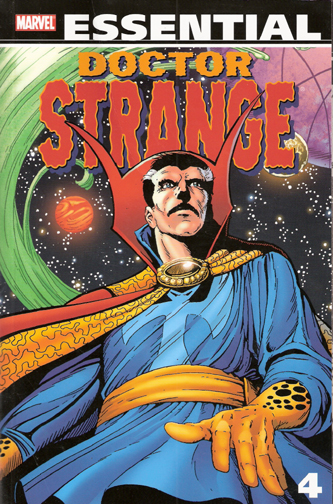
Essential Dr. Strange, v. 4

Collects: Dr. Strange (v. 2) #30-56 (1978-82)

Released: June 2009 (Marvel)

Format: 584 pages / black and white / $19.99 / ISBN: 9780785130628

What is this?: Dr. Strange battles foes old and new and deals with Clea actually getting a personality

The culprits: Writers Roger Stern, Chris Claremont, and others; artists Gene Colan, Marshall Rogers, and others

I expected to be underwhelmed by Essential Doctor Strange, v. 4. I usually am underwhelmed by Dr. Strange stories, despite being a fan of the character. I think most Marvel fans are underwhelmed by Strange; it’s why everyone thinks a Dr. Strange series is a good idea but no one buys them .

But v. 4 surprised me, after a rough start. The book certainly has the pedigree to succeed; Roger Stern, who was at his peak with early ‘80s Marvel, writes most of the book, while Chris Claremont writes eight stories (#38-45) and the included Man-Thing story. Stern feels like the better fit. He’s remembered for writing Spider-Man, who’s a solo hero, like Strange. Claremont is known for his legendary X-Men run, which doesn’t seem to have much in common with Dr. Strange at all. But it’s Claremont, who wrote #38-45, who really gets things going in v. 4.

Essential Dr. Strange, v. 4 coverIt’s through a typical Claremontian concern for female characters. Under Claremont’s pen, Clea, Strange’s lover and disciple, realizes she has learned somewhere between jack and squat from Strange, despite being raised in a more magical dimension. She draws the wrong conclusion from this — that she’s a bad student, rather than Strange being an indifferent-to-incompetent teacher — but at least it breaks the status quo and gives us a reason for Clea’s relative insignificance in magical battles. Claremont also develops Wong a little — well, mainly his forebears, but it’s something.

Claremont also introduces new magical enemies who look like Native Americans and gives Strange a business manager, Sara Wolfe, who’s both a woman AND a Native American. This reminds us that even when Claremont was at the height of his powers, not all his ideas were winners.

Stern gets the beginning (#30-7) and end (#47-56) of the book. His first run is a running battle between Strange and the Dweller in Darkness’s goons, and Strange never does figure out who is behind his assailants. The story ends abruptly, with the Dweller making a unilateral declaration of a nebulous, non-physical victory, as Stern leaves. His exit was probably the reason for the sudden stop — Stern had already switched to plotter (Ralph Macchio scripts) with #33 — but frankly, it had become dull even before then. Stern’s exit was a mercy killing. The only interesting bit is Stern reusing a character from a minor story from an issue of Chamber of Chills, but even that was done haphazardly.

When Stern returns, though, he picks up with Claremont’s disaffected Clea (and drops almost everything else). He introduces a romantic rival for Clea, which finally gives movement to Strange’s static personal life. He also brings back Mordo, one of the go-to villains for strange. Really, Mordo’s just there for credibility; the magician could have been anyone. But Mordo (and eventually Dormammu) lead Strange back through time on a great series of stories (#50-3) that brings in Sgt. Fury and his commandos, Nazis, the Fantastic Four, and Rama-Tut and ends with Clea leaving Strange. Another story has D’Spayre trying to convince Strange he’s a fictional character, even introducing him to Stan Lee and Steve Ditko analogues. In the final issue, Strange plays with former minions of Mordo who thought they were being clever. It’s a strong finish to the book, and it makes me eager for v. 5.

On the other hand, having such expectations of consistent quality is a recipe for disappointment. On the other other hand, the Unofficial Handbook of the Marvel Universe says the next 20 or so issues are Stern teamed up with artists Paul Smith (who did a great job on #54 and 56) and Dan Green with a few others.

Adding even more to the plus side, Stern also has Strange and Clea engage in a rather suggestive “tantric exercise,” which Clea describes as “wonderful” and one she wants to try “more often.” So points to Stern for that. On the other hand, Stern kills a cat. So no perfect score for him either.

The pencils are primarily from Gene Colan and Marshall Rogers. Both are excellent choices. Few artists in Marvel’s stable did shadowy and spooky like Colan, who excelled at it on Tomb of Dracula and Daredevil. (To be fair, Marvel’s bright spandex world didn’t need it so often.) But he does an excellent job here (#36-45, 47), atmospheric and moody and occasionally frightening. His Strange frequently looks a bit too much like his Dracula for my tastes, but they don’t cross over so there’s no confusion, and they’re both imposing, handsome figures, so that’s OK. He uses darkness effectively, so that the reader always suspects something horrible is about to come from the shadows. That expectation is frequently greater than any actual horror inspired by the creatures on the page, but I blame that on the rather plain demons and adversaries Stern and Claremont give him. The black-and-white reproduction doesn’t help him either; with no color to help the shading, his work occasionally looks blotchy.

I am shocked that I enjoy Rogers’s pencils, given how unimpressed I was with his work in Batman: Strange Apparitions. His run (#48-53) is shorter than Colan’s, which is a shame. His style is completely different than Colan’s; while Colan eschews clear lines and his characters look like they can find shadow in a desert at noon, Rogers’s work is clear and bright, even in black and white. His art looks more modern than his contemporaries’, and some of the panels in this look like something that could have been created in the ‘90s, except Marshall has a command of anatomy and exaggerates physical attributes only slightly. Rogers’s Mordo is impressive, full of menace. His work in #53, in which Strange breaks down after Clea announces she’s leaving, is heartbreaking.

I didn’t expect to enjoy Essential Dr. Strange, v. 4. After the first ten issues, I really didn’t, despite the beginning of Colan’s run. But the story grew on me, and the art, more than the writing, won me over. By the end, though, Stern was putting together an impressive run, and I’m looking forward to finding out if he continued it.

Rating: Dr. Strange symbol Dr. Strange symbol Dr. Strange symbol Half Strange symbol

Labels: , , , , , , , ,

10 July 2008

Essential Peter Parker, the Spectacular Spider-Man, v. 3

Collects: Spectacular Spider-Man #54-74 and Spectacular Spider-Man Annual #3 (1981-4)

Released: February 2007 (Marvel)

Format: 536 pages / black and white / $16.99 / ISBN: 9780785125013

There’s not much to say about the Essential Peter Parker, the Spectacular Spider-Man, v. 3. Well, I suppose there is, but it’s mostly repeating how much I like the Essential Spectacular Spider-Man.

In v. 3, Spider-Man swings into his ‘80s heyday, with stories by two of the best Spider-writers from that time: Roger Stern (#54-61) and Bill Mantlo (#62-74). Stern has received a great deal of praise for his Spider-work, and although this isn’t the equal of his long run on Amazing Spider-Man, it has a lot of fun stuff with B-villains like the Jack o’ Lantern, Nitro, Will o’ the Wisp, the Ringer, and the Gibbon. He also throws in stories with three future Thunderbolts: the Beetle, Moonstone, and the Smuggler (Atlas / Goliath).

Essential Peter Parker, the Spectacular Spider-Man, v. 3 cover Mantlo’s run is more distinguished, creating Cloak and Dagger and introducing the Owl / Octopus War. Mantlo concentrated on “classic” villains — Electro, the Molten Man, Doc Ock — and brought back older villains with strong connections to Spider-Man: the aforementioned Molten Man, Robot Master, Silvermane. He treated the Kingpin as he had been treated in Daredevil: a force within the city who could be reluctantly used but had his own agenda. He also gave Kraven his mania for “honor” that would lead to his destruction.

Words can’t express how much fun these stories are. Few — Cloak and Dagger being the exception — are groundbreaking, but they’re solid superhero stories. There are some disappointments — the weak resolution to the Deb Whitman story stands out there — but overall, it’s a lot of fun.

The art isn’t going to make anyone forget Steve Ditko or John Romita, Sr., but there are echoes of both throughout. Pencillers and inkers come and go with regularity — editor-in-chief Jim Shooter did the layouts for three issues — but it’s all high-quality work that surprisingly works despite the number of different contributors. Jim Mooney and Ed Hannigan did the lion’s share of the work, with Luke McDonnell, Bob Hall, and Al Milgrom making significant contributions. Many others, like John Byrne and Rick Leonardi, pitch in an issue or two.

These issues represent a high level of quality and nostalgia for many collectors. They stand up well to time, and they don’t disappoint, a quarter century later.

Rating: Spider-Man symbol Spider-Man symbol Spider-Man symbol Spider-Man symbol (4 of 5)

Labels: , , , , , , , ,

03 April 2006

Essential Peter Parker, the Spectacular Spider-Man, v. 2

Collects: Spectacular Spider-Man (v. 1) #32-53, Spectacular Spider-Man Annual #1-2, Amazing Spider-Man Annual #13, Fantastic Four #218 (1979-81)

Released: February 2006 (Marvel)

There was a time when things were simpler, and comic books had longer names. The Essential Peter Parker, the Spectacular Spider-Man takes you back to that time.

The Essential reprints, in glorious black and white, issues #32-53 and the first two annuals of Peter Parker, the Spectacular Spider-Man (the title was shortened to Spectacular Spider-Man in 1988), along with a couple of associated stories. If you’ve seen the Essential format before, you know whether you think $16.95 for more than 500 monochrome reprint pages is worth it. If you haven’t seen Essentials before, I’ll tell you it’s worth it ... if the stories are any good.

Are they? Well, the majority are written by Bill Mantlo, who did a lot of Spider-Man at the time and did it pretty well. There are a few odd stories in this volume, but it’s absolutely nothing like Lightmaster or Razorback in the first volume, so if your tolerance for men in giant pig hats is low, then this one’s safe. And Roger Stern, who did an exellent job on Amazing Spider-Man in the ’80s, does a few stories as well, including the introduction of the man who would eventually become the first Hobgoblin. So it’s got that going for it. The art comes from a wide range of creators, including John Byrne, John Romita Jr., Jim Mooney, and Mike Zeck — good stuff, for the most part, from creators who have done a lot of Spider-Man.

But really all you need to know is that this is quintessential ’70s Spider-Man: you have classic villains, goofy villains, and newer villains trying to make classic status. That, along with money trouble and the constant sacrifice of his personal life, is all Spider-Man truly needs. (Are you listening, Straczynski?) Dr. Octopus, Vulture, and the Lizard — the Mindworm and Swarm — Belladonna, Morbius, and the Tinkerer. Not to mention (yet another) Lizard knockoff, the Iguana, and the Spider-Lizard. But hey, it’s all in good fun, even if Peter Parker isn’t having fun.

There are two oddities about this volume that have nothing to do with supervillains and deathtraps. The first is that the Essential actually contains one more issue than is listed on the front cover: Fantastic Four #218, the second part of a two-part Frightful Four story. (This time the Frightful Four says nuts to girls and chooses Electro as its final member. The next time they show up, they’ve decided Electro isn’t the answer but a woman of another humanoid species might be, adding Llyra.) So you get an extra issue for your money.

The other is a downside: three issues (#40, #43, Annual #2) have atrocious reproduction, so instead of the tight line that marks most of the volume (and most of the Essentials series), the art is blotchy, muddied, and overall difficult to make sense of. Marvel must have made the reproduction from a different kind of source on those three issues — or perhaps it was just a printer’s mistake, one that might show up only in my copy.

Even with those problems, this is another of the quality reprints Marvel has been producing in the last decade. It’s well worth your time — as are the other Spider-Man Essentials (Essential Spider-Man #1-7, Essential Peter Parker ... #1, and Essential Marvel Team-Up #1). I’m just looking forward to the next volume in all three series.

Grade: A

Labels: , , , , ,