


Birds of Prey, v. 8: Club Kids
Collects: Birds of Prey #109-12, 118 (2007-8)
Released: January 2009 (DC)
Format: 128 pages / color / $17.99 / ISBN: 9781401221751
What is this?: The Birds of Prey adapt to a new writer and developments in the DC universe.
The culprits: Writer Tony Bedard and artists Nicola Scott, Jason Orfalas, and David Cole
I had avoided Birds of Prey, v. 8: Club Kids for quite a while, afraid new writer Tony Bedard would turn the title and its characters into a flavorless waste of time. Happily, I found that was not the case.
Club Kids has little overall plot, as Bedard eschews an overarching story for the beginning of his run. Instead, he favors character pieces that deal with developments outside the title. Bedard deals with Black Canary choosing to marry Green Arrow and an assassin attacking the New Gods in #109 and #112. He also uses past continuity to his advantage in two other stories: the aftermath of Oracle destroying her clocktower base in 2004-5’s War Games crossover facilitates a face-to-face confrontation between Calculator and Oracle in #111, and Misfit’s origins are looked at in #118.
 None of these stories are award winners. On the other hand, most of them are solid comics in the old-school mold. Huntress foils mad bombers, who turn out to be less “mad” and more naïve. Black Alice and Misfit are put into a superhero gladiatorial ring, a plot straight out of New Mutants. Lady Blackhawk honors a fallen comrade. Oracle and Calculator scrap over data. Simple stories, and all the characters are true to the personalities previous writer Gail Simone gave them. I would not say Bedard is as good with the characters as Simone was — although they easily coexist with Simone’s conceptions, they lack a certain je ne sais quoi. But Simone had several years to mold the characters; Club Kids contains Bedard’s first five issues on the title.
However, letting other titles dictate stories occasionally robs Birds of Prey‘s stories of their impact. All of #109 is dedicated to either reacting to a development outside the title or adding heat to a subplot running through the DCU. Although Oracle arguing with Black Canary over her boyfriend’s fidelity issues is long overdue, the discussion was engendered by Green Arrow’s marriage proposal in another title (Green Arrow). Developing another title’s dangling plots does no favors to Birds of Prey‘s narrative flow, especially since Black Canary wasn’t a character at this point — she left the title in #100. The issue still might have worked, however, if the assassination of the New Gods story hadn’t been shoehorned into the same issue. Bedard tries to give Knockout a fitting last moment, but her part of the story feels rushed. And the death Lady Blackhawk memorializes in #112, that of a prominent supporting character, seemingly comes from nowhere (the Death of the New Gods miniseries); #112 starts with a half page of her memorial service before getting on with the action. Brevity is laudable, but it feels as if the dead character is being cheated of the respect she is due.
(Although not as cheated as Manhunter is; I know she barely appears in Club Kids, but her head shot in the intro / recap section of the book is actually a picture of Scandal Savage, a villain, from #109.)
Why couldn’t Simone have worked with artists like Bedard gets? Nicola Scott draws #109, 110, and 118 and does an excellent job — action-packed, expressive, exceedingly pretty, with a tight line I admire. She even puts Huntress in a more modest costume than the Jim Lee monstrosity (thank God), although Big Barda’s red bikini costume is awful. (I don’t think Scott designed it, but it’s still awful.) Jason Orfalas does a good job on the quieter #111, and David Cole‘s slightly cartoony, looser style is perfect for the free-spirited Lady Blackhawk’s story.
Club Kids is the perfect book for a title that is coming off a big storyline and a change of writers; Bedard uses the characters respectfully, putting them in appropriate situations, and reacts to what DC editorial sends him. But that’s Club Kids’s shortcoming, as well: it’s reactive, and Birds of Prey loses all its momentum from Simone’s run without establishing any clear new direction. Over the long run, that’s death for a title, but for one collection, it can be enjoyable — and in this case, it is.
Rating:
 (4 of 5)
Labels: 2009 January, 4, Birds of Prey, Black Alice, Black Canary, Calculator, David Cole, DC, Huntress, Jason Orfalas, Knockout, Metropolis, Misfit, Nicola Scott, Oracle, Tony Bedard
posted by Raoul | 11:00 AM
|
0 comments

 But I wouldn’t have begrudged Simone the chance to go out with a big bang; it is a comics tradition, after all. It used to be said of Spider-Man in the Bronze Age that you could tell when a writer was leaving the title because he’d wheel out his Green Goblin story. But the only green I see in this story is on the costumes of Spy Smasher and Knockout.
 (3.5 of 5)
 It’s an expansion on the team’s concept: one member leaves, so Oracle calls in the services of other female heroes with the idea of eventually choosing one or more to become one of the Birds of Prey. After the new setup is introduced in #100 — odd to have the launching point for a new development in the middle of the book, but I suppose that’s the way the issues fall — the action doesn’t stop. Issues #100-103 are a high point on this series; issue by issue, Simone raises the stakes. It starts as a routine getting-to-know-you mission to a multi-front battle that spirals out of the heroes’ control to a war for the identity of the team and its founder. Throughout, Simone never relinquishes her strengths in characterization or dialogue — even bit player Judomaster gets a memorable moment of dialogue. Those four issues, by themselves, are more than enough reason to read this book, especially since they make a great jumping on place.
 There are two main storylines in Perfect Pitch. In the first, which lasts from #87-90, Oracle and the Birds of Prey follow through with Huntress’s plan to infiltrate and neuter the Gotham mobs while Calculator tries to discover Oracle’s identity. In the second, lasting from #92-5, the Birds of Prey — now counting Lady Shiva as a member — tries to keep Matthew Thorne, the Crime Doctor, and his daughter safe as he tries to defect to the side of angels.
 As I mentioned, this is the first Birds of Prey without Benes, and I couldn’t be happier. Paulo Siquiero provides the bulk of the pencils; his work is good, more than slightly reminiscent of Terry Dodson in line and style. Appropriate, considering Dodson provides the cover for the volume. On the other hand, someone should really get him a picture of what a shotgun is, as the gun he draws as the punchline of the joke on the right is more of a machine gun. Joe Bennett, who has worked on previous volumes, does part of two issues and turns in decent work, and although it’s a little too much like Benes’s work for me, it does avoid most of Benes’s cheesecake tendencies. Among the other artists, Bruce Timm provides the art for one of two stories in #86, an amusing tale well suited for his art.
 I remember being slightly disappointed by Battle when I first read it. Looking over it now, I can’t quite see why. Battle is a heck of a value: ten issues for $17.99. (I tend to say this with the DC books I review but rarely the Marvel books.) It really feels like you’re getting two books in one with this one — and I mean that literally: #76-80 makes up one book, and #81-5 is a completely different storyline. Although it gives the reader more for the dollar, it does take away from a dramatic departure at the end of the first storyline. (On the other hand, that character stays in the book, if not always with the team, so the departure isn’t that big of a cliffhanger.)
 His job is taken over by Joe Bennett, who draws five of the remaining eight issues in Battle. He draws action scenes pretty well, which is good, because he gets to draw a lot of them in Battle. I never warmed to his style, however; his women lack well-defined noses, have slack, open mouths, and generally don’t have much expression on their faces. They look a little like blow-up dolls, to be frank. I really like the art from Joe Prado, who draws a slightly scratchy #76, featuring the Birds vs. a Goth teenage Wicca with real power, and Tom Derenick, who draws #77-8 in a style more than slightly reminiscent of Sal Buscema, whom I never get tired of.
 Neither of the plots worked. Despite having fun dialogue and the characters readers have come to enjoy, this was too by-the-numbers. First, showing a character interfacing between “cyberspace” and the real world is always a dicey proposition, and even though the explanation for Oracle’s infection makes sense, it still doesn’t feel right. It starts out interesting — Oracle seeing patterns in an unplugged screen is suitably creepy — but the more it becomes concrete, the less interesting it is, the less possible madness is for an explanation and the more it becomes a standard fight that Oracle shouldn’t win. She does win, of course, through the most hackneyed way possible: beating the logical machine with emotion.
 The most interesting part of Sensei is Black Canary’s story. She heads to Hong Kong to see her dying sensei; while there, she meets the assassin Lady Shiva, who is also there to pay her respects. When the sensei is murdered before he can die, they team up to find the culprit; the trail leads to assassin / poisoner Cheshire, who insists she’s being set up.
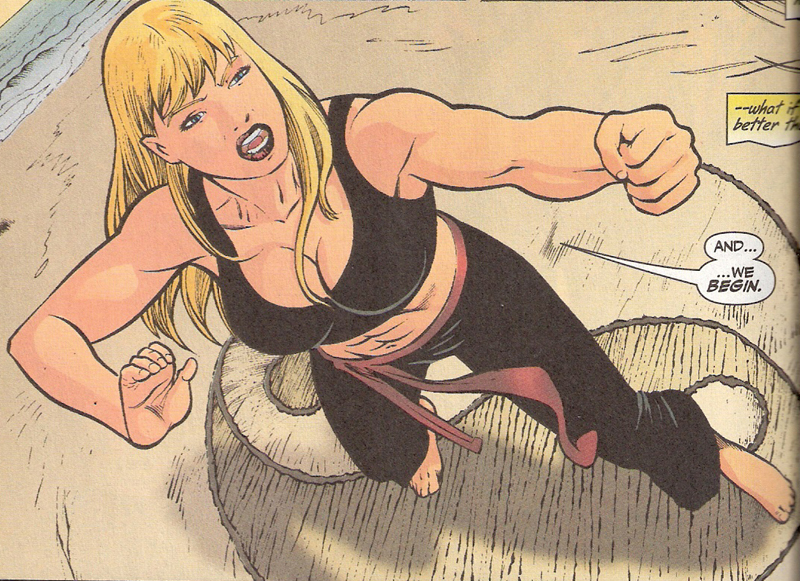
 Ed Benes provides most of the pencils (and some inks) for Sensei, and he shows his usual restraint and taste when drawing the female form. There’s nothing I can say that I didn’t say in the review of Of Like Minds: he’s a good artist who lets the female anatomy dominate his style. I have nothing to say about Joe Bennett (penciler for #68) or Cliff Richards, who pitched in with pencils on the first two issues. For Richards, that’s good, since he’s obviously supposed to blend in with Benes’s work. It’s good for Bennett as well; his style differs from Benes’s more than Richards, but he definitely fits in with the artistic tone of the book: I mean, just look at the crop top he gave Canary in that issue.
 So we have Simone, who seems to be living the kind of life story every comics fan would like to experience. Gaining attention with
 Dixon is determined to make Oracle an interesting and active — as active as he dares, at least — character. He succeeds, mainly, and Birds of Prey: Batgirl is one of the high points of the book. Oracle is captured by Spellbinder, who makes her hallucinate that she (as Batgirl) and Black Canary are fighting the Mad Hatter and the inmates of Arkham. This includes Joker, of course, who naturally triggers more than a little fear. But Oracle pieces together Spellbinder’s plan, outwits her, and then outfights her. I could do with Oracle giving herself fewer pep talks, but that’s a minor quibble.