Reviews of trade paperbacks of comic books (mostly Marvel), along with a few other semi-relevant comments / reviews.

11 January 2013

Birds of Prey, v. 8: Club Kids

Collects: Birds of Prey #109-12, 118 (2007-8)

Released: January 2009 (DC)

Format: 128 pages / color / $17.99 / ISBN: 9781401221751

What is this?: The Birds of Prey adapt to a new writer and developments in the DC universe.

The culprits: Writer Tony Bedard and artists Nicola Scott, Jason Orfalas, and David Cole


I had avoided Birds of Prey, v. 8: Club Kids for quite a while, afraid new writer Tony Bedard would turn the title and its characters into a flavorless waste of time. Happily, I found that was not the case.

Club Kids has little overall plot, as Bedard eschews an overarching story for the beginning of his run. Instead, he favors character pieces that deal with developments outside the title. Bedard deals with Black Canary choosing to marry Green Arrow and an assassin attacking the New Gods in #109 and #112. He also uses past continuity to his advantage in two other stories: the aftermath of Oracle destroying her clocktower base in 2004-5’s War Games crossover facilitates a face-to-face confrontation between Calculator and Oracle in #111, and Misfit’s origins are looked at in #118.

Birds of Prey: Club Kids coverNone of these stories are award winners. On the other hand, most of them are solid comics in the old-school mold. Huntress foils mad bombers, who turn out to be less “mad” and more naïve. Black Alice and Misfit are put into a superhero gladiatorial ring, a plot straight out of New Mutants. Lady Blackhawk honors a fallen comrade. Oracle and Calculator scrap over data. Simple stories, and all the characters are true to the personalities previous writer Gail Simone gave them. I would not say Bedard is as good with the characters as Simone was — although they easily coexist with Simone’s conceptions, they lack a certain je ne sais quoi. But Simone had several years to mold the characters; Club Kids contains Bedard’s first five issues on the title.

However, letting other titles dictate stories occasionally robs Birds of Prey‘s stories of their impact. All of #109 is dedicated to either reacting to a development outside the title or adding heat to a subplot running through the DCU. Although Oracle arguing with Black Canary over her boyfriend’s fidelity issues is long overdue, the discussion was engendered by Green Arrow’s marriage proposal in another title (Green Arrow). Developing another title’s dangling plots does no favors to Birds of Prey‘s narrative flow, especially since Black Canary wasn’t a character at this point — she left the title in #100. The issue still might have worked, however, if the assassination of the New Gods story hadn’t been shoehorned into the same issue. Bedard tries to give Knockout a fitting last moment, but her part of the story feels rushed. And the death Lady Blackhawk memorializes in #112, that of a prominent supporting character, seemingly comes from nowhere (the Death of the New Gods miniseries); #112 starts with a half page of her memorial service before getting on with the action. Brevity is laudable, but it feels as if the dead character is being cheated of the respect she is due.

(Although not as cheated as Manhunter is; I know she barely appears in Club Kids, but her head shot in the intro / recap section of the book is actually a picture of Scandal Savage, a villain, from #109.)

Why couldn’t Simone have worked with artists like Bedard gets? Nicola Scott draws #109, 110, and 118 and does an excellent job — action-packed, expressive, exceedingly pretty, with a tight line I admire. She even puts Huntress in a more modest costume than the Jim Lee monstrosity (thank God), although Big Barda’s red bikini costume is awful. (I don’t think Scott designed it, but it’s still awful.) Jason Orfalas does a good job on the quieter #111, and David Cole‘s slightly cartoony, looser style is perfect for the free-spirited Lady Blackhawk’s story.

Club Kids is the perfect book for a title that is coming off a big storyline and a change of writers; Bedard uses the characters respectfully, putting them in appropriate situations, and reacts to what DC editorial sends him. But that’s Club Kids’s shortcoming, as well: it’s reactive, and Birds of Prey loses all its momentum from Simone’s run without establishing any clear new direction. Over the long run, that’s death for a title, but for one collection, it can be enjoyable — and in this case, it is.

Rating: DC logo DC logo DC logo DC logo (4 of 5)

Labels: , , , , , , , , , , , , , , ,

12 November 2010

Birds of Prey, v. 6: Blood and Circuits

Collects: Birds of Prey #96-103 (2006-7)

Released: August 2007 (DC)

Format: 208 pages / color / $17.99 / ISBN: 9781401213718

What is this?:

The culprits: Writer Gail Simone (with a small assist from Tony Bedard) and pencilers Paulo Siqueira, James Raiz, and Nicola Scott

Despite writer Gail Simone’s tricks and plots, it was hard for me to avoid feeling that the Birds of Prey lacked a great deal of stunning plot developments. Things evolve, change, slightly mutate, but the status quo the book began with issue #56 hadn’t changed through five volumes of trade paperbacks. But building on the momentum from v. 5, Perfect Pitch, Birds of Prey, v. 6: Blood and Circuits changes that impression, and for the better.

Birds of Prey: Blood and Circuits coverIt’s an expansion on the team’s concept: one member leaves, so Oracle calls in the services of other female heroes with the idea of eventually choosing one or more to become one of the Birds of Prey. After the new setup is introduced in #100 — odd to have the launching point for a new development in the middle of the book, but I suppose that’s the way the issues fall — the action doesn’t stop. Issues #100-103 are a high point on this series; issue by issue, Simone raises the stakes. It starts as a routine getting-to-know-you mission to a multi-front battle that spirals out of the heroes’ control to a war for the identity of the team and its founder. Throughout, Simone never relinquishes her strengths in characterization or dialogue — even bit player Judomaster gets a memorable moment of dialogue. Those four issues, by themselves, are more than enough reason to read this book, especially since they make a great jumping on place.

The first four issues — well, three and a half — are dedicated to tying up loose ends, or at least further developing past adversaries. In #96-7, the team tries to talk some sense into Black Alice, a teenager who can steal the magical abilities of other characters, just as the Secret Society makes a pitch to her. Simone introduced Black Alice in v. 4: The Battle Within as largely a one-off villain without any indication that she is important to the DC Universe at large. Here, though, we’re told she is immensely powerful, and Felix Faust tells the reader this every time he’s on the page. This is a technique that will grate on some readers — Faust’s “We’re attempting to bring a supernova to heel” could come off as Simone giving Black Alice some cheap heat — but Simone mostly gets away with it. Yes, Black Alice is powerful, but she’s also a teenager who is confused about what she wants, mitigating her power. It’s a setup that’s been seen before, and Simone’s heroes and villains, especially Faust and Talia al-Ghul, make it a pleasant reuse of the idea.

In #98-9, Huntress and Black Canary have to deal with Yasemin, a Turkish gunrunner the team put behind bars in v. 5. Obviously, she’s out for revenge, which doesn’t go so well for her. Other than humiliating some mob thugs, she’s a mainly distraction while the team figures out who the redhead impersonating Batgirl is. Although the new Batgirl, who quickly gets renamed Misfit, is charmingly wacky, she doesn’t really fit into the stories in which she’s inserted, and her power levels seem a bit too high, especially when she reveals she knows all the secret IDs of the Birds.

My only real complaint about the writing is part of #100, in which Tony Bedard and Simone recap Black Canary’s career and life. It’s … serviceable, but it’s an odd choice for a sendoff for the character. It’s an introduction to the character, and as an introduction, it feels clunky — Black Canary narrates her life to her new ward, Sin, and tries to justify her decision to leave the team. The story feels like something put into #100 to make it larger for an anniversary issue; like most stories meant to pad out annuals and double-sized issues, it’s missable and largely inconsequential without being offensive.

(I’m also not real fond of the volume’s title. Neither the literal interpretation nor the pun makes much sense for the stories within, and I can’t help but wonder if something about the story got lost somewhere — perhaps between the page and my brain.)

The art is provided by three different pencilers this time around. They’re all pretty good, and their styles are distinct yet similar enough to avoid style clash. Paolo Siqueira draws #96-7 and the backup in #100, James Raiz contributes #98-9, and Nicola Scott draws the rest. I prefer Scott’s work; it has a slightly smoother line, and I prefer Scott’s handling of action scenes. In fact, she’s part of what makes #100-3 so much fun. But Siqueira and Raiz are also good fits for the title, and none of them indulge in excessive cheesecake. Siqueira also seems to enjoy working with Black Alice, who gives him the chance to draw a character with many different looks, and the Secret Society.

I’ve been reading Birds of Prey because of its consistent quality; even when the art or the plots weren’t to my liking, Simone’s characters and dialogue kept me coming back. For the first time, I really feel excited about this title and really can’t wait for the next (and Simone’s last) volume, Birds of Prey, v. 7: Dead of Winter.

Rating: DC logo DC logo DC logo DC logo (4 of 5)

Labels: , , , , , , , , , , , , , , , , ,

24 September 2010

Birds of Prey, v. 5: Perfect Pitch

Collects: Birds of Prey #86-90, 92-5 (2005-6)

Released: February 2007 (DC)

Format: 224 pages / color / $17.99 / ISBN: 9781401211912

What is this?: The Birds of Prey set up shop in Superman’s hometown, but the roster of the all-female team keeps shifting.

The culprits: Writer Gail Simone and penciler Paulo Siqueira (with others)

Birds of Prey, v. 5: Perfect Pitch is a big step up over the previous volumes. And not just because it’s the first volume to feature no art by Ed Benes.

No, in this volume, writer Gail Simone has two stories to tell, and she doesn’t let fill-in issues or a line-wide “one year later” mandate get in the way. Perfect Pitch is filled with fun, action-filled stories without skimping on characterization, witty banter, or victories for each character.

Birds of Prey: Perfect Pitch coverThere are two main storylines in Perfect Pitch. In the first, which lasts from #87-90, Oracle and the Birds of Prey follow through with Huntress’s plan to infiltrate and neuter the Gotham mobs while Calculator tries to discover Oracle’s identity. In the second, lasting from #92-5, the Birds of Prey — now counting Lady Shiva as a member — tries to keep Matthew Thorne, the Crime Doctor, and his daughter safe as he tries to defect to the side of angels.

The first arc sets up the Calculator as a nemesis for Oracle. This is fitting; they fulfill the same roles, although Oracle gives information and computer hacking to the heroes (primarily Bat-Family) and Calculator, for a fee, to the villains. I appreciate Simone keeping the heroes occupied with a previous plot involving the Gotham mobs while Calculator is making his move; it gives Calculator some credit, being able to put his pieces in place without the heroes knowing what’s coming. Of course, his pieces aren’t as good as Oracle’s, but that’s to be expected. Oracle’s new, sunnier disposition and Black Canary’s banter with Green Arrow are a pleasure, and Oracle letting her father know about her work is a good decision for the character.

Two big guest stars loom over this arc: Batman and Deathstroke. Batman is used well, glowering disapprovingly at Oracle and Huntress and generally acting like a holier-than-thou jackhole. Which is fine, as Batman, even at his most heroic, can sometimes come off that way. On the other hand, Deathstroke seems weakened by disinterest, delaying and talking when he could have had his opponents at his mercy. He never really seems interested in fighting, as if fighting or the opponents are not worth his time. His entire appearance, after a menacing opening sniper shot he doesn’t ending up taking, consists of him telling his adversaries to give up, with occasional punches used as punctuation.

The second arc makes good use of DC’s post Infinite Crisis “one year later” gimmick to have Black Canary and assassin Lady Shiva switch places — Lady Shiva becomes a member of the Birds of Prey, while Canary undergoes the training that made Sandra Wu-San into the deadliest assassin in the world. Shiva as the “Jade Canary” is amusing and vicious. She refuses to take the mental illness of the Ventriloquist seriously and has an unreasonable antipathy toward dolls; she attacks villains without pity or regard for their long-term well-being — or their competence level, really.

Black Canary’s training is less successful as a sequence; it is necessarily truncated, as it’s shown in occurring in the same time span as the rush to save the Crime Doctor. In the end, there are only three sequences in the training regimen, so it is difficult to show much development or how hard the long-term conditioning would be. The final sequence, with Canary battling a warlord’s entire army, is intellectually an impressive feat, but it’s hard to judge how much her training aided her victory.

The plan to help the Crime Doctor defect in return for his library of villain’s medical files works as a vehicle for Shiva’s tenure with the Birds, although since his information is so important, I’m not sure why the organized villains don’t send more muscle to stop him. Granted, Prometheus is impressive, so it’s easy to argue the villains would consider him more than enough to take care of things. The story has a powerful ending, full of compromise and sacrifice; the exchange of students between Canary and Shiva illustrates evil can’t be averted, just diverted.

(One thing I couldn’t figure out: Why did it take a couple of issues before Simone identified who Gypsy was? She appears, the Birds accept her without identifying her, and then her name is given two issues later. It just seems a basic piece of information to reveal. A simple “You’ll be working with Gypsy” or “Hi, Gypsy!” or “Gypsy?” would have sufficed. It wasn’t a secret reveal, since there was no fanfare over the revelation. Is there something about Gypsy and secrecy I don’t understand?)

Usually, I would complain about a missing issue in the middle of a trade paperback, but the issue in question, #91, was a fill-in issue written by Jim Alexander and penciled by Brad Walker. I have nothing against these two creators — or for them, either — but a fill-in in the middle of Simone’s 50 or so issue run just before a big editorial gimmick is probably going to be as missable as an issue can be. So DC probably made the right choice here to omit #91.

I call shotgunAs I mentioned, this is the first Birds of Prey without Benes, and I couldn’t be happier. Paulo Siquiero provides the bulk of the pencils; his work is good, more than slightly reminiscent of Terry Dodson in line and style. Appropriate, considering Dodson provides the cover for the volume. On the other hand, someone should really get him a picture of what a shotgun is, as the gun he draws as the punchline of the joke on the right is more of a machine gun. Joe Bennett, who has worked on previous volumes, does part of two issues and turns in decent work, and although it’s a little too much like Benes’s work for me, it does avoid most of Benes’s cheesecake tendencies. Among the other artists, Bruce Timm provides the art for one of two stories in #86, an amusing tale well suited for his art.

This is, I think, my favorite volume of Simone’s Birds of Prey. It’s got unexpected twists, snappy dialogue, and plenty of action, and even though it might not appeal to those who aren’t into Birds of Prey (at least until they read the first four volumes of Simone’s run), it’s worth catching up for. (And yes, I know I’m quite a bit behind.)

Rating: DC logo DC logo DC logo DC logo (4 of 5)

Labels: , , , , , , , , , , , , , , , ,

20 February 2010

Birds of Prey, v. 4: The Battle Within

Collects: Birds of Prey #76-85 (2005)

Released: October 2006 (DC)

Format: 240 pages / color / $17.99 / ISBN: 9781401210960

What is this?: The Birds go after violent femme vigilantes, and then everyone tries to stop the Singapore-to-Gotham drug pipeline.

The culprits: Writer Gail Simone

I have been meaning to write about Birds of Prey, v. 4: The Battle Within for a couple of months now, but something always gets in the way: a Snowpocalypse, a Human Target, something. And now, here I am, getting to write about it, and I can’t quite remember what I was going to say in the first place.

Birds of Prey, v. 4: The Battle Within coverI remember being slightly disappointed by Battle when I first read it. Looking over it now, I can’t quite see why. Battle is a heck of a value: ten issues for $17.99. (I tend to say this with the DC books I review but rarely the Marvel books.) It really feels like you’re getting two books in one with this one — and I mean that literally: #76-80 makes up one book, and #81-5 is a completely different storyline. Although it gives the reader more for the dollar, it does take away from a dramatic departure at the end of the first storyline. (On the other hand, that character stays in the book, if not always with the team, so the departure isn’t that big of a cliffhanger.)
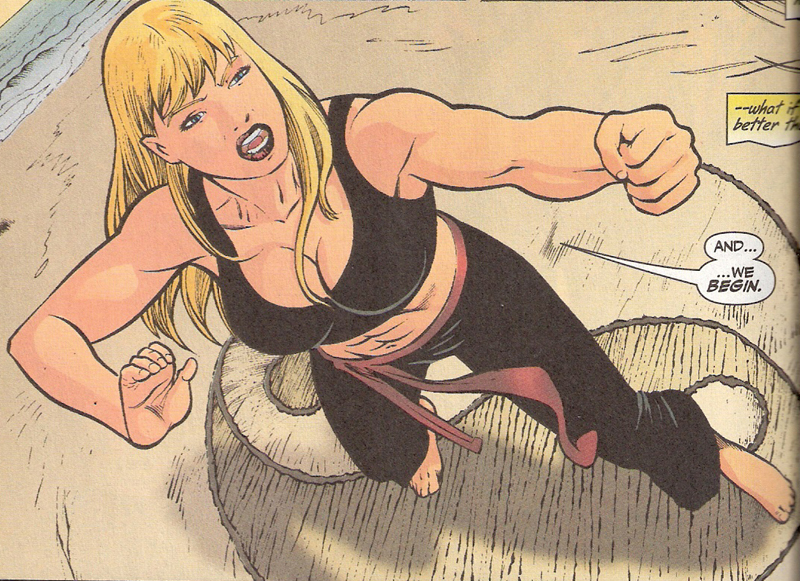
The plot seems a little thin in places. The first half of the book follows the Birds as they hunt down female vigilantes; as Oracle later notes, they get a win, a draw, and a loss, and I don’t know that that speaks all that well of the team. Although there are some chances to work some obvious parallels in those five issues, I feel those opportunities were missed. The second half involves stopping a Singaporean drug supplier and an attempt to infiltrate the Gotham mob. The stateside story works fine, but the Singapore side seems too steeped in “honor” stereotypes for me to get into. And I still don’t buy Oracle’s cyberinterface or its complications, which are resolved way too easily here.

Writer Gail Simone keeps the team humming along. The dialogue is excellent, especially when Simone stays away from the sappy moments. Zinda (Lady Blackhawk), who was introduced last volume, shows why she’s part of the team; Simone never forgets that Zinda is both from a different time and very good at what she does, and she manages to get those characteristics across to readers without banging them over the head with it. (I think Zinda is my favorite Bird now.) Simone keeps track of her loose ends and keeps the reader feeling like it’s the characters, not the team or the book’s gimmick, that matters. Simone also uses the DC Universe to her advantage, bringing in characters that advance the storyline without letting those characters overwhelm her story.

The good news: this is the end of Ed Benes’s run on the title. If you’ve read my previous reviews of Birds of Prey, you might remember my complaints about his cheesecake art. Nothing changes about that here: he’s a good artist who lets his predilection for certain parts of pretty ladies show through too much.

Black Canary, Bennett styleHis job is taken over by Joe Bennett, who draws five of the remaining eight issues in Battle. He draws action scenes pretty well, which is good, because he gets to draw a lot of them in Battle. I never warmed to his style, however; his women lack well-defined noses, have slack, open mouths, and generally don’t have much expression on their faces. They look a little like blow-up dolls, to be frank. I really like the art from Joe Prado, who draws a slightly scratchy #76, featuring the Birds vs. a Goth teenage Wicca with real power, and Tom Derenick, who draws #77-8 in a style more than slightly reminiscent of Sal Buscema, whom I never get tired of.

I suppose that feeling of disappointment I remember comes from being slightly underwhelmed by the story. Simone’s characters and dialogue once again meet my high expectations, but I miss the feeling of a deeper plot. Huntress’s storyline is a move in the right direction, and it might be even better in the next volume, but it isn’t quite there yet. I suppose I also didn’t care for the heaviest artistic workloads being given to my least favorite of the four pencilers.

Although, if I had paid for Battle rather than checking it out of the library, I suppose getting so much story for so little might have mitigated those feelings.

Rating: DC logo DC logo Half DC symbol (2.5 of 5)

Labels: , , , , , , , , , , , , , , , ,

23 September 2009

Birds of Prey, v. 3: Between Dark & Dawn

Collects: Birds of Prey #69-75 (2004)

Released: February 2006 (DC)

Format: 176 pages / color / $14.99 / ISBN: 9781401209407

What is this?: Huntress infiltrates a cult while Oracle battles the enemy within; then, the Birds clear up loose ends before leaving Gotham.

The culprits: Writer Gail Simone and pencilers Ed Benes, Ron Adrian, Jim Fern, Eduardo Barretto, and Eric Battle

Gail Simone Week begins with Birds of Prey, v. 3: Between Dark & Dawn, the third volume (even if DC is loathe to admit it) of the Gail Simone-written run on the title.

I’ve reviewed the first and second volumes of the series, but this is the first one that has disappointed me. The main plot, which takes place in issues #69-73, has Huntress investigating a cult that revolves around superheroes and Oracle dealing with what appears to be a cybervirus. (There’s also an amusing sideplot about Oracle giving Savant a job to prove himself worthy, but that one pays off in #74.)

Birds of Prey: Between Dark and Dawn coverNeither of the plots worked. Despite having fun dialogue and the characters readers have come to enjoy, this was too by-the-numbers. First, showing a character interfacing between “cyberspace” and the real world is always a dicey proposition, and even though the explanation for Oracle’s infection makes sense, it still doesn’t feel right. It starts out interesting — Oracle seeing patterns in an unplugged screen is suitably creepy — but the more it becomes concrete, the less interesting it is, the less possible madness is for an explanation and the more it becomes a standard fight that Oracle shouldn’t win. She does win, of course, through the most hackneyed way possible: beating the logical machine with emotion.

I have only one word for the hybrid of Oracle and the infection: no. Silver skin with thick electrical cables for dreadlocks does not work as a look.

I also have my troubles with Huntress and the cult. Simone has fun with Huntress, making her sharp witted and sharp tongued. But I’m not quite sure Simone pulls off the idea of a cult leader with mind control (unoriginal) and faith in superheroes. That the mind control works only on those with faith doesn’t help; instead, it only muddies matters, throwing another element into a story that might have needed something different to help it along but didn’t need what feels like tacked-on mutterings about belief.

The final two issues are excellent and raise the book out of the doldrums. Issue #74 has a few different elements, but most of them are amusing, and even though it’s an overall mishmash, it is wrapping up some dangling plots. Issue #75 blows up Oracle’s base with no warning of plot development — it’s a fait accompli when the issue begins, so I don’t feel bad about spoiling it — but it takes off from there, with the Birds of Prey running one last mission before leaving Gotham. The issue also introduces Lady Blackhawk to the Birds with a bittersweet story of a timelost character — it’s not a new idea, but on the other hand, her gender and feelings of discrimination make her a unique fit for Birds.

If you’ve read my reviews of the other Simone Birds, you know my feelings about Ed Benes’s art: overemphasis on cheesecake, but other than that, a good artist. I particularly like his work on the Lady Blackhawk story (if that’s who it was; DC doesn’t provide credits on individual issues). On the other hand, dreadlock cyberOracle was his fault, and he makes Black Canary wear a flyaway frilled blouse to the hospital; it’s aggressively ugly. Some artist also thinks bait for fishing looks like hotdogs, but I believe that’s Ron Adrian who drew #69. Adrian does an admirable job of fitting in with Benes’s work. Adrian and Eric Battle pencil #73, and Jim Fern contributes #74; I imagine Eduardo Barretto does #75, but I have no proof. None of these artists really stand out, except for Adrian.

Although this is below average for Simone, I think this is just a bump in the Birds of Prey road. I’ll keep reading along — and I’m excited, because in only two more volumes, there will be a new artist.

Rating: DC logo DC logo Half DC symbol (2.5 of 5)

Labels: , , , , , , , , , , , , , ,

17 July 2009

Birds of Prey, v. 2: Sensei & Student

Collects: Birds of Prey #62-8 (2004)

Released: January 2005 (DC)

Format: 168 pages / color / $17.99 / ISBN: 9781401204341

What is this?: Black Canary and Lady Shiva meet for the death of their sensei and are entangled in Cheshire’s poisonous plots; Oracle is menaced by a talented hacker.

The culprits: Writer Gail Simone and pencilers Ed Benes, Cliff Richards, Michael Golden, and Joe Bennett

When it comes to Birds of Prey, v. 2: Sensei & Student, there is a strong temptation to say, “Second verse, same as the first, good job,” and call it a day. Very strong temptation — hmm, I wonder when happy hour begins down at that tiki bar down near the public beach …

No! No, I have to do a better job than that. This isn’t a retread of the first volume, Of Like Minds. Writer Gail Simone didn’t slack off, and I shouldn’t either. There are new antagonists, a new interaction for Black Canary, and thrilling new hacking action! OK, that last part isn’t true: the hacking is decidedly not thrilling.

Birds of Prey, v. 2: Sensei & Student coverThe most interesting part of Sensei is Black Canary’s story. She heads to Hong Kong to see her dying sensei; while there, she meets the assassin Lady Shiva, who is also there to pay her respects. When the sensei is murdered before he can die, they team up to find the culprit; the trail leads to assassin / poisoner Cheshire, who insists she’s being set up.

The interaction between the three is great; a grudging respect between Canary and Shiva is turned into a genuine partnership when the truly evil Cheshire is thrown into the mix. The dialogue and characterization of the three is great, even if Cheshire shies away from some of her evil (mutilating Shiva) for no defined reason. Simone does her best work in this part of the story; every time Shiva is on the page, the story seems more lively, more interesting, and more dangerous, and some of that rubs off on Black Canary.

Unfortunately, Oracle’s subplot, in which she is menaced by a hacker whose abilities seem to outstrip hers, seems lacking. Although it’s nice — and it would have been eventually necessary — for Oracle to run into someone better at the keyboards, there’s no effective payoff for that part of the story. Oracle is also abducted by a mysterious government group, forcing her to call on Huntress for rescue; even though those two storylines have a connection, they never feel related, just like Canary’s story doesn’t feel connected with Oracle’s despite common antagonists. That’s worse, in its way, than a swarm of completely unconnected plots.

That has me worried; I’m not quite convinced about Simone’s overall plotting skills. There’s too much coincidence in the story; the plans of Cheshire, the hacker’s employer, and an old serial killer investigated by the original Black Canary come to a head all of once, and the evil is all related by blood. This raises certain nature / nurture questions Simone doesn’t address, despite the presence of a perfect candidate: Huntress, a daughter of the mob. Speaking of Huntress, if a male writer had emphasized her sexual proclivities as Simone does, he would probably be accused of titillating his readers. And while we’re on gender politics, doesn’t Oracle know any male superheroes? All the ones who aid in her escape are female, except Savant; although I appreciate his presence as a tie in to the previous storyline, I’m not sure about his long-term viability as a character.

Black Canary in a crop topEd Benes provides most of the pencils (and some inks) for Sensei, and he shows his usual restraint and taste when drawing the female form. There’s nothing I can say that I didn’t say in the review of Of Like Minds: he’s a good artist who lets the female anatomy dominate his style. I have nothing to say about Joe Bennett (penciler for #68) or Cliff Richards, who pitched in with pencils on the first two issues. For Richards, that’s good, since he’s obviously supposed to blend in with Benes’s work. It’s good for Bennett as well; his style differs from Benes’s more than Richards, but he definitely fits in with the artistic tone of the book: I mean, just look at the crop top he gave Canary in that issue.

I’m torn on Michael Golden’s work on #66; it’s a flashback, in which the bulk of the issue is narrated by Canary’s mother, the original Black Canary. It’s a nice idea to have a different artist for the flashback issue, and Benes’s pencils would have looked odd in the shadowily defined past. But Golden’s work doesn’t say “past” to me either, for the most part; he does better on the more detail-oriented pages — in the hospital, for instance. At one point in the story, though, I had trouble figuring out a murder victim was a woman rather than an Albert Einstein impersonator. Perhaps she was both. I don’t know.

Although the comments in this review are different than the ones for the first Birds of Prey volume, the summary and rating aren’t: I’m looking forward to the next volume, and I’ll be very happy when Benes has moved on. Now, if you will excuse me, I can already hear the steak sizzling, and the beach is calling …

Rating: DC logo DC logo DC logo Half DC symbol (3.5 of 5)

Labels: , , , , , , , , , , ,

01 June 2009

What the Hell, DC?

I got my copy of Batman: Battle for the Cowl #3 in the mail yesterday. (I had subscribed to Batman, which got switched to issues #2 and #3 of Battle for the Cowl — but not #1. Thanks, DC!) Anyway, I noticed that Black Canary appears in one panel in the issue, in a crowd scene but in the foreground.

Writer / artist Tony S. Daniel has made the decision to go for a rare triple on Black Canary: ass shot, torn fishnets on legs that are 150 percent as long as her head and torso combined, and breasts in profile with a hint — the merest hint — of an upturned nipple. As I mentioned, this is Black Canary’s only appearance in the issue.

Comparatively, Daniel played it conservatively with Huntress — she too has her backside to the reader, but she has her hand obscuring her rear. Her legs are as proportionally long as Black Canary’s, but of course she features boots just above the knee rather than fishnets. Still: breast in profile, hint of nipple.

Keep it classy, DC.

Labels: , , , , , ,

03 March 2009

Birds of Prey, v. 1: Of Like Minds

Collects: Birds of Prey #56-61 (2003-4)

Released: February 2004 (DC)

Format: 138 pages / color / $14.99 / ISBN: 9781401201920

What is this?: Oracle and Black Canary battle a rival information broker and decide about what to do with Huntress.

The culprits: Writer Gail Simone and penciler Ed Benes

In Birds of Prey, Vol. 1: Of Like Minds, writer Gail Simone takes over the reins of a mid-list Batman Universe title and makes it into something to talk about, whether or not the person talking had ever read Birds of Prey.

Is Simone experienced enough? Will having a woman write a book featuring women as its leads help the book? Will she start writing it as womyn? Will it hurt sales? Will it help sales? Frankly, these questions are unimportant to me. All I care about are the stories the book tells. I liked the earlier v. 1 of Birds of Prey, but it’s not like I had some sort of attachment to the title or creative team, so I have a relative open mind on where Simone takes the title.

Birds of Prey, v. 1: Of Like Minds coverSo we have Simone, who seems to be living the kind of life story every comics fan would like to experience. Gaining attention with Women in Refrigerators, Simone moved on to a humor column, You’ll All Be Sorry. From there, it was a clear path to full-time comic book writing, fame, money, and respect.

Well, not really. But it makes a shorter story that way, and my attention span isn’t … hey, isn’t Lost on tonight?

Simone makes some changes to Birds right away. She introduces humor into the story, although the good lines are unobtrusive and rarely require sacrificing plot or characterization. She also brings Huntress into Oracle and Black Canary’s group, and she introduces a new villain — Oracle’s opposite number, Savant, who uses his data hacking abilities for blackmail instead of justice. As is common for a new writer on a title, they seem to have a special fondness for their new characters. Savant is fun, in a savage way, although that might just be me — I like humor based on cruelty. Huntress is similar in some ways, her best lines playing off her greater willingness to inflict pain than the other heroes. The characters play well off each other; Simone’s facility with their interactions would be a credit to much more experienced writers.

It’s not all smiles and sunshine, though. I’m not sure what to make of Savant’s mental disability, in which he has a non-linear memory. Savant seems a little overpowered, which happens with new villains. The pacing seems a little off; the main story takes up four issues, making the final issues feel tacked on, stalling for time. That might be an artifact of the trade paperback, but, well, that’s what I’m reading. There’s an off-page breakup that smacks of clearing the decks. The moral dilemmas, involving blackmail information and Oracle’s fear for Black Canary’s well being, seemed contrived to me, a new reader.

Like many (most?) comic book artists, Ed Benes likes drawing pretty females, and he’s pretty good at it, although he is the first artist I can think of with a “long abdomen” fetish. (The legs are more out of proportion, but that’s not uncommon.) For some reason, Benes’s cheesecake irritates me, despite it not being an uncommon flaw. He revels in the cheesecake, and he makes no apology for it, not even when he gives us crotch or butt shots. Benes isn’t the one who gave Huntress that horrible new ludicrous bare-midriff costume — that was Jim Lee in Hush — but I don’t approve of its continuation. There are more than a few moments of physical comedy he seems to overplay as well, and I’m not sure he’s the right artist for Simone’s writing, which seems to require someone with greater delicacy of facial expressions.

I have a feeling Simone is going to improve as the title goes on (all right, I’m partially basing that on what I’ve heard from others). I’m excited to read the next volume, even more excited than I would have been to read the next Chuck Dixon volume of Birds, if there had been another. I’ll be even more excited for v. 4 of the Simone experience, when Benes leaves the title.

Rating: DC logo DC logo DC logo Half DC symbol (3.5 of 5)

Labels: , , , , , , , ,

23 December 2008

Birds of Prey, v. 2: Old Friends, New Enemies

Collects: Birds of Prey: Wolves, Birds of Prey: Batgirl, Birds of Prey #1-6 (1997-9)

Released: 2003 (DC)

Format: 224 pages / color / $17.95 / ISBN: 9781563899393

What is this?: The second volume of the first go-round for Birds of Prey, in which Oracle (the paralyzed former Batgirl) and Black Canary fight crime and get their own ongoing series.

The culprits: Writer Chuck Dixon and pencilers Dick Giordano and Greg Land

I haven’t had much experience with the characters in Birds of Prey. Oh, I know Oracle used to be Batgirl before the Joker left her paralyzed, and Black Canary is perpetually romantically linked with Green Arrow. (Although I’m always hazy about whether she has sonic powers.) So I decided to try Birds of Prey, v. 2: Old Friends, New Enemies from James Madison University’s Carrier Library. What I found was something not earthshattering but something that felt like it deserved its long (for the time) run.

I was mostly curious about whether Old Friends, New Enemies would offer something beyond the high concept: two women, one wheelchair bound and the other an active agent, fighting crime. There are times, like the first story, Birds of Prey: Wolves, when it really doesn’t. Writer Chuck Dixon veers dangerously close to stereotypes of women at times: men are no good, women eat ice cream to cope, etc. Not that there aren’t women with these traits, but they do seem a bit pat.

Birds of Prey: Old Friends, New Enemies coverDixon is determined to make Oracle an interesting and active — as active as he dares, at least — character. He succeeds, mainly, and Birds of Prey: Batgirl is one of the high points of the book. Oracle is captured by Spellbinder, who makes her hallucinate that she (as Batgirl) and Black Canary are fighting the Mad Hatter and the inmates of Arkham. This includes Joker, of course, who naturally triggers more than a little fear. But Oracle pieces together Spellbinder’s plan, outwits her, and then outfights her. I could do with Oracle giving herself fewer pep talks, but that’s a minor quibble.

The main series works well. Oracle and Black Canary function as a team, although an uneasy one at times, since they’re still working out the boundaries of their relationship. Issues #1-3 feature Black Canary busting up a kidnapping ring in southeast Asia after being kidnapped; issues #4-6 introduces the Ravens, the Birds of Prey’s opposite numbers, and includes Kobra, time travel, a Russian satellite, and a real dinosaur in a Minnesota lake. It doesn’t take a genius to figure out which is more interesting.

The Ravens — Cheshire, Pistolera, and Vicious — steal the show, and quite frankly, I would read a Ravens series. (I’m sure I’m going to get an e-mail telling me about some Ravens limited series or one-shot or something. I don’t care. I’m sure my imagination is better than whatever was actually released.) The action is weird, high concept, and fun — it feels like some of the stuff Matt Fraction overreaches for in Punisher War Journal or Casanova. These issues make reading Old Friends, New Enemies worth it, although to be fair, there’s not an awful lot of stuff for the Birds to do while the Ravens do all the cool stuff.

Actually, Black Canary gets a fair amount of action, although little of it against the Ravens. Dixon seems to struggle for something for Oracle to do, and he fills it in with side plots introduced in the first three issues of the ongoing series. Someone has Oracle under surveillance, the Air Force is looking for a hacker, Oracle has an e-pen pal … and I don’t care about any of it. None of it is useful to the plot, and nothing comes of it. It’s annoying, as well, especially the Air Force officers, who are stepping over laws to track down the hacker … and there are no consequences. Blockbuster also hangs around the fringes of the story, and while I assume that pays off later, he mostly looms and looks menacing here.

Pencils are by Greg Land, except for Wolves, which is by Dick Giordano. Now, in 2008, if you have a comic featuring two female protagonists with a team of three female villains against them, the name “Greg Land” is going to come up when you discuss prospective artists. I don’t know if that was true in 1999, but Land does a good job. His cheesecake tendencies are nowhere near what they became later, and his admiration of the female form does not interfere with telling the story. There are more than a few panels with a scantily clad Black Canary, but given her default costume, that’s to be expected.

I wish there were more of this part of the series. There isn’t, though; only two volumes were released before the trades were renumbered to collect the Gail Simone issues. Still, Old Friends, New Enemies is worth picking up and perhaps buying the original stories in single-issue form.

Rating: DC logo DC logo DC logo (3 of 5)

Labels: , , , , , , , , , ,