Reviews of trade paperbacks of comic books (mostly Marvel), along with a few other semi-relevant comments / reviews.

06 June 2008

She-Hulk, v. 3: Time Trials

Collects: She-Hulk v. 2 #1-5 (2005-6)

Released: June 2006 (Marvel)

Format: 136 pages / color / $14.99 / ISBN: 0785117954

You can bet that any She-Hulk book with Dan Slott’s name on it will be gold.

Slott is the writer of She-Hulk, v. 3: Time Trials, the first TPB in the series’s new lease on life after cancellation. In Time Trials, She-Hulk deals with the changes caused by the big battle at the end of her previous series and repairing the damage Avengers writers Chuck Austen and Brian Michael Bendis inflicted upon the character.

She-Hulk, v. 3: Time Trials coverFor that reason alone, Time Trials should appeal to Marvel traditionalists. But also there’s not a hint of decompression here; each issue is packed with story, characterization, continuity, and gags.

The art for issues #1, 2, 5, and part of #3 is by Paul Pelletier. He’s an acquired taste, sparse on details and certainly short on glamour. But given the other artists on the “jam session” issue (#3) and Skott Collins’s work on #4, that’s not such a bad thing. Pelletier makes her look powerful and large without making her seem casually grotesque or a refugee from the ‘80s. (Or a very bizarre Amazonian pin-up girl, which is cover artist Greg Horn’s take.) Pelletier is adept at comedy, which is the most important aspect of an artist’s job when keeping up with Slott’s scripts.

In Time Trials, She-Hulk works a trial in which the jury pool has been pulled from the past. Among the veniremen is Hawkeye, whom She-Hulk knows was killed in Avengers: Disassembled. Her mucking with time gets her tried by the Time Variance Authority as an excuse for a big retrospective in an anniversary issue (again, #3). After that, she brings home an Avenger from time limbo and deals with her destruction of Bone, Idaho, while under the influence of one of the Scarlet Witch’s spells.

That doesn’t sound impressive, and Slott’s run on She-Hulk could be criticized as being too reactive to other storylines (the same can be said about Slott’s The Thing, v. 1: Idol of Millions). But there’s nothing intrinsically wrong with using past stories, no matter how bad, as springboards for future stories. In fact, it’s laudable in a shared universe, and given the nudge and wink Slott gives readers over the more absurd plots, it’s almost cathartic. Even besides the jokes, even Slott’s throwaway ideas are excellent: the Green Cross, for example, is an organization that cleans up the destruction caused by gamma-spawned creatures, founded by the man who dared Rick Jones onto the bomb range and cause the Hulk to be created in the first place.

As always, enjoyable.

Rating: Marvel logo Marvel logo Marvel logo Marvel logo Half of a Marvel logo(4.5 of 5)

Labels: , , , , ,

05 September 2006

Essential Savage She-Hulk, v. 1

Collects: Savage She-Hulk #1-25 (1980-2)

Released: June 2006 (Marvel)

Format: 552 pages / black and white / $16.99 / ISBN: 0785123350

In the annals of Marvel, She-Hulk seems underappreciated. For a character who has been both an Avenger and a member of the Fantastic Four as well as having four solo series, rarely does anyone talk about the character. Sure, the second series, by John Byrne, is remember for being a humor series that broth the fourth wall and not much else, despite running X issues. The third and fourth series, written by Dan Slott are critically acclaimed but low sellers. And I don’t think I’ve ever heard anyone talk about the first series, Savage She-Hulk.
Well, there’s a reason for that.

All 25 issues of Savage She-Hulk are collected in the Essential Savage She-Hulk, v. 1, which should satisfy anyone’s curiosity about the series. She-Hulk was created by Stan Lee and John Buscema, making her one of Lee’s last creations at Marvel.6 After the first issue, David Anthony Kraft and Mike Vosburg took over. Both do a workmanlike job, but there’s just no spark or life in the book.

The character of She-Hulk has several problems. A female derivative of an already established male character, She-Hulk was created for trademark protection — that is, to head off someone else using the name. She-Hulk reuses the Hulk’s schtick (savage persona hidden in shy personality) without the extreme violence, conflict, or scope of the Hulk. The latter is one of the biggest disappointments to me; I always like the Hulk’s aimless wandering, as if no place was big enough to hold him except the Earth itself, and that only barely. She-Hulk is tied to LA like Philip Marlowe.

The Essential Savage She-Hulk also lacks decent villains. The highs profile villain — actual villain, not just sparring partner — is Gemini, a member of the Zodiac. There are plenty of guest stars — Iron Man, Man Wolf, Man-Thing, Hellcat, Morbius, and Bruce Banner — but there are no threats the reader of the early ‘80s would deem credible (or anyone the modern reader would deem credible either). The back cover mentions that She-Hulk encounters Man Wolf, Man-Thing, and the Man-Elephant — and those are highlights. The villains aren’t even goofy enough to be endearing; Man-Elephant, for example, is just a guy who thinks elephant shaped armor (with weapons) is a reasonable idea to fight crime, but when he’s told his actions are irresponsible vigilantism, he agrees and quits wearing the armor.

She-Hulk’s main opponents are the Mob, which makes a lot of sense for She-Hulk’s altar ego, Jen Walters, but not so much for She-Hulk herself. She smashes whatever morons get in her way, and the bosses often try stupid super-science to stop her. They fail. What they really need is a better hiding place, not Iron Man’s castoff armor. She-Hulk’s lack of credible rogue’s gallery is used for laughs in the second issue of Slott’s She-Hulk series: when pressed for the names of those who would hurt her in her human form, She-Hulk comes up with Man-Elephant, Ultima, and Titania (twice).

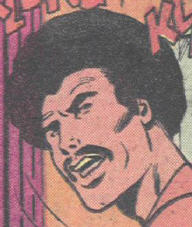
The supporting cast is dull, dreadfully dull. Jen engages in the most tepid love triangle in Marvel’s history, with Jen between a Man-Thing castoff (loser Richard Rory) and the med student next door (“Zapper” Ridge). Neither has much of a personality. For some reason, Jen prefers Rory, while She-Hulk’s likes to jump Zapper’s bones. But Zapper has a Magnum moustache and an impressive ‘fro, so he gets the girl in the end.

Jen’s dad, LA County Sheriff Morris Walters, is a jerk; he won’t talk to his daughter about a bounced check, deciding to disown her instead. When her defense of Michael Morbius (“the Living Vampire”) leads to his conviction on involuntary manslaughter charges instead of first-degree murder, he acts as if Jen killed Morbius’s victims himself, saying he wishes she’d never have been born. Rounding off the cast is male chauvinist DA “Buck” Buckowsky, who eggs on the woman’s libber and generally is an ass.

There are altogether too many cheesecake shots of the She-Hulk. Whenever Jen transforms into She-Hulk, her dress is strategically torn in order to titillate; that’s artistic license, sure, but it’s always torn in the same way. I’m not saying Vosburg has an Amazon fetish, since Buscema drew the first issue and give the heroine a cheesecake design and a few “sexy” poses. But there are entirely too many panels where a green-skinned giant is meant to be an object of desire. I can’t decide whether the effect is better or worse in black and white.

This book is just below mediocre, but it isn’t bad enough to excite exceptional interest (like Street Poet Ray).

Rating: (1.5 of 5)

Labels: , , , , , , , , ,