Reviews of trade paperbacks of comic books (mostly Marvel), along with a few other semi-relevant comments / reviews.

29 June 2013

Demon Knights, v. 2: The Avalon Trap

Collects: Demon Knights #0 and 8-12 (2012)

Released: May 2013 (DC)

Format: 144 pages / color / $14.99 / ISBN: 9781401240394

What is this?: Medieval heroes head to Camelot. Camelot? Camelot? Camelot! (It’s only an alternate version.)

The culprits: Writer Paul Cornell and artists Diogenes Neves and Bernard Chang


Following the fantasy protagonists’ defeat of an army in Demon Knights, v. 1: Seven against the Dark, the book’s seven heroes head to Alba Sarum to receive their reward in Demon Knights, v. 2: The Avalon Trap. Well, “reward”: it’s not so much compensation or perquisites as it is another mission. This time, the group is sent to Avalon to rescue the spirit of Merlin, who has been murdered in Alba Sarum.

So: fantasy quest. Writer Paul Cornell gives us Fantasy Quest #28b, the one with a crumbling castle, a trap, and a double cross; the “b” denotes the variant where the characters are given their fondest desires, but it come with a price. In truth, the quest is not as cookie cutter as I’m making it seem, but it does lack heft. The trap is set by the obvious culprit, and the trap itself lacks any subtlety or hint that it is anything but what it is. The double-cross comes from the person Cornell has already told readers is a double-crosser.

Demon Knights, v. 2: The Avalon Trap coverThe plot’s predictability isn’t Avalon Trap’s only weakness, however, and it isn’t even the plot’s only weakness. It story is also slow, with the quest creeping through a landscape filled with giant, distorted animals that are eventually shown to have little relevance to the villain's plan. And then there’s the question of Camelot and King Arthur …

Three of Demon Knights’s protagonists were at Camelot when it fell: Jason Blood (who shares his body with Etrigan the Demon), Madame Xanadu, and Shining Knight. Jason and Xanadu were sweethearts, but they and Shining Knight have no knowledge of each other. To rectify that apparent contradiction, Cornell posits a multiplicity of Camelots and Arthurs. It solves the problem with the Shining Knight neatly, but it robs the fall of Camelot and the death of Arthur — the heart of the Arthurian legend — of some of its narrative heft. What does it matter that those characters’ Camelot fell? Camelot is always falling, Arthur is always dying and returning. Camelot is significant to the world of Demon Knights, but Camelot’s devastation and Arthur’s transformation in issues #9-12 aren’t a tragedy or even especially sad; each fallen Camelot is just a set with different dressing, starring a different actor as Arthur with a slightly different costume.

The ensemble approach to character development Cornell used in Seven Against the Dark is put aside in Avalon Trap in favor of an emphasis on Xanadu and Etrigan. Issue #8 goes into the history of their love triangle with Jason Blood, and #0 follows Etrigan’s rise through the demonic ranks. Given the large cast, concentrating on a few characters seems wise; Xanadu and Jason Blood / Etrigan are the book’s most recognizable characters, so starting with them makes sense. The other characters get only a few chances to shine; Al Jabr is distrustful of Vandal Savage, who gets the best lines (“I will not die so a woman with no face can gain different genitalia!”), and Shining Knight displays some impressive swordwork. Those moments do not dispel the “Etrigan, Madame Xanadu, and Friends” vibe Avalon Trap has, though.

A few notes strike me as false, even after suspending my disbelief. First, the characters use the British insult “swivers” a few times; the word is roughly from the right time, dating back to at least 1440, according to the Oxford English Dictionary. It means “someone given to sexual indulgence.” That doesn’t seem like much of an insult to characters like Etrigan or Vandal Savage, and the term looks self-consciously strange to Americans. Secondly, Alba Sarum is ruled by a pair of princesses who hope to marry each other. While royal lesbians surely existed, by the laws of averages at the very least, the medieval protagonists’ and townsfolk’s acceptance is strange. Stranger still is Xanadu’s thinly veiled plug for gay marriage.

Diogenes Neves provides most of the art, although on more than half his five issues he has to have an assist. Neves differentiates the characters well, and his storytelling is good. He draws some excellent monsters as well. However, the extent of the characters’ transformations in #11 is a bit unclear. Bernard Chang draws #0 and does a very good job as well. If only Marvel had demons as fearsome as the ones Chang draws!

The visuals aren’t enough to save Avalon Trap, though. The setting is disposable, the plot is slight, and most of the cast is underused. The promise of Demon Knight has faded; I don’t know if I’m going to pick up v. 3.

Rating: DC logo DC logo (2 of 5)

Labels: , , , , , , , , , , , , , , , , ,

26 September 2009

Wonder Woman: The Ends of the Earth

Collects: Wonder Woman #20-5 (2008)

Released: March 2009 (DC)

Format: 144 pages / color / $24.99 (hardcover) / ISBN: 9781401221362

What is this?: A man with no soul sends Wonder Woman on a quest against a great evil, along with Beowulf.

The culprits: Writer Gail Simone and pencilers Aaron Lopresti and Bernard Chang

And to end Gail Simone Week, we have Wonder Woman: The Ends of the Earth. This is Simone’s second volume as writer of Wonder Woman (although again, it’s not like DC will tell anyone, omitting volume numbers).

Issues #20-3 make up the eponymous story, in which a nameless man with no soul forces Wonder Woman to gather Beowulf and a barbarian to fight the demon who has taken his soul. It’s a straightforward story, although Simone manages to get a few twists in. However, the major drama in “Ends of the Earth” seems to be whether Wonder Woman will lose touch with mercy and / or kill someone. Although that is threatened, it’s something that doesn’t seem very likely … Wonder Woman’s death seems more likely, since you can come back from death but not from being a murderer.

Wonder Woman: The Ends of the Earth cover On the other hand, Wonder Woman has murdered a man, and the demon torments her with the knowledge. Wonder Woman did it for a greater good, but … the mercy / murder dichotomy seems to be part of Simone’s grand unifying plan for Wonder Woman, the idea that assimilates (or tosses aside) all the piecemeal characterizations Wonder Woman has had and finally gives her a proper concept. It doesn’t quite work here, I think; the opponent feels generic, and the threat doesn’t have enough dramatic heft to make Simone’s concept stand out.

The final two issues have two stories: Nemesis meeting with Wonder Woman’s mother, Hippolyta, for half an issue, and the rest with Wonder Woman on the set of the Wonder Woman movie, which has been hijacked by a villainess. Both of these B stories are better than the main tale. Hippolyta and Wonder Woman put the bewildered Nemesis through hell, tormenting him both as a test and because they can, and it is, at times, hilarious, although it is over the top. The Wonder Woman movie is amusing as it goes through all the bad ideas that have been thrown at the Wonder Woman character over the years and forces the character to face them. She is rightly embarrassed and wishes they would go away. The villainess is forgettable, but Diana’s superintelligent ape advisors amuse me greatly. I’m not sure I’d want their help on contract negotiations, as they’re too distracted by offers of fresh fruit, but I’m sure they’d be a benefit if discussions got too sticky.

The Ends of the Earth features a couple of strong artists. As I mentioned in my review of Wonder Woman: The Circle, I like the work of penciler Bernard Chang, who drew the final two issues. His Wonder Woman stands out as a warrior and not a pinup. Aaron Lopresti penciled “Ends of the Earth” and did a very good job, although his work is a little too generic — or perhaps Dodson-like — to truly stand out. Still, I have no quibbles about the art itself.

This one’s out only in hardback, which I’m a little disappointed in; the paperback is due out next March, according to Amazon. (Obviously, solicitations aren’t announced that far ahead of time.) DC often waits a year before putting out paperback version of hardbacks. I don’t like that, but it’s their company. On the other hand, this is my review, and I can’t recommend buying this in hardback. If you’re a Wonder Woman or Simone fan, by all means, get the paperback — but $25 is too much for this.

Rating: Wonder Woman symbol Wonder Woman symbol (2 of 5)

Labels: , , , , , , ,

29 May 2009

Wonder Woman: The Circle

Collects: Wonder Woman v. 3 #14-9 (2008)

Released: August 2008 (DC)

Format: 160 pages / color / $24.99 / ISBN: 9781401219321

What is this?: A reinvisioning of just what it means to be Wonder Woman, an Amazonian princess in Man’s World

The culprits: Writer Gail Simone and pencilers Terry Dodson and Bernard Chang (with some help)

Many comic fans much more prominent than I have wondered what is compelling about Wonder Woman. Does she have a claim to prominence other than being an editorially mandated peer of Batman and Superman? What is Wonder Woman, other than a female superhero — what’s her schtick?

Is she a warrior? A soldier? A diplomat? Martial artist Diana Prince? A superspy? The ambassador to Man’s World?28 A goddess? She’s been all this and more, really, although she’s never really staked a solid, long-term claim to anything other than a warrior, and warriors in superhero comics are a drachma a dozen.

Wonder Woman: The Circle coverIn Wonder Woman: The Circle, writer Gail Simone goes for the best of all of these things. As helpfully pointed out by writer Mercedes Lackey in her introduction to the volume, Simone has made Wonder Woman into the “Supreme Warrior,” who wants to end conflict — a diplomat, a warrior, a tactician, with compassion and strength. With a bit of the goddess thrown in.

That’s a heck of a standard to live up to, and to be honest, it doesn’t resemble the character I’d read about in Jodi Picoult’s Wonder Woman, v. 2: Love and War. But I have to admit, for the most part, Simone’s Wonder Woman does live up to the billing.

The Circle has two stories: one in which Wonder Woman deals with Nazi invaders and native fanatics in Themiscyra, and the other in which she is brought to a world of aliens, whose prior invasion of Earth she had thwarted, to end a war they are losing badly. The first, the eponymous “The Circle,” is the big one, in which Simone sets up her status quo and tells the reader who her Wonder Woman is going to be. And she pulls out all the stops to make us like her: there’s a couple of fights with intelligent gorillas from Gorilla City, a lot of punching of Nazis. Superpowered Nazis, even. And I’m impressed with how well the mostly-new, a-good-deal-different Wonder Woman works. She converts enemies into allies. She shows a decent handle on diplomacy, although some of it seems to be at the cost of long-term consequences. She tries to use tactics, although again I doubt some of her wisdom. And the reappearance of Lt. Col. Candy comes out of nowhere, but at least she’s a long-standing Wonder Woman character. The point is, Simone tries to pull off her Supreme Warrior Woman, and it mainly works.

I didn’t think the subplot worked, though. In it, Wonder Woman’s mother, Hippolyta, appoints four Amazons as her personal guards before Wonder Woman was born; when they see their queen pregnant, they think the child’s birth will tear the island apart, so they try to murder poor infant Diana. And fail. And when the island is invaded, many years later, they get free and try to kill the adult Wonder Woman. But the four Amazons have the feel of characters ret-conned in for a specific story — even if they weren’t, they have that aura — a story I felt went nowhere. Also, I remained unconvinced as to why those four felt so sure their queen having a baby would be such a catastrophe. Perhaps I underestimate the emotional power of an island full of childless women (who will likely remain childless), but the betrayal felt arbitrary. Simone may be setting them up for a longer-term plot, but that doesn’t make me optimistic.

The second story, “Expatriate,” is much more to my liking. Wonder Woman begins her formal and funny courtship of Nemesis, and an alien race she had trounced before calls her for help. And then a Green Lantern gets involved, and the questions of justice and genocide are put into play, and it really does seem deeper, in two issues, than four issues of punching Nazis and rogue Amazons do in four. The situation Wonder Woman finds herself in makes diplomacy a better option than in “The Circle,” although Diana’s solution should come back and bite someone on the ass, even if it doesn’t.

The art on “The Circle” is furnished by Terry Dodson on pencils and Rachel Dodson on inks. If you’ve seen the Dodsons’ work before, “The Circle” looks exactly like that, down to the identical noseline on every female character. It’s very pretty, and I have no real complaints, other than Wonder Woman usually seeming more like a model than a Supreme Warrior. Ron Randall fills in for half of one issue and most of another and does a good job — the same sort of pretty, smooth line but without aping Dodson’s style. However, I prefer the work of Bernard Chang on “Expatriate.” His Wonder Woman looks stronger, more human, and slightly different — definitely not standard Western European supermodel that most artists provide. His aliens are a little too human in their trappings, I think, but at least his females look different.

The Circle is the best Wonder Woman story I’ve read — not a major competition, really, but still an accomplishment. I have some misgivings about the plot, but I enjoyed the audacity of the character, the depth given to someone who was previously “the female one.” But this doesn’t feel like the same character I’ve read about before, and I have a hard time expressing how uncomfortable that makes me feel. Is this the real Wonder Woman? I have a hard time saying anything but “Yes.” If that’s true, then who was that other woman I read about? For some reason — unlike, say, Batman — I have a hard time considering multiple takes on Wonder Woman. (I have the same problem with Superman.) Given the mediocre / forgettable Wonder Woman stories I’ve read in the past, I’d almost rather Simone have created a new character; but given that Wonder Woman has cachet and a need for a definitive characterization (other than bondage model), then this will do well.

Rating: Wonder Woman symbol Wonder Woman symbol Wonder Woman symbol Wonder Woman symbol (4 of 5)

Labels: , , , , , ,

12 December 2008

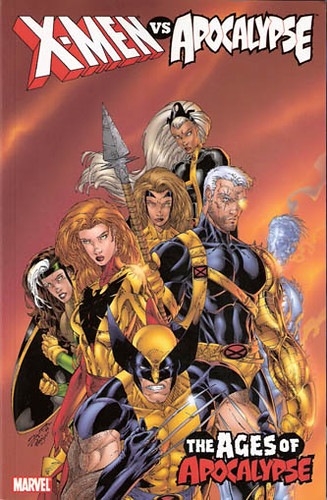
X-Men vs. Apocalypse, v. 2: Ages of Apocalypse

Collects: X-51 #8, Uncanny X-Men #378, Uncanny X-Men Annual ‘99, Wolverine #148, Cable #77, X-Men #98, X-Men: The Search for Cyclops #1-4 (2000-1)

Released: September 2008 (Marvel)

Format: 288 pages / color / $29.99 / ISBN: 9780785122647

What is this?: Continuation from X-Men vs. Apocalypse, v. 1, picking up almost immediately after the previous volume leaves off.

The culprits: A predictably large crossover cast; writer Joseph Harris and artist Tom Raney get the biggest chunk of the book.

If you would have told me I would prefer X-Men vs. Apocalypse, v. 2: Ages of Apocalypse to X-Men vs. Apocalypse, v. 1, I would have called you a damn dirty liar and punched you in the face.

Well, I probably wouldn’t have punched you in the face, since the court-ordered treatments have taken care of that. (Mostly.) But I probably would have thought you had a few servomotors malfunctioning in your metaphorical power armor.

X-Men vs. Apocalypse, v. 2: Ages of Apocalypse coverI remember reading most of these stories when they came out, back at the turn of the century, and thought they were, for the most part, forgettable. Putting aside the idea I can remember something as forgettable, it certainly felt it was not a worthy follow up to the storyline that ended The Twelve storyline once and for all. Having actually read what was in v. 1, however, I have to reappraise v. 2.

Don’t get me wrong; the quality of the content in Ages of Apocalypse is wildly variable. X-51 #8 and Uncanny X-Men Annual ’99 have nothing to do with Apocalypse and are included because, well, they seem to fit in the chronology, even if the characters’ chronology is a distraction from the plot. Not that the plot itself is much to write home about, but I have to pay lip service to it.

In v. 1, Apocalypse didn’t gain all the power he wanted, and he usurped the wrong body; to rectify this, he makes the X-Men think they are in various alternate realities so they will expend their energies and he can harvest them. Fair enough, although the stories sort of wave their hands in the general direction of how Apocalypse actually harvests it. The alternate realities stretch from the founding of the X-Men to the far future.

The best of the stories have fun with the alternate realities. Erik Larsen and Roger Cruz tell a story of the very brief, how-Bendis-might-have-conceived-them “New” Fantastic Four that briefly formed in Fantastic Four #347-9. Larsen doesn’t worry about making the story coherent; he drops readers into an action sequence, and keeps blowing stuff up and having the Fantastic Four save the day. It is far and away the best part of the book, and parenthetically, it’s the best part of Larsen’s otherwise disappointing run on Wolverine. The rest of the stories aren’t that kinetic, but they have their highlights: Adam Kubert’s Rogue as Mastermind-in-Uncanny-X-Men #1 is very nice, and Alan Davis has fun with the far future X-Men in X-Men #98, which serves as an excellent coda to the stories.

Not all of the stories are as fun, of course; Bernard Chang’s art in Cable #77 is stiff, and the plot is nothing to write home about. The lettering in Cable bothers me, just as it did in v. 1; it’s distracting and adds nothing to the story. X-Men Unlimited #26 is eminently forgettable, as most X-Men Unlimited stories were after the first year.

Whether the book succeeds depends on the miniseries collected at the end of Ages of Apocalypse: The Search for Cyclops. It’s a serviceable return to the status quo by Joseph Harris and Tom Raney, although no one’s going to remember it in a few years. In fact, no one remembers it now. But Harris was given the order to return things to the status quo, and he manages to do it.

It’s disappointing, but it was inevitable. The story doesn’t tread any new ground, except to introduce Anais, another superpowered follower of Apocalypse. I would have rather an old henchman of Apocalypse fulfilled her role; really, to build the idea that this might be the end for Apocalypse, it would have been better to throw in more of his old allies, such as the Dark Riders, his Horsemen, or the Alliance of Evil. Instead, we get Gauntlet, a former member of the Dark Riders, acting as an assassin, and … well, that’s it. There’s three issues of Scott wondering who he really is and Jean and Cable arguing over whether they can kill the merged Cyclops and Apocalypse, followed by one issue of fighting. As I said, disappointing, but inevitable. (Well, inevitable except for the odd alternate covers for issues #2 and 3, which feature Jean and / or Scott semi-clothed despite no hint of sensual content in any part of the series. But that’s just an odd cover choice.)

As I said, I enjoyed this more than v. 1. That does not, of course, make it good. The entirety of this series is best left to the X-Men fans, perhaps as a punishment for being on top of the comic-book heap for so long.

Rating: X-Men symbol X-Men symbol (2 of 5)

Labels: , , , , , , , , , , , , , ,

03 October 2008

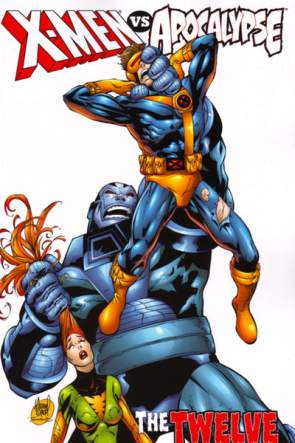
X-Men vs. Apocalypse, v. 1: The Twelve

Collects: Uncanny X-Men #376-7, X-Men #96-7, Cable #73-6, Wolverine #145-7 (1999-2000)

Released: March 2008 (Marvel)

Format: 312 pages / color / $29.99 / ISBN: 9780785122630

When I started buying trade paperbacks in earnest four years ago, I was obsessed with value — how many issues I could get for the dollar. I think X-Men vs. Apocalypse, v. 1: The Twelve would have made me very happy back then, with eleven issues for less than $20 at Amazon. That’s less than I would have paid for the individual issues.

X-Men vs. Apocalypse: The Twelve coverBut Twelve isn’t actually a good deal, and you know why? Because almost two-thirds of the book is useless and irrelevant. If this collection had added the Uncanny X-Men and X-Men issues that preceded the ones included here and dropped Cable and Wolverine, this collection might have been worthwhile. I mean, it’s a simple story: genocidal, idiot-Darwinist Apocalypse and his religious-themed henchmen capture the long-prophesied mutants called the Twelve and try to drain their powers to make Apocalypse all powerful. But no, you’ve got to slog through ancillary stuff to get to the meat.

Wolverine #145-7 is a distraction to the main story, and without earlier stories, the tale of how Apocalypse made him “Death” and how he reclaimed his soul (or some such thing) isn’t important. Everyone at the time knew his turn to the dark side wasn’t going to stick, and everyone knows it eight years later as well. And then Angel, another former “Death,” takes over the Wolverine story with his struggles with what Apocalypse had done to him. No one cares about that; that was resolved years ago. Let it go.

The Cable issues are no treat. They too are irrelevant to the main plot, showing who the new “Pestilence” and “War” are but not much else. It doesn’t take four issues to do that, believe me. Cable #75 takes the cake: Cable, captured by Apocalypse, very briefly escapes and is recaptured; #76 takes place entirely in Cable’s mind and doesn’t move the story forward at all.

(The weirdest part of the Cable issues is that the art is split between enemy of perspective Rob Liefeld (#73 and 75) and Bernard Chang (#74 and 76), presumably because Liefeld needed the break. But Liefeld’s art is actually better. I’m not saying Liefeld is good, but his work has an intensity and seriousness Chang’s cartoony style can’t match. I mean, you have to deal with Liefeld’s weirdly creased faces — everyone’s faces fold inward toward the eyes — and perspective problems and odd feet and … well, you get the idea.)

And the lettering … I never mention lettering, a credit to the many professional, competent, occasionally brilliant people who have lettered comic books over the years. But the lettering in Cable — ascribed to “RS and Comicraft’s Said Temofonte” — is godawful. I’m assuming RS refers to Richard Starkings, and Starkings and Comicraft have done a lot of Marvel’s lettering over the past decade. But man, this painful stuff: an unconventional font that makes it seem Cyclops, Cable, Caliban (a simple-minded, mutated mutant), and Jean Grey all speak in the same tone. … I think this font is my least favorite part of Twelve, and that’s saying something.

The main issues are no picnic either. I know writer Alan Davis is trying hard, but without the proper setup and foreshadowing, the conclusion to Twelve looks slipshod. The four issues of the X-Men / Uncanny X-Men crossover seems to almost be as much about mutant Skrulls as about the X-Men themselves. The X-Men fall into Apocalypse’s clutches without putting up much of a fight, and they escape their prisons to stop by accident, not something they did. (You can argue it was a miscalculation on Apocalypse’s part, but I don’t believe it.) The cast is far too sprawling for a mere four issues, and it doesn’t help that some people pop in solely for the purpose of being used by Apocalypse and pop out for their own stories / plot convenience (Bishop, Mikhail Rasputin).

And the shifts in art styles throughout the books … Davis on X-Men, Roger Cruz and Tom Raney on Uncanny X-Men, Liefeld, Chang … There’s a different penciller on each issue of Wolverine: Leinil Francis Yu, Mike Miller, and Cruz. It’s a mess, and the artistic continuity is nil. Chang’s and Cruz’s exaggerated, cartoony styles contrast with Davis’s elegant pencils and Yu’s gritter realism. Raney’s style works pretty well with Davis’s, and Miller’s work is a good fill-in for Yu, but although Yu and Miller’s work appear in consecutive issues of Wolverine, they’re separated by three issues in Twelve. And then there’s whatever Liefeld does; that doesn’t play well with anyone at this end of the ‘90s.

Twelve could work as it was originally structured in the original core X-Men titles: meandering stories with a bit of foreboding, a bit of Skrulls, and a lot of Apocalypse. (And a goodly amount of Alan Davis.) Instead, with the tie-ins, well …

Sadly, despite knowing better, I’ll probably end up buying X-Men vs. Apocalypse, v. 2.

Rating: X-Men symbol Half X-Men symbol (1.5 of 5)

Labels: , , , , , , , , , , , , , , ,