


Essential Sub-Mariner, v. 1
Collects: Tales to Astonish (Namor stories only) #70-101, Daredevil #7, Tales of Suspense #80, Iron Man & Sub-Mariner (Namor story only) #1, and Sub-Mariner #1 (1965-8)
Released: September 2009 (Marvel)
Format: 504 pages / black and white / $19.99 / ISBN: 9780785130758
What is this?: Prince Namor deals with love and challenges to his oft-neglected throne. Imperious Rex!
The culprits: Writers Stan Lee, Roy Thomas, and others and artists Gene Colan, Bill Everett, and others
I picked up Essential Sub-Mariner, v. 1 because I had a big old Namor-shaped hole in the middle of the heart of my Silver Age library, and I was excited to fill it. Turns out, I would have been better off having open-Silver Age surgery.
Namor the Sub-Mariner, prince of Atlantis, is not a Silver Age creation of Stan Lee and his talented group of co-creators; Namor was created in the Golden Age, back in 1939 by Bill Everett. Lee, never one to let a good idea go fallow, picked up Namor in Fantastic Four #4 (not reprinted here) and plopped him into the new Marvel Universe as a major player, giving him his own kingdom (Atlantis) and an unrequited romance with Sue Storm. Both Namor’s desires to conquer the surface world and / or bed Sue Storm were both pushed to the side after a few years, about the time Namor got his own feature in Tales to Astonish.
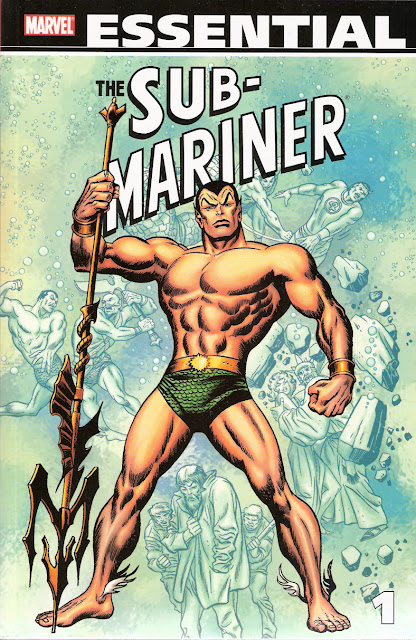 What Essential Sub-Mariner collects is the Namor stories from Tales to Astonish; the title had formerly been an anthology series and had been converted, like Strange Tales and Tales of Suspense, into superhero comics featuring two different heroes in their own tales. Namor shared Astonish with another headstrong brute, the Hulk, but the two never met in the title they cohabited. If they had, they would have made Tales to Astonish the most redundant title of redundancy.
Hulk and Namor are surprisingly similar characters. Namor might not be a green, gamma-irradiated brute, but he is a hot-headed thug whose answer to most problems of statecraft is to punch something. This is not a problem — Sir Punch-a-Lot is a character note that a lot of superheroes have carried off gracefully — but it doesn’t do a lot of favors to the character either, since it doesn’t set him apart from the pack.
What is interesting and unique about Namor? The Atlantean setting is the only unique part of Namor stories, although he shares the weight-of-leadership character note with Black Panther. To me, the latter is the more interesting, as “Atlantean” is generally portrayed as “fighting sharks and submarine monsters,” and Namor also has the burden of being a half-blood prince. He is half human, half Atlantean, and it would be understandable if many of his subjects found a prince of “impure” blood unacceptable.
But that’s not goes on Sub-Mariner; instead, Namor is nominally the ruler of Atlantis, while he spends almost as much time on dry land as he does in Atlantis. He is overthrown by Warlord Krang and Byrrah; he is challenged by the barbarian leader Attuma. He turns into a tyrant on one of the occasions he is returned to the throne. Does he have to politick? Do the people have any say about who rules them? (Well, they do when Byrrah takes over, and Namor’s lack of empathy with his people is brought out.) But mostly Atlantis is a waterlogged Banana Republic, with revolutions and counter-revolutions happening almost daily. It’s almost enough to make one’s head spin.
One gets the feeling that Lee is plotting by the seat of his pants and not doing as well as he usually did. The twelve-page stories don’t help, but the stories switch between multi-part stories (as in Namor’s pursuit of Krang and his estranged love, Dorma) and throwaway stories — insults from the surface world, another challenger for his kingdom, etc. Without a prolonged emphasis on what makes Namor different, it all runs together. Roy Thomas’s attempt to build some interest in Namor by exploring his origin, which serves as a cliffhanger for the book, isn’t enough to to hook me. (So to speak.)
The art is an interesting mix, although none of them get across the underwater element of Atlantis very well. Bill Everett, who created Namor in the Golden Age, drew several issues, and his art, although updated, resembles comics from World War II more than those of his younger colleagues. An issue or two from Jack Kirby, king of the Silver Age (and, to some, all comics), shows a contemporary look for the prince of Atlantis. About half the issues are drawn by Gene Colan, though, and that’s a welcome sight. Colan isn’t the artist he would be later in his career when he drew Daredevil and Tomb of Dracula with such a shadowy flair, but he’s very good, and and his work here is a harbinger of the Bronze Age to come. Whether it’s right for Namor is another question, but by the end of Essential Sub-Mariner, it’s certainly very pretty to look at.
The timing of the Essential Sub-Mariner’s release is almost assuredly a sign it is regarded by Marvel as a book for completists. While the almost all the other prominent Silver Age titles (with the exception of Nick Fury, Agent of SHIELD and Howling Commandos have at least one volume out and usually many more, Namor is bringing up the rear — trailing behind the Human Torch and Ant-Man, for Heaven’s sake. The forgettable contents of Essential Sub-Mariner do nothing to dispel that impression.
Rating: 
 (1.5 of 5)
Labels: 2009 September, Atlantis, Bill Everett, Gene Colan, Marvel, Namor, Roy Thomas, Stan Lee
posted by Raoul | 3:22 PM
|
0 comments

 Essential Super-Villain Team-Up is a book filled with more misnomers than any Marvel TPB. The eight issues of Astonishing Tales are not so astonishing; Super-Villain Team-Up is generally Dr. Doom trying to figure out what to do with Namor the Sub-Mariner, who at that point wasn’t really a villain, super or otherwise; the Avengers don’t really avenge anything; and the Champions would be lucky to win a co-ed softball league. And really, only one of the two issues of Giant-Size Super-Villain Team-Up is all that large, and that’s because they made the reprints in it too intrinsic to remove easily. The only thing “essential” about it is if you want to read about Dr. Doom’s first, unsuccessful attempt to take over the world with a contaminant in the atmosphere. (He’s successful in the graphic novel Emperor Doom.)