


Pop Quiz: Essential Sgt. Fury and the Howling Commandos, v. 1
 I’ve just read the Essential Sgt. Fury and His Howling Commandos, v. 1, and boy, did it raise some questions. Lucky you: I’m going to share some of them, and I’ll even add a few of my best guesses for each. But I don’t know which is right. For the answers, visit your local Army recruitment office, which will be glad to educate you on all manner of topics related to national service. (You may have to sign some paperwork before they give you the answers. Please do so without annoying the nice recruiters by reading it.)
1. When during World War II do these issues take place?
a) 1942. The missions in North Africa means everything must happen before the Afrika Korps surrendered in May 1943 and more probably before the climactic battle of El Alamein in fall 1942.
b) Late 1943 or the first half of 1944. Many mentions of the future D-Day landing are made, and planning for that operation took place between late 1943 and the invasion date of June 6, 1944.
c) Yes.
d) The Silver Age of World War II. Excelsior, True Believers!
2. The Howling Commandos go on at least one suicide mission per issue, but after the 23 issues in Essential Sgt. Fury and the Howling Commandos, v. 1, the seven-member squad loses only one man. Why can’t the Germans (and occasionally the Japanese) kill the verdamnt Howlers?
a) For dramatic purposes — if the book were more realistic, the series would have been a miniseries, and everyone would have been dead at the end of it.
b) No one dared tell Stan Lee that “suicide mission” didn’t mean what he thought it meant.
c) The German soldiers were actually time-lost clones of Jango Fett, which is why they have to share six names (Otto, Fritz, Siegfried, Ernst, Ludwig, and Baron).
d) Well, judging from the art, the Japanese suffered from some unfortunate eye condition that probably hampered their aim. The Germans were probably too busy learning English to practice their marksmanship.
3. Hmm … Well, why don’t the Germans speak German?
a) Comic book conventions for foreign languages, such as brackets and footnotes, were not common at the time.
b) They were so poor they had only this outrageous accent!
c) The German language was taken by the Allies after World War I as part of reparations.
d) German and Japanese didn’t exist as languages before the end of World War II. They were inflicted upon the defeated Axis powers by the Allies as their cruelest punishment.*
4. This is World War II. Where are all the dead bodies?
a) These particular battles were fought under the GI Joe / Hardy Boys rules. Deaths are for exceptional, dramatic reasons only, and injuries can’t actually cause anything more than general weakness, holes in clothing, and mild blood stains. Soldiers being knocked unconscious and / or suffering head wounds (especially if bullets “graze the temple”) are acceptable.
b) These particular battles were fought under the video game rules. Dead bodies disappear a few seconds after they collapse, leaving occasional power ups such as health packs and grenades.
c) The dead bodies are immediately swept under the Comics Code of America symbol.
d) People died in World War II? Oh my God! Why didn’t anyone tell me?
 5. What is Baron Strucker doing in this panel?
a) Spoken-word performance art titled “For the World Is Hollow, and I Have Committed Genocide against the Lesser Races.”
b) Breakdancing to a funky groove being laid down by DJ Nazi Jeff.
c) The latest dance craze to sweep the Fatherland — either the Hitler Stomp or the Nazi Hop.
d) Waiting for his turn to dance with Mary Jane Watson down at the Coffee Bean. She’ll dance with anyone … and I think you know what I mean by “dance.”**
6. In #17, why are the Howling Commandos, who have just finished a mission in the Sahara Desert, said to be only “a few miles” from a jungle?
a) Because the lush, tropical rainforest is right next to the arid, sandy desert. Duh. That happens. It’s like asking why someone would say you’re only “a few miles” from New York if you’re in Weehawken, N.J.
b) Nazi super science.
c) As every American knows, it’s only about 100 miles or so from Cape Town to Cairo. How far from one another can things in Africa be?
d) Because Stan Lee — that’s why.
7. What does the narrative box mean when it says Dum-Dum Dugan took care of the German guards “Commando style”?
a) He slit their throats, dispatching them silently.
b) He shot them both with a single bullet to the back of the head, killing them quickly and professionally.
c) He knocked them unconscious, then stole their underwear. The Allies wanted to bring freedom to all men in Europe!
d) He confused them with an Arnold Schwarzenegger impersonation, shot them, then made a horrible pun about “not seeing” (“Nazi-ing”) them again.
 8. Fury and the Howling Commandos was published in the mid-‘60s, before the Civil Rights Movement gained traction in popular media, and it depicted an era when Americans dehumanized their war-time enemies with ethnic slurs. So just how racist is this book? (Please see #10, iii, before answering.)
a) More nationalistic than racist. Like most comic books of the time (and even up to the present day), other nationalities are reduced to quaint stereotypes. These are meant to be shorthand for “different” rather than demeaning, no matter how outdated or simplistic they are. The Howling Commandos are more ethnically diverse than most comic book teams of the time, and they were definitely more diverse than the actual US Army during World War II, which was still segregated.
b) As above, but still kinda racist.
c) Pretty racist.
d) This is a book in which Gabe Jones cows a bunch of African tribesmen with the jitterbug, crappy magic tricks, and a Masonic ring. What do you think?
9. Each combat mission, no matter how involved or difficult, takes place entirely in one issue. How many issues would each mission take to tell in a decompressed 21st-century comic?
a) Two or three issues each. These stories don’t leave much room for things like subtlety or, you know, characterization.
b) A mission could be spread over three issues, but you need downtime issues — these are soldiers; they need to, well, decompress.
c) Each Silver Age issue probably could sustain a whole storyline — one trade paperback per mission.
d) Brian Michael Bendis has just announced that Sgt. Fury and His Howling Commandos #1 will form the basis of the first two years’ worth of stories in Ultimate Sgt. Fury and His Howling Ultimates.
10. Consider the following four statements, each of which happened in Essential Sgt. Fury I:
i. The Germans attempted to tunnel from France to Britain, secretly, as an invasion plan.
ii. A submarine fired the Howling Commandos out of torpedo tubes, which should have crushed their spines like soda cans.
iii. Izzy Cohen passed himself off as a Japanese officer with a little tape and mud.
iv. Fury led a mission (without orders) against a German bomber squadron base to get revenge for one person killed in a bombing raid.
Which of the above is the most ridiculous?
a) ii.
b) iv.
c) i and iv, tied.
d) iii and iv, because ii happens in movies and books often enough we’ve become used to the idea.
e) This book has infantrymen shooting down enough German planes — with machine guns — to qualify as aces; one squadron performing missions in Europe, Africa, and the Pacific (always returning to England); suicide missions on which no one ever dies; and missions with no logical chronological order. But you’re concerned with these four things? Really?
*As for Italy, there is no such language as Italian. It actually is heavily accented English and wild hand gestures.
** The mashed potato, perhaps, or the cool jerk.
Labels: England, France, Howling Commandos, Marvel, Nick Fury, quiz, Sgt. Fury, World War II
posted by Raoul | 3:00 PM
|
4 comments

 Davis puts an end to the stories of Widget, the Warpies, and Alistair Stuart, even tying the last two into one neat bow — a bit of craftsmanship undercut only by my complete disinterest in the Warpies. The culprit who framed Alistair’s sister, Alysdane, faces justice. Roma resets Captain Britain’s status quo so that future writers don’t have to understand what gives Brian Braddock his powers, and Davis gives a definitive direction to Brian and Meggan’s romance. Rachel confronts her place in the universe and the Phoenix; all the manipulations of her body and mind are wiped out so that she can begin again. (And be jettisoned in quick order by another writer, but that’s not Davis’s fault.) He even wraps up the Days of Future Past timeline, although I question the wisdom of doing it by having Excalibur team up with Marvel UK and Marvel’s UK characters. C’est la guerre, I suppose.
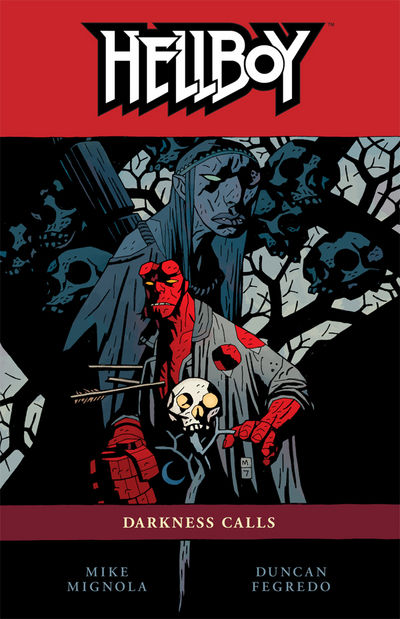 Happily, Fegredo fits right in. His art for Darkness Calls is similar to Mignola’s, although scratchier and not quite as shadowy or blocky. The loss of shadows works against Fegredo, but that’s a quibble. His Hellboy is slightly different as well, less massive and square — although a quick glance might not be enough for readers to be able to detect the differences. Fegredo’s fight scenes are well choreographed, and readers will have little trouble following the action. All in all, if readers can’t have Mignola’s art, then Fegredo will serve excellently.
 (3.5 of 5)
 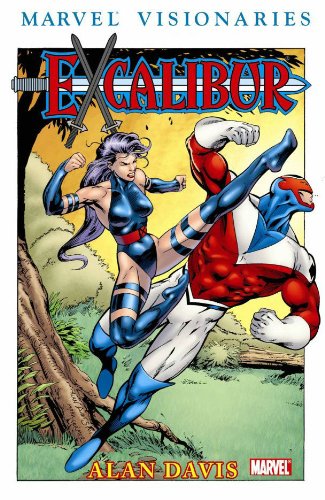 Plotwise, this one’s all over the place. You start out with a serviceable cross-time / alternate Earth story, then dive into the confusing backwater of Phoenix continuity, before making a sidetrek into a non-Davis (and very ’90s) story of Captain Britain and Spider-Man fighting a group of foreign-exchange students who transform into various ethnic varieties of dogs and call themselves “the Litter.” (Is there a Eurotrash joke there? I can’t be sure.) After Davis returns to do a Crazy Gang story, readers would be well served to ignore XX Crossing — a pointless story where an assassin with time powers tries to prove himself to Dr. Doom by trying to kill Excalibur in one of the most convoluted ways possible. To finish out the book, there’s two two-part stories: one, a very dark story featuring Captain Britain and Psylocke’s flesh-warping brother, and the second, in which Excalibur fights very stupid trolls, guest starring the X-Men.
  (1.5 of 5)