


Hellboy, v. 8: Darkness Calls
Collects: Hellboy: Darkness Calls #1-6 (2007)
Released: May 2008 (Dark Horse)
Format: 200 pages / color / $19.95 / ISBN: 978-1593078966
What is this?: England’s witches want Hellboy to be their king, but Baba Yaga wants revenge on the demoniform hero.
The culprits: Writer Mike Mignola and artist Duncan Fegredo
The second Hellboy title of the fortnight is Hellboy, v. 8: Darkness Calls — a change for the Hellboy graphic novel series, in that this is the first book in which series creator Mike Mignola provides little of the artwork.
That was what defined Darkness Calls in my mind before I started reading the book, overshadowing anything else it could offer. The first few chapters I was consumed with the question of whether losing Mignola’s artwork in favor of Duncan Fegredo’s made the series lose an essential something that made Hellboy Hellboy. It didn’t matter that Mignola remained the writer; everything about Hellboy, series and character, is laconic, and so much rides on the ability and style of the art.
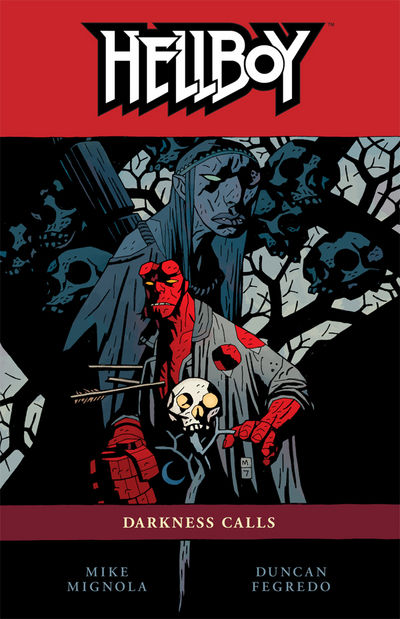 Happily, Fegredo fits right in. His art for Darkness Calls is similar to Mignola’s, although scratchier and not quite as shadowy or blocky. The loss of shadows works against Fegredo, but that’s a quibble. His Hellboy is slightly different as well, less massive and square — although a quick glance might not be enough for readers to be able to detect the differences. Fegredo’s fight scenes are well choreographed, and readers will have little trouble following the action. All in all, if readers can’t have Mignola’s art, then Fegredo will serve excellently.
The continuity of Hellboy is steadily getting more difficult; soon it will a bachelor’s degree in Hellboyology to be able to follow the plots. Although Mignola makes reference to past stories, you won’t be able to get all of the tangled references between Baba Yaga, Hecate, Igor Bromhead, Rasputin, Giurescu, and Ilsa Haupstein unless you have a decent recall of volumes 2, 3, and 4 (Wake the Devil, The Chained Coffin and Others, and The Right Hand of Doom). Pretty impressive for a comic about a big red guy punching and shooting monsters; on the other hand, I found the feeling I was missing out on some of the story disconcerting. Is this how others feel when the continuity of a superhero universe piles up on them? Hmm. Perhaps.
In the main story, the Russian witch Baba Yaga seeks revenge on Hellboy for putting out her eye decades in the past; she works through proxies, not daring to face Hellboy directly. Her main weapon is Koshchei the Deathless, a warrior who is immortal because he hid his soul inside an egg inside a duck inside a rabbit inside a goat. Predictably, such silly precautions have rebounded upon him, and Baba Yaga controls the goat, while all Koschchei wants is death. This, of course, is a set up for more than three issues of a running fight between Koshchei and Hellboy.
That’s not to say that there isn’t a wide variety of creatures from mythology and folklore; there are. Mignola is never afraid to drop a minor spirit or a great god into a story just as a background character, and that’s the case here as he plunks house spirits and witchfinders and the leader of the Russian pagan gods … Yes, most of the cast is from Russian and Gaelic fairy stories, but even within a specific mythos, these background characters help flesh out the world and make it seem living, like there’s enough of a supernatural population for characters to bump into each other.
Hellboy walks through some secondary plots as well. The witches of Britain are looking for a new king, and they think Hellboy fits the bill even if he’d rather fight on the side of a witchfinder; the faerie Gruagach looks to resurrect a powerful creature to lead the creatures of darkness into prominence; and warlock Igor Bromhead steals the power of Hecate. The last has little to do with anything, it feels like, except allow Hecate a chance to give a final, foreboding speech. Which is a bit of a gyp — stealing the power of Hecate should have had more of an effect on the story. (As should the deicide in the story.) The witches of Britain end up serving as a bookend to the story, the plot that Baba Yaga’s quest for vengeance hijacks Hellboy from. Only Gruagach seems to be an interesting subplot, setting up a more powerful future adversary for Hellboy.
Still, it’s good to have a full-length Hellboy tale after two straight collections of shorter material. It gives Mignola (and Fegredo) to stretch out their legs, so to speak, and tell a story that has room for more than just the main narrative. Even if I didn’t think all of the storylines were exploited to their full potential and even if I found some of the narrative confusing, I enjoyed having a multitude of plot points to chew on as the story went on. And it’s good to see the Hellboy mythos advanced in a more organized manner.
I’m actually looking forward to the next volume, something I wasn’t after v. 7.
Rating: 
 (3.5 of 5)
Labels: 2008 May, 3.5, Dark Horse, Duncan Fegredo, England, Hellboy, Mike Mignola
posted by Raoul | 2:11 AM
|
0 comments

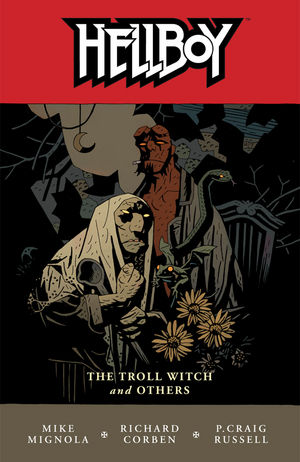 The title story is the best of the lot. It’s a simple tale that Mignola borrows from a Scandanavian folktale, only to have one of the characters in the story specifically point out the folk tale ends too neatly. The story ends with a nice character moment for Hellboy as well, with the witch seeing a bit too deeply into Hellboy’s psyche for his comfort. “Dr. Carp’s Experiment” is a nice little story as well, involving mad Victorian science, time travel, and demon apes. Unfortunately, it’s a little reminiscent of Inger von Klemt and his Kriegaffe in
 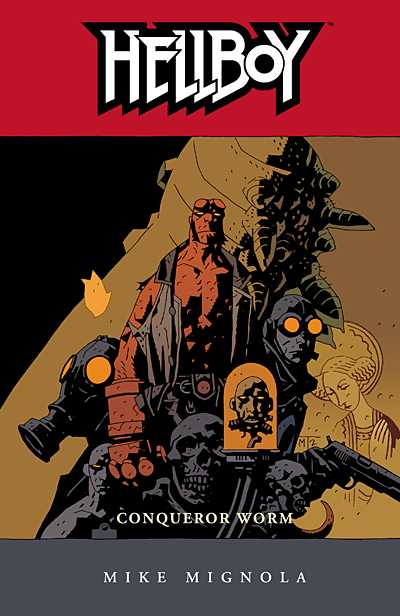 First, let me say what is unquestionably right: Hellboy drawn by creator / writer / artist Mike Mignola. Nothing looks quite like it, even if everyone’s feet are weird. It’s brooding, dark, and exists so a huge, bright red guy can smash through it. The castle in which the story is set is looming, always about to fall apart but always standing as well; the setting is oppressive and evil without being over the top. Mignola is an outstanding visual storyteller with an excellent sense of design.