


2009 Hugo Graphic Novels Nominees
The 2009 Hugo Award nominees were announced last week. Just so you don’t have to scroll down, I give you the first-ever Hugo nominees for “Best Graphic Story”:
- The Dresden Files: Welcome to the Jungle: written by Jim Butcher, art by Ardian Syaf (Del Rey / Dabel Brothers)
- Girl Genius, v. 8: Agatha Heterodyne and the Chapel of Bones: written by Kaja and Phil Foglio, art by Phil Foglio, colors by Cheyenne Wright (Airship Entertainment)
- Fables, v. 11: War and Pieces: written by Bill Willingham, pencilled by Mark Buckingham, art by Steve Leialoha and Andrew Pepoy, color by Lee Loughridge, letters by Todd Klein (DC / Vertigo Comics)
- Schlock Mercenary: The Body Politic: story and art by Howard Tayler (Tayler Corporation)
- Serenity: Better Days: written by Joss Whedon & Brett Matthews, art by Will Conrad, color by Michelle Madsen, cover by Jo Chen (Dark Horse)
- Y: The Last Man, v. 10: Whys and Wherefores: written / created by Brian K. Vaughan, penciled / created by Pia Guerra, inked by Jose Marzan, Jr. (DC / Vertigo Comics)
The only one of these nominees I’ve read is Fables; I was lukewarm on it, but since it wraps up the story Willingham and Buckingham have been setting up for the last few years, I see why it was nominated. I have a feeling Y would have been nominated regardless of its content, for the same reason; v. 10 is the end of the series. The two licensed / spinoff titles, The Dresden Files and Serenity, have name recognition and might have benefitted from the low number of ballots cast (212, less than a third of the number of Best Novel votes and lower than any category other than “Best Fan Artist”). On the other hand, I’ve heard good things about Dresden, and Whedon’s work is, well, Whedon’s. I’m familiar with the Foglios’ work on Girl Genius, although not this volume in particular.
The only nominee I know nothing about is Schlock Mercenary. I’ve never heard anyone else talking about it either, but it appears to be a Web comic, begun in 2000, about a far-future mercenary company. It’s extremely different from the other nominees, to say the least — not only in form (comic strip vs. comic book) and initial medium, but it’s the only nominee to be produced by only one person.
This is the first year for this award, so there’s no history to indicate who might win. It’s not really worthwhile handicapping science fiction / fantasy awards anyway. But my guess would be that voters would go for what they’re most familiar with, and that puts Y and Fables in the driver’s seat. Or maybe familiarity with Butcher or Whedon wins out. Or maybe I’m wrong completely, and “Schlock Mercenary” or Girl Genius gets the award.
The Hugos will be presented at Anticipation in Montreal in August.
Labels: awards, Dresden Files, Fables, Girl Genius, Hugos, not a review, Schlock Mercenary, Serenity, Y: The Last Man
posted by Raoul | 11:03 AM
|
0 comments

 But ultimately, War and Pieces disappoints, for the same reason
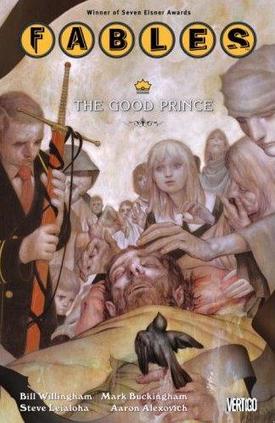 Writer Bill Willingham’s plot is essentially divided in two: the ramping up of tensions and revelations to what looks like an inevitable war and the story of bumbling janitor Fly, who becomes King Ambrose. The war preparations are more interesting; here, long-term hints are confirmed or denied, further threads are spun, and pieces are put in place for the final conflict. This is the path the series has been journeying down for six or so years, and it dominates the first half of the book.
  (2.5 of 5)
 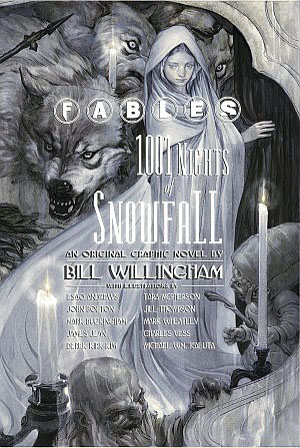 There are quite a few excellent stories that fill in missing pieces in some of the most prominent characters’ histories. The story of Snow White and the Seven Dwarves is recast as a revenge tale. Old King Cole, a merry old soul in prosperity, is shown as a good king in adversity. Frau Totenkinder, the grandmotherly villain of Hansel and Gretel, truly and frighteningly lives up to her name. Ambrose, the lowly janitor of the Fables’ apartment building, becomes a tragic figure after spending so long as bumbling comic relief; this story should be read before Fables, v. 10: The Good Prince, or it loses most of its emotional impact.
  Sinbad’s retinue contains two sore spots for the Fables: slaves, for the obvious reasons, and a djinn, because it is an incredibly destructive weapon (and of course, the back cover of the TPB compares the djinn to a WMD). Both of these problems are dealt with ridiculously easily, and the resulting conflict is swept under the flying carpet much too easily. Imprisonment, torture, and nation building are shuffled off the stage as quickly as they occur. Perhaps it will be dealt with in future issues; Willingham has left the probability it will.