


Fables, v. 11: War and Pieces
Collects: Fables #70-5 (2008)
Released: November 2008 (DC / Vertigo)
Format: 192 pages / color / $17.99 / ISBN: 9781401219130
What is this?: The battle for the Homelands begins as the Fables in exile take the fight to the Adversary
The culprits: Writer Bill Willingham, penciler Mark Buckingham, and artist Niko Henrichon
Anticipation, like fame, is a difficult beast. It’s hard to capture and harder to hold onto, and often it turns out to be a bit of a burden.
Writer Bill Willingham, penciler Mark Buckingham, and a host of other artists have been building the story of the exile Fables for the past six years, telling stories of the community of exiled storybook characters as they first resisted the Adversary who drove them from their homelands and then put themselves into a position to return the favor. Willingham has been building to this volume — Fables, v. 11: War and Pieces — which I’ve read was originally supposed to end the series. (I can’t find a primary source, so you’ll have to take my word for that.)
 But ultimately, War and Pieces disappoints, for the same reason The Good Prince disappoints. The hints and mysteries have all come to an end, and there is not enough suspense to replace them. There seems little danger, little challenge for the Fables during their war. They have their plan, which involves a flying ship filled with mundy weapons, and it is nearly unassailable. It all works too well. Willingham tries to make it appear anyone can die — and there are casualties — but one or two small reversals can’t create that atmosphere. It may seem like a spoiler to say the outcome’s never in doubt, but it’s obvious from the beginning, and there aren’t enough red herrings in the actual story to deceive. The anticipation of a tale of love and glory, a case of do or die, is blunted; I don’t think War and Pieces will live up to whatever story the reader has built up in his mind.
More enjoyable is the two-part story that kicks off the action, “Skullduggery,” in which superspy Cinderella retrieves a “package” in Tierra del Fuego. There is the action, the suspense, that the main story lacks, that the larger story of Fables has only rarely lost. Willingham and Buckingham do an excellent job with these little caper stories, and this one is no exception.
Buckingham’s art, as always, is a joy to see. It’s pretty, obviously, but Buckingham gives the story his usual attention to detail, interesting panel layouts, and page borders. Niko Henrichon supplies the art for the first issue in War and Pieces; it’s hard for me to give it a fair shake. It isn’t to my taste — a bit scratchy and imprecise for me — and the polished, smooth work from Buckingham only emphasizes the qualities in Henrichon’s work that I dislike. Fortunately, the subject matter — it’s a story about relationships — is a better fit to his style than the action pieces that follow.
This is a definite finish to the storyline that started in 2002, and it’s all wrapped up tidily, despite the narration’s insistence that there’s still a wild ride ahead. (I don’t doubt that there is; it’s just it spoils the ending, the triumph, the creators have spent so long building toward when they add a discordant note that late in the story.) This story is not a flop, like Episodes II and III of Star Wars; it isn’t even the disappointment that surrounded Episode I. It just isn’t as good as the overall, 75-issue story Willingham and Buckingham have created.
Rating:  (3 of 5)
Labels: 3, Bill Willingham, DC, Fables, Mark Buckingham, Niko Henrichon, Vertigo
posted by Raoul | 12:41 AM
|
0 comments

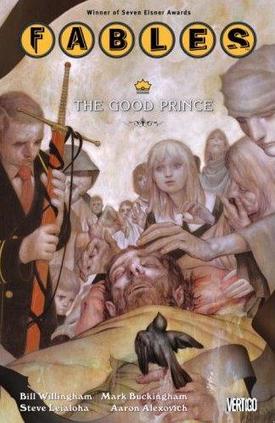 Writer Bill Willingham’s plot is essentially divided in two: the ramping up of tensions and revelations to what looks like an inevitable war and the story of bumbling janitor Fly, who becomes King Ambrose. The war preparations are more interesting; here, long-term hints are confirmed or denied, further threads are spun, and pieces are put in place for the final conflict. This is the path the series has been journeying down for six or so years, and it dominates the first half of the book.
  (2.5 of 5)
  Sinbad’s retinue contains two sore spots for the Fables: slaves, for the obvious reasons, and a djinn, because it is an incredibly destructive weapon (and of course, the back cover of the TPB compares the djinn to a WMD). Both of these problems are dealt with ridiculously easily, and the resulting conflict is swept under the flying carpet much too easily. Imprisonment, torture, and nation building are shuffled off the stage as quickly as they occur. Perhaps it will be dealt with in future issues; Willingham has left the probability it will.