


Planetary, v. 1: All over the World and Other Stories
Collects: Planetary #1-6 (1998-9)
Released: March 2000 (DC / Wildstorm)
Format: 160 pages / color / $14.99 / ISBN: 9781563896484
What is this?: A trio of archaeologists of the unknown travel around the world, looking at weird stuff.
The culprits: Writer Warren Ellis and artist John Cassaday
Do you like action? Fast-paced plots? Interesting characters? Then Planetary, v. 1: All over the World and Other Stories is not for you.
Those questions aren’t important, though. You’re either interested when you hear the creators are Warren Ellis and John Cassaday, or you’re not. And make no mistake: this is very much a Warren Ellis book. It’s full of big, high concept ideas, investigated by hard-bitten, cynical people who smoke. Ellis has refined the style, but that’s the skeleton version of most of his work.
 Ellis’ stories are almost entirely built on fictional analogues and familiar genres. Recurring character Doc Brass is strongly reminiscent of pulp hero Doc Savage. Island Zero, in issue #2, reminds readers of Toho’s Monster Island. Issue #3 is a Hong-Kong action movie crossed with a ghost story, although it is nowhere near as cool as that sounds. Since Planetary started in the late ‘90s, Ellis is beginning to lash out at superheroes, and All around the World features superhero analogues that border on the antagonistic. In issue #6, Ellis sets up the Fantastic Four (Voyagers Four?) as major villains, and in the preview issues, reprinted as a bonus, Ellis rewrites the origin of the Hulk. (I personally prefer the massive cancer beast Ellis cast the Hulk as in Ruins to Planetary’s indestructible monster.) And Ellis ties Planetary in with his other Wildstorm work, The Authority.
There’s nothing wrong with using well-worn ideas, especially when having new ideas or new characters intersect with them. In All over the World, Ellis introduces the Planetary team, a trio of “archaeologists” of the fantastic who investigate the weird under the mandate of the mysterious and fabulously rich Fourth Man. But they refuse to do much of anything. In the first four issues, everything works itself out before they get a chance do anything — although Elijah Snow, the new guy, does promise to help someone at some future date. Issue #5 is a conversation between Snow and Doc Brass. Only in #6 does Planetary do anything that poses any danger or involves effort beyond boarding a plane. There are hints and whispers of a larger conspiracy, but there is nothing compelling about it. If you are not captivated by Ellis’s reconceptualization of those older ideas, then there is little in this book that will interest you.
Each “adventure” seems unconnected, with little to suggest the links between them that is the hallmark of serial comic book stories. Even the action in #6 — which should be a welcome relief — is connected to #5 only tenuously, almost as if there is an issue missing.
Planetary features the early art of John Cassaday. How early? The author bios at the end mention only his work on Union Jack, X-Men / Alpha Flight, and Desperadoes. I think it’s safe to say those works are mere footnotes in his career now. His designs for the protagonists and Doc Brass are memorable — except for Jakita Wagner, the leader of the Planetary team, I immediately recognized them, more than a decade after the last time I had read an issue of Planetary. His work with Hong Kong ghosts in #3 manages to balance the ethereal and the real impressively. His one-page illustrations of Doc Brass’s career in #5 are fabulous and easily the highlight of All over the World. However, either the script or Cassaday himself seems to lack confidence in the art. The layouts rarely seem to include the spreads that would allow an artist to cut loose on Ellis’s big ideas, and occasionally important reveals are minimized or kept off the page entirely: the Hulk analogue in the preview story, the monsters on Island Zero, the spaceship in #4. DC even replaced his vivid original cover of the trade with the drab one pictured above.
Planetary has a great reputation, but I didn’t see why in All over the World. There are a lot of ideas here, but faith in Ellis is the only way a reader would believe they would coalesce into anything.
Rating:

 (2.5 of 5)
Labels: 2.5, 2000 March, DC, Doc Brass, Elijiah Snow, Hong Kong, John Cassaday, Planetary, Warren Ellis, Wildstorm
posted by Raoul | 11:46 AM
|
0 comments

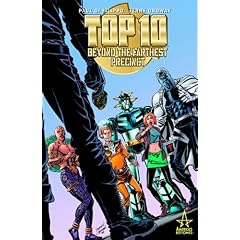 Put bluntly, the characters in Beyond the Farthest Precinct don’t sound or feel the same as they did in Moore’s original Top 10 series. In the original twelve-issue series, Moore managed to give depth to each character; the characters didn’t fit together — socially, at least — except in their professional lives. Di Filippo tries to fit a greater number of characters into a five-issue series, and everyone seems safer, more sanitized … the book begins and ends with police picnics, for heaven’s sake.

