


Promethea, Book 5
Collects: Promethea #26-32 (2003-5)
Released: August 2006 (DC / ABC)
Format: 200 pages / too much color / $14.99 / ISBN: 9781401206208
What is this?: Sophie is flushed out of hiding, allowing Promethea to finish her mission to end the world.
The culprits: Writer Alan Moore and artist J.H. Williams III
I really enjoyed Promethea when I started reading the series. Book One showed a lot of promise, exploring the novel (to comics) concepts of magic and reality using a context very similar to traditional superhero origins. The bloom was off the magic rose a bit in Book Two, as writer Alan Moore’s script became more concerned with dialogues about magic than with telling a story. Those dialogues essentially devolved into monologues in Books Three and Four, with any action or development50 shunted to the side in favor of philosophy, tarot, numerology, kabala, and other religious / magical matters. The presence of artist J.H. Williams III has been a mitigating factor in the decline of enjoyability of the book, but it couldn’t staunch my overall loss of interest. Frankly, if I didn’t finish Promethea soon, I was never going to finish it.
 I was curious to know whether Promethea, Book 5 would be more like the earlier books or Books Three and Four. Fortunately, for all but the last issue, it’s more like Books One and Two. At the beginning, Sophie is in hiding from the authorities, afraid to let Promethea come out and betray her position. She has constructed a new life, has a new boyfriend, and generally seems to be OK in the fictional Millennium City, home to another of Moore’s ABC titles, Tom Strong. Strong, the perfect science hero, finds Sophie in short order after the FBI asks him to, and the plot begins.
Which is that Promethea will bring about the end of the world. Why? Because God or gods said so, although I don’t remember reading that command in any previous book, and the urgency of the command seems to come from nowhere. However, I’ll admit my memory might be hazy, and stick to the book at hand. … So Promethea flies to New York and by her very presence starts altering reality. Time is out of joint; people succumb to madness; the landscape transforms into a new, psychedelic skyline. In this post-9/11 world, the heroes have to put things right before the government nukes New York, while Promethea calmly goes about her job, talking to people while the disturbances that will end the world radiate from her.
The parts with Promethea are boring, however. She smiles, and talks, as the world falls apart around her. My interest was piqued by the efforts of Moore’s other ABC “science heroes” — including my favorite, Jack B. Quick — to forestall Armageddon. The Five Swell Guys, now down to four after 9/11, wrap up a Painted Doll loose end that was buried under Promethea’s magic quest in Books Three and Four. The Swell Guys’ and the Painted Doll’s scenes are the only ones that seem to have much life; most of the rest involves other characters being confused by everything while Promethea smiles. I will say Moore has the courage to pull the trigger on Armageddon — although after Watchmen, I’m sure no one doubted that — and he wraps up everyone’s stories in Promethea #31, the penultimate issue.
The final issue … man, I appreciate Moore was trying to do something big with #32, something memorable and possibly unique. And he gets points for that. But printing the final issue of Promethea so that the backgrounds would form two Impressionist-style poster portraits of the eponymous heroine doesn’t work out so well in collected form. There is a smaller version of the poster bound in the back of the book, so you can get the idea of what it looked like in the original. But reading each page in succession is an eye-throbbing chore that literally gave me a headache: orange and blue backgrounds, with yellow and navy line art and black, red, white, and blue word balloons is a painful, brainsplitting mess on the page. You might think that 32 pages of naked Prometheas would make up for part of that. You would be wrong.
And was it worth reading Professor Moore’s last lecture? No, not really. Moore uses #32 to sum up his arguments and make one last push at convincing the readers. It doesn’t work for me because once the story recedes and the message becomes obvious, I’m much more resistant to it. If it’s the background of the story, worked into the narrative, I’ll think about it and consider it … for at least the time it takes to read the story, if not longer. If the message is obvious, I read it as the same improbable parapsychological theories I’ve read and rejected before — as I did here.
Still, God bless Williams for sticking with Moore. This had to be a difficult task, illustrating a comic that is somewhere between metatextual criticism, magical doctrine, and a superhero story, but Williams is up to the task. He apes the styles of the other ABC artists — Rick Veitch, Chris Sprouse, and Kevin Nowlan, for instance — with aplomb, and as he has shown with previous books in the series, he can shift styles when the story demands it. I wasn’t convinced by the “realistic” style that envelops the characters as Armageddon hits, and that last issue doesn’t really work on the micro level, but Williams’s work is still the highlight of the book.
Unfortunately, Book Five is just not that enjoyable. If it hadn’t been the last book in the series, it would have been for me; there’s nothing compelling enough for me to want to read on, since I think I’ve heard all of Moore’s lecture. Fortunately, the story ran out at the same time my interest did.
Rating:  (2 of 5)
Labels: 2, 2006 August, ABC, Alan Moore, J.H. Williams III, Millennium City, Promethea
posted by Raoul | 2:43 AM
|
0 comments

 For those of you who aren’t a big fan of symbolic journeys, please stop reading this review now and use your time more productively. If you read this, it will be a gigantic waste of your time, as the majority of both books is Promethea, controlled by college student Sophie Bangs, exploring the nature of reality and fiction, the divine and the profane, with a previous bearer of the Promethea identity. There’s a great deal of kabbalah, tarot, language of magic, numerology, and deities involved. Come to think of it, those things might be a red flag for some readers as well.
  For the rest of us, however, it can get quite tedious. Moore is teaching the readers a lesson, divulging to us his personal philosophy, while the story of Promethea and Sophie’s development is dripped out to us without a lot of action to accompany it. For one book, that would be fine; for two — a year of comic book releases (or two, actually, since the book was delayed) — it’s a bit much. The bloom is off the rose of the book’s background details and jokes, such as the Weeping Gorilla and the city’s science heroes and mayoral difficulties (although I enjoyed Williams sneaking himself, his wife, and Moore into the foreground of a panel in Book 3). The replacement Promethea (a combination of a previous Promethea and Sophie’s friend, Stacia) provides the real fun of the book, but she’s on page far too little, even as she tries to wrest the title of “true” Promethea from Sophie. A simmering subplot emerges fully at the end, but still … it’s not enough.
  In Book 2, her training continues, and she strikes back at those who have attacked and threatened her — almost too quickly, too effectively. The idea of ubiquitous collections was new when Moore was writing, but this volume is paced oddly; the climax comes in the middle. I can’t complain about how that storyline plays out, which some might see as a letdown, but I thought the lack of a battle was a neat stroke by Moore, especially given Promethea’s fictional background.
  All very much the common comics theme of growing up, passing the torch, etc. But Moore loves to play with the nature of fiction and ideas, and Promethea is very much a character of the imagination, a fictional character who can interact with the material and immaterial worlds. Sophie has to learn what the imagination means, how to use it in the material world, and who wants Promethea to stay in the land of imagination.
  (4.5 of 5)
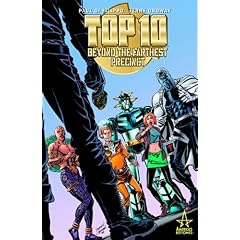 Put bluntly, the characters in Beyond the Farthest Precinct don’t sound or feel the same as they did in Moore’s original Top 10 series. In the original twelve-issue series, Moore managed to give depth to each character; the characters didn’t fit together — socially, at least — except in their professional lives. Di Filippo tries to fit a greater number of characters into a five-issue series, and everyone seems safer, more sanitized … the book begins and ends with police picnics, for heaven’s sake.
